Lesson 12 of 12 · Chapter 12
Building Automation and Green Refrigerants
Smart controls are where HVAC becomes self-aware, and low-GWP refrigerants are where it becomes more careful. Neither is a new trade layered on top. Both are HVAC becoming more precise about what it was already trying to do, and both make your troubleshooting discipline more valuable, not less.
Step one
Read the material
Five ideas. Two on smart controls: what makes them smart, and how they help and hide. Two on refrigerants: what low-GWP really changes, and the new habits it demands. And one on where the whole trade is heading.
Idea one
Smart controls are feedback loops
A smart control uses more information than one space temperature and more logic than on-off. What makes it “smart” is not the touchscreen. It is the feedback loop: sensors report, the controller compares with a target, and it adjusts outputs to reduce error.
Communicating equipment narrates its decisions: why it is in stage one, why it slowed the compressor, why it is prioritizing dehumidification. Reading those messages is not trusting the board. It is collecting its version of the story and comparing it to measured reality. Smart controls do not change physics.
In smart systems, setpoints become strategies that shift with time, rates, occupancy or humidity. Variable-speed equipment can run gently for a long time, but only if airflow and ducts support it; controls can compensate, but they cannot repeal the laws of airflow.
Idea two
Automation that helps and hides
A fan on a VFD might be running at 42 percent to hold duct static pressure, held at a minimum for air changes, or capped by a smoke control sequence. So when “the air handler is running but the rooms are stuffy,” ask what the fan is being commanded to do and what it is trying to prove. Demand-controlled ventilation depends on a CO2 sensor that can drift; reset strategies save energy but, set too aggressively, can leave the coil too warm to dehumidify.
Fault detection can catch drift early or flood operators with nuisance alarms. Treat the alert as a hypothesis, not a verdict.
And smart controls can hide mechanical problems until the system runs out of margin: a variable-speed compressor ramps up for a dirty coil, a VFD fan speeds up for a loading filter bank, and the space looks fine. Adaptation is not the same as health.
Idea three
Low-GWP does not mean low-consequence
GWP, Global Warming Potential, measures how much heat a gas can trap in the atmosphere compared with carbon dioxide over a set period. The industry is moving from high-GWP HFCs toward HFOs and blends, and toward carbon dioxide (R-744), propane (R-290) and ammonia (R-717) where they fit. Technicians will see more refrigerant types, not fewer. Low-GWP does not mean low-consequence. It often means different consequences.
Many comfort systems are moving to A2L refrigerants, classed as mildly flammable. Dismissing that as overblown is wrong, and treating it like a bomb is wrong too: they are harder to ignite and slower to burn, but still flammable. Ignition sources, ventilation during service and leak checking become part of a safety case.
So identify the refrigerant from the nameplate, verify it against documentation, and treat unknowns as stop signs. You cannot diagnose what you have not correctly identified.
Idea four
Glide, charging and retrofits
Many new blends have temperature glide: they change phase across a range rather than at one sharp saturation temperature. Be precise about which one you are using: bubble point for liquid and dew point for vapor. If a digital tool shows something inconsistent, ask whether you are reading the wrong one or have the wrong refrigerant selected before you blame the system.
Many blends must be charged as liquid. Charge vapor from a blend cylinder and you can fractionate it, leaving a mixture in the system that no longer matches the design. Use the right method and a scale. And a new refrigerant is rarely a drop-in: it is tied to the compressor, oil, expansion device, pressure ratings and safety listings. A system that runs is not necessarily a system that is safe, reliable, or legal.
Keep refrigerants segregated in recovery cylinders, labelled and recorded. Mixing them can turn reclaimable refrigerant into expensive waste.
Idea five
Where the trade is heading
Electrification means more heat pumps and more attention to electrical demand and emergency power. Decarbonization comes from system-level efficiency, not nameplates: a dirty coil is now an emissions issue too. Heat recovery reuses what buildings used to throw away. Leaks become a tracked performance metric, variable capacity makes trending a normal expectation, and hydronics with thermal storage becomes a future skill rather than an old-building one.
Grid-interactive buildings pre-cool, coast and shed load, so “it used to hold 72 exactly and now it floats” may be a strategy, not a failure. Define the problem first: what is it being commanded to do right now?
A lower-GWP refrigerant in a leaky, dirty, short-cycling machine is not truly green. The cleanest refrigerant is the one you do not leak, and the method never changes: trace intent, respect pathways, measure what matters, and leave the system in a known, repeatable state.
Step two
Work it with your hands on it
The Compensation bench. Load the filter bank and foul the condenser coil, and watch the fan and the compressor speed up to keep the space at setpoint. Set each device’s maximum speed. The bench tells you two different things: whether the space is holding, and whether the machine is healthy. The speed curves are the bench’s own illustration, not manufacturer data.
Hands on it, off the screen. Find the nameplate on your outdoor unit or heat pump and read which refrigerant it lists. That is the first fact any technician should verify, and the chapter says unknowns are stop signs.
If you have a smart or communicating thermostat, look through its settings or history for anything that shows the system’s decisions: stages, fan speed, dehumidification, or alerts.
Step three
Prove you understood it
One question per idea, a new situation every time. Miss one and you are sent back to the idea it was testing.
All five solid. The class is complete.
You can explain what makes controls smart, tell adaptation from health, treat low-GWP and A2L refrigerants with the right care, handle glide, charging and retrofits honestly, and read the trade’s future through the same method. You have finished all twelve lessons. Next: sit the certificate exam, or go back to the class.
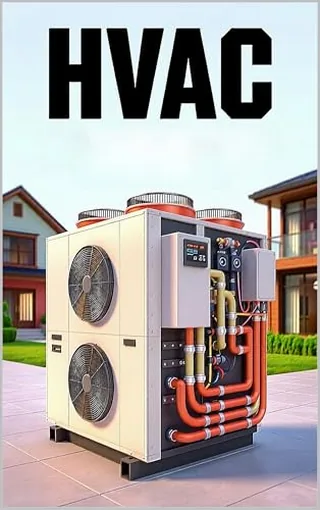
The HVAC Apprentice’s Field Guide
Lesson twelve of twelve, from chapter twelve, the last. Written by our founder, Dr. Gene A Constant, and donated to the Foundation. Published by Global Sovereign University Press.
Buy a copy — it funds a free seatGSU is a 501(c)(3) nonprofit and book sales are its only income. A purchase is not a tax-deductible donation. This lesson is free and always will be.