Global Sovereign University · Skilled Trades

HVAC

The recession-proof, AI-proof trade America can’t fill fast enough — and the free field guide to master it.

Over 40,000 HVAC openings come open every year, largely from retirements, while the industry runs an estimated 110,000 technicians short. Enrollment is finally surging — but there aren’t enough instructors to teach everyone. This page is your instructor. Read the whole book free, ask GENO anything, play the gamified challenge, and prove what you know with a free Certificate of Comprehension.

HVAC Apprentice's Field Guide by Dr. Gene A. Constant

Free to read online · $3.99 Kindle keeps a copy on every device

The Curriculum

What You’ll Master

Twelve chapters take you from the physics of heat to a live diagnostic call — built around the way working technicians actually learn the trade, not the way a textbook lists it.

The EAR Framework

Electrical, Airflow, Refrigerant — the three-part method every seasoned tech uses to diagnose any system, in order.

The Refrigeration Cycle

The four-component thermodynamic core — compressor, condenser, metering device, evaporator — learned first because everything else builds on it.

The A2L Transition 2025–26

The urgent, non-negotiable shift to A2L refrigerants: ASHRAE 34 safety classes, spark-resistant tools, Refrigerant Detection Systems, and R-32 charging.

Static Pressure & Airflow

Reading Total External Static Pressure to find the hidden chokepoints that starve a system while every gauge still “looks” normal.

Low-Voltage Troubleshooting

Isolating a 24-volt control short with the half-splitting method — one of the most common sources of frustration for new techs.

Inverter, VRF & Heat Pumps

Variable-speed boards, safely discharging the DC bus, IGBT checks, communication faults, and precision EEV brazing on cold-climate systems.

Building Automation

The jump to heavy commercial: DDC controls, mixed-vendor protocols, IT networking, and writing a sequence of operations.

Diagnostics & Safety

Master troubleshooting plus EPA Section 608 — the federal credential every technician who touches refrigerant is legally required to hold.

The Comfort Advisor

The soft-skill side no one teaches: pre-arrival professionalism, active listening, translating jargon, and Good-Better-Best presentation.

Why HVAC, Why Now

A trade that can’t be outsourced or automated

Every building with people in it needs heating, cooling, or ventilation — usually all three. The work is local, hands-on, and safe from AI displacement, which is exactly why interest is exploding.

~40,000
HVAC job openings every year through 2034 (BLS)
~110,000
technicians the industry is currently short
+62%
growth in two-year HVAC enrollment since 2020
~8%
projected job growth 2024–2034 — much faster than average

Sources: U.S. Bureau of Labor Statistics · National Student Clearinghouse Research Center · ACHR News

Practice and Prove

Play the gamified challenge. Then earn your Certificate of Comprehension.

Two paths, both free, no login, no paywall. Level up with the gamified HVAC IQ Challenge, then sit the GSU Certificate of Comprehension for HVAC — publicly verifiable and serial-numbered, the credential that proves you mastered the field guide before you ever pay for an industry exam.

Play

The Gamified HVAC IQ Challenge

Three tiers — Apprentice, Journeyman, Master — 39 questions total, 10 per round, per-tier best score saved. Level up through real technician scenarios all the way to EPA 608–level questions.

Start the Challenge →

Free · No login · Progress saved on your device

Prove

Certificate of Comprehension — HVAC

The free GSU credential that proves you mastered the field guide. Publicly verifiable, serial-numbered, print-ready. Sit it any time — the credential to carry into your first HVAC interview before you ever pay for EPA 608 or NATE.

Sit the Exam →

Free · Verifiable · Anonymous or signed, your choice

Ask GENO

A tutor who has read the entire book, cover to cover

GENO is our 24/7 AI tutor — and he has memorized every one of the twelve chapters of the HVAC Apprentice’s Field Guide, not just an excerpt. Ask him to explain the refrigeration cycle. Ask him to walk you through a low-voltage troubleshoot. Ask him to translate a section into your language. He speaks 83.

He can explain any chapter, walk any diagnostic, quiz you before your exam, translate on the fly, and answer your voice — all free, no login, no paywall.

Ask GENO Now →

The Credentials Employers Want

The field guide maps directly to what shops ask for on day one

Sit the free Certificate of Comprehension above to prove you mastered the book. Then the field guide preps you for the industry-recognized credentials employers actually ask about — none of which require a four-year degree.

EPA Section 608 OSHA 10-Hour NATE Ready-to-Work NATE Professional

Free HVAC Downloads — Yours to Keep

Four foundational HVAC skills — the furnace filter change, the outdoor condensing unit tune-up, reading a manifold gauge set, and understanding your thermostat. Illustrated guides and demonstration videos. Download them, print them, share them, teach from them. Free forever.
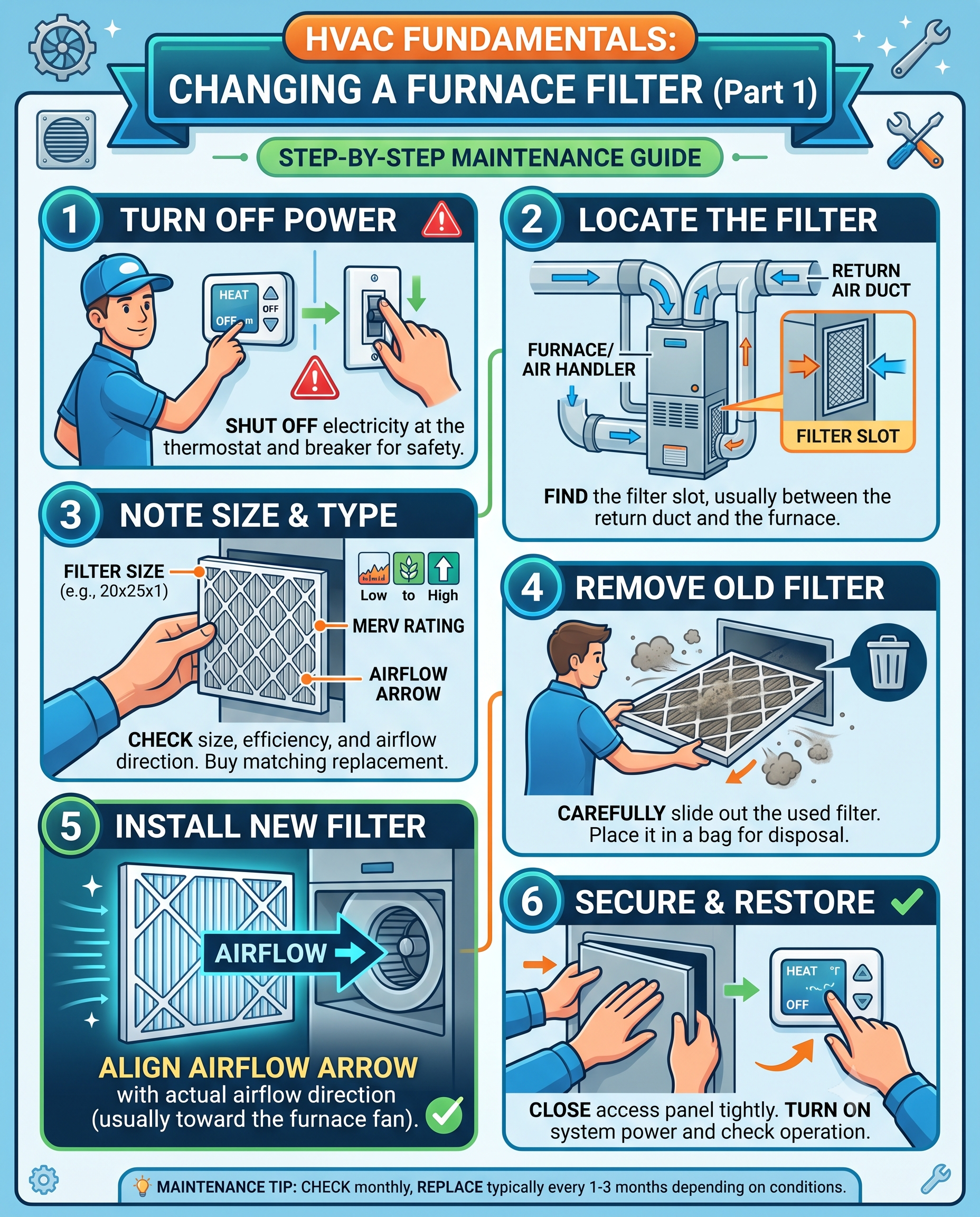
Skill 1 · Changing a Furnace Filter

Step-by-Step Infographic

HVAC Fundamentals: Changing a Furnace Filter — six-step illustrated maintenance guide

High-resolution 6-step guide (PNG, 7 MB). Print it, post it in the shop, or keep it on your phone.

Watch It Done — Demo Video

Watch the full filter change before you do it yourself (MP4, 2.7 MB). Works on any phone.
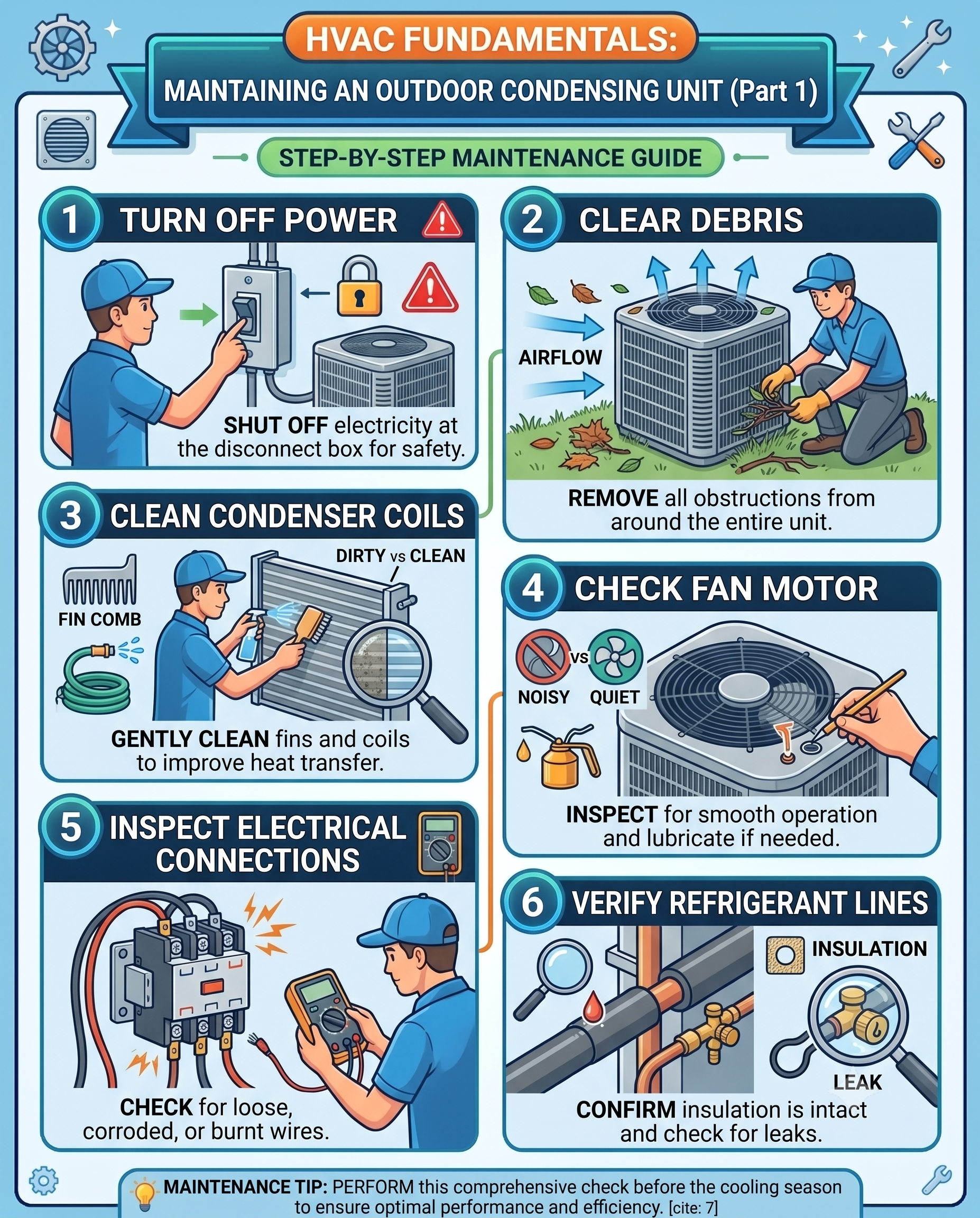
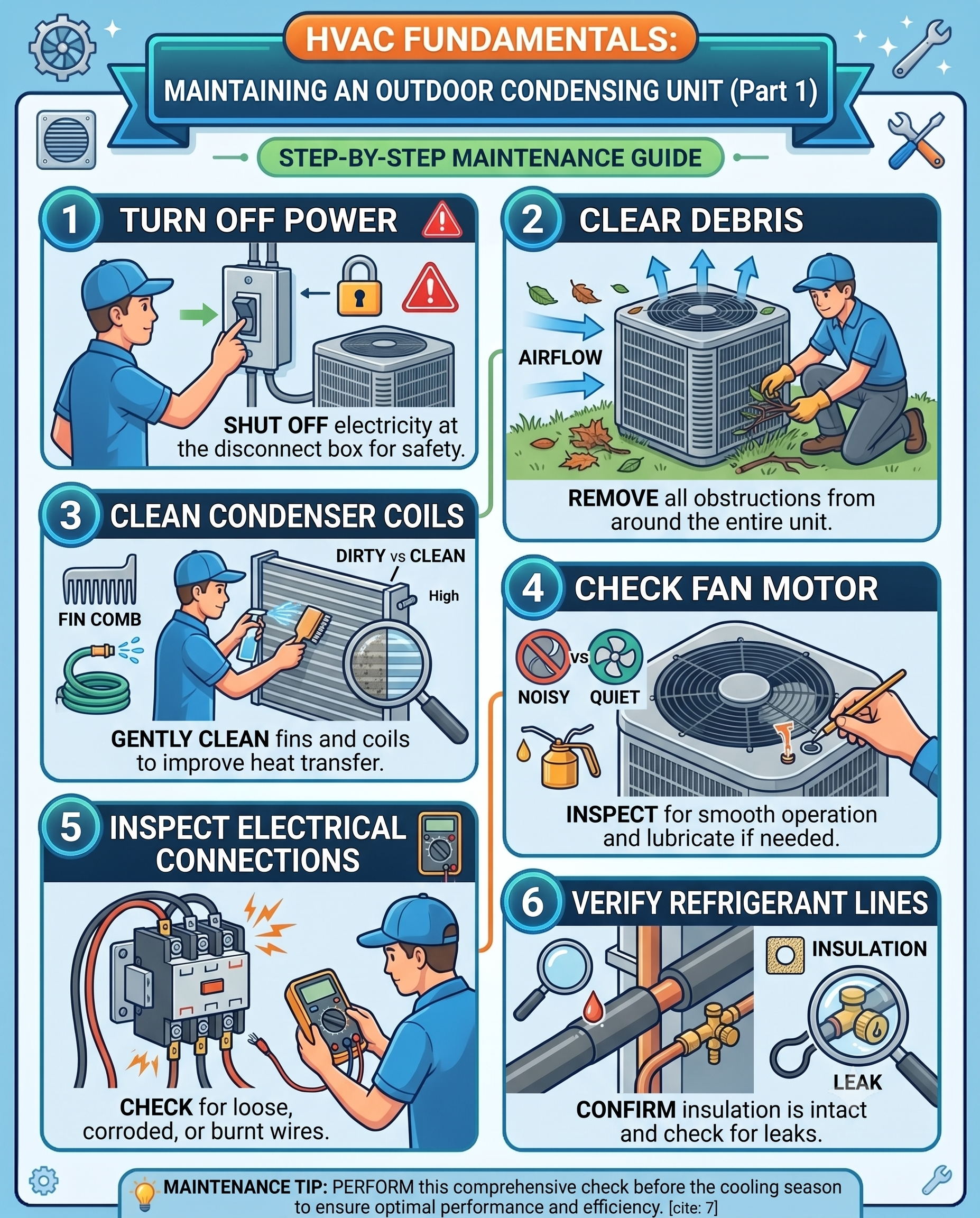
Skill 2 · Maintaining an Outdoor Condensing Unit

Step-by-Step Infographic

HVAC Fundamentals: Maintaining an Outdoor Condensing Unit — six-step illustrated maintenance guide

High-resolution 6-step tune-up guide (PNG, 7.8 MB) — power-down, debris, coils, fan motor, electrical, refrigerant lines.

Watch It Done — Demo Video

See the full condenser tune-up performed step by step (MP4, 2.7 MB). Works on any phone.

Skill 3 · Reading a Manifold Gauge Set

Watch It Done — Demo Video

The tool every technician lives by — watch how the high and low gauges are read on a working system (MP4, 3 MB). Works on any phone.
Skill 4 · Understanding Your Thermostat

Step-by-Step Infographic

HVAC Fundamentals: Understanding Your Thermostat — step-by-step illustrated guide

High-resolution illustrated thermostat guide from the HVAC Fundamentals series (PNG, 7.9 MB). Print it, post it, keep it on your phone.

Provided free by Global Sovereign University — read the complete HVAC Apprentice's Field Guide above, then ask GENO anything about it, 24/7.

Global Sovereign University · Skilled Trades

HVAC

The recession-proof, AI-proof trade America can’t fill fast enough — and the free field guide to master it.

Over 40,000 HVAC openings come open every year, largely from retirements, while the industry runs an estimated 110,000 technicians short. Enrollment is finally surging — but there aren’t enough instructors to teach everyone. This page is your instructor. Read the whole book free, hear it read aloud, ask GENO anything, and prove what you know.

HVAC Apprentice's Field Guide by Dr. Gene A. Constant

Free to read online  ·  $3.99 Kindle keeps a copy on every device

Play — Then Prove It

The HVAC IQ Challenge

Thirty-nine tiered questions from Apprentice to Master — real calculation and diagnosis, not trivia. Play it right here, as many rounds as you want. When you can clear the top tier, take the free, serial-numbered HVAC Comprehension Certification and prove it.

The Curriculum

What You’ll Master

Twelve chapters take you from the physics of heat to a live diagnostic call — built around the way working technicians actually learn the trade, not the way a textbook lists it.

The EAR Framework

Electrical, Airflow, Refrigerant — the three-part method every seasoned tech uses to diagnose any system, in order.

The Refrigeration Cycle

The four-component thermodynamic core — compressor, condenser, metering device, evaporator — learned first because everything else builds on it.

The A2L Transition2025–26

The urgent, non-negotiable shift to A2L refrigerants: ASHRAE 34 safety classes, spark-resistant tools, Refrigerant Detection Systems, and R-32 charging.

Static Pressure & Airflow

Reading Total External Static Pressure to find the hidden chokepoints that starve a system while every gauge still “looks” normal.

Low-Voltage Troubleshooting

Isolating a 24-volt control short with the half-splitting method — one of the most common sources of frustration for new techs.

Inverter, VRF & Heat Pumps

Variable-speed boards, safely discharging the DC bus, IGBT checks, communication faults, and precision EEV brazing on cold-climate systems.

Building Automation

The jump to heavy commercial: DDC controls, mixed-vendor protocols, IT networking, and writing a sequence of operations.

Diagnostics & Safety

Master troubleshooting plus EPA Section 608 — the federal credential every technician who touches refrigerant is legally required to hold.

The Comfort Advisor

The soft-skill side no one teaches: pre-arrival professionalism, active listening, translating jargon, and Good-Better-Best presentation.

Why HVAC, Why Now

A trade that can’t be outsourced or automated

Every building with people in it needs heating, cooling, or ventilation — usually all three. The work is local, hands-on, and safe from AI displacement, which is exactly why interest is exploding.

~40,000
HVAC job openings every year through 2034 (BLS)
~110,000
technicians the industry is currently short
+62%
growth in two-year HVAC enrollment since 2020
~8%
projected job growth 2024–2034 — much faster than average

Sources: U.S. Bureau of Labor Statistics · National Student Clearinghouse Research Center · ACHR News

Prove It

The credentials that get you hired

The field guide maps directly to the certifications employers look for — and the free GSU HVAC Comprehension Certification is live: prove you’ve mastered the material before you ever pay for an exam.

EPA Section 608 OSHA 10-Hour NATE Ready-to-Work NATE Professional

Practice and Prove

Play the gamified challenge. Then earn your Certificate of Comprehension.

Two paths, both free, no login, no paywall. Level up with the gamified HVAC IQ Challenge, then sit the GSU Certificate of Comprehension for HVAC — publicly verifiable and serial-numbered, the credential that proves you mastered the field guide before you ever pay for an industry exam.

Play

The Gamified HVAC IQ Challenge

Three tiers — Apprentice, Journeyman, Master — 39 questions total, 10 per round, per-tier best score saved. Level up through real technician scenarios all the way to EPA 608–level questions.

Start the Challenge →

Free · No login · Progress saved on your device

Prove

Certificate of Comprehension — HVAC

The free GSU credential that proves you mastered the field guide. Publicly verifiable, serial-numbered, print-ready. Sit it any time — the credential to carry into your first HVAC interview before you ever pay for EPA 608 or NATE.

Sit the Exam →

Free · Verifiable · Anonymous or signed, your choice

HVAC Field Guide Dictionary

The trade's core vocabulary — 30 terms every apprentice, homeowner, and career-changer should know. GENO has all of these memorized and can explain any of them in 83 languages.

BTU
British Thermal Unit — the energy needed to raise one pound of water by one degree Fahrenheit. The base unit of heating and cooling capacity.
Ton of Cooling
12,000 BTU per hour. A three-ton unit removes 36,000 BTU/hr. Named after the cooling produced by melting one ton of ice in 24 hours.
SEER2
Seasonal Energy Efficiency Ratio (2023 test standard). Cooling output over a season divided by watt-hours consumed. Higher number, better efficiency.
HSPF2
Heating Seasonal Performance Factor (2023 standard). The heat pump equivalent of SEER2. Higher means more heat delivered per watt.
EER
Energy Efficiency Ratio — cooling output in BTU/hr divided by wattage input at a single peak condition. Used for rating cooling under stress.
Superheat
The temperature of refrigerant vapor above its saturation point. The key charging measurement on fixed-orifice systems.
Subcooling
The temperature of liquid refrigerant below its saturation point. The primary charging measurement on TXV systems.
MERV
Minimum Efficiency Reporting Value — the filter rating scale from 1 to 20. Higher captures smaller particles but restricts airflow more.
Static Pressure
The pressure the blower must overcome to push air through ducts, coils, and filters. Measured in inches of water column.
CFM
Cubic Feet per Minute — the volume of air moved. Residential systems typically deliver about 400 CFM per ton of cooling.
Refrigerant
The working fluid in a vapor-compression system. Common types today include R-410A, R-32, and R-454B. R-22 is phased out.
R-454B
A lower-GWP refrigerant replacing R-410A in new residential systems. Mildly flammable (A2L) — requires updated tools and handling.
Compressor
The pump that raises refrigerant pressure and drives the cycle. The most expensive component in a split system.
Condenser
The outdoor coil where hot high-pressure refrigerant releases heat to the air and turns back into a liquid.
Evaporator
The indoor coil where low-pressure liquid refrigerant absorbs heat from indoor air and boils into vapor.
TXV
Thermostatic Expansion Valve — a metering device that adjusts refrigerant flow to maintain a target superheat.
Recovery
The legally required act of pulling refrigerant out of a system into a recovery cylinder before opening it. EPA-mandated.
Manifold Gauge Set
The two- or four-port gauge assembly used to read system pressures, add or recover refrigerant, and pull a vacuum.
Micron Gauge
A precision vacuum gauge measuring in microns of mercury. A tight system pulls to 500 microns or below before charging.
Nitrogen Purge
Running dry nitrogen through refrigerant lines during brazing to prevent scale from forming inside the copper.
Brazing
Joining copper refrigerant lines with a filler metal above 840°F. The trade's standard for pressurized connections.
EPA 608
Section 608 of the Clean Air Act — the federal certification required to buy or handle refrigerant. Four types: I, II, III, and Universal.
Split System
An HVAC system with an outdoor condenser and a separate indoor air handler or furnace-coil combination.
Package Unit
A self-contained HVAC system where the compressor, condenser, and evaporator all live in one cabinet — common on rooftops.
Heat Pump
A reversible refrigeration cycle that cools in summer and heats in winter by moving heat rather than generating it.
Reversing Valve
The four-way valve inside a heat pump that flips the direction of refrigerant flow between cooling and heating modes.
AFUE
Annual Fuel Utilization Efficiency — the rating for a fuel-burning furnace. 80% AFUE means 80% of fuel becomes usable heat.
Delta T
The temperature difference between return air and supply air. A well-tuned residential system typically shows 18–22°F.
Wet Bulb / Dry Bulb
Two thermometer readings used with a psychrometric chart to determine humidity, enthalpy, and system performance.
Manual J / D / S
ACCA's residential design standards: Manual J sizes the load, Manual D sizes the ductwork, Manual S selects the equipment.

Every term above is covered in depth in the Apprentice's Field Guide. GENO has memorized the entire book — ask him anything.

Straight Answers to Real HVAC Questions

The questions we hear most from apprentices, career-changers, and homeowners doing their own homework.

Do I need to be certified to work on HVAC?
To handle refrigerant legally in the U.S., yes — you need EPA Section 608 certification. State licensing for install and service work varies: some states require a full mechanical license, others let you work under a licensed contractor. Check your state's licensing board for the exact rules.
What is EPA Section 608 and why does it matter?
Section 608 of the Clean Air Act requires anyone who buys, handles, or works with refrigerant to be certified. Fines for uncertified handling can reach five figures. Section 608 comes in four types: Type I (small appliances), Type II (high-pressure), Type III (low-pressure), and Universal (all three). Universal is the standard for a working technician.
Is this training really free? What's the catch?
No catch. The Foundation for Global Instruction is a 501(c)(3) nonprofit. Every book here is free to read in full on the GSU website, and the free audiobook reader will read it aloud to you. Kindle editions are $3.99 on Amazon to help fund the platform. Donations are welcome but never required to access anything.
How long does it take to become a licensed HVAC technician?
Timelines vary. A motivated learner can prepare for and pass EPA 608 in weeks. State journeyman licenses typically require two to five years of documented field hours plus an exam. Union apprenticeships usually run four to five years. The training here is designed to compress the classroom side so your hours in the field carry more weight.
Do I need a high school diploma or GED to start?
Not for this training. To sit for many state license exams or enroll in most union apprenticeships, yes — a diploma or GED is typically required. If you don't have one, GSU's free Adult Literacy Lab and Readification hub can help you close that gap at your own pace.
What tools do I need on day one?
To start learning: nothing but the field guide. To start hands-on service work: a manifold gauge set, a digital thermometer, a micron gauge, a leak detector, a solid multimeter, refrigerant recovery cylinders, insulated gloves, and safety glasses. Most first apprentice tool kits run $400 to $800; employers often cover the more expensive gear.
Can I take the EPA 608 exam online?
Type I is available online through several EPA-approved organizations for a small fee. Types II, III, and Universal usually require proctored testing — either in person or through approved online proctoring. The training here prepares you for all four levels.
Is HVAC a good career if I don't want to sit at a desk?
Yes. HVAC work is physical, varied, and mostly on-site — attics, rooftops, mechanical rooms, and homes. Demand is steady because equipment doesn't stop breaking. If you want work that can't be outsourced and a paycheck tied to real skill, it's a legitimate path.
Can veterans use GI Bill benefits for HVAC training?
Yes — the GI Bill covers approved HVAC programs at community colleges, trade schools, and many union apprenticeships. The training on this site is free and doesn't require GI Bill funding, but it pairs well with a formal program. A VA education counselor can confirm what's approved in your state.
What's the difference between residential and commercial HVAC?
Residential work covers homes: split systems, heat pumps, gas furnaces, and mini-splits, mostly under five tons. Commercial work is bigger — rooftop package units, chillers, boilers, VRF systems, building controls, and complex ductwork. Commercial pays more but demands more electrical, controls, and blueprint literacy. Many techs start residential and move up.