Lesson 1 of 20 · Chapter 1
The Foundations of Modern Total Productive Maintenance
Most plants lose far more production than anyone sees. Machines stop for a minute here and there, run a little slow, make a few bad parts after every changeover, and nobody writes it down because nothing actually “broke.” Total Productive Maintenance (TPM) is a way of running a whole plant so those losses become visible, and then disappear. This first lesson gives you the foundation everything else stands on.
Choose how you want to learn
You can change this any time. Every level does the same hands-on steps. Press Listen on any part to hear it read aloud.
- 1 · Design loss out
- 2 · Where TPM came from
- 3 · The full spectrum of loss
- 4 · Eyes for abnormalities
- 5 · The whole system
- 6 · Restore, stabilize, improve
- 7 · Try it at work
- 8 · Your card
- 9 · Check yourself
Part 1
From firefighting to designing loss out
Picture two plants. In the first, a machine breaks, everyone runs, a skilled technician fixes it fast, and people cheer. In the second, the machine rarely breaks, because small problems are spotted and fixed early. Nobody cheers. It is just quiet.
TPM wants the second plant. It says: design the loss out of the system, and make looking after the equipment everyone’s job, not only the maintenance department’s.
In older plants there was a wall. Operators ran the machines. Technicians fixed them. Each side was measured on different things. Many losses lived behind that wall, where neither side was looking.
The chapter traces why the old model failed. Production was measured on output and maintenance on how fast it responded. Neither was measured on stopping the problem from happening, so small interruptions went unrecorded, an odd noise became “normal,” defects were blamed on the material, and unsafe shortcuts became habits.
The first fix most plants tried, servicing every machine on a fixed calendar, was real progress. But it brought a new problem: work done because the calendar said so, whether or not it prevented anything. TPM keeps the planning and adds the question the calendar forgot: is this task actually preventing a loss?
“It evolved as a management system and a cultural idea: the belief that perfect production is not achieved by heroic maintenance firefighting, but by designing loss out of the system and making equipment care a shared responsibility.”
“Maintenance calendars became rituals, and in some plants the “PM program” became a checklist performed because it was required, not because it prevented losses.”
Read the whole chapter free in the book reader.
Take the wall down, then tap each hidden loss to see who could have caught it.
Part 2
Where TPM came from, and why the target is zero
TPM is not new, and it is not a software product. It grew up in Japanese factories. They took the idea of servicing machines on a schedule from American industry and built it into something bigger: the person who runs the machine also helps keep it healthy.
An engineer named Seiichi Nakajima started teaching productive maintenance to Japanese industry in 1951. He is often called the father of TPM. He also set up an award for it. In 1971 that award went for the first time to a plant using the full, company-wide method: Nippondenso, a parts maker in the Toyota group, known today as Denso. Most people date TPM from that year.
From the start, TPM set three targets: zero breakdowns, zero defects, and zero accidents. They sound impossible on purpose. A goal of “fewer” lets a plant celebrate and stop. A goal of zero makes it keep asking what is still going wrong.
The chapter describes how Japanese firms did not simply copy time-based maintenance. They joined it with maintenance prevention, maintainability and operator involvement, which meant training, trust and a new idea of who owns a machine. The Japan Institute of Plant Maintenance played a major role in defining TPM as a company-wide programme, not a maintenance department initiative: a whole-business discipline aimed at overall equipment effectiveness.
Nakajima spent more than half a century teaching and refining the method. His PM Prize later became the TPM Awards, and his book Introduction to TPM, published in English in 1988, carried TPM to plants around the world.
The zeros are about direction, not a finish line. No plant reaches all three and stays there forever. What matters is the question each zero forces once the easy gains are made. That promise has not changed: the chapter calls TPM 4.0 an extension of TPM’s original intent, not a replacement for it.
“In 1971 that award went for the first time to a plant using the full, company-wide method: Nippondenso, the Toyota-group parts maker now known as Denso. Most practitioners date TPM itself from that year.”
“From the start, TPM set three targets that sound impossible on purpose: zero breakdowns, zero defects, and zero accidents. No plant reaches all three and stays there forever. The point of the zeros is direction.”
“A goal of “fewer breakdowns” invites a plant to celebrate an improvement and stop. A goal of zero forces the next question: what is still causing the breakdowns we have left?”
Read the whole chapter free in the book reader.
The dates come from the chapter. The monthly counts are illustrative. Switch the goal and watch what happens after month 4.
Part 3
Breakdowns are only one kind of loss
When people think of lost production, they think of breakdowns. But TPM counts six big losses: breakdowns, setup and adjustment, small stops, running slow, making defects, and losses while starting up.
Most of them never reach a breakdown log, because nothing “broke.” A 40-second jam cleared by hand, ten times a shift, is never written down. Over a year it can cost more than the big breakdown everyone remembers.
So the first habit is simple: count all six, not just the dramatic one.
Each loss tells you something different. Setup losses show changeovers that are uncontrolled. Small stops are too brief to call maintenance, yet frequent enough to eat throughput. Speed losses come from vibration, wear, cautious running or problems upstream. Startup losses are scrap and instability after a restart, a real cost even though the machine is “running.”
Lesson 2 goes through all six in depth. For now, the point is that a plant measuring only breakdowns can look healthy on paper while output keeps falling short.
“Idling and minor stops exposed a hidden layer of inefficiency: small interruptions that were too brief to trigger a maintenance call, yet frequent enough to erode throughput.”
“Breakdowns steal availability in large, obvious chunks, but idling, minor stops, and speed losses often take more production than the plant realizes because they are frequent, brief, and normalized.”
One shift of planned time. Switch between what a breakdown log sees and what TPM sees. The minutes are an illustration, not data from a real plant.
Part 4
Clean to inspect: eyes for abnormalities
The first thing most TPM programmes do is surprisingly plain: restore basic conditions. Clean the machine, lubricate it, tighten what is loose, and look at it closely.
Cleaning is not about looks. When you clean a machine with your own hands, you find things: an oil leak, a loose bolt, fine metal dust, a bearing that is too hot. Those are warnings, caught early, while they are cheap to fix.
The habit is a chain of four: clean to inspect, inspect to detect, detect to correct, and correct to prevent it coming back.
The chapter calls this “eyes for abnormalities.” Once operators take part in cleaning and inspection, leaks, heat, dust and changes in sound stop being background noise and become early signals.
Two limits matter. First, this does not turn operators into mechanics: operators do the routine care and first checks; diagnosis, precision work and lockout repairs stay with trained maintenance people. Second, care needs a written normal. Without a standard, two shifts check the same machine two different ways, and a deviation means nothing.
“It created what practitioners sometimes call “eyes for abnormalities.” Leaks, unusual heat, metal dust, and changes in sound became early warning signals instead of background noise.”
“It meant building daily discipline: clean to inspect, inspect to detect, detect to correct, and correct to prevent recurrence.”
“It did not mean turning operators into mechanics.”
Clean each area of the machine. Every time you clean, you see. Tag what you find.
Part 5
Equipment performance belongs to the whole system
TPM says a machine’s performance is not just maintenance’s job. The people who run it, fix it, design it, schedule it and buy it all shape how well it works.
Three habits follow. Put effort where failure hurts most: the machine that stops the whole line gets more attention than a spare pump. Measure results, not busyness: uptime, speed and quality, not hours worked or jobs closed. And learn from every failure: a finished repair is a chance to stop it happening again.
The chapter’s name for this is holistic asset management. A machine’s life starts when its requirements are written and the purchase is made, not at installation, so a rushed purchase or handover can bake losses in for years.
Criticality thinking decides where engineering time, spares, sensors and planned work go. Measuring work orders closed only proves that people were busy; overall equipment effectiveness (OEE) combines availability, speed and quality into one outcome. And emergency work is not something to celebrate: it shows the detection and planning system missed something.
“One principle sits at the center of holistic asset management in modern TPM: treat equipment performance as a property of the system, not the maintenance department.”
“Not all assets deserve the same strategy.”
“A completed work order is not the end; it is a learning event.”
Five assets, one maintenance team. Decide how much attention each deserves.
Part 6
Restore, stabilize, then improve
TPM works in a set order. Restore: bring the machine back to its basic good condition. Stabilize: make the care routine, written down and owned, and make all the losses visible. Improve: now attack the chronic problems and add smart tools.
Many plants try to skip to “improve.” They add sensors and dashboards to a dirty, leaking machine. The dashboards turn red, and nothing gets better, because the data can only tell you the machine is sick. It cannot make it well.
The sequence exists because improvement needs a stable base to measure against. Restore removes the obvious defects. Stabilize means standard care, planned maintenance, and losses made visible through OEE and the six big losses. Only then does improvement stick: focused improvement on chronic losses, better designs through early equipment management, and digital tools that predict and prevent.
The bench below lets you set up a plant and see which part of the staircase holds. Try getting everything right except one choice, and see which single choice breaks it.
“Finally, holistic asset management is governed by a simple improvement ethic: restore, stabilize, then improve.”
“If contamination and lubrication are uncontrolled, data will only confirm that the machine is unhealthy; it will not make it healthy.”
“how do we create a production system where equipment performance is stable enough to improve, and improving enough to stay stable?”
Set up the plant. The staircase shows which step holds; the verdict shows what you would see on the floor.
Part 7
Try it where you work
Do these on a real machine: at work if you work with equipment, or at home on a car, washing machine, furnace or lawn mower if you do not. Tick each one when it is done. Safety first: look and clean only what you are allowed to touch, never reach into moving equipment, and follow your site’s lockout rules.
Part 8
Your “My Machine Care” card
Make a card for one machine you look after, at work or at home. Keep it on the machine or in your pocket. Nothing you type here leaves this device.
My Machine Care
Global Sovereign University · Modern TPM, lesson 1
The chain, and the order
- Clean to inspect.
- Inspect to detect.
- Detect to correct.
- Correct to prevent it coming back.
Then keep the order: restore, stabilize, then improve. And count all six losses, not just breakdowns.
Part 9
Check yourself
Eight real situations. Pick what you would do. You will see why after each one.
Lesson 1 complete.
You have the foundation: design loss out, aim at the three zeros, count all six losses, clean to see, put effort where failure hurts, and restore before you improve. Next: Lesson 2, the six big losses in depth.
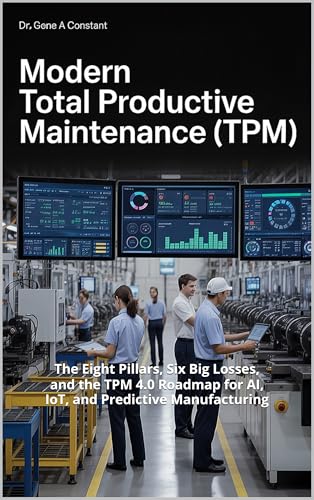
Modern Total Productive Maintenance (TPM) by Dr. Gene A Constant. This lesson comes from chapter one. Read the whole book free in the reader, or keep a copy.
Buy a copy — it funds a free seat
GSU is a 501(c)(3) nonprofit and book sales are its only income. A purchase is not a tax-deductible donation. This lesson is free and always will be.