Lesson 10 of 20 · Chapter 10
Intelligent TPM: IoT, Sensors, and Predictive Maintenance
Sensors connected to the internet can watch a machine every second of every shift. That sounds like the answer to everything. This chapter is more careful: sensors are just devices; what matters is a health model that says what to watch and what to do when it changes. Done right, predictive maintenance does not eliminate failure. It eliminates surprise, and turns breakdowns into planned work.
Choose how you want to learn
You can change this any time. Every level does the same hands-on steps. Press Listen on any part to hear it read aloud.
- 1 · Sensors are not health
- 2 · Retrofit old machines
- 3 · Sensors you can trust
- 4 · Three layers
- 5 · Prove it on the trend
- 6 · The Forecast Bench
- 7 · Try it at work
- 8 · Your card
- 9 · Check yourself
Part 1
Start with health, not with sensors
A sensor is just a device that measures something. Health is knowing what normal looks like for that machine and what to do when it drifts.
Most plants get the most value from three familiar signals on motors and gearboxes: vibration, temperature and electrical current.
Start small: a few signals on the machines that hurt most, where the team already knows how to act. Adding sensors is easy; being able to respond is harder.
Treated as a technology project with a maintenance logo on it, IoT collapses into the failure modes of bad dashboards: false precision, alarm fatigue, and data shaped to avoid blame. Installed without a health model, sensors collect numbers that look scientific but change no decisions.
The deployment path the chapter recommends: pick the bottleneck or chronic-loss assets first, start with a few signals per asset, agree the decision rules, and add sensors only as fast as the plant can respond with discipline. Early wins (fewer nuisance stops, faster troubleshooting because handoffs include evidence) build the trust the rest depends on.
“Deploying IoT for asset health is not a technology project with a maintenance logo on it.”
“The highest-leverage health signals on rotating and driven equipment remain familiar: vibration, temperature, and electrical current.”
“Adding sensors is easy; adding response capacity is harder.”
Read the whole chapter free in the book reader.
Five things a motor-gearbox can tell you. Which signal shows each one?
Part 2
Old machines can join in: retrofit
Most plants are full of older machines, built long before machines were connected to networks. You cannot replace them all at once, and you do not need to.
Many old machines can be fitted with add-on sensors and a small box called a gateway. Together they read vibration, temperature, electrical current or cycle counts, without touching the machine’s original controls.
Which machine goes first? Start where the losses are largest and the warning signs can be measured. Leave the rest until the first ones are paying for themselves.
The chapter is careful about one trap. Engineers have planning models for connected factories, such as RAMI 4.0, Germany’s Reference Architectural Model Industrie 4.0. A model like that helps plan how retrofitted machines will connect. It does not tell you which machine deserves the money.
That choice is still a loss decision, not a technology decision. The easiest machine to connect is often the one that loses the least. A machine whose losses have no measurable warning sign, such as losses that come from rushed changeovers, gives a sensor nothing to see, however big the losses are.
“A factory full of machines that predate networked controls cannot be replaced at once, and it does not need to be.”
“Many machines can be fitted with add-on sensors and gateways that read vibration, temperature, current, or cycle counts without touching the original control system.”
“Reference models such as RAMI 4.0, Germany’s Reference Architectural Model Industrie 4.0, can help engineers plan how retrofitted machines will connect, but the choice of which machine to instrument first is still a loss decision, not a technology decision.”
Read the whole chapter free in the book reader.
Five older machines, money for two retrofits. The minutes are illustrative. Pick two, or try replacing them all.
Part 3
A sensor is only as good as where it sits
A vibration sensor bolted to a thin guard tells you how the guard rattles, not how the bearing is doing. A temperature sensor next to an oven reads the oven.
So installing a sensor is treated like any precise maintenance job: right place, correct setup, and a check that the reading matches reality.
The system also needs context: is the machine warming up, running, changing product? Without it, a normal product change can look like a failing bearing.
The chapter suggests a simple commissioning checklist for sensors, in the spirit of the return-to-safe-baseline checklists: defined method, correct placement, documented configuration, verified signal.
Context comes from reliable operating states: run, stop, setup, fault and known product modes. The plant must also control who can change thresholds, or it creates a new normalised abnormality: silent drift in the monitoring system itself.
“A vibration sensor mounted on a thin guard will faithfully report the guard’s vibration, not the bearing’s condition.”
“Intelligent TPM therefore treats sensor installation like maintenance quality work: defined method, correct placement, documented configuration, and verification that the signal matches reality.”
“However, forecasting must be tied to operating context, or it will produce confident nonsense.”
The same bearing, measured three ways. Choose where the sensor goes, then give the system context. The traces are an illustration.
Part 4
From watching to forecasting
An alarm that goes off when vibration is high is useful, but it is still mostly reactive with a better warning.
Real prediction builds up in three layers. Common sense: what should never happen (temperature rising and rising at the same load). Pattern: what normal looks like for this machine. Forecast: how many days until it crosses the limit, and which kind of failure is likely.
“Rising risk of a bearing fault within 14 days” is far more useful than “vibration high.”
Not every failure mode is forecastable: sudden failures (a cracked fitting, a tool left in a guard, a power surge) are not where predictive analytics earns its reputation. It shines on slow deterioration, the modes that produce micro-stops first, then speed loss, then defects and downtime.
Pattern recognition matters because two identical gearboxes can have different normal signatures if one sits on a stiffer base or carries a different load. Predictive analytics becomes credible when it stops treating the plant like a textbook and starts treating it like itself.
“Many sites install vibration and temperature sensors, set a few alarm thresholds, and call it predictive maintenance.”
“The first layer is physics-based sanity.”
““Rising risk of bearing outer race fault within 14 days” is more useful than “vibration high.” It changes how maintenance prepares: parts selection, tools required, and whether alignment verification must be included.”
Five pieces of forecasting logic. Which layer does each one belong to?
Part 5
A forecast is work, and done means proved
A forecast that nobody acts on is not prediction. So every forecast becomes a work item with an owner, like a tag.
The response matches the risk. Low: tag it and inspect in the next planned window. Medium: kit the parts and schedule the repair within two weeks. High: escalate now and decide on a controlled stop.
And the job is not done when the alert goes quiet. It is done when the trend is back in its normal band and stays there. Mature plants call this “prove it on the trend.”
If the system produces a risk score without explanation, technicians treat it as a nuisance. A good forecast shows the evidence: the trend, which feature changed, and how the signal differs from normal. When a forecast is wrong, that is model improvement, the learning culture of Chapter 6 applied to analytics.
Verification is recorded against the original prediction, so the plant learns whether its forecasts are accurate and its restorations are high quality: not only restoring function, but restoring health.
“The answer is to treat forecasts as work objects, not as notifications.”
“If the system produces a risk score without explanation, technicians will treat it as a nuisance.”
“Predictive maintenance adds a new version: “alert cleared” is not completion.”
Three repairs, three trends after the work. Which job is really done? The traces are an illustration.
Part 6
From reactive to predictive: a planning behaviour
Reactive plants borrow time from the future: every breakdown is an emergency, a rushed restart and extra risk.
Predictive plants pay that debt down by turning “fix it now” into “act within the right window.” The forecast gives time to order the right part, not “something similar.”
The hardest test: will the plant honour a planned window even when today’s output pressure is loud? If not, it drifts back to reactive, just with nicer graphs.
Reactive maintenance is not a moral failure; it is a visibility and system design failure. Predictive does not replace planned maintenance either; it makes it smarter and more selective, acting only when evidence supports the need.
Going predictive across the whole site at once floods people with alerts and forecasts they cannot close, and trust collapses. Start where the pain is, make forecast states visible, protect predictive work from daily chaos, and reward the team that prevented the breakdown, not only the one that fixed it fastest.
“Reactive maintenance is not a moral failure; it is a visibility and system design failure.”
“In modern TPM, predictive does not replace planned maintenance; it makes planned maintenance smarter and more selective.”
“The system then drifts back to reactive, but now with nicer graphs.”
“Predictive cultures reward the team that prevented the breakdown from being needed.”
The Forecast Bench. Set the reading, the limit and the rise per day, then decide how the forecast is handled.
Part 7
Try it where you work
Do these on a real machine: at work if you work with equipment, or at home on a car, washing machine, furnace or lawn mower if you do not. Tick each one when it is done. Safety first: look and clean only what you are allowed to touch, never reach into moving equipment, and follow your site’s lockout rules.
Part 8
Your “My Predictive Start” card
Plan one small, honest start on one machine. Nothing you type here leaves this device.
My Predictive Start
Global Sovereign University · Modern TPM, lesson 10
Intelligent TPM
- Health model before sensors.
- Mount it right; give it context.
- Forecasts become owned work.
- Match the response to the risk.
- Done means proved on the trend.
Predictive maintenance does not eliminate failure; it eliminates surprise. Add sensors only as fast as you can respond.
Part 9
Check yourself
Eight real situations. Pick what you would do. You will see why after each one.
Lesson 10 complete.
You can now choose health signals before sensors, decide which older machine to retrofit first, spot an untrustworthy reading, tell the three layers of forecasting apart, turn a forecast into owned work, and prove a repair on the trend. Next: Lesson 11, autonomous maintenance in the digital era.
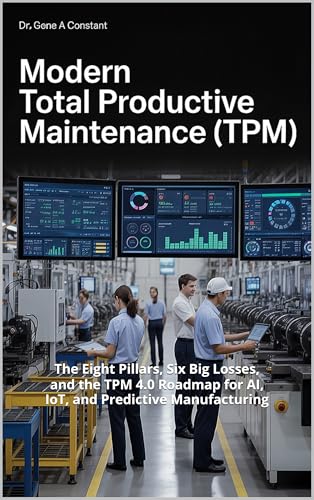
Modern Total Productive Maintenance (TPM) by Dr. Gene A Constant. This lesson comes from chapter ten. Read the whole book free in the reader, or keep a copy.
Buy a copy — it funds a free seat
GSU is a 501(c)(3) nonprofit and book sales are its only income. A purchase is not a tax-deductible donation. This lesson is free and always will be.