Lesson 16 of 20 · Chapter 16
Training, Safety, and the Human Factor in Industry 4.0
Every system in this book lives or dies in the hands that run it. A twin can prove access is possible, but it cannot make people do the work right on the night shift. Capability is limited less by what people care about than by what they can do repeatedly, correctly, under pressure. This chapter uses virtual reality, augmented reality and wearables to close that gap, and a culture that lets people tell the truth about it.
Choose how you want to learn
You can change this any time. Every level does the same hands-on steps. Press Listen on any part to hear it read aloud.
- 1 · VR: rehearse the rare
- 2 · AR: at the machine
- 3 · Wearables
- 4 · Governing the data
- 5 · Culture
- 6 · Industry 5.0
- 7 · Try it at work
- 8 · Your card
- 9 · Check yourself
Part 1
Practise the rare, high-stakes job safely
Training has often been where plants accidentally create heroes: a veteran shows a new hire “how we do it here,” and the method lives in one head.
Many skills are hard not because they are complicated, but because they are rare, high-stakes, and done under stress.
Virtual reality (VR) gives a safe place to practise those jobs until the sequence feels natural, like the seal head rebuild from lesson 15, before anyone does it on the real line.
VR and AR matter not as tech theatre but as a practical way to compress time to competency and protect standard work against drift. A VR module rehearses cause and effect, so the learner sees what happens when a step is skipped. It can also teach decision rules, not just mechanical steps, building consistent judgment aligned to risk rather than personality.
Restraint applies again: a plant does not need VR modules for every routine action on day one. Start with safety-critical work, high-frequency transitions, and tasks that protect measurement integrity.
“Not as tech theater, and not as “nice to have” training innovation, but as a practical way to compress time to competency and protect standard work against drift.”
“Many TPM skills are not hard because they are complex. They are hard because they are rare, high consequence, and performed under stress.”
“A plant does not need VR modules for every routine action on day one.”
Read the whole chapter free in the book reader.
Three pairs of jobs. Which one should get the first VR module?
Part 2
The right method at the moment of need
Augmented reality (AR) puts the standard in front of you at the machine: steps, arrows and checks overlaid on the real equipment, through a tablet or glasses.
Nobody has to walk away to find a binder. And AR can know which product mode the line is in, and show the right sequence for it.
VR is for rehearsing before. AR is for guiding during. Some simple routine work needs neither, just good coaching.
AR can guide the same verification on the real machine that VR rehearsed, and capture the evidence as part of closure: work is not done until it is verified and learning attached. It also reduces the temptation to borrow time from the future, because the right method is quicker to follow than to guess.
VR and AR must not be a parallel training universe. When a new failure mode appears, it should become an AR-guided step and a VR-rehearsed sequence with a clear verification gate, fed by the same learning capture used in focused improvement.
“AR complements this by bringing training to the point of use.”
“AR makes the standard visible in the work zone without forcing the operator to leave the machine to find a binder or search a terminal.”
“That is how the plant turns learning into capability, and capability into stability.”
Six pieces of work. Which tool fits each one best?
Part 3
Making hidden risk visible
Wearables are small sensors people wear. They can show posture, force, heat and fatigue while the work is happening.
They often find the risk somewhere nobody expected. Not in the heavy lift everyone complains about, but in a “two-minute” task repeated 200 times.
The fix is not “remind people to bend their knees.” It is to remove the condition that makes the unsafe way the quick way.
The chapter’s filler: “sensor blocked” micro-stops after changeover forced operators to reach into a tight zone to clear them. A wearable pilot showed a spike in high-risk bends in that same window, confirming what people had felt but could not prove. The countermeasure became a viewing window, safer access, the sensor moved out of the contamination path.
Wearables also verify training: if a new method stops a reach across a hot surface, the data should show fewer high-risk postures in that task. That turns “training completed” into “risk reduced.” For human work, trained is not completion.
“If VR and AR compress time to competency by making the right method visible, IoT wearables compress time to awareness by making risk visible while the work is happening.”
“The high-risk posture is not during the heavy lift everyone complains about; it is during the “two-minute” repeated task that happens 200 times.”
“The countermeasure is no longer “remind people to bend their knees.” It is to remove the condition that makes unsafe posture the default.”
Three guesses about where the risk is. What did the wearables actually show?
Part 4
Data to improve the system, never to punish
Wearables touch the most fragile promise in the plant: that data will be used to fix the work, not to punish people.
So wearable data is combined across people and used to redesign tasks. Watching one person is allowed only for immediate safety, like a warning near a moving forklift.
If people believe it is a new way to police them, they will resist it, game it, or stop trusting management.
Individual-level monitoring should be tightly restricted, time-limited, and used only for immediate safety protection, not performance management. Reviews follow three rhythms: daily for high-severity events, weekly for patterns by task, station and product mode, monthly for design-level fixes such as tooling, guard redesign or requirements for the next machine.
A wearable safety event is treated like a defect or a predictive alert: a work object with context. Alerts without governance become alarm fatigue, and wearables protect the plant from a subtle trap: believing that if equipment is monitored, work is safe.
“Wearables touch the most fragile contract in the plant: the belief that data will be used to improve the system, not to punish individuals.”
“Wearable data should be aggregated and used to redesign work.”
“Individual-level monitoring should be tightly restricted, time-limited, and used only for immediate safety protection, not performance management.”
Six proposed uses of wearable data. Which are allowed?
Part 5
A closure system strong enough for the truth
Technology does not create a safety culture. People stop reporting problems if reporting gets them punished.
If a leader asks “Why did you stop the line?” as an accusation, people will stop stopping. Ask instead: what did the system see, and what do you need?
And “trained” means more than a finished module: shown in practice, done on the line with a coach, and proven by the results.
Safety, quality and maintenance cannot run in separate lanes when they see slices of the same condition: modern TPM insists on one closure pipeline. A weekly review that demands corrective actions but never protects the time to do them trains people that improvement is theatre.
Psychological safety without discipline gives comfort and variation; discipline without psychological safety gives compliance theatre and hidden risk. The bench below uses the chapter’s filler, with 240 high-risk bends a shift before the change.
“By now, it should be clear that technology does not create a safety culture, and it does not create a learning culture.”
“If the sponsor asks, “Why did you stop the line?” in a tone that implies guilt, people will stop stopping.”
“They demonstrate it in a simulation, then perform it on the line with a coach, and the result is verified by evidence: defect rate stays down, restart is stable, and ergonomic exposure does not spike.”
The Exposure Board. Before the change: 60 clears a shift, 4 high-risk bends each, 240 in all. Set what the wearable shows after, and how the plant runs the human side.
Part 6
Industry 5.0: an old idea with a new name
In 2021 the European Commission gave a name to an idea: Industry 5.0. It means industry that is human-centric, sustainable and resilient, using technology to support workers, not replace them.
The name is new. The idea is not. Nakajima’s method put the operator at the centre of equipment care about fifty years before anyone said “Industry 5.0.”
Modern TPM keeps that same respect for people in a factory full of sensors, cameras and software. The same tool can help a worker or work against one. The difference is how you choose to use it.
This lesson has already shown both directions. VR and AR put knowledge in a worker’s hands and let them rehearse risk without exposure. Wearables can find hidden strain, or, misused, become surveillance that teaches people to hide problems. Industry 5.0 is a name for choosing the first direction on purpose.
For a TPM plant, this is less a new programme than a check on the one it already runs: does each new technology make the operator more capable and safer, or does it treat the person as the thing to remove?
“In 2021 the European Commission described “Industry 5.0” as an industry that is human-centric, sustainable, and resilient, using technology to support workers rather than to replace them.”
“The label is new, but the principle is not. Nakajima’s method put the operator at the center of equipment care fifty years before the term existed.”
“Modern TPM carries that same respect into a factory full of sensors, cameras, and software.”
Read the whole chapter free in the book reader.
Fifty years from Nakajima to the new name. Then sort six uses of technology (examples written for this lesson).
Part 7
Try it where you work
Do these on a real machine: at work if you work with equipment, or at home on a car, washing machine, furnace or lawn mower if you do not. Tick each one when it is done. Safety first: look and clean only what you are allowed to touch, never reach into moving equipment, and follow your site’s lockout rules.
Part 8
Your “My Human-Side Plan” card
One task where people carry the risk, and how to take it off them. Nothing you type here leaves this device.
My Human-Side Plan
Global Sovereign University · Modern TPM, lesson 16
The human factor
- VR for rare, high-stakes jobs.
- AR for the right step at the machine.
- Wearables find hidden risk.
- Remove the condition; do not remind.
- Data fixes the work, never ranks people.
- Trained means shown, coached, proven.
Ask what the system saw, not why they stopped. Trained is not completion.
Part 9
Check yourself
Eight real situations. Pick what you would do. You will see why after each one.
Lesson 16 complete.
You can now choose where VR and AR earn their place, find hidden risk with wearables, govern human data so it fixes work instead of ranking people, define trained as proven, not completed, and explain Industry 5.0 as TPM’s old respect for people under a new name. Next: Lesson 17, the technological backbone: AI, 5G and blockchain.
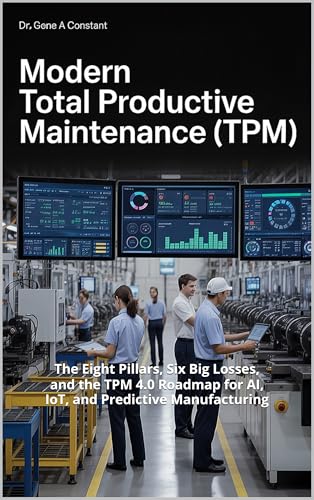
Modern Total Productive Maintenance (TPM) by Dr. Gene A Constant. This lesson comes from chapter sixteen. Read the whole book free in the reader, or keep a copy.
Buy a copy — it funds a free seat
GSU is a 501(c)(3) nonprofit and book sales are its only income. A purchase is not a tax-deductible donation. This lesson is free and always will be.