Lesson 20 of 20 · Chapter 20
Implementation Roadmap: Achieving TPM 4.0
The last chapter turns everything into a plan. Not a big launch, and not a technology purchase, but three phases, each earning the right to the next. Phase 1 makes the factory safe to improve. Phase 2 removes losses so they cannot come back. Phase 3 defends normal, even in the worst week of the year. The goal is a plant that gets better and stays better when nobody is watching.
Choose how you want to learn
You can change this any time. Every level does the same hands-on steps. Press Listen on any part to hear it read aloud.
- 1 · Phase 1: safe to improve
- 2 · Phase 1 in practice
- 3 · Phase 2: three locks
- 4 · Phase 3: defend normal
- 5 · Scale, and the roadmap
- 6 · Not hypothetical
- 7 · Try it at work
- 8 · Your card
- 9 · Check yourself
Part 1
Start small and make it boring
Phase 1 exists for one reason: to make the factory safe to improve.
A common mistake is launching everywhere at once with posters and checklists. The result looks busy, completes lots of forms, and stabilises nothing.
Instead, pick a few critical machines, usually the bottleneck plus one upstream and one downstream, and make them boring. And build the basics before buying technology: faster data without closure just makes problems normal faster.
Phase 1 is time-boxed and ruthless about scope: the aim is a repeatable pattern on a pilot value stream that can then be scaled. It builds the minimum operating system first: a governed state model, the abnormality pipeline, basic conditions, and a rhythm of daily, weekly and monthly reviews.
It also sets the governance later technology will inherit: stop, slow or continue rules made socially safe to follow, and escalation logic so nobody has to negotiate in the moment. Done well, the plant feels different before the numbers move.
“Phase 1 exists for one reason: to make the factory safe to improve.”
“The result is compliance theater: high completion rates, low abnormality reporting, and no measurable stabilization.”
“A modern TPM Phase 1 picks a small number of critical assets, typically the bottleneck line plus one upstream and one downstream constraint, and makes those assets boring.”
“Faster visibility without closure discipline becomes faster normalization of abnormality.”
Read the whole chapter free in the book reader.
Three Phase 1 decisions. What would the chapter choose?
Part 2
States, observable checks, protected windows
First, agree what each machine state means in plain words: running, stopped by a fault, stopped waiting, changeover, cleaning, warm-up, quality hold.
Then a hard rule: no standard without a visual reference. A check is either something you can see and confirm, or it is not a check.
And leadership protects maintenance windows. If windows are traded away whenever it is busy, the plant stays reactive, however clever the tools.
OEE is only as trustworthy as the state model underneath it, so the states come first. If operators are expected to check fluid levels, the normal band is marked on the machine and in the digital SOP. Cleaning and inspection standards fit the real rhythm of the line, including post-changeover and start-up.
Planned maintenance in Phase 1 is mostly about stopping the plant from calling something restored without evidence. And a protected-window policy for the pilot area is a critical deliverable: when evidence shows a controlled micro-stop now prevents a long stop later, the organisation must choose the micro-stop.
“This is where you apply a hard rule: no standard without a visual reference.”
“A check is either observable or it is not a check.”
“If leadership does not protect windows, the plant will remain reactive no matter how advanced the tools become.”
Six routine checks. Which can actually be confirmed by looking, and which are not really checks?
Part 3
Find the mechanism, then lock the fix
Phase 2 begins when the pilot area is no longer chaotic. Now improvement targets specific losses.
Rule one: find the mechanism before choosing the solution. Do not jump from “we lose time” to “we need a new sensor.” And measure only what you intend to close.
Rule two: every fix ends with three locks. Physical: the design makes the right way easier. Procedural: the standard work changes. Evidence: the checks prove it stays fixed. Miss one, and it slips back under pressure.
The chapter runs both of its long examples through Phase 2: the “sensor blocked” micro-stops in the first forty minutes after changeover on product family B, and the sealing station whose corrections were rising. The goal becomes restoring stability margin, not merely preventing a stop, and the question becomes why the process needs more correction.
Phase 2 earns the right to add sensors selectively, aimed at the mechanisms under attack. It also finds that the next bottleneck is often administrative: stores, procurement and scheduling. A predictive system without protected windows is just a better alarm clock.
“When a targeted improvement is selected, Phase 2 applies a simple rule: define the mechanism before you define the solution.”
“Each targeted improvement must end with three locks.”
“If any one lock is missing, the plant will relapse under pressure, because pressure always returns.”
“Planned window adherence becomes a leadership KPI with decision rules, because a predictive system without protected windows is just a better alarm clock.”
Six parts of one fix for the sensor-blocked stops. Which lock does each one belong to?
Part 4
The worst week of the year
Phase 3 begins when improvement is no longer fragile. Now the job is to defend normal.
The weekly review changes: less choosing new projects, more protecting standards and checking that closures are real.
The test of success is simple: can the plant keep its discipline during the worst week of the year? And when things are going well, does it still protect the standards, or relax them?
The states and decision rules are locked into governance so they cannot drift quietly, and tamper-evident thinking applies even without blockchain. A new improvement thread opens only when a mechanism is genuinely new.
Success brings its own temptation, complacency. A leader who says “we are doing great, so we can skip the planned window this week” teaches that standards are optional. A leader who protects the window teaches that standards are how success is maintained, not how failure is corrected.
“Phase 3 begins when improvement is no longer fragile.”
“Finally, Phase 3 defines what “sustain” means with a simple test: can the plant maintain discipline during the worst week of the year?”
“A leader who says, “We are doing great, so we will protect the planned window because we do not want to drift back” is teaching the plant that standards are how success is maintained, not how failure is corrected.”
Three moments from the worst week of the year. What does a plant that has reached Phase 3 do?
Part 5
Copy the method, not the rules
Scaling does not mean copying the pilot’s rules onto another machine. A different process needs its own basic conditions, normal bands and proof gates.
What you copy is the method: pick the next area, install the minimum operating system, stabilise the basics, build the closure pipeline, then start targeted improvement.
The bench below runs the whole roadmap. The plant stalls at the first phase with a failure; later phases cannot be reached until earlier ones hold.
Phase 3 also scales competence without dependence on heroes: a training architecture tied to real loss mechanisms and real verification gates, using the VR and AR from earlier chapters. And it should be faster than Phases 1 and 2, because the organisation now knows how to build normal.
The chapter’s closing picture is a factory where truth arrives early, closure is verified, standards are protected under pressure, and technology accelerates discipline rather than amplifying shortcuts.
“Scaling is not replication of artifacts.”
“Phase 3 scaling therefore uses a deliberate pattern: select the next value stream, install the minimum operating system, stabilize basic conditions, build the closure pipeline, then begin targeted improvement.”
“Phase 3 is the phase where the plant earns its most valuable capability: the ability to get better and stay better, even when no one is watching, because the operating system makes the right work the easiest work.”
The Roadmap Gates. Set up a TPM 4.0 roadmap and see how far the plant gets. It stalls at the first phase with any failure.
Part 6
This roadmap is not hypothetical
Real factories have walked this road. Since 2018 the World Economic Forum has run a Global Lighthouse Network that recognises factories that took digital manufacturing past the pilot stage and into daily work at scale.
Their lesson is this lesson’s lesson: the technology scales only where the basics already hold.
One example is Unilever. The company reported that its factory in Cavite, in the Philippines, raised OEE from 51% in 2023 to 66% by the end of 2024, and that its ice cream plant in Sikeston, Missouri, cut raw-material and packaging waste by 32.5% in 2024, to a record 1.9%.
Two cautions keep those numbers honest. They are company-reported figures, and every plant is different. Copying the tools will not copy the result.
What transfers is the order of operations. Unilever’s own system, which it describes as an evolution of world-class manufacturing and which it said would be live in 124 factories by 2025, follows the same order as the three phases in this lesson: stable basics and a common loss language first, then digital tools that help people see and act sooner.
“Since 2018 the World Economic Forum has run its Global Lighthouse Network, which recognizes factories that have taken digital manufacturing past the pilot stage and into daily operation at scale.”
“The lesson those sites teach is the lesson of this chapter: the technology scales only where the basics already hold.”
“These are company-reported figures, and every plant is different, but the order of operations is the one described here: stable basics and a common loss language first, then digital tools that help people see and act sooner.”
Read the whole chapter free in the book reader.
Unilever’s reported results, then the order that produced them. Put the three steps in order.
Part 7
Try it where you work
Do these on a real machine: at work if you work with equipment, or at home on a car, washing machine, furnace or lawn mower if you do not. Tick each one when it is done. Safety first: look and clean only what you are allowed to touch, never reach into moving equipment, and follow your site’s lockout rules.
Part 8
Your “My Roadmap” card
The first steps of TPM 4.0 in one area. Nothing you type here leaves this device.
My Roadmap
Global Sovereign University · Modern TPM, lesson 20
TPM 4.0 in three phases
- Phase 1: small scope; make it boring.
- Basics before technology.
- No standard without a visual reference.
- Protect the windows.
- Phase 2: mechanism first; three locks.
- Phase 3: defend normal; copy the method.
Can the plant keep its discipline in the worst week of the year? The right work, made the easiest work.
Part 9
Check yourself
Eight real situations. Pick what you would do. You will see why after each one.
Lesson 20 complete.
You have finished all twenty lessons. You can now plan TPM 4.0 in three phases: a small pilot made safe to improve, fixes locked three ways, and a normal defended in the worst week of the year and scaled by method, not by copying rules. Next: the Modern TPM certificate exam.
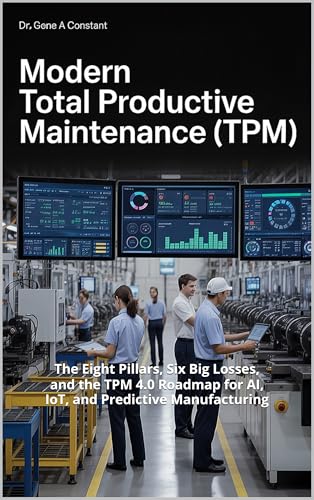
Modern Total Productive Maintenance (TPM) by Dr. Gene A Constant. This lesson comes from chapter twenty. Read the whole book free in the reader, or keep a copy.
Buy a copy — it funds a free seat
GSU is a 501(c)(3) nonprofit and book sales are its only income. A purchase is not a tax-deductible donation. This lesson is free and always will be.