Lesson 1 of 8 · Chapter 1
Welcome to the World of Life
What makes something alive? In this lesson you learn the signs of life, discover that life is all around you and even inside you, use curiosity to ask four kinds of questions, turn a foggy question into a fair test, and find biology in your own heartbeat, kitchen and hands.
Choose how you want to learn
You can change this any time. Press Listen on any part to hear it read aloud. Grown-ups: read along with younger children.
- 1 · What counts as life?
- 2 · Life all around you
- 3 · Curiosity and questions
- 4 · Ask it so you can test it
- 5 · Biology you can use today
- 6 · The whole chapter
- 7 · Try it at home
- 8 · Your card
- 9 · Check yourself
Part 1
What counts as life?
Biology is the study of life. It is a way of noticing.
A toy car moves, but it is not alive. A kitten is alive. What is the difference?
Living things grow, use energy, notice and react to what is around them, and make more living things.
A fan spins and a candle flame flickers, but they are not alive. Living things are built in a special way, usually from tiny building blocks called cells.
Living things use energy to grow and do work. They respond to their surroundings. They keep their insides balanced while the world outside changes. And living things make more living things: a kitten grows into a cat, a seed becomes a plant, one tiny bacterium splits into two.
Be careful, though. Some living things are too small to see without help; a spoonful of pond water can hold a hidden world. And a plant does not run or bark, but it is busy all day, solving problems in its own quiet way.
“Biology is not just a pile of words to memorize. It is a way of noticing.”
“Living things use energy to grow and do work.”
“A plant does not run, jump, or bark, but it is still alive, still busy, still solving problems in its own quiet way.”
Alive or not alive? Tap one for each. Get all eight to finish.
Part 2
Life all around you, and inside you
Put your hand on your chest. Feel your heart beat? You are full of working parts.
Tiny living things called microbes live on your skin and in your tummy. Many of them help you.
Look out a window. Birds, grass, a weed in a sidewalk crack: life is everywhere.
Your heart pumps, your lungs bring in oxygen, your muscles pull on your bones like ropes, and your nerves carry messages to your fingers. You are a whole team of working parts.
You are also a home for microbes. Some can make you sick, but many help: they break down food, protect you from harmful germs, and teach your body how to defend itself.
Living things are connected. A plant uses sunlight to make food. An insect chews the leaf. A bird eats the insect. In the soil, worms and microbes break down dead leaves and return what they hold to the ground. Nothing is wasted for long. To see all this you need your senses, a notebook, and the patience to watch before you decide what it means.
“You are a whole community of working parts.”
“Nothing is wasted for long. Life is constantly recycling.”
“Observation is not the same as guessing.”
Who does which job in the backyard? Tap one for each. Get all seven to finish.
Part 3
Curiosity: your science superpower
Curiosity means wanting to know what is really happening. It can be very quiet.
Good questions help you learn. A good question is like a flashlight: it shows you where to look next.
If you have a big question you cannot answer today, write it on a Question Parking Lot page. Save it for later.
Scientists, doctors, gardeners and park rangers all do the same four things: notice, ask, test, and learn. Curiosity gets powerful when it learns to ask good questions.
There are four kinds of questions. Observation: What do I notice? Explanation: Why did that happen? Prediction: What will happen if I change one thing? Meaning: Why does this matter, and how should we act?
A good science question looks for patterns and causes, not just names. “What is that plant called?” gives you a name. “Why does it grow here but not over there?” leads you to sunlight, water and soil. That is real biology.
“The superpower is curiosity.”
“A good question is like a flashlight in a dark room.”
“Questions are not distractions from learning. They are the engine of learning.”
What kind of question is it? Tap one for each. Get all eight to finish.
Part 4
Ask it so you can test it
Some questions are foggy, like “Do plants like music?”
A testable question says exactly what you will compare and measure.
A fair test changes only one thing at a time. And it is fine to say, “I don’t know yet.”
A vague question is big and foggy. A testable question is clear. Instead of “Do pill bugs like water?” ask: “If I put ten pill bugs in a box with a damp paper towel on one side and a dry one on the other, where will most of them be after ten minutes?”
Being fair in science means changing one thing at a time. If you grow one cup of seeds in the sun and one in the dark, but you also give one cup more water, you will not know which change made the difference.
You do not need a fancy lab. A kitchen table, a backyard and a notebook can be your lab. If your first idea turns out wrong, that is not failure. That is training: “I used to think one thing, but now I’ve learned something new.”
“Curiosity becomes scientific when it becomes careful.”
“a lab is just a place where you ask careful questions and collect careful evidence.”
“‘I don’t know yet’ is a hopeful sentence.”
Vague or testable? Tap one for each. Get all six to finish.
Part 5
Biology you can use today
Count your pulse, your heartbeats. Then jump and count again. It goes up!
Bread dough rises because tiny living yeast make gas bubbles.
Washing your hands stops germs from riding to your mouth and eyes.
Find your pulse on your wrist or neck. Count the beats for 15 seconds and multiply by 4. Do 20 jumping jacks and check again. When your muscles work harder, your heart speeds up to bring them more oxygen. That is a pattern you discovered, not a fact you memorized.
Your kitchen is full of biology. Yeast eat sugar and give off gas that puffs up bread dough. A banana goes from green to yellow to brown spots as it ripens, because starches inside turn into sugars.
You cannot see most germs, which is why habits matter. Sprinkle a little cinnamon on your hands and touch a doorknob, a pencil and a book: that shows how germs spread. Sneezing into your elbow protects the people around you. Each day, write one sentence on a page called “Biology I Used Today.”
“when your muscles work harder, your heart speeds up to deliver more oxygen.”
“The goal is not to be scared of germs.”
“The goal is to help you see.”
Count your pulse for 15 seconds at rest, then again after 20 jumping jacks. Type both numbers.
Part 6
Read the whole chapter
Here is all of Chapter 1, “Welcome to the World of Life”, exactly as the book tells it. Press Listen to hear it read aloud, or open it and read along.
Open Chapter 1 (about 22 minutes to read)
Part 7
Try it at home
Do these with your family. Tick each one when it is done.
Part 8
Your “My Biology Notebook” card
Fill it in, then print it for the fridge. Nothing you type here leaves this device.
My Biology Notebook
Global Sovereign University · Biology: How Life Works, lesson 1
Four kinds of questions
- Observation: What do I notice?
- Explanation: Why did that happen?
- Prediction: What will happen if I change one thing?
- Meaning: Why does it matter?
Part 9
Check yourself
7 questions. Pick an answer. If it is not right, read the hint and try again.
Lesson 1 complete.
You can tell living things from objects, see how living things are connected, ask four kinds of questions, turn a vague question into a fair test, and find biology in your everyday life. Next: Lesson 2, Getting to Know Ourselves.
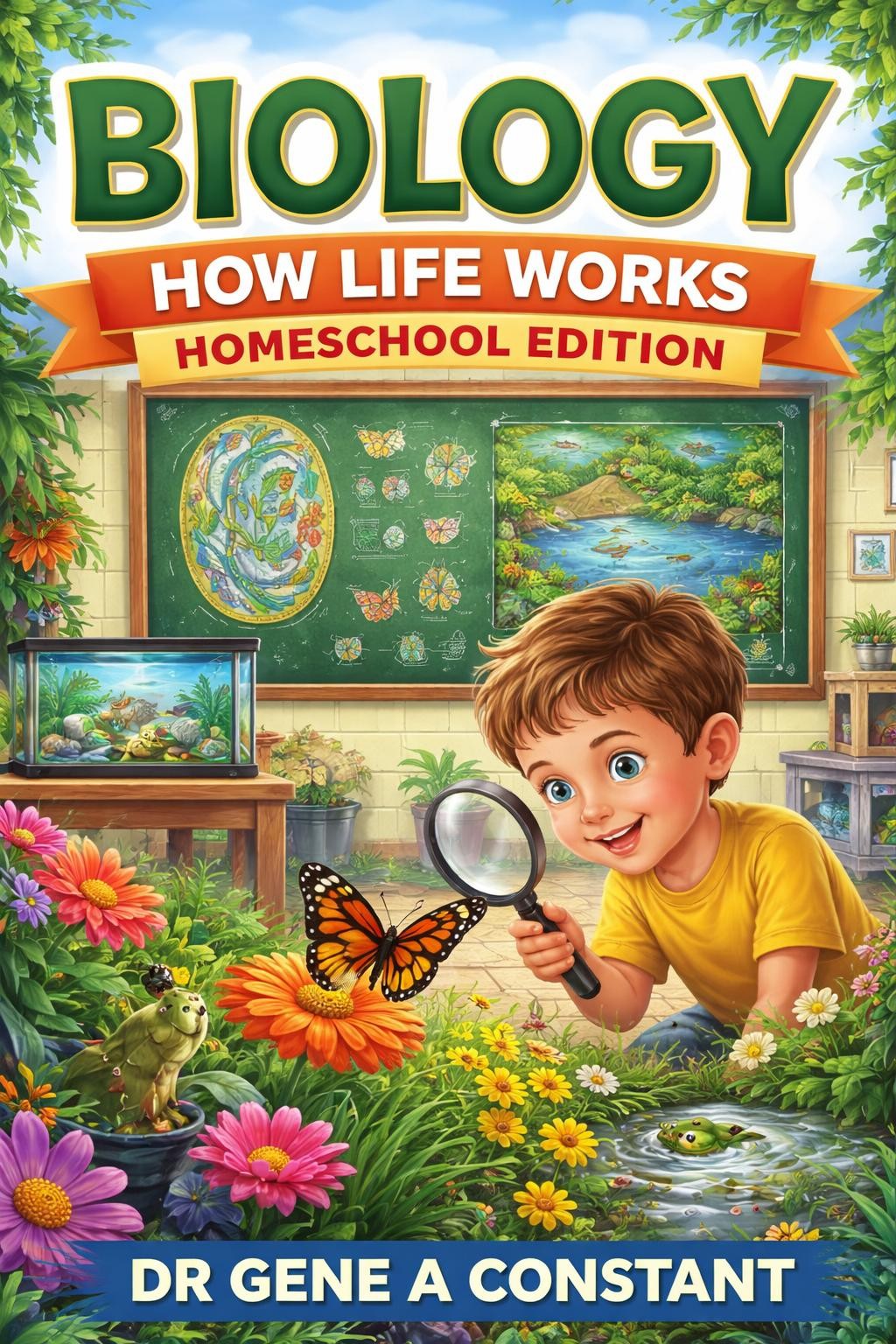
Biology: How Life Works, Homeschool Edition by Dr. Gene A Constant. This lesson is chapter 1, and the whole chapter is on this page.
GSU is a 501(c)(3) nonprofit and book sales are its only income. A purchase is not a tax-deductible donation. This lesson is free and always will be.