Lesson 5 of 8 · Chapter 5
Nature’s Web
How is all of life connected? In this lesson you follow energy from the sun through food chains, meet the producers, consumers and decomposers, sort nature’s partnerships, and find your own place in the web of life.
Choose how you want to learn
You can change this any time. Press Listen on any part to hear it read aloud. Grown-ups: read along with younger children.
- 1 · Energy moves through life
- 2 · Producers, consumers and decomposers
- 3 · Close partnerships
- 4 · Teamwork, competition and the web
- 5 · Your place in the web
- 6 · The whole chapter
- 7 · Try it at home
- 8 · Your card
- 9 · Check yourself
Part 1
Energy moves through life
Every living thing needs energy. Most of it starts with the sun.
Plants catch sunlight and turn it into food. Animals get energy by eating.
A food chain shows who eats whom: sun, grass, grasshopper, frog, snake, hawk.
Your breakfast, your jumping jacks and your healing scrape all run on energy. Plants, algae and some microbes capture sunlight and store it as sugar through photosynthesis, the job of the chloroplasts you met in Lesson 2.
Every time an animal eats, it is borrowing energy that first came from the sun. Even if you eat an animal, that animal ate plants, or ate animals that ate plants. A food chain is a step-by-step path of that energy: sunlight, grass, grasshopper, frog, snake, hawk.
Real life is messier than one line: a hawk also eats mice, and a frog eats many kinds of insects. Many food chains woven together make a food web. And energy does not go around in a circle like water. It flows: in as sunlight, through living things, and out as heat.
“This is where you meet a powerful idea: energy moves through life.”
“Energy has a history.”
“Energy is not cycling the way water cycles. Energy flows.”
Build the food chain. Tap what comes next, starting where the energy begins.
Part 2
Producers, consumers and decomposers
Producers make their own food from sunlight. Plants are producers.
Consumers eat other living things. Rabbits, hawks and people are consumers.
Decomposers break down dead things. Worms, mushrooms and tiny microbes are decomposers.
Producers make their own food, mostly from sunlight: plants on land, algae in water. Consumers must eat other living things; if you cannot make your own food from sunlight, you are a consumer. Decomposers, like fungi and bacteria, break down dead plants and animals, helped by earthworms and pill bugs that shred dead material into smaller pieces.
So two stories happen at once. Energy flows: sun to plant to animal, with heat leaving along the way. Nutrients cycle: when things die, decomposers return their building blocks to the soil and water, where producers use them again. Compost turning into dark soil is that cycle in action.
That is why a field has many plants, fewer rabbits, fewer foxes, and maybe one hawk. Each animal uses most of the energy it eats just to live: to move, stay warm and breathe. Only part becomes new body. Picture a bucket brigade where some water spills at every hand-off.
“If you cannot make your own food from sunlight, you are a consumer.”
“The living world does not like to waste building blocks.”
“Producers are the entry point for sunlight energy into the living system.”
Producer, consumer or decomposer? Tap one for each. Get all eight to finish.
Part 3
Close partnerships
Some living things live close together as partners. This is called symbiosis.
A bee and a flower help each other. The bee gets food, and the flower gets help making seeds.
A tick takes blood from a deer and helps nothing. That partnership hurts the deer.
Symbiosis means “living together.” It comes in three kinds. In mutualism, both partners win. In commensalism, one wins and the other is hardly affected. In parasitism, one wins and the other is harmed.
Mutualism: a bee drinks nectar, and pollen on its body helps the plant make seeds, a trade of food for delivery. Underground, fungi spread threads that help roots reach water and nutrients, and the plant shares its sugar. Commensalism: a bird nests in a tree, or a burr hitches a ride on a dog’s fur to a new place.
Parasitism: ticks, fleas, lice and some worms feed on a host and harm it. Harmful microbes from Lesson 4 work the same way at a tiny scale. Relationships can shift with conditions: a microbe that is harmless on your skin can cause trouble in a cut.
“Symbiosis means ‘living together,’ and it can happen in different ways.”
“So they trade services: food for delivery.”
“Biology loves the phrase ‘it depends,’ and you have seen why: conditions shape outcomes.”
Mutualism, commensalism or parasitism? Tap one for each. Get all seven to finish.
Part 4
Teamwork, competition and the web
Animals of the same kind often work as a team. Ants share jobs, and wolves hunt in a pack.
Living things also compete for things there are not enough of, like sunlight or nesting spots.
Put all the connections together and you get a web.
Cooperation within one species improves survival. Ants forage, care for young, defend and build. Wolves hunt in packs, geese travel together, dolphins herd fish, and small birds call alarms when a predator appears.
Competition happens when resources are limited: two plants racing for sunlight, two birds wanting the same nesting spot, two squirrels after the same acorns. Competition, predators, disease and weather keep populations from growing past what a habitat can support, and they push species to find different strategies.
Put food chains, partnerships, cooperation and competition together and you get a web. Tug one strand and others move: if pollinators disappear, flowers make fewer seeds, insects that eat those plants decline, and so do the birds that eat the insects.
“Cooperation is a survival strategy.”
“If you tug on one strand, other strands move too.”
“If you are not sure, write ‘not sure yet.’ That is honest science.”
Cooperation or competition? Tap one for each. Get all six to finish.
Part 5
Your place in the web
People are part of nature’s web too.
We eat food from plants, breathe air plants help make, and drink water that flows through habitats.
Small choices can make the web stronger, like planting a flower or wasting less food.
You are not outside the web looking in. You eat food grown in soil, breathe oxygen made mostly by plants and algae, and depend on pollinators and decomposers every day. And because people can change habitats quickly, your actions travel: a porch light changes where bats hunt, and soap or oil on a driveway can reach a stream.
That also means small actions can help. Planting a flower adds an energy entry point that feeds insects and birds. A quiet leaf corner protects the recyclers. Throwing trash away properly and minding the storm drain sends fewer harmful passengers into the flow. Wasting less food respects sunlight energy that took a whole food chain to reach your plate.
This is stewardship: caring for something valuable without pretending you control everything. When nature feels inconvenient, like ants in the kitchen, respond like a biologist and change the conditions. And remember that a spider in a safe corner may be part of the pest-control team.
“In ecosystems, connection means actions travel.”
“A helpful way to remember it is this: if everything is connected, then nothing is ‘just’ something.”
“Noticing is where responsible choices begin.”
Does each choice strengthen or weaken the web? Tap one for each. Get all eight to finish.
Part 6
Read the whole chapter
Here is all of Chapter 5, “Nature’s Web: Understanding Ecosystems”, exactly as the book tells it. Press Listen to hear it read aloud, or open it and read along.
Open Chapter 5 (about 25 minutes to read)
Part 7
Try it at home
Do these with your family. Tick each one when it is done.
Part 8
Your “My Web Detective” card
Fill it in, then print it for the fridge. Nothing you type here leaves this device.
My Web Detective
Global Sovereign University · Biology: How Life Works, lesson 5
Relationships in the web
- Mutualism: both win
- Commensalism: one wins, the other is hardly affected
- Parasitism: one wins, the other is harmed
- Cooperation: a team of the same kind
- Competition: sharing what there is not enough of
Part 9
Check yourself
7 questions. Pick an answer. If it is not right, read the hint and try again.
Lesson 5 complete.
You can follow energy through a food chain, name producers, consumers and decomposers, sort mutualism, commensalism and parasitism, tell cooperation from competition, and explain your place in the web. Next: Lesson 6, Specialty Science.
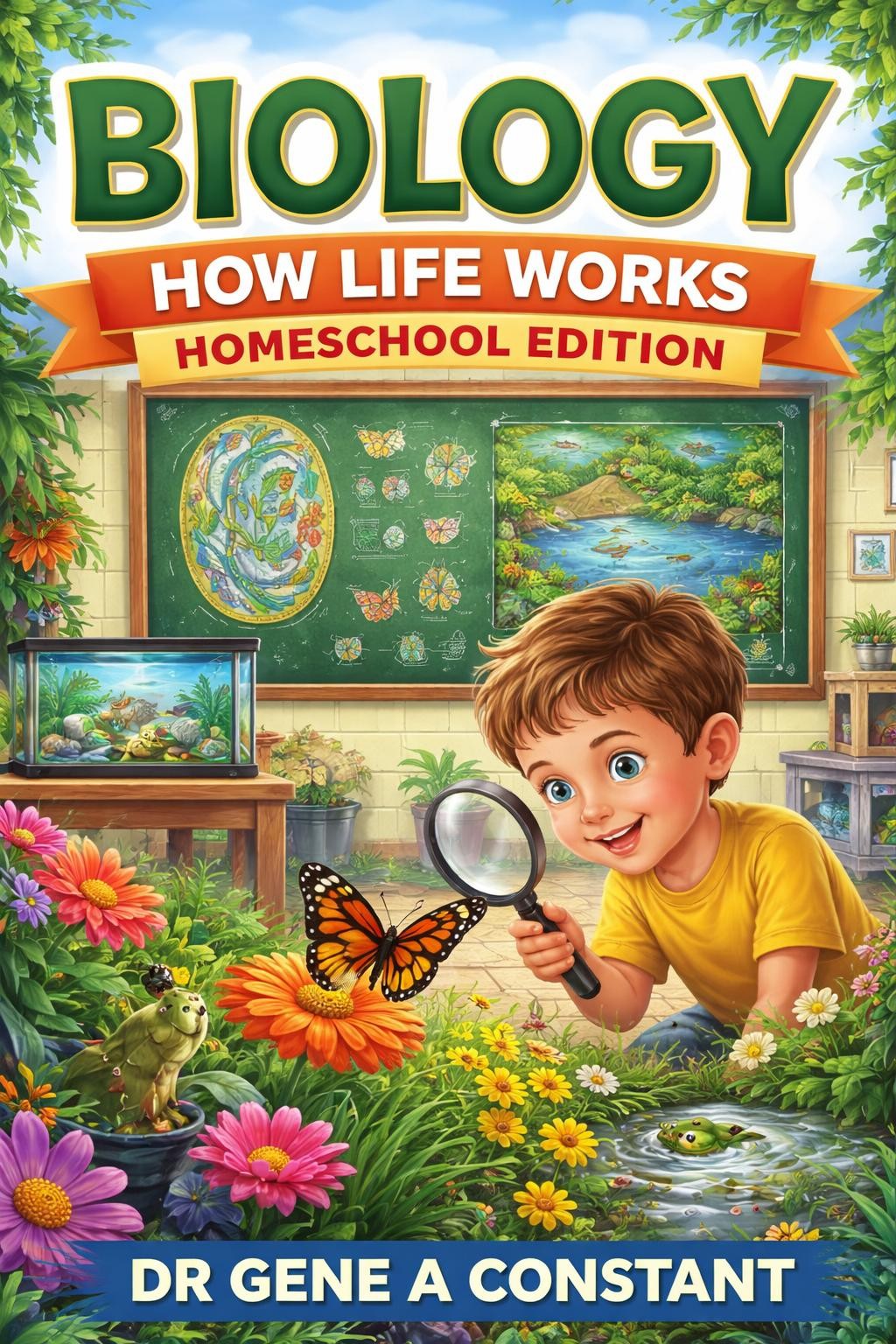
Biology: How Life Works, Homeschool Edition by Dr. Gene A Constant. This lesson is chapter 5, and the whole chapter is on this page.
GSU is a 501(c)(3) nonprofit and book sales are its only income. A purchase is not a tax-deductible donation. This lesson is free and always will be.