Lesson 6 of 8 · Chapter 6
Specialty Science
Pick the science you love! In this lesson you dive into the ocean, meet animals as clever problem-solvers, and discover the quiet, busy lives of plants.
Choose how you want to learn
You can change this any time. Press Listen on any part to hear it read aloud. Grown-ups: read along with younger children.
- 1 · The ocean: one giant habitat
- 2 · Survival in the sea
- 3 · Animals: bodies built for jobs
- 4 · Animal messages and groups
- 5 · Plants: quiet problem-solvers
- 6 · The whole chapter
- 7 · Try it at home
- 8 · Your card
- 9 · Check yourself
Part 1
The ocean: one giant habitat
Marine biology is the study of life in the ocean.
Ocean water is salty, it gets darker deeper down, and the deep sea is cold and squeezed by the water above.
Tiny floating plant-like living things called phytoplankton catch sunlight and feed the ocean.
The ocean is not a big bowl of water. It is a habitat with hard rules. It is salty, and salt changes how water moves in and out of cells, so sea animals need special body tools to keep their inner balance, the same homeostasis you met in Lesson 2.
Light fades as you go deeper, so producers mostly live near the surface. In the open ocean, tiny drifters called phytoplankton capture sunlight and feed whole food webs. Deeper still, pressure rises from the weight of water above, and it gets dark and cold. Life lives there anyway.
The ocean has neighborhoods, called zones. The shore has waves, tides and changing conditions. The open ocean is wide water with few places to hide. The reef is full of hideouts and food. The deep ocean is dark, cold and high-pressure.
“The ocean is salty. That one fact shapes everything.”
“They are like floating grasslands.”
“Each zone has rules, and those rules shape who can live there.”
Which ocean zone is this? Tap one for each. Get all eight to finish.
Part 2
Survival in the sea
Tide pools fill and empty with the tide. The animals there are tough survivors.
Some ocean animals, even some giant whales, eat by straining tiny food out of the water.
A coral reef is built by tiny animals, not plants.
A tide pool is ocean at high tide and a small, cut-off pond at low tide, so it can heat up, lose oxygen or turn saltier. Barnacles glue themselves to rocks like tiny forts, close up to hold moisture when the tide goes out, and open to filter food when water returns. Some huge whales filter tiny krill. Size does not always tell you what an animal eats.
Ocean food chains follow the same energy rules from Lesson 5: sunlight, phytoplankton, small fish, bigger fish, shark. Coral is made of tiny animals called polyps that build hard skeletons. Many corals hold tiny algae inside them in a mutualism: the algae share sugar, and the coral gives them a safe home. If water gets too warm, the partnership can break down. That is called bleaching.
Open-ocean travelers like tunas, dolphins and sea turtles are shaped to glide. Fish breathe with gills, but dolphins and whales breathe air and must surface. Blubber keeps marine mammals warm. And near deep-sea vents, some microbes make food from chemical energy instead of sunlight.
“So tide pool creatures are like survival champions.”
“Different path, same flow: energy moving through life.”
“But here is something many people do not realize at first: coral is made of animals, not plants.”
Build an ocean food chain. Tap what comes next, starting where the energy begins.
Part 3
Animals: bodies built for jobs
Zoology is the study of animals.
An animal’s body parts are tools. A hummingbird’s long beak reaches into flowers.
Animals stay warm or cool in different ways. A dog pants to cool down.
Zoology starts with the animals near you: a squirrel on a fence, ants on a sidewalk, a robin tugging a worm. Ask what jobs it does: finding food, staying safe, handling weather, raising a family.
Form and function: form is shape, function is job, and in animals shape often matches job. A seed-eater has a strong beak for cracking, a hummingbird a long narrow beak for flowers, a hawk a curved beak for tearing. Squirrels have sharp claws for climbing. Ducks have webbed feet for swimming.
Animals balance their bodies too. A lizard basks on a warm rock, then moves to shade. A dog pants to cool off. A bird fluffs its feathers to trap warm air like a jacket. All of it costs energy, so behavior often makes sense as energy math: a snake rests after a big meal because digestion is work.
“Zoology is not just a list of animal names.”
“In animals, shape often matches job.”
“Zoology is full of ‘balance problems’ and ‘balance solutions.’”
How is each animal balancing its temperature? Tap one for each. Get all six to finish.
Part 4
Animal messages and groups
Some animals hide by looking like their surroundings. This is camouflage.
Some bright colors warn, “Don’t eat me!”
Many animals stay safer in groups, like fish in a school or birds in a flock.
Animals send messages without words. Camouflage says “you can’t see me”: a stick insect looks like a twig, and a moth patterned like bark blends in. Warning colors say “don’t eat me”: bright colors can advertise a bad taste or a defense.
Mimicry is a trick: a harmless animal looks like a dangerous one, and looking like the wrong snack can save its life. Timing matters too. Some animals are active by day, some by night, so they can share a habitat with less danger and competition.
Groups help survival. Ant colonies have gatherers, defenders and caretakers. Flocks, schools and herds can confuse predators, find food and keep young safer. And one bird’s alarm call warns many birds.
“Bright colors can be a billboard in nature.”
“One bird spots danger, many birds benefit.”
“Wonder is not the enemy of science. Wonder is often what starts science.”
What is each animal doing to stay safe? Tap one for each. Get all seven to finish.
Part 5
Plants: quiet problem-solvers
Botany is the study of plants.
Roots drink water. Leaves catch sunlight. Flowers invite helpers like bees.
Seeds are like little suitcases that carry baby plants to new places.
A plant cannot walk away when conditions change, so it solves problems with built-in tools. Leaves catch sunlight and make food by photosynthesis. When you eat an apple, you are eating sunlight the tree caught months ago.
Roots grab water and minerals from soil, with fine root hairs that work like a bigger net. Some roots stay shallow to catch quick rain, and others go deep. Leaves take in air through tiny pores but can lose water that way, so some have waxy surfaces, tiny hairs or curl in the heat. Plants stand tall without bones thanks to stiff cell walls and water pressure.
A flower is a plan to make seeds: shape, smell and opening time invite certain visitors. A seed is a baby plant with a starter food supply, packed to travel by wind, water, animals, or your socks. Plants defend themselves too, with thorns, tough or hairy leaves, bitter chemicals, and even scents that call in predators of the insects chewing on them.
“Plants are busy.”
“So when you look at a green plant, you are looking at an energy worker.”
“Life does not have to move loudly to be powerful.”
Which plant part is doing this job? Tap one for each. Get all eight to finish.
Part 6
Read the whole chapter
Here is all of Chapter 6, “Specialty Science: Deep Dives into Passion Topics”, exactly as the book tells it. Press Listen to hear it read aloud, or open it and read along.
Open Chapter 6 (about 23 minutes to read)
Part 7
Try it at home
Do these with your family. Tick each one when it is done.
Part 8
Your “My Specialty Science” card
Fill it in, then print it for the fridge. Nothing you type here leaves this device.
My Specialty Science
Global Sovereign University · Biology: How Life Works, lesson 6
Three specialty sciences
- Marine biology: life in the ocean
- Zoology: the study of animals
- Botany: the study of plants
- Form and function: shape matches job
Part 9
Check yourself
7 questions. Pick an answer. If it is not right, read the hint and try again.
Lesson 6 complete.
You can describe ocean zones and how sea life survives, explain how coral and phytoplankton power the sea, match animal tools to their jobs, name camouflage, warning colors and mimicry, and tell what roots, leaves, flowers and seeds do. Next: Lesson 7, Faith, Wonder, and Scientific Discovery.
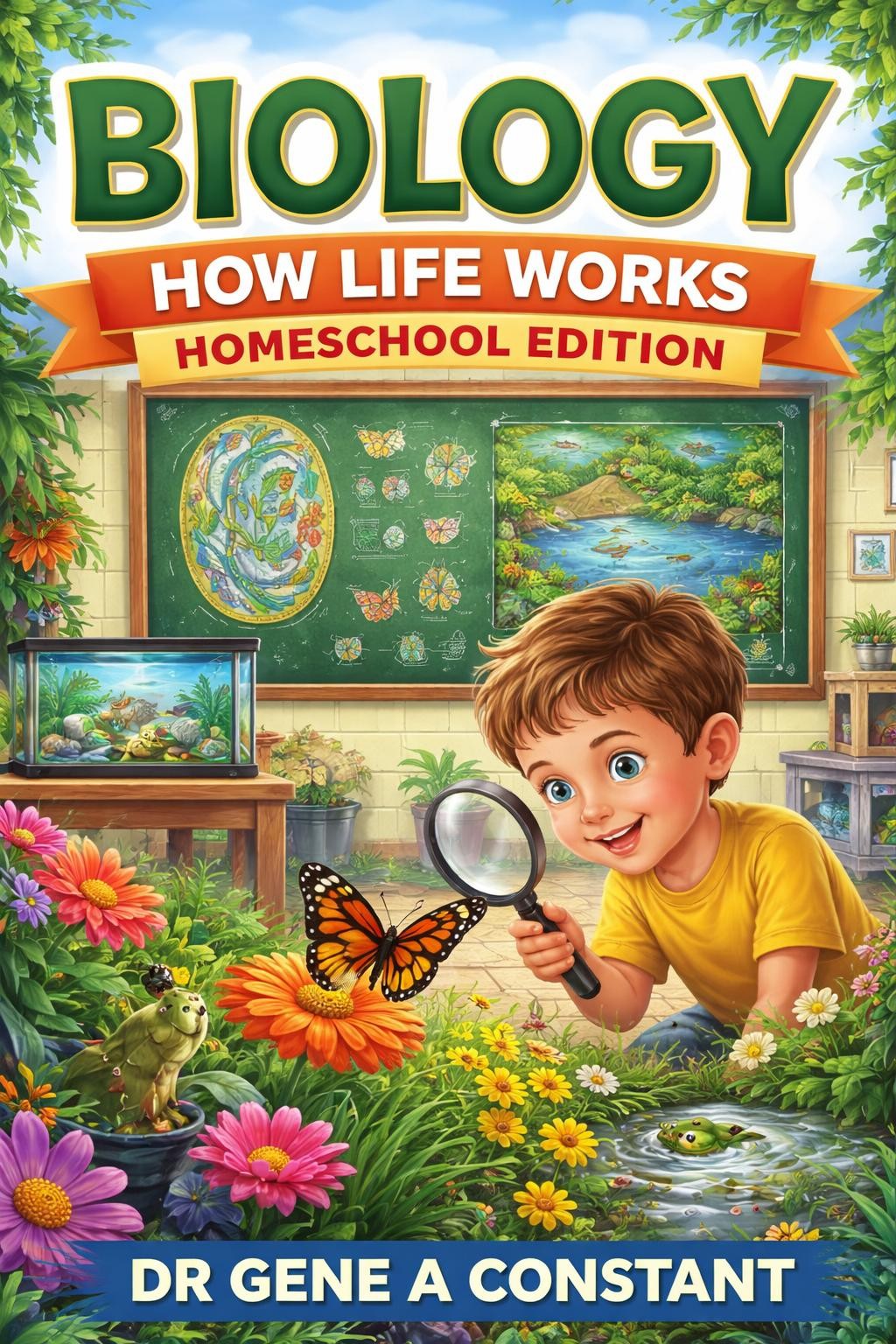
Biology: How Life Works, Homeschool Edition by Dr. Gene A Constant. This lesson is chapter 6, and the whole chapter is on this page.
GSU is a 501(c)(3) nonprofit and book sales are its only income. A purchase is not a tax-deductible donation. This lesson is free and always will be.