Lesson 7 of 8 · Chapter 7
Faith, Wonder, and Scientific Discovery
Science can make you say “wow,” and it can lead to big questions. In this lesson you explore wonder and gratitude, how many families talk about science and faith together, the hard parts of nature, and your place in creation as a learner, neighbor and caretaker.
Choose how you want to learn
You can change this any time. Press Listen on any part to hear it read aloud. Grown-ups: read along with younger children.
- 1 · Wonder and careful science
- 2 · Awe, gratitude and big questions
- 3 · When nature is gentle and wild
- 4 · Three respect rules
- 5 · Your place: learner, neighbor, caretaker
- 6 · The whole chapter
- 7 · Try it at home
- 8 · Your card
- 9 · Check yourself
Part 1
Wonder and careful science
When you learn about living things, you may feel wonder: “Wow, the world is amazing!”
Wonder makes you want to look closer and ask more questions.
Many families talk about science and faith together. Both can be careful and honest.
After microbes, food webs and hidden plant teamwork, you may feel two big things at once: wonder, and questions, not only “How does this work?” but “What does it mean?” Many homeschooling families talk about both at the dinner table, on nature walks, or after a documentary.
Some families use a picture of two ways to learn: through Scripture and faith teachings, about purpose, values and how to live; and through creation itself, by observation, patterns and evidence. You do not have to choose between being a “science person” and a “faith person.” Wonder is often where science begins.
The habits you have practiced are science habits and character habits. Pausing by a sidewalk-crack plant is attention. Putting a rock back is respect. Tracing energy from sun to hawk is connection. Parking a question instead of rushing an answer is humility.
“Because one of the best things you have practiced since Chapter 1 is this: curiosity can be careful.”
“Wonder is not weakness. Wonder is motivation.”
“Gratitude does not replace investigation. It fuels it.”
Which character habit is each science habit practicing? Tap one for each. Get all eight to finish.
Part 2
Awe, gratitude and big questions
Awe is the big feeling you get when you see something real and amazing.
Gratitude means being thankful, and it can turn into helpful actions.
Some questions are too big to answer in one day. You can keep them in your Question Parking Lot.
Awe is not the same as being confused. Often it is what you feel when you understand enough to see how much is going on, like when pond water stopped being “just water” and became a neighborhood. Awe points to patterns: teamwork across scales, balance, and hidden work you rarely see.
Gratitude can be practical. If you are grateful for your immune system, you rest when you are sick and wash your hands before eating. If you are grateful for pollinators, you plant flowers. If you are grateful for clean water, you mind the storm drain.
Some questions can be tested in an afternoon. Others are big: “Why does life feel so connected?” Two kinds of questions help here. “How does it work?” is a science question. “What does it mean?” and “How should I live?” are meaning questions. They are different, and both can matter.
“Awe is often what happens when knowledge stops being flat.”
“That kind of gratitude has hands and feet.”
“Sometimes big questions are answered slowly, like a plant growing.”
What pattern of awe is this? Tap one for each. Get all eight to finish.
Part 3
When nature is gentle and wild
Nature has beautiful parts and hard parts. A hawk might catch a mouse.
It is okay to feel sad or surprised by what you learn.
Ask two questions: What is true here? and How should we respond?
Sooner or later every learner meets a hard wonder: a bird feeding its chicks, then a hawk catching a mouse. Food webs include predation, ecosystems include death and decomposition, and microbes include both partners and pathogens. Good science does not pretend these things are not real.
“What is true here?” leads back to science: predators keep prey populations from growing past what a habitat can support, decomposers recycle nutrients, and inflammation is part of how your body defends itself.
“How should we respond?” leads to values: respect life, avoid cruelty, care for health, practice stewardship, and remember you do not control everything but you do have choices. Feeling upset is not a sign to stop learning. It means you are taking life seriously.
“Biology does not hide these realities. It helps you name them.”
“Biology does not require you to be emotionless. It asks you to be honest.”
“You are allowed to feel tender and still be a good scientist.”
Is it “what is true” or “how we respond”? Tap one for each. Get all six to finish.
Part 4
Three respect rules
Rule 1: Look first, touch second.
Rule 2: Change as little as you can.
Rule 3: Leave it better when you can.
Living things are not props in your story. They have needs, limits and a place in the web. Respect means treating life as life, even when it is small, slow or silent.
Observe first, act second: take your two minutes and sketch before you grab. Change as little as possible: lift a log gently and put it back, use only a small scoop of pond water, keep your distance from animals. Leave it better when you can: close a gate so animals don’t get trapped, and put a stepping stone back so you don’t crush a trail.
Respect does not mean you must like ants in the kitchen or mosquito bites. It means responding with wisdom: remove crumbs and block entry points, move a spider outside, and empty standing water where mosquitoes breed. Change the conditions, not just your mood.
“Respect is the decision to treat life as life.”
“Let your eyes work before your hands do.”
“Respect means you respond with wisdom instead of panic or cruelty.”
Which respect rule is this? Tap one for each. Get all seven to finish.
Part 5
Your place: learner, neighbor, caretaker
You are a learner: you look closely and ask good questions.
You are a neighbor: you share air, water and space with other living things.
You are a caretaker: you do small things to help life.
Your body is part of creation too: a habitat of cells and microbes with its own defenders. Sleeping, washing your hands, caring for a scrape and eating well are ways of respecting it.
If everything is connected, are you responsible for everything? No. You are responsible for your reach: your home habits, your neighborhood, what you waste and throw away, and how you treat small creatures when nobody is watching. Living systems have balancing tools and can recover from some changes, but not from changes that are too big, too fast or constant. That is why your choices matter.
A simple weekly page helps: Respect, one living thing you treated gently; Responsibility, one choice that reduced harm; Repair, one small problem you helped fix. Learner, neighbor and caretaker, and humble enough to keep learning.
“You are not responsible for everything. You are responsible for your reach.”
“You are not separate from creation. You carry it around with you.”
“Curiosity can be a kind of care.”
Respect, responsibility or repair? Tap one for each. Get all eight to finish.
Part 6
Read the whole chapter
Here is all of Chapter 7, “Faith, Wonder, and Scientific Discovery”, exactly as the book tells it. Press Listen to hear it read aloud, or open it and read along.
Open Chapter 7 (about 22 minutes to read)
Part 7
Try it at home
Do these with your family. Tick each one when it is done.
Part 8
Your “My Place in Creation” card
Fill it in, then print it for the fridge. Nothing you type here leaves this device.
My Place in Creation
Global Sovereign University · Biology: How Life Works, lesson 7
Learner, neighbor, caretaker
- Learner: I observe honestly and ask careful questions
- Neighbor: I share air, water and space with living things
- Caretaker: steady care, not control or panic
- Humble: I keep learning and say “not sure yet”
Part 9
Check yourself
7 questions. Pick an answer. If it is not right, read the hint and try again.
Lesson 7 complete.
You can explain how wonder leads to science, tell “how” questions from “meaning” questions, face the hard parts of nature honestly, use the three respect rules, and describe your place as a learner, neighbor and caretaker. Next: Lesson 8, Hands-On Science.
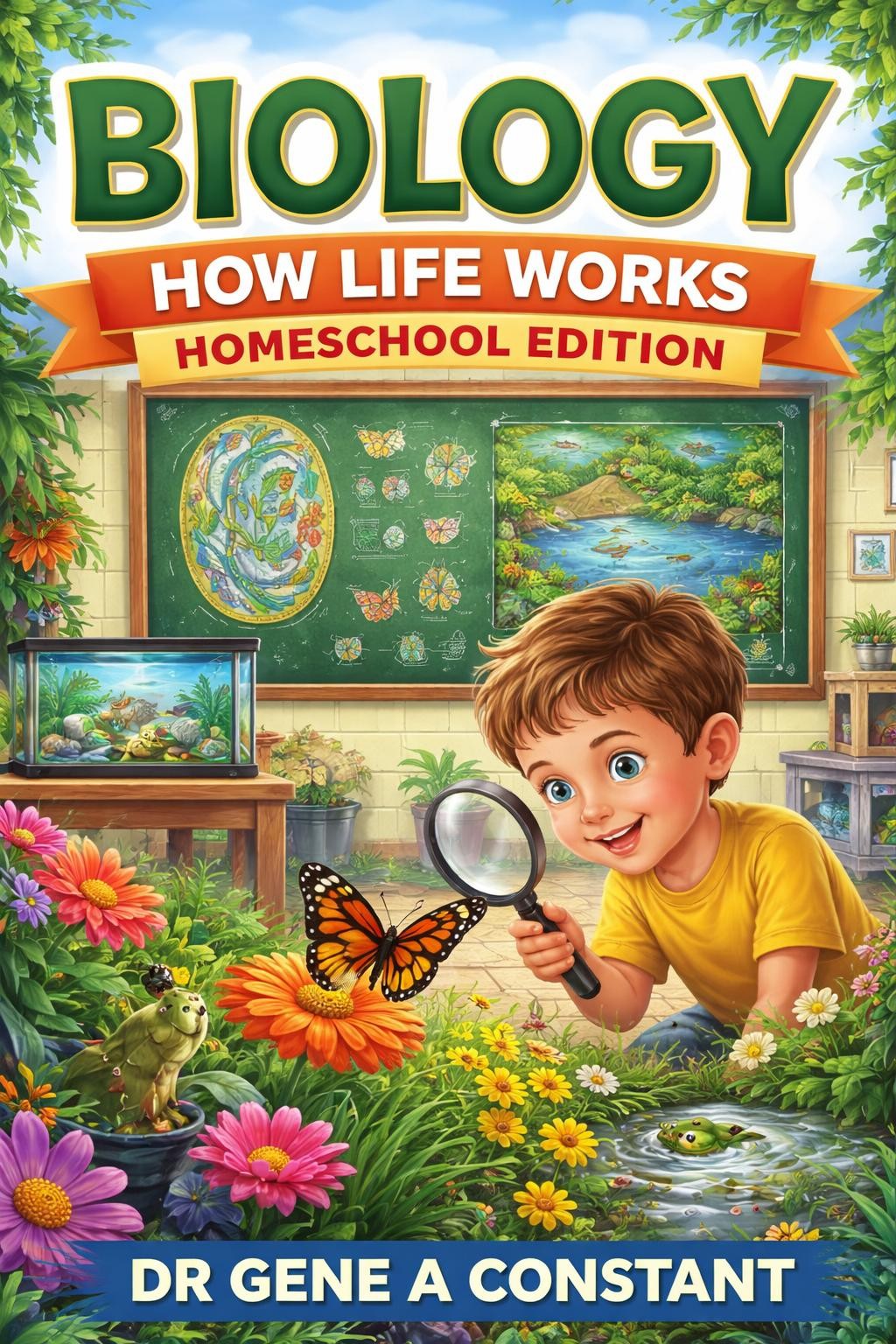
Biology: How Life Works, Homeschool Edition by Dr. Gene A Constant. This lesson is chapter 7, and the whole chapter is on this page.
GSU is a 501(c)(3) nonprofit and book sales are its only income. A purchase is not a tax-deductible donation. This lesson is free and always will be.