Lesson 1 of 10 · Chapter 1
Who’s the Boss? The Three Branches
Who makes the rules for the whole country? Who makes sure they happen? And who decides what they mean? In this lesson you meet the three teams that share the power, and you find out why nobody gets to be the “super boss.”
Choose how you want to learn
You can change this any time. Press Listen on any part to hear it read aloud. Grown-ups: read along with younger children.
- 1 · No super boss
- 2 · Rules Team
- 3 · Action Team
- 4 · Fairness Team
- 5 · Checks and balances
- 6 · The whole chapter
- 7 · Try it at home
- 8 · Your card
- 9 · Check yourself
Part 1
Nobody gets to be the super boss
A country needs rules. But one person should not make all the rules.
Think about a game. What if one kid made the rules, played the game, and was the referee too? That kid would always win. That is not fair.
So the United States splits the power into three teams. Each team is called a branch, like three branches on one tree.
The three branches each have their own job, and each one can slow the others down. That way no single person or team can become the “super boss.”
The book uses a big video game as the example. A game needs rule-makers, people who run the game, and referees. If one player did all three jobs, the game would stop being fair for everyone else. The country works the same way.
“That would be like letting one kid be the principal, the teacher, the referee, and the hall monitor all at the same time. Not very fair, right?”
“Instead of one ‘boss,’ we have three teams that share power.”
Part 2
The Rules Team makes the laws
The first team is the Legislative Branch. Call it the Rules Team.
Its job is to make laws. A law is a rule for the whole country.
The Rules Team is called Congress. Congress has two parts: the House of Representatives and the Senate. Both parts must say yes before a rule can become a law.
A new law starts as an idea written down. That idea is called a bill. A bill is a “maybe-law.” People talk about it, change it, and vote on it.
The House has more members. Each one speaks for a smaller area. The Senate has fewer members, and every state gets the same number of senators. That way big states and small states both get a voice.
Arguing about a bill can be a good thing. It helps people find problems before the rule is made. That takes time, like a family trying to pick a movie, but the time protects everyone from a rushed, unfair rule.
“A bill is like a ‘maybe-law.’ It is a rule proposal.”
“If they cannot agree, it does not become a law.”
Part 3
The Action Team carries the laws out
The second team is the Executive Branch. Call it the Action Team.
A rule on paper does nothing by itself. The Action Team makes the rules really happen.
The leader of the Action Team is the President. Many helpers work with the President, like people who keep our food safe.
When Congress passes a bill, it goes to the President. The President can sign it, which means “yes, make it a law,” or veto it, which means “no, not like this.” A veto is like a big pause button. It sends the bill back.
The Action Team also runs groups that take care of education, nature, food safety, national parks and more. When a hurricane or a wildfire hits, the Action Team organizes fast help.
“A rule that stays on paper and never happens is like a ‘No running in the hallway’ sign that nobody pays attention to.”
“You can think of a veto as a serious ‘pause’ button.”
Part 4
The Fairness Team decides what laws mean
The third team is the Judicial Branch. Call it the Fairness Team.
This team is the courts. The most famous court is the Supreme Court.
When people disagree about a law, the courts decide what the law means. They are like the referee in kickball who says “fair ball” or “foul ball” using the same rules for everyone.
To interpret a law means to figure out what its words mean and how to use them. Courts also check whether a law follows the Constitution, the country’s biggest rulebook.
A good referee does not make up brand-new rules in the middle of the game. The courts look at the rules that already exist and apply them fairly, even when somebody is disappointed.
“But if a referee decides using the same rules for everyone, the game feels more fair, even if someone is disappointed.”
“Rule-makers. Action-takers. Fairness-checkers.”
Who does this job? Tap the team for each job. Get all nine right to finish.
Part 5
The teams check each other
Each team can stop another team from going too far. This is called checks and balances.
The President can veto a bill from Congress. Courts can say a law breaks the Constitution. Congress decides how money is spent.
Things can go slowly. That is on purpose. Going slowly gives people time to catch mistakes.
A check is a way to stop another branch from going too far. A balance is what happens when no one branch can tip the whole system over by itself.
If the President vetoes a bill, Congress can change it and try again, or override the veto with a very big vote. That is hard on purpose.
Regular people check the teams too. People vote, write letters, go to meetings and speak up. Kids cannot vote yet, but kids can still speak up and ask good questions.
“A check is a way to stop another branch from going too far.”
“That is not a mistake in the design. That is the design.”
“In a system built on shared power, your voice matters because no one gets to do everything alone.”
Follow the bill. Try saying yes, then try saying no, and see what happens.
Part 6
Read the whole chapter
Here is all of Chapter 1, “Who’s the Boss?”, exactly as the book tells it. Press Listen to hear it read aloud, or open it and read along.
Open Chapter 1 (about 25 minutes to read)
Part 7
Try it at home
Do these with your family. Tick each one when it is done.
Part 8
Your “Three Teams” card
Fill it in, then print it for the fridge. Nothing you type here leaves this device.
My Three Teams
Global Sovereign University · Civic Literacy for Kids, lesson 1
Rules. Action. Fairness.
- Congress makes laws. Two parts must agree.
- The President signs or vetoes.
- The Action Team makes laws real.
- Courts decide what laws mean.
- Each team checks the others.
- My voice matters too.
Part 9
Check yourself
Six questions. Pick an answer. If it is not right, read the hint and try again.
Lesson 1 complete.
You can name the three teams, say what each one does, and explain why they check each other. Next: Lesson 2, Your Secret Shield (the Bill of Rights).
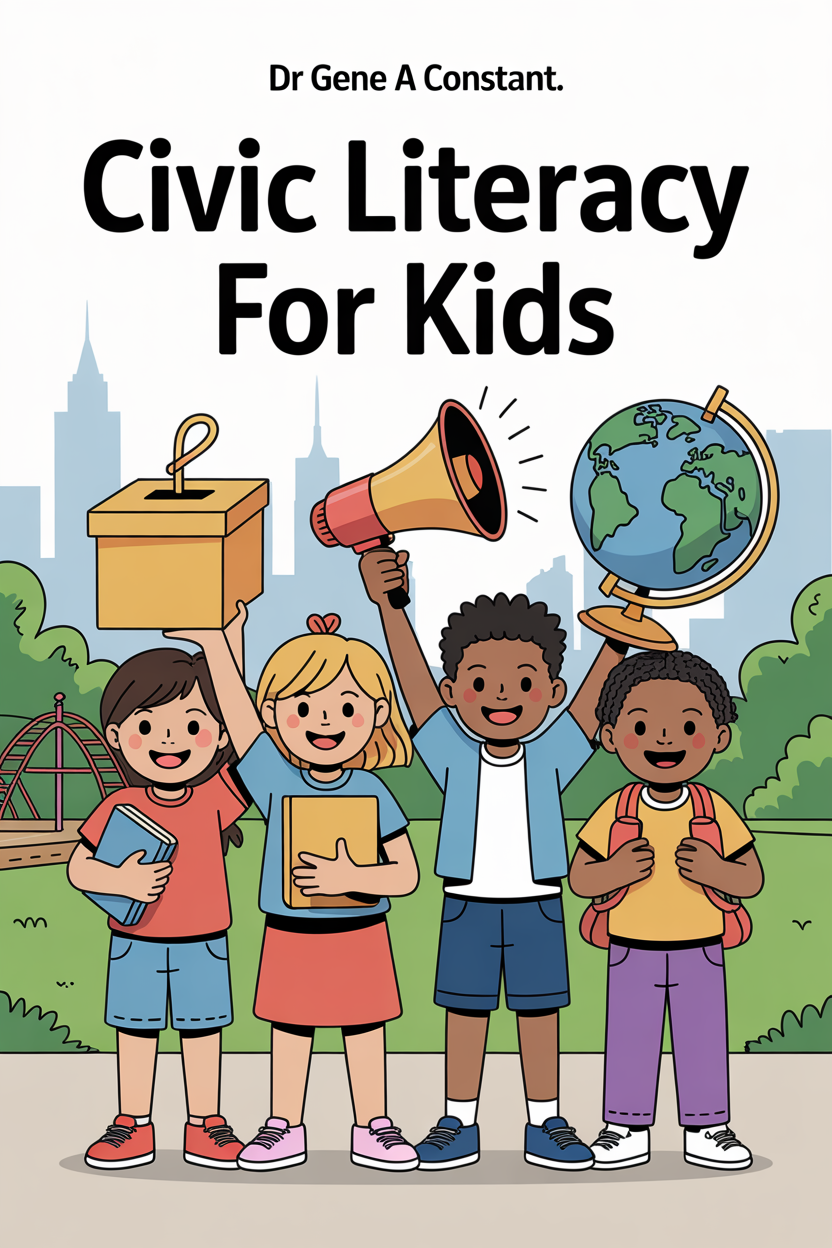
Civic Literacy for Kids by Dr. Gene A Constant. This lesson is chapter one, and the whole chapter is on this page.
Keep a copy — it funds a free seat
GSU is a 501(c)(3) nonprofit and book sales are its only income. A purchase is not a tax-deductible donation. This lesson is free and always will be.