Lesson 2 of 10 · Chapter 2
Your Secret Shield: The Bill of Rights
The Constitution is full of promises that protect you, not just presidents and judges. In this lesson you learn the Bill of Rights: the five freedoms that protect your voice and beliefs, the fair steps that protect people, and how to use your rights wisely.
Choose how you want to learn
You can change this any time. Press Listen on any part to hear it read aloud. Grown-ups: read along with younger children.
- 1 · A list of promises
- 2 · Voice and beliefs
- 3 · Fair steps
- 4 · Responsibility
- 5 · Kids use rights too
- 6 · The whole chapter
- 7 · Try it at home
- 8 · Your card
- 9 · Check yourself
Part 1
A list of promises
The Bill of Rights is a list of promises. It is part of the Constitution, the country’s biggest rulebook.
The promises protect people from unfair treatment. They protect kids too.
A right is like a line the government is not allowed to cross.
The Bill of Rights is the first ten amendments to the Constitution. An amendment is a change or an addition to the biggest rulebook.
Long ago, when the country was new, people worried the government might get too strong. So they wrote down promises it must keep, even when a powerful leader wants something else.
Rights are not prizes for being popular, and they are not treats handed out to some people only. They are boundaries. And writing them down matters: you can point to them and say, “This is what you agreed to.”
“That’s what the Bill of Rights is: a list of promises.”
“They draw a line and say, ‘Stop. You can’t cross this line.’”
“Because written promises are harder to pretend you never made.”
Part 2
Your voice and your beliefs
The First Amendment protects five freedoms.
You can speak up. You can believe what you believe. People can share the news. You can gather with others peacefully. And you can ask leaders to fix a problem.
Speech: the government is not supposed to punish you just because it dislikes your opinion. You can say “I disagree” and suggest a better idea.
Religion: the government cannot force you to follow a religion or stop you from practicing yours peacefully, and it should not pick one religion for everyone. That protects people who do not practice a religion too.
Press: the government cannot shut down news reporters just because it does not like what they report.
Assembly: people can gather together, like at a meeting or a march, as long as it stays peaceful.
Petition: people can ask the government to fix something, with a letter or a list of signatures.
“You can speak. You can believe. You can learn and share information. You can gather with others. You can ask for change.”
“And the Bill of Rights begins by saying, ‘Yes. You are allowed to use it.’”
Which freedom is it? Tap the freedom for each scene. Get all nine to finish.
Part 3
Privacy and fair steps
The government cannot search your things just because it feels like it. There must be a good reason and rules.
If someone is blamed for breaking a law, they get fair steps: a fair trial, a lawyer, and no cruel punishment.
Think of a broken window at recess. A fair grown-up asks questions first. They do not just punish whoever is standing nearby.
The Bill of Rights protects people from unreasonable searches. That does not mean there are never searches. It means there must be reasons and rules. Courts, the Fairness Team, help decide what “reasonable” means.
If the government accuses someone of a crime, the book lists promises that protect them: people cannot be forced to confess, they have a right to a fair trial, they have a right to a lawyer, and punishments cannot be cruel and unusual.
These promises make sure the government cannot just point at someone and say “Guilty” without proof and fair steps.
“It means power is not supposed to be used like a grabby hand.”
“A fair process would ask questions.”
Part 4
Rights come with responsibility
Having rights does not mean you can do anything you want.
Use your voice to tell the truth and to stand up for someone. Do not use it to be mean or to spread rumors.
If you want people to respect what you believe, respect what they believe too.
Schools can still have rules, like “Please wait your turn,” because a classroom is not supposed to be chaos. And no one may use their voice to threaten people.
Speaking wisely is a skill. Ask questions before jumping to conclusions. Separate facts from opinions. Listen, even when you disagree. Criticize ideas without insulting people. Choose words that solve problems.
“Rights come with responsibility.”
“The shield is meant to protect people, not to turn you into a bully with a megaphone.”
“But cruelty is not a civic superpower.”
Fair or crosses the line? Decide for each scene. Get all seven to finish.
Part 5
Kids can use their rights too
Maya and Jordan’s library kept closing early. They are too young to vote. But they could still help.
They asked the librarian what was wrong. They could write a kind letter, speak at a town meeting, and help start a petition.
You do not have to be 18 to be an active citizen.
Kids do not have every power adults have. Kids cannot vote yet, and school has special rules. But fairness, safety and freedom are human ideas, not adult-only ideas.
Rights shape how police may act, how courts must treat people, and how people can gather to speak up. Most days you never notice them, like guardrails on a mountain road, until something goes wrong.
A shield only helps if you know you have it. That is why learning your rights matters.
“Rights work best when people know them.”
“A shield doesn’t help if it’s left in a closet and nobody remembers it exists.”
“It’s the reason your voice has space.”
Part 6
Read the whole chapter
Here is all of Chapter 2, “Your Secret Shield (The Bill of Rights)”, exactly as the book tells it. Press Listen to hear it read aloud, or open it and read along.
Open Chapter 2 (about 26 minutes to read)
Part 7
Try it at home
Do these with your family. Tick each one when it is done.
Part 8
Your “My Shield” card
Fill it in, then print it for the fridge. Nothing you type here leaves this device.
My Shield
Global Sovereign University · Civic Literacy for Kids, lesson 2
Five freedoms and fair steps
- Speak up.
- Believe freely.
- Share the news.
- Gather peacefully.
- Ask for change.
- Fair steps for everyone.
Part 9
Check yourself
7 questions. Pick an answer. If it is not right, read the hint and try again.
Lesson 2 complete.
You can explain what the Bill of Rights is, name the five First Amendment freedoms, say why fair steps matter, and use your voice wisely. Next: Lesson 3, The Power of the Polling Place.
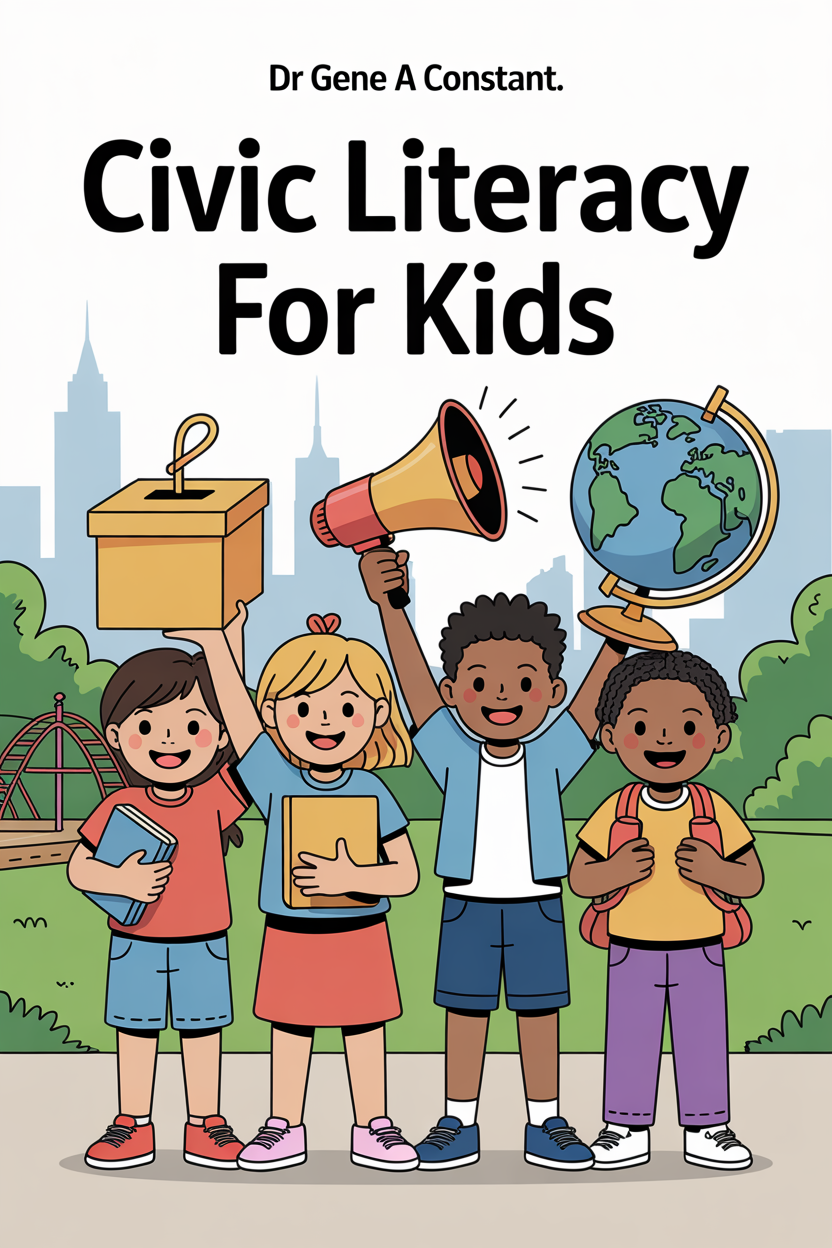
Civic Literacy for Kids by Dr. Gene A Constant. This lesson is chapter 2, and the whole chapter is on this page.
Keep a copy — it funds a free seat
GSU is a 501(c)(3) nonprofit and book sales are its only income. A purchase is not a tax-deductible donation. This lesson is free and always will be.