Lesson 3 of 10 · Chapter 3
The Power of the Polling Place
How does a whole town choose its leaders without a fight? In this lesson you learn what voting is, how an election goes from ballots to a winner, the difference between a majority and a plurality, and how kids can take part long before they turn 18.
Choose how you want to learn
You can change this any time. Press Listen on any part to hear it read aloud. Grown-ups: read along with younger children.
- 1 · How a group decides
- 2 · Who we vote for
- 3 · Ballot to winner
- 4 · Who wins?
- 5 · Before you are 18
- 6 · The whole chapter
- 7 · Try it at home
- 8 · Your card
- 9 · Check yourself
Part 1
Voting: how a group decides
Imagine your whole town has to share one giant pizza. Some people want pepperoni. Some want cheese. Some want pineapple.
You cannot order a different pizza for every person. So the group votes. Everyone gets a say, instead of one loud person grabbing the menu.
A good voter thinks about what is best for everyone, not just what they want.
Voting is when eligible citizens choose between options. Sometimes they choose candidates, people who want a government job, like mayor, governor or president. Sometimes they choose ideas, like “Should our town build a new park?”
The list of choices is called a ballot. It can be paper or a screen. Think of it as a menu of decisions.
Voting is a peaceful way for lots of different people with different needs to decide together, without turning every disagreement into a fight.
“Voting is like the method the group uses to choose.”
“If civic literacy is your instruction manual, voting is one of the main buttons on the controller.”
Part 2
Who we vote for, and why it matters
People vote for members of Congress, the Rules Team. They vote for the President, who leads the Action Team.
They also vote for leaders close to home, like governors, mayors and the school board.
If a leader does a bad job, voting lets people choose someone new, peacefully.
Many judges are appointed instead of elected. But elected leaders often choose or confirm judges, so voting still connects to the Fairness Team.
A representative speaks and acts for a group of people, because most people cannot spend every day studying laws and budgets. No leader will match one person’s wishes every time, just like picking the movie for family night.
Leaders are supposed to earn the job again and again. That keeps them accountable: they cannot just do whatever they want forever. And voting works best with the rights from Lesson 2: speech, the press, gathering and petitioning help people make an informed choice.
“A representative is someone who speaks and acts for a group of people.”
“Voting is a way of saying, ‘I belong here, and I care what happens.’”
Part 3
From ballot to winner
An election happens in steps, like a relay race.
People who want the job share their plans. Voters fill in a ballot. People vote at a polling place, or early, or by mail.
Then the votes are counted carefully, and the winner starts the job.
Only eligible voters may vote: citizens old enough who follow their state’s rules. For a town election, you usually have to live in that town, just as students at your school pick your student council, not kids from another school.
The first results on TV are often unofficial. The final, official count can come later, after everything is checked. Close elections take longer, and a very close one may get a recount, which means counting again to double-check.
Remember Lesson 1: sometimes slow is protection. Careful counting, with watchers from different sides, helps the result match what voters really chose.
“Counting votes is serious.”
“A recount is not automatically a sign that something is wrong.”
Put the election in order. Tap the step that comes first, then the next, until all eight are in place.
Part 4
Who wins? Majority and plurality
In many elections, the person with the most votes wins.
If the winner gets more than half of the votes, that is a majority.
If the winner gets the most votes but not more than half, that is a plurality. That can happen when there are three or more choices.
Different elections can have different “winning rules”, which is one reason civic literacy is a useful map. A simple town election might be “most votes wins.” Others have extra steps.
After the win, the leader takes office on a start date. Then the real work begins, and the winner still has to follow the rules: checks and balances from Lesson 1 and the Bill of Rights from Lesson 2 still apply.
Elections are not only every four years for president. Many are local, and local leaders decide the things you notice first: libraries, parks, crosswalk timers and schools.
“A winner is someone who met the election rules and earned enough votes to get the job.”
“Even a winning leader doesn’t get to do absolutely anything.”
The pizza vote. Change the votes and watch who wins. Find a majority winner and a plurality winner to finish.
Part 5
You can take part before you are 18
Kids cannot vote yet. But kids still have a voice.
You can ask good questions. You can check if something is true before you repeat it. You can write a kind letter to a leader. You can go to a town meeting with a grown-up.
When grown-ups vote, help them think about plans, not just names.
A strong kid letter says who you are, describes the problem in a few clear sentences, explains why it matters to the community, asks one specific question, and stays respectful. Maya’s letter asked her town why the library closes at 3:00 and what the plan is to keep it open later.
Good voter questions: What problem is this leader trying to solve? How do they plan to solve it? Do they respect people’s rights? Do they tell the truth? Do they listen to the community? Do they follow fair rules?
Voting without learning turns into a popularity contest: picking the name you heard most, or whoever made the funniest video. Kids can also volunteer, like helping at the library, which gives them real evidence when they speak up.
“Not being able to vote yet does not mean you are powerless.”
“Voting is important, but it is not the only way to have a voice. And a voice is not the same thing as a vote.”
“That’s not real civic power. That’s just being pushed around by noise.”
Part 6
Read the whole chapter
Here is all of Chapter 3, “The Power of the Polling Place”, exactly as the book tells it. Press Listen to hear it read aloud, or open it and read along.
Open Chapter 3 (about 26 minutes to read)
Part 7
Try it at home
Do these with your family. Tick each one when it is done.
Part 8
Your “Smart Voter” card
Fill it in, then print it for the fridge. Nothing you type here leaves this device.
Smart Voter
Global Sovereign University · Civic Literacy for Kids, lesson 3
Before you choose
- What problem will they solve?
- What is the plan?
- Do they tell the truth?
- Do they respect rights?
- Do they listen?
- Do they follow fair rules?
Part 9
Check yourself
7 questions. Pick an answer. If it is not right, read the hint and try again.
Lesson 3 complete.
You can explain what voting is, follow an election from ballot to winner, tell a majority from a plurality, and name real ways kids take part. Next: Lesson 4, Truth Detectives.
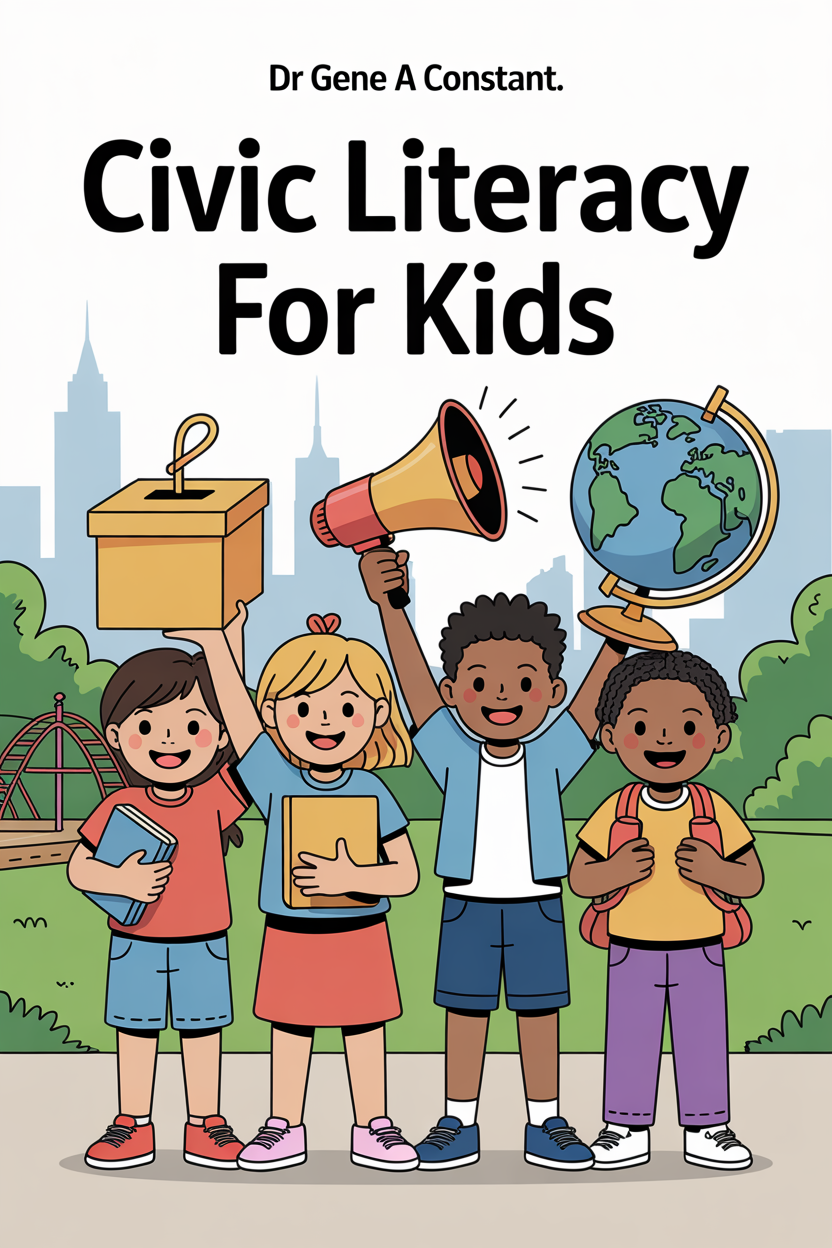
Civic Literacy for Kids by Dr. Gene A Constant. This lesson is chapter 3, and the whole chapter is on this page.
Keep a copy — it funds a free seat
GSU is a 501(c)(3) nonprofit and book sales are its only income. A purchase is not a tax-deductible donation. This lesson is free and always will be.