Lesson 4 of 10 · Chapter 4
Truth Detectives: Navigating the News
How do you know what is true? In this lesson you learn to tell a fact from an opinion, spot the tricks in fake news and tricky headlines, use STOP and CHECK before you share, and find your way to the best sources.
Choose how you want to learn
You can change this any time. Press Listen on any part to hear it read aloud. Grown-ups: read along with younger children.
- 1 · Fact or opinion?
- 2 · Facts are the bricks
- 3 · Tricky headlines
- 4 · STOP and CHECK
- 5 · Smart explorer
- 6 · The whole chapter
- 7 · Try it at home
- 8 · Your card
- 9 · Check yourself
Part 1
Fact or opinion?
A fact can be checked. It is true or false. The score in a game is a fact: the scoreboard says 6, not 12.
An opinion is what someone thinks or feels. “That was the best game ever” is an opinion. You can disagree, but you cannot prove it.
A truth detective asks: Can I check this?
Maya heard a kid say, “The library closes early because nobody uses it.” It sounded like a fact. So she checked. The librarian said lots of kids use it; the library closes early because there is not enough staff.
Four detective questions: Can I prove it or check it? Is there a number, a date, a direct quote or an event I can verify? Is the speaker telling me what happened, or what to think about it? Is this trying to inform me, or to make me upset fast?
Watch for judgment words like best, worst, lazy, terrible, everyone knows and nobody cares. They usually mean an opinion is coming.
“A fact is something that can be checked.”
“An opinion is what someone thinks, believes, or feels.”
“Opinions are not the enemy. Confusing opinions with facts is the enemy.”
Fact, opinion, or both? Tap the right label for each line. Get all nine to finish.
Part 2
Facts are the bricks
Facts are like bricks. Opinions are what people build with the bricks.
Opinions are fine. Communities need them. But a good opinion stands on facts.
A strong argument uses facts. A loud argument just shouts.
Opinions can hide inside sentences that look like facts. “The library closes early because leaders don’t care about kids.” The first part can be checked. The second part is a guess about what is in someone’s heart.
Strong: “The library closes at 3:00, and many students need a place to do homework. I think the town should fund an extra staff member.” Weak: “People are selfish. Everything is ruined.” The weak one gives you nothing to fix.
Watch for cherry-picking: sharing a real fact but leaving out the other facts, like choosing only the red candies and pretending the blue ones don’t exist.
“Facts are the bricks. Opinions are what people build with the bricks.”
“Use facts to support opinions, not opinions to replace facts.”
“Truth detectives learn to ask, ‘What might be missing?’”
Part 3
Tricky headlines and fake news
Fake news pretends to be true, but it isn’t. Sometimes it is made up. Sometimes it takes a real fact and twists it.
A headline is the title at the top of a story. Some headlines are like a cereal box that says “Giant Chocolate Mountain!” when there are only three chips inside.
If a post makes you very upset very fast, slow down.
The seven tricks: big emotions first; a headline that doesn’t match the story; vague enemies and blurry sources (“they,” “experts say”); a true fact telling a false story; a cropped quote or clipped video; the too-perfect story with a purely bad villain; and the share-me-now design.
Maya saw “Town SHUTS DOWN Library for Kids, Parents Furious!” But the library was not shut down. It was closing early on weekdays. Closing early and shutting down are not the same thing.
A careful story has handles you can grab: names, dates, and what exactly changed. A vague post gives you fog.
“A headline is like the label on a box.”
“If you only read the top line, you are not reading the news. You are reading advertising for the news.”
“But in civic life, urgency is not proof.”
Spot the trick. Each post below uses one trick. Tap the trick it uses. Get all six to finish.
Part 4
STOP and CHECK
When you see a big claim, do two things.
STOP: pause before you react.
CHECK: make sure it is true before you repeat it. Ask a grown-up to help you check.
Five checks. The source: who made this? The date: is this old news shared as if it were new? A second source: can you find it somewhere else that is independent? The original: the full article, the full quote, where the numbers came from. Your own brain: do I want this to be true?
Jordan read the “SHUTS DOWN” post and asked, “Is that a fact claim we can check, or is it just trying to make us mad?” The post linked to nothing. So they asked the librarian, and got the real story.
With the true story, Maya and Jordan could do something useful: tell their families the real issue, bring clear questions to the town meeting, and write respectful letters like in Lesson 3.
“Stop means pause before you react.”
“Check means verify before you repeat.”
“Truth detectives try to care more about accuracy than about winning.”
“And sharing is a responsibility, not just a button.”
Detective case: the library post. Put Maya and Jordan’s steps in order. Tap the first step, then the next, until all six are in place.
Part 5
Become a smart information explorer
Go to the closest source. If you want to know when the library closes, look at the library sign or website, not a random post.
Many people saying something does not make it true.
Sometimes the best thing to do is not share. Ask a question instead: “Is this confirmed?”
A primary source is the closest-to-the-original information you can find: the library’s hours, the meeting notes, the full speech.
Build a trusted places list: the library, your town’s official page, your school district, a local newspaper that names sources and corrects its mistakes. Then cross-check with a second solid source, like asking two referees what they saw.
Evidence is something you can point to and check: a recorded vote, a schedule, a full quote. Volume is just noise; ten comments are not ten proofs. Keep a context backpack: Who decides this? What are the limits? And practice slow sharing: read past the headline, check the source and date, check one more source, then decide.
“It means you don’t stop at what someone says about a thing. You look for the thing itself.”
“Loud does not mean true.”
“Being willing to correct is a sign of seriousness.”
Part 6
Read the whole chapter
Here is all of Chapter 4, “Truth Detectives: Navigating the News”, exactly as the book tells it. Press Listen to hear it read aloud, or open it and read along.
Open Chapter 4 (about 28 minutes to read)
Part 7
Try it at home
Do these with your family. Tick each one when it is done.
Part 8
Your “Truth Detective” card
Fill it in, then print it for the fridge. Nothing you type here leaves this device.
Truth Detective
Global Sovereign University · Civic Literacy for Kids, lesson 4
Before you share
- Can I check it?
- Who made it?
- When was it made?
- Is there a second source?
- Did I see the full quote?
- Do I want it to be true?
Part 9
Check yourself
7 questions. Pick an answer. If it is not right, read the hint and try again.
Lesson 4 complete.
You can tell a fact from an opinion, spot tricky headlines and fake news, STOP and CHECK before you share, and find the closest source. Next: Lesson 5, Where Does the Money Go?
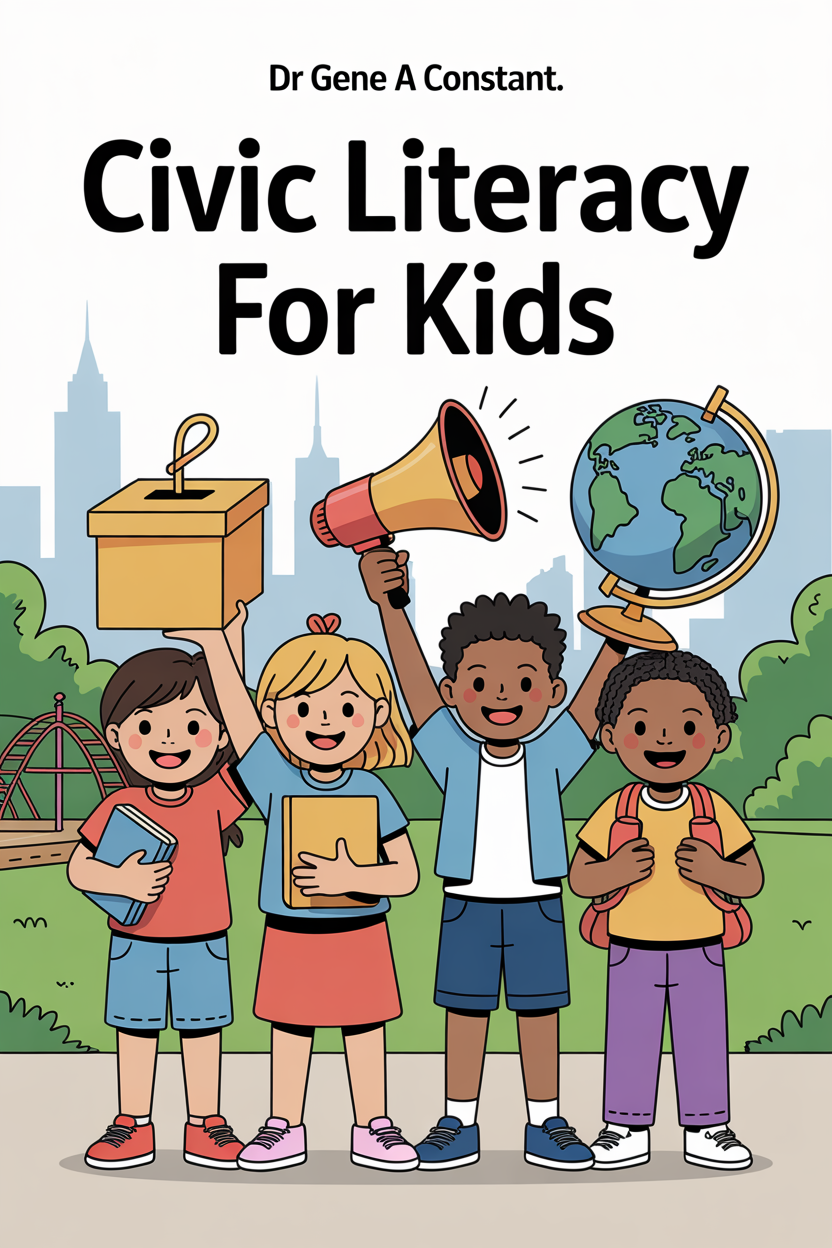
Civic Literacy for Kids by Dr. Gene A Constant. This lesson is chapter 4, and the whole chapter is on this page.
Keep a copy — it funds a free seat
GSU is a 501(c)(3) nonprofit and book sales are its only income. A purchase is not a tax-deductible donation. This lesson is free and always will be.