Lesson 5 of 10 · Chapter 5
Where Does the Money Go?
Who pays for the school, the park and the library? In this lesson you learn what taxes are, the different kinds, how leaders make a budget, why every budget has trade-offs, and how budgets shape your town.
Choose how you want to learn
You can change this any time. Press Listen on any part to hear it read aloud. Grown-ups: read along with younger children.
- 1 · Everyone chips in
- 2 · Kinds of taxes
- 3 · Where it goes
- 4 · Why not just move it?
- 5 · Budgets shape a town
- 6 · The whole chapter
- 7 · Try it at home
- 8 · Your card
- 9 · Check yourself
Part 1
Everyone chips in
Think about a class party. If one kid had to pay for everything, the party would not happen.
So everyone brings something: napkins, fruit, juice, plates. That is teamwork.
Taxes work the same way for a whole town. Everyone chips in a little, so the town can pay for things everyone needs.
A tax is money that people and businesses pay to the government to fund shared community needs: schools, libraries, parks, roads, firefighters, clean water, trash pickup, and the workers who keep records and run elections.
Some of these are easy to see, like a playground. Some you only notice when you need them, like a firefighter or clean drinking water.
Kids don’t pay most taxes yet, but taxes shape your day: your school, your park, your library, the roads you ride on. And the grown-ups who care for you do pay them.
“Most community money comes from taxes.”
“But taxes are not supposed to be a punishment.”
“That’s one reason taxes can feel fair in the big picture: we pay together because we live together.”
Part 2
Kinds of taxes, and what is fair
There is more than one kind of tax.
Income tax comes from money people earn at work. Sales tax is added when you buy some things. Property tax comes from owning a house or a building.
People argue about what is fair. That is normal.
Income taxes often help pay for national and state needs. Sales taxes often support state and local services. Property taxes often help pay for local things like schools, libraries and emergency services. You do not need to memorize them; the big idea is that taxes are several tools, not one.
Some people think fair means everyone pays the same. Some think people who have more should pay more. Some want lower taxes and fewer services. Some want enough to make sure everyone has what they need.
Use your Lesson 4 skills. “The town collected this much money last year” is a fact. “That is too much” is an opinion. Good conversations keep the two clear.
“The important idea is that taxes are not just one single thing.”
“Fair does not always mean identical.”
“They are debating what the community should be responsible for, and how the responsibility should be shared.”
Which kind of tax is it? Tap Income, Sales or Property for each one. Get all six to finish.
Part 3
Where the money goes
After the town collects the money, leaders make a budget. A budget is a plan for how to spend money.
Picture a tray of cups. Each cup is something important: schools, safety, roads, parks and libraries, clean water, and running the town.
If you pour a lot into one cup, there is less for the others.
Schools: teachers, buildings, buses, supplies. Safety: firefighters, police, emergency dispatch, like a seatbelt you hope you never need. Roads: potholes, bridges, sidewalks, crosswalks and traffic lights.
Parks, libraries and community spaces: a library is not just shelves of books. It is internet access, homework help, a quiet place to learn, and help with job applications. Water and trash: the behind-the-scenes work nobody cheers for, but everybody needs.
Running the town: keeping records, paying workers, and running elections. Remember Lesson 3: counting votes carefully takes workers, training and equipment.
“A budget is a plan for how to spend money.”
“If taxes are the pot of money everyone helps fill, then a budget is the recipe for what gets cooked.”
“Democracy costs money too, because fairness takes effort.”
Which cup pays for it? Tap the right budget cup for each thing. Get all eight to finish.
Part 4
Why leaders can’t just move the money
Maya asked, “If the town has tax money, why can’t they just pay for the library?”
Jordan said, “Maybe they already promised the money to other things.”
You cannot spend the same dollar twice.
Four limits. Some money is already promised, like contracts and last year’s projects. Some spending is required by law: a town cannot decide to stop having clean water. People disagree about wants and needs: for a kid with no quiet place at home, the library may be a need. And every choice has trade-offs.
A trade-off means more of one thing, less of another: two more library staff might mean the basketball courts wait to be repainted. Wanting different things does not make someone a villain.
Turn a complaint into a plan. Instead of “They don’t care,” ask: How much does it cost? Is it one staff person or several? Are there grants? Does the town decide, or the county? Is there a budget vote coming?
“A trade-off is when you get more of one thing but less of another.”
“Neither person is automatically a villain.”
“And values are not math problems.”
Part 5
How a budget shapes your town
A budget is like the town’s Yes list and Not yet list.
It decides if the library is open when kids need it, if the playground gets fixed, and if crosswalks are safe.
Fixing things early usually costs less than fixing them late.
How a budget is made: departments say what they need; leaders count the money they expect; they write a proposed budget; the public can look, ask questions and speak up; leaders vote; then it becomes real life, with hours, hires and repairs.
Maintenance means taking care of things so they don’t fall apart. Skip it, and small problems become big, expensive ones, like dishes piling up in the sink.
A budget buys opportunities: when the library closes early, some kids lose the quiet place they needed. Small steps count: one extra library day a week, one crossing guard, fixing the most dangerous potholes first.
“Budgets are where a community’s priorities stop being a speech and start being a plan.”
“So a budget doesn’t only buy ‘things.’ It buys opportunities.”
“Budgets are often about progress, not perfection.”
Build a town budget. You have 12 coins. Put them in the cups. Follow the two rules, place every coin, and see your trade-offs.
Part 6
Read the whole chapter
Here is all of Chapter 5, “Where Does the Money Go?”, exactly as the book tells it. Press Listen to hear it read aloud, or open it and read along.
Open Chapter 5 (about 27 minutes to read)
Part 7
Try it at home
Do these with your family. Tick each one when it is done.
Part 8
Your “Budget Builder” card
Fill it in, then print it for the fridge. Nothing you type here leaves this device.
Budget Builder
Global Sovereign University · Civic Literacy for Kids, lesson 5
Budget-shaped questions
- How much does it cost?
- Who decides?
- Where would the money come from?
- What is the trade-off?
- Is it required or optional?
- What is a first step?
Part 9
Check yourself
7 questions. Pick an answer. If it is not right, read the hint and try again.
Lesson 5 complete.
You can explain what taxes are, name three kinds, say what a budget is, spot a trade-off, and ask a budget-shaped question. Next: Lesson 6, Your Neighborhood Heroes.
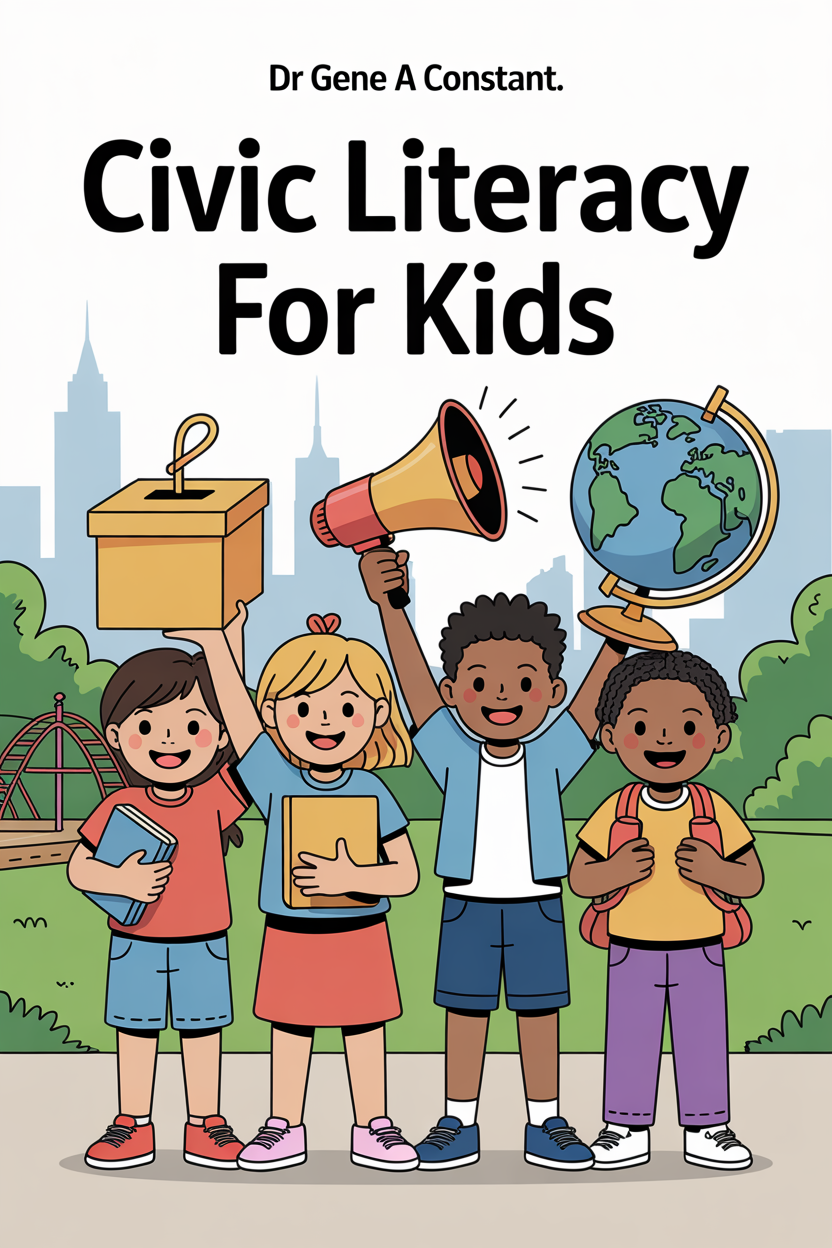
Civic Literacy for Kids by Dr. Gene A Constant. This lesson is chapter 5, and the whole chapter is on this page.
Keep a copy — it funds a free seat
GSU is a 501(c)(3) nonprofit and book sales are its only income. A purchase is not a tax-deductible donation. This lesson is free and always will be.