Lesson 9 of 10 · Chapter 9
The “I Can Help” Toolkit
How do you go from wanting change to making it? In this lesson you learn to turn a complaint into a clear request, start a petition, write to a leader, and plan a safe neighborhood clean-up.
Choose how you want to learn
You can change this any time. Press Listen on any part to hear it read aloud. Grown-ups: read along with younger children.
- 1 · From wanting to doing
- 2 · A petition
- 3 · Writing to a leader
- 4 · Planning a clean-up
- 5 · Clean-up day
- 6 · The whole chapter
- 7 · Try it at home
- 8 · Your card
- 9 · Check yourself
Part 1
From wanting to doing
Maya didn’t want to be a person who only complains. She wanted to be a person who helps.
Two helping tools: a petition shows that many people care. A project is a job you actually do.
Start small, but real.
Step one: say the problem in one sentence. Maya wrote: “The public library closes at 3:00 on weekdays, which makes it hard for students to do homework after school.” Clear, specific, no villain words.
Step two: choose an exact goal. Not “keep it open late forever,” but “try staying open until 5:00 on two weekdays as a trial.” Leaders can say yes, no or offer another option, but they can’t answer a cloud.
Step three: collect your proof: the hours now, the later hours in past years, and what library staff told them. A petition and a project together show you are serious.
“Wanting change is one thing. Building change is another.”
“A petition is mostly about showing support. A project is mostly about doing a task.”
“But they can’t answer a cloud.”
Part 2
Starting a petition
A petition is a paper people sign to show they support one clear request.
Ask for the exact thing, so everyone knows what they are signing.
Collect signatures safely: with a grown-up, from people you know.
Maya’s petition: “We, the undersigned community members, support a trial program to keep the public library open until 5:00 on two weekdays to help students with after-school homework and learning.” It says who, what and why.
Safety and permission first: no standing outside alone asking strangers, and no collecting people’s personal information online. Start with families, neighbors you know, and teachers if the school allows it.
Do petitions work? Sometimes directly, sometimes not. A petition can’t make money appear, but it shows leaders what the community cares about, can help get a meeting, and builds a list of supporters. And if someone gets upset, listen for what they are protecting, like in Lesson 7.
“Because signatures should be connected to something real.”
“A petition table is not a battle station.”
“It’s the ‘we’ part.”
A cloud or a clear request? Tap Cloud or Clear for each one. Get all seven to finish.
Part 3
Writing to a leader
Writing to a leader really counts.
Make it clear, kind and easy to understand. You don’t have to sound like a grown-up.
Ask someone to read it before you send it. That is editing, not weakness.
Six parts of a good email: a subject line that tells the truth; a greeting and who you are; your point, one sentence near the top; your proof, a few facts; your plan, a next step or question; and thank you.
Think about privacy: Maya wrote “library staff told us” instead of using Ms. Patel’s name. And don’t threaten: say “we are gathering community input to share with you,” not “you’d better do this.”
Then follow through. Jordan made a “Leader Reply Tracker” to write down dates, questions and who else to contact. If the answer is “not this year,” adjust the plan without giving up the value.
“Your job is to be understandable.”
“That’s not weakness. That’s editing.”
“Lots of people speak up once. Fewer people keep going politely and steadily.”
Build Maya’s email. Put the six parts in order. Tap the first part, then the next.
Part 4
Planning a clean-up
A clean-up is a project you can do right now. It doesn’t need a vote.
First find out who decides about the place, and ask permission.
Safety first. Kids never pick up sharp things, and always have a grown-up.
Maya’s plan: pick a place, get permission, get supplies, get helpers, stay safe, share results. The park belonged to the town, so they emailed the parks coordinator, who sent rules, bags and grabbers.
Safety rules: no sharp objects, no unknown liquids, no roads, grown-up supervision, gloves always, wash hands. If you find something sharp, mark the spot and tell the town.
Privacy counts here too: sign-in with first names only, and photos of the ground, not people’s faces. The flyer was short and clear, because clear is kind.
“We’re not trying to be heroes. We’re trying to be safe and useful.”
“Clear is kind.”
Safe or not safe? Tap the right answer for each clean-up choice. Get all eight to finish.
Part 5
Clean-up day: strangers become teammates
Neighbors came to help, even Trevor and his dad.
They filled ten bags of trash.
The park wasn’t perfect, but it looked cared for.
People talked, pointed things out to each other, and turned into a team for an hour. Ms. Patel walked over from the library with granola bars and a thank-you note.
The clean-up made evidence: most trash was near the bench and the fence. Trevor’s dad said the town might need another trash can on that side. Evidence leads to solutions.
Helping where you live is also community support. When Maya asks leaders for something, she can say, “We’re the kind of people who show up.”
“It was about turning strangers into teammates for an hour.”
“And care, she realized, was one of the most practical civic actions there is.”
Part 6
Read the whole chapter
Here is all of Chapter 9, “The ‘I Can Help’ Toolkit”, exactly as the book tells it. Press Listen to hear it read aloud, or open it and read along.
Open Chapter 9 (about 30 minutes to read)
Part 7
Try it at home
Do these with your family. Tick each one when it is done.
Part 8
Your “I Can Help” card
Fill it in, then print it for the fridge. Nothing you type here leaves this device.
I Can Help
Global Sovereign University · Civic Literacy for Kids, lesson 9
The I Can Help steps
- Say the problem in one sentence.
- Make one clear request.
- Collect your proof.
- Ask who decides.
- Stay safe, with a grown-up.
- Follow through.
Part 9
Check yourself
7 questions. Pick an answer. If it is not right, read the hint and try again.
Lesson 9 complete.
You can turn a complaint into a clear request, start a petition safely, write a clear email to a leader, and plan a safe clean-up. Next: Lesson 10, Being a Good Neighbor Online.
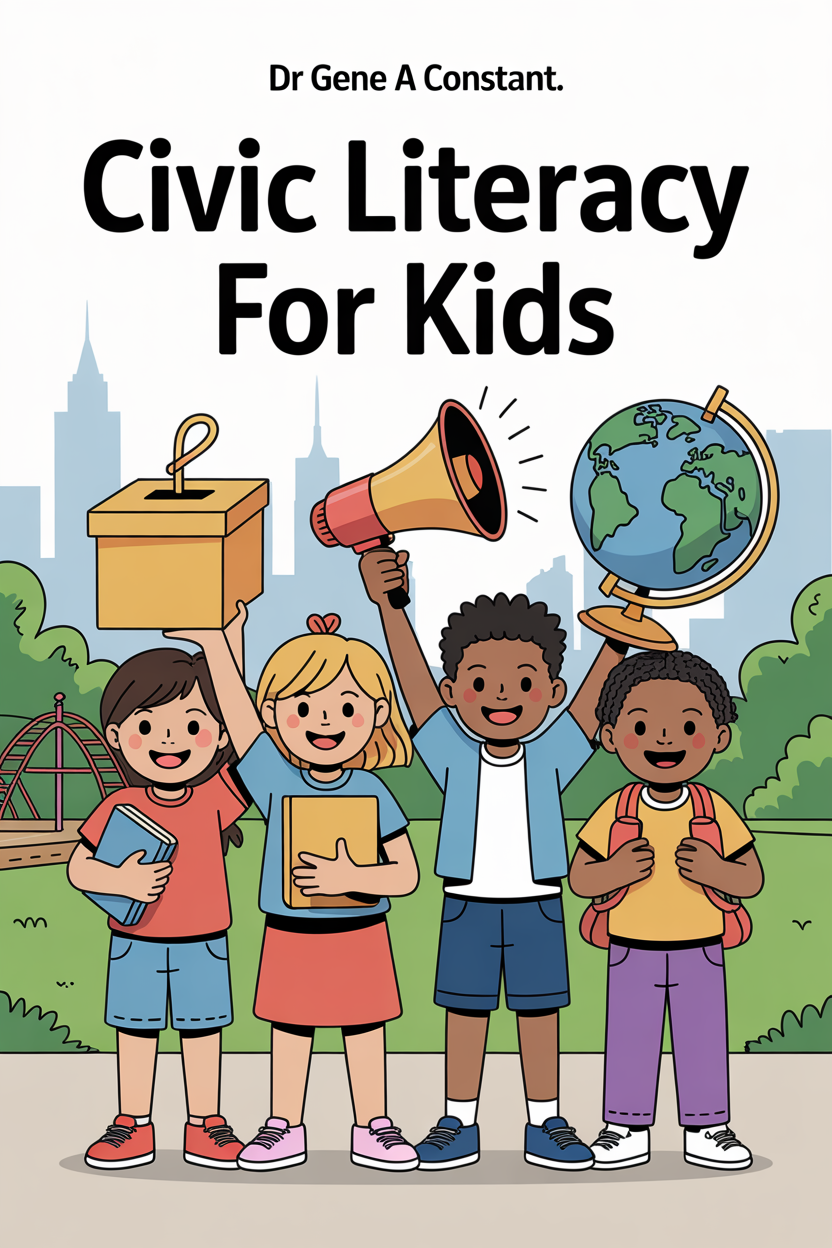
Civic Literacy for Kids by Dr. Gene A Constant. This lesson is chapter 9, and the whole chapter is on this page.
Keep a copy — it funds a free seat
GSU is a 501(c)(3) nonprofit and book sales are its only income. A purchase is not a tax-deductible donation. This lesson is free and always will be.