Lesson 1 of 10 · Chapter 1
Welcome to Little Economy Land
Ms. Rivera’s class is about to build a whole pretend economy in Room 12. In this lesson you learn the big three of money, play the token experiment, make the class promises, meet the starting jobs, and discover the secret powers of a group.
Choose how you want to learn
You can change this any time. Press Listen on any part to hear it read aloud. Grown-ups: read along with younger children.
- 1 · The most important ingredient
- 2 · Choices bump into each other
- 3 · Three adventure promises
- 4 · Everybody gets a starting job
- 5 · The secret powers of a group
- 6 · The whole chapter
- 7 · Try it at home
- 8 · Your card
- 9 · Check yourself
Part 1
The most important ingredient
Ms. Rivera’s class in Room 12 is going to build a pretend town called Little Economy Land.
An economy is how a group of people work, buy, sell, and share.
The most important thing they need is not money. It is each other.
Before printing money or opening a bank, Ms. Rivera asks what the most important ingredient is. Theo guesses scissors, Imani a calculator, Jasper snacks. The answer is the group. In a working economy, each person matters, each choice matters, and how we treat each other matters too.
In one week, one person can be a worker, a shopkeeper, a customer, a neighbor and a voter. That sounds big, and it is. It is also what grown-up life is like.
Ms. Rivera writes the big three on the board: earning (getting money for work), spending (using money to buy) and saving (keeping money for later). Everyone in Little Economy Land will do all three, with other people watching and choosing too.
“The ingredient is us. The group. The class.”
“In Little Economy Land, no one is alone on an island.”
“Money is not only a math thing. It is a people thing.”
Is it earning, spending or saving? Tap the right word for each one.
Part 2
Choices bump into each other
One kid alone with a jar of pretend coins can practice counting and saving.
But in a group, your choices bump into other people’s choices.
What happens to you depends partly on what everyone else does.
Ms. Rivera draws a pretend kid named Solo, who practices money alone. Then she draws a whole crowd. If you save but nobody sells anything, your money does not do much. If you want to buy but nobody works, there is nothing to buy. If everyone spends at once, sellers might raise prices or sell out.
Then she runs a token experiment. Each child gets two tokens, their “time and energy” for the day. Spending one means doing a helpful class job. If enough people help, the whole class earns a reward, even the people who did not help.
That made Theo mad: someone could get the sticker without doing the work. When a person gets a benefit without paying the cost, people notice. It can cause arguments, or it can lead to new rules. The class also felt risk: nobody knew if enough people would help. In a group, risk is shared.
“In a group, your choices bump into other people’s choices.”
“But those bumps are where the learning lives.”
“In a group economy, your outcome depends on other people’s choices.”
Play the token experiment. You have two tokens. Choose, then see what the class did. Play three rounds.
Part 3
Three adventure promises
Before the economy starts, the class makes three promises.
Treat it like it is real. Stay kind. Solve problems together.
Promises like these are the start of the class’s rules.
Promise one: treat our economy like it is real. Take jobs seriously, pay what you owe, and don’t grab or sneak.
Promise two: stay kind. Money can make people feel proud, worried, jealous, excited or disappointed. No money bragging and no money bullying, like saying “I’m rich and you’re not.”
Promise three: solve problems together. If something feels unfair, confusing or messy, talk about it, vote when you need to, and adjust. In Little Economy Land, the children are not only earners and spenders. They are citizens who help make the rules.
“We treat our economy like it is real.”
“We will not use money to hurt people.”
“In Little Economy Land, you’re not only earners and spenders. You’re builders of rules.”
Which promise does each action keep? Tap the promise.
Part 4
Everybody gets a starting job
Everyone pulls a folded slip from the basket. It is their starting job.
Theo is Cleaner Captain. Imani is Bank Helper. Jasper is Market Crier. Mina is on the Design Team.
Doing one kind of job well is called specializing.
These are not forever jobs. Jobs can rotate, businesses can start, and new jobs can appear when the class needs them. A group economy begins when a group chooses to carry the work together.
The Cleaner Captain plans how everyone cares for the room. The Bank Helper helps build the bank and makes sure every bill is counted right. The Market Crier tells everyone what is happening and what the rules are. The Design Team will design the class money.
Specializing means not everyone has to do everything. It lets you get good at something, and it lets other people trust you. Different jobs can earn different pay. That is not because some people are better, but because different work solves different problems for the group.
“A group economy begins with a group choosing to carry the work.”
“Not because one person is more important than another, but because different jobs solve different problems.”
“One person can do many things slowly. A group can do many things well.”
Which starting job does each task belong to? Tap the job.
Part 5
The secret powers of a group
Ms. Rivera names three secret powers a group has when it works together.
A group can create value. A group can specialize. A group can make fair rules.
Big feelings about money are not bad. They tell you something.
Value is anything that matters to people: a clean classroom, a helpful game, a poster that explains the rules. Ms. Rivera puts up three labels, Pay Day, Rent Due and Market Day. A schedule turns guessing into knowing. That is why confusion is expensive: if you do not know when rent is due, you might spend your money and come up short.
Good rules do not only stop bad behavior. They help good behavior happen, like a rule that says when rent is due so nobody forgets, or how the banker records deposits so no one’s money disappears.
Feelings are information. Worried about rent? You may need a budget. Jealous of someone who earned more? Maybe try a different job or start a business, and practice being happy for them. Proud? Your work mattered. And power comes with something else: responsibility.
“Clear information can be as valuable as a coin.”
“Rules are also about helping good behavior happen.”
“Those feelings are not the enemy. They are information.”
Which secret power is each example? Tap the power.
Part 6
Read the whole chapter
Here is all of Chapter 1, “Welcome to Little Economy Land”, exactly as the book tells it. Press Listen to hear it read aloud, or open it and read along.
Open Chapter 1 (about 25 minutes to read)
Part 7
Try it at home
Do these with your family. Tick each one when it is done.
Part 8
Your “Our Group Promises” card
Fill it in, then print it for the fridge. Nothing you type here leaves this device.
Our Group Promises
Global Sovereign University · The Little Economy, lesson 1
The secret powers of a group
- A group can create value
- A group can specialize
- A group can make fair rules
- Feelings are information
- Power comes with responsibility
Part 9
Check yourself
7 questions. Pick an answer. If it is not right, read the hint and try again.
Lesson 1 complete.
You know the big three, how choices bump into each other, the three promises, why we specialize, and the secret powers of a group. Next, the class mints its own money in Lesson 2, Mint Your Own Money. Find it on the class page.
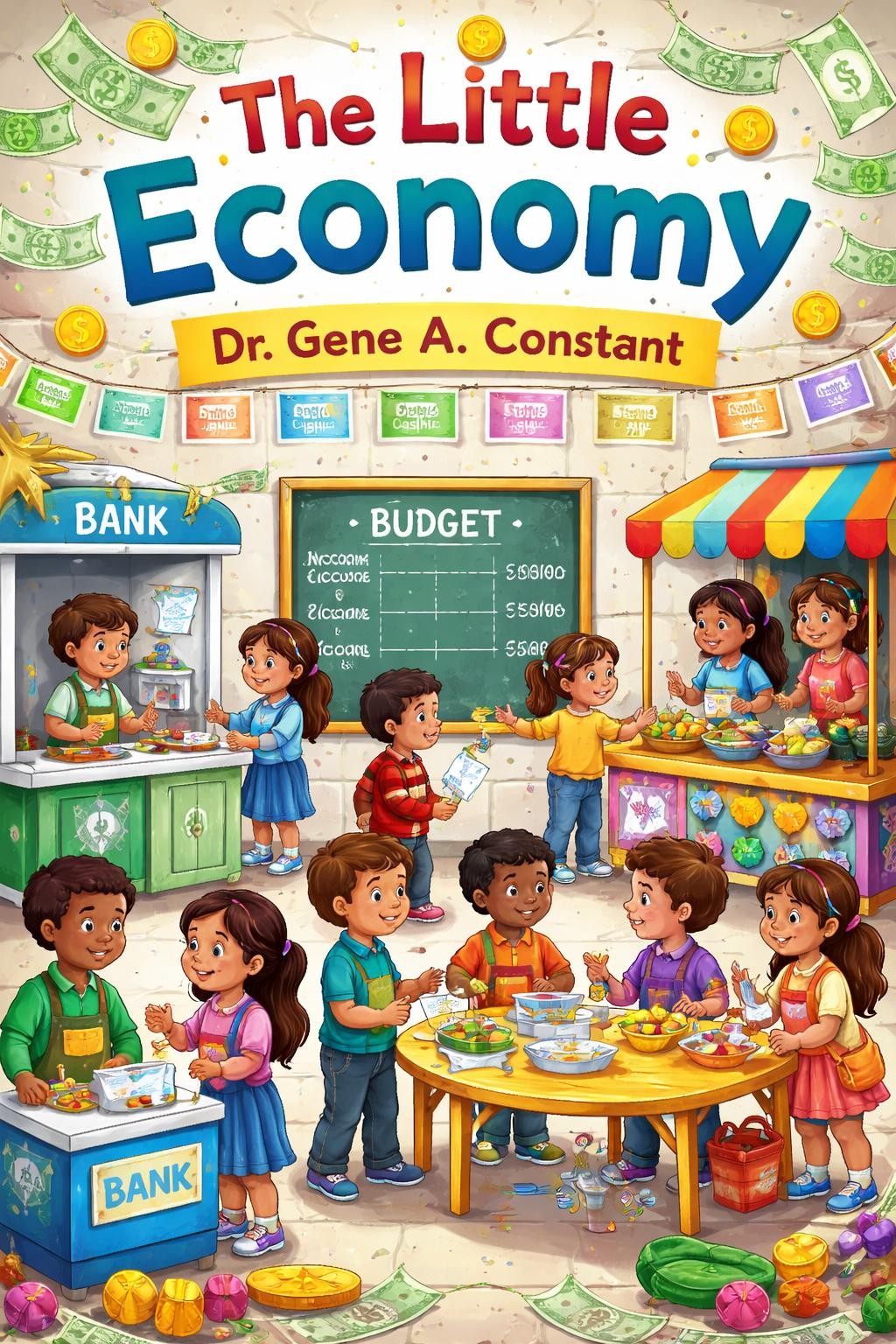
The Little Economy by Dr. Gene A Constant. This lesson is chapter 1, and the whole chapter is on this page. The book arrives in December 2026.
GSU is a 501(c)(3) nonprofit and book sales are its only income. This lesson is free and always will be.