Lesson 2 of 10 · Chapter 2
Mint Your Own Money
Room 12 designs its own money and makes it, one careful step at a time. In this lesson you learn what money needs to do, how to make it easy to use and hard to fake, why every bill needs two signatures, how a mint and a ledger work, and why money should be not a flood, not a drought.
Choose how you want to learn
You can change this any time. Press Listen on any part to hear it read aloud. Grown-ups: read along with younger children.
- 1 · What money needs to do
- 2 · Easy to use, hard to fake
- 3 · Designing trust
- 4 · Minting Day
- 5 · Not a flood, not a drought
- 6 · The whole chapter
- 7 · Try it at home
- 8 · Your card
- 9 · Check yourself
Part 1
What money needs to do
Today the class designs its own money.
Money works because everyone agrees to use it and trusts it.
Their money will be used to buy things, pay rent and bills, save, and pay fines.
Ms. Rivera explains that in a real country, money is something people agree on. It works because people trust it and all use the same system. Room 12 is going to build its own system.
First comes the name. Jasper wants “Jasper Bucks.” Mina suggests “River Notes,” after Ms. Rivera. Both are named after one person, and that can make it feel as if one person owns the whole economy. A good money name is easy to say, hard to twist into teasing, and belongs to everyone.
Lucas suggests Bridges, because everyone crosses a bridge. The class lists what money must do: buy, pay rent, pay bills, save at the bank, and pay fines.
“It works because we trust it, and because we all use the same system.”
“Naming is part of design.”
“Hard to twist into teasing. And they should belong to everyone.”
What is the money being used for? Tap the right job for each one.
Part 2
Easy to use, hard to fake
Good money has to be easy to use and hard to fake.
It also has to be fast to count.
And it should never become a way to brag.
Plain white paper is easy to copy or lose. Bright paper is easy to spot. Ms. Rivera draws three boxes: Easy to Use, Hard to Fake and Fast to Count. You want all three, but you have to balance them. If one bill takes ten minutes to make, the class would spend all year printing and no time earning.
The class picks safety features: a stamp, a serial number in the corner so the bank can check, and different colors for different values so counting is quick. Ones are blue, fives green, tens orange.
But colors let people see who has a ten, and that could lead to bragging. So the class adds a rule: money stays private in your desk envelope unless you are paying. Money is information, but it should not turn into a scoreboard. The values stay small and simple, 1, 5 and 10, instead of giant bills.
“If it’s too hard to fake, it might also be too hard to make.”
“Money is information. It tells you what you can afford. But it can also turn into a scoreboard if we let it.”
“Money design is not only paper. It’s behavior.”
Is each idea about being easy to use, hard to fake, or kind? Tap one.
Part 3
Designing trust
Each table group designs a practice bill, called a prototype.
Then the whole class votes on the real one.
Every real bill needs two signatures: one from the Mint and one from the Bank.
The class draws a bridge seal in a circle, matching the bridge on the road into Little Economy Land. It stands for connection, trading and working together. The Market Crier can announce: only bridge bills are real.
A mint is the place that makes money. To stop fakes, Theo and Imani suggest two-person verification: one person makes the bill, a different person checks and records it. If the banker is absent, the bank picks a backup. Systems need backups.
After every group presents, the class votes with their eyes closed, thinking about the promises. The winner: Bridges, with the bridge seal, values of 1, 5 and 10, a serial number, and two signature lines marked Mint and Bank.
“In our Little Economy, trust is not automatic. We build it.”
“Design is creative, but in a group economy, the final choice has to be shared.”
“You are designing trust.”
Who does each job on Minting Day? Tap the right person.
Part 4
Minting Day
Now the class becomes a mint and makes the money.
They follow the same steps every time.
Every bill is written in a ledger, a book that records money coming in and going out.
The steps are: Print, Count, Record, Sign, Store, Teach the rules. Mina stamps the bridge in the same corner every time, because then a missing stamp is easy to spot. Imani writes each bill’s serial number, value and date in the Bridges Ledger. The finished money goes into the Class Vault, a plastic box that only opens when two trusted people are there.
When a bill comes out smudged, Theo spots it. A misprint is torn up, and it is still written in the ledger, so nobody can sneak it back in later. Mistakes are expected. Systems keep mistakes from turning into unfairness.
Then the class learns the honesty rules: only the mint makes money; real money has a stamp, a serial number and two signatures; and found money goes to the bank, because it might belong to someone. A serial number only matters when it matches a record.
“Trust likes receipts.”
“A serial number is only powerful when it matches a record.”
“Mistakes are expected. Systems are what keep mistakes from turning into unfairness.”
Put the Minting Day steps in order. Tap the step that comes next.
Part 5
Not a flood, not a drought
Money is like water.
Too little, and everything dries up. Too much, and it floods the town.
The class chooses its pay, rent and bills so money keeps moving.
Minting is making the money. Issuing is putting it into the world. The vault is like a dam that holds the water until the class decides how much to let out.
If everyone had huge piles of money, sellers would raise prices, and the same money would buy less. That is called inflation, and it hurts savers most. If pay is too tiny, everyone spends every coin just to pay rent. Nobody can save, take a risk, or enjoy Market Day. The economy gets stuck.
The class votes on a starter plan: pay 6 Bridges a week, rent 2, bills 1. That leaves 3 Bridges a week to save or spend, which is enough for choices. Money also has to come back through rent, bills, Market Day and saving, or the vault runs dry. And the plan can be fixed later, because real economies watch what happens and adjust.
“Money is like water.”
“It means prices rise, and the same amount of money buys less.”
“Enough to move, not enough to flood.”
Try your own weekly plan. Find a drought, a flood, and a balanced plan.
Part 6
Read the whole chapter
Here is all of Chapter 2, “Mint Your Own Money”, exactly as the book tells it. Press Listen to hear it read aloud, or open it and read along.
Open Chapter 2 (about 30 minutes to read)
Part 7
Try it at home
Do these with your family. Tick each one when it is done.
Part 8
Your “Our Money Design” card
Fill it in, then print it for the fridge. Nothing you type here leaves this device.
Our Money Design
Global Sovereign University · The Little Economy, lesson 2
The honesty rules
- Only the mint makes money
- Real money has a stamp, a serial number and two signatures
- Found money goes to the bank
- Keep money private and safe
- Enough to move, not enough to flood
Part 9
Check yourself
7 questions. Pick an answer. If it is not right, read the hint and try again.
Lesson 2 complete.
You know what money needs to do, how to make it hard to fake, how a mint and a ledger build trust, and why money should flow like water, not flood or dry up. Next, everybody gets to work in Lesson 3, Everybody Works: Jobs for All. Find it on the class page.
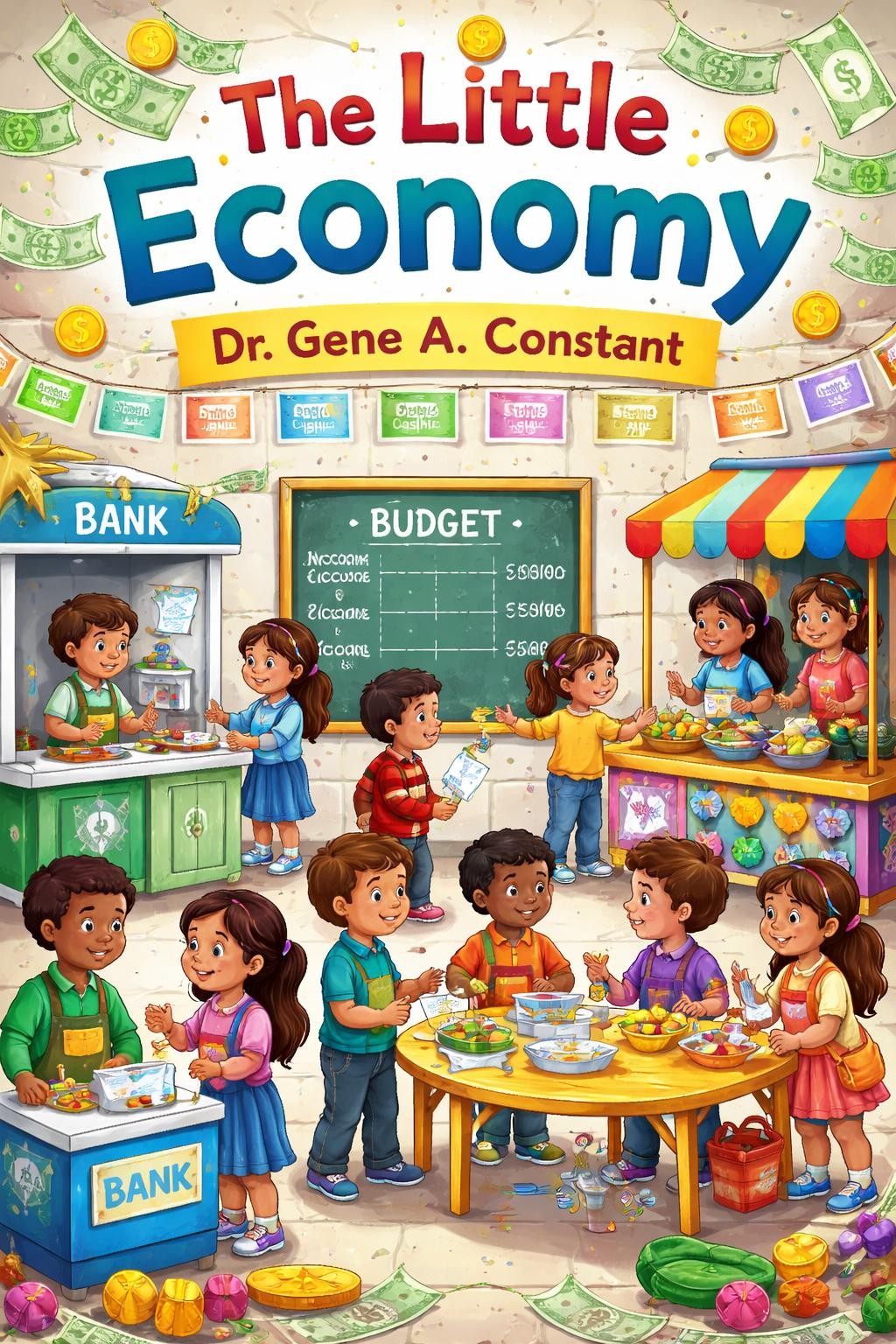
The Little Economy by Dr. Gene A Constant. This lesson is chapter 2, and the whole chapter is on this page. The book arrives in December 2026.
GSU is a 501(c)(3) nonprofit and book sales are its only income. This lesson is free and always will be.