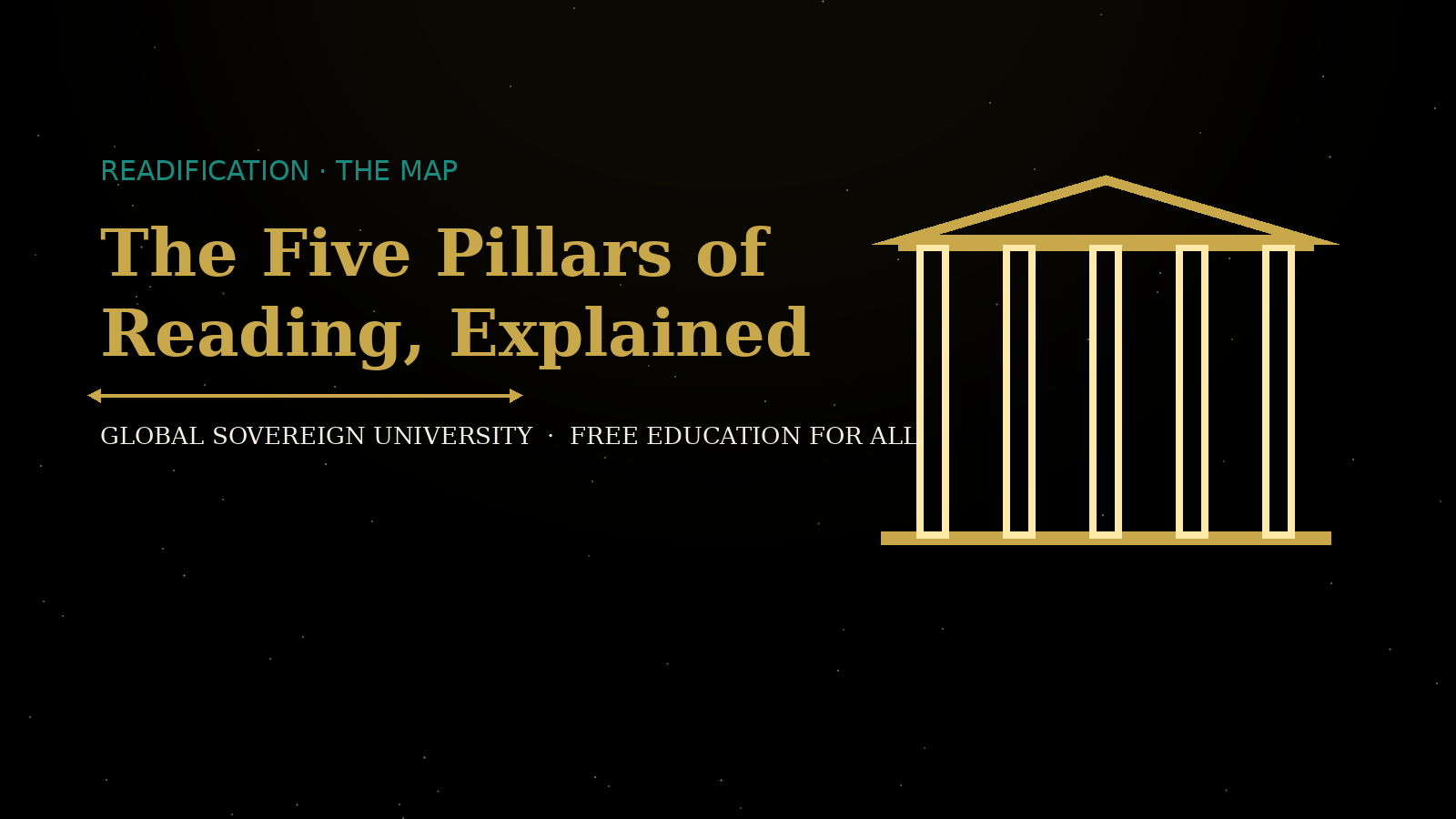
Reading looks like one skill from the outside — eyes move, meaning arrives. Inside, it is five distinct skills standing together like columns under one roof, and the science of reading has named them for decades: phonemic awareness, phonics, fluency, vocabulary, and comprehension. When a reader struggles, the cause is almost never "bad at reading." It is one specific pillar carrying less than its share — and a specific pillar can be rebuilt.
The five, in plain language
- Phonemic awareness — hearing the individual sounds inside spoken words, before letters are even involved. /c/ /a/ /t/ as three separable sounds.
- Phonics — the code: which letters and letter teams represent which sounds, so print can be turned into speech.
- Fluency — reading with speed, accuracy, and expression, so decoding stops consuming the mind's attention.
- Vocabulary — knowing what the words mean once you can say them.
- Comprehension — the roof the pillars hold up: questioning, connecting, and judging what the text actually says.
Why the order matters
Each pillar feeds the next. A child who cannot hear /sh/ as a sound cannot map it to letters; a reader who decodes laboriously has no attention left for meaning; a fluent reader with a thin vocabulary reads smoothly past words she cannot picture. Diagnosis, not effort, is the first act of teaching — find the weak column, strengthen it, and the whole roof rises.
Nobody is "bad at reading." They are under-served on one pillar — and pillars can be built at any age.
Walk the pillars at GSU
The Readification hub is GSU's free home for all five: each pillar has its instruction, its practice instruments, and its shelf of GSU titles (Kindle editions $3.99, with everything on the hub itself free). Over the next two weeks, this blog walks each pillar in depth — one column at a time, until the roof stands.






.jpeg)
.jpg)