Blog
Business

Markup Versus Margin: The Six-Dollar Sandwich

Blog Image

A café owner makes a breakfast sandwich for $4 in ingredients. She adds a 50 percent markup, sells it for $6, and tells herself the business makes 50 percent on every sandwich. She plans her rent, her payroll, and her own pay around that number.

She is wrong, and the mistake is not small. The business keeps $2 from every $6 sale. Two dollars divided by six dollars is about 33 percent, not 50. She has confused two different numbers that sound alike: markup and margin.

Two numbers, two different bases

    Same two dollars. Different denominator. And because every business plan is built on what is left from each sale, the denominator matters enormously.

    Why the error hurts

    Suppose the café needs $6,000 a month left over from sandwich sales to cover its share of rent, wages, and insurance. Planning on a 50 percent margin, the owner believes she needs $12,000 in sandwich sales. At the true 33 percent margin, she needs about $18,000. That is 50 percent more sales than her plan assumed for the same bills. If she does not find them, the gap comes out of her savings, her pay, or her suppliers' patience.

    The price may win the customer and lose the business.

    Working backward to the right price

    The fix is to start from the margin the business needs and work backward. If a product costs $10 and you need a 60 percent margin, the cost must be the remaining 40 percent of the selling price. So divide the cost by 40 percent:

    $10 ÷ 0.40 = $25

    Check it: $25 minus $10 leaves $15, and $15 divided by $25 is 60 percent. Exactly right.

    Now see what happens if you simply add 60 percent to the cost instead: $10 plus $6 is $16. Six dollars divided by $16 is only a 37.5 percent margin. The owner who "adds 60 percent" thinks she is earning 60 percent and is earning a little more than a third.

    A quick table to keep

      The general rule: price = cost ÷ (1 − target margin).

      Service businesses are not exempt.

      A tutor, a designer, or a handyman may think there is no "cost of goods," so the margin must be high. But time is the cost. If a job priced at $300 takes eight hours instead of the four you planned, your effective pay was cut in half. Track hours as carefully as a café tracks ingredients.

      Practice it for free.

      GSU's free Entrepreneurship page includes the Owner's Gauntlet, a set of owner decisions on pricing, margin and break-even with fresh numbers every round, so you cannot memorize your way through. For the math underneath, the Mathification hub rebuilds percentages from the ground up.

      The six-dollar sandwich is the opening example of Chapter 8, The Price of Value, in the forthcoming GSU book From Risk to Reward: Decoding the Entrepreneurial Mindset by Dr. Gene A Constant.

      Get the book on Amazon
      Blog

      Latest Updates and Insights

      The GSU Bookstore Is Open: Browse Every Title on One Shelf

      The new GSU Bookstore puts 288 book pages on one searchable shelf. Type a word, find the title, read the story behind it — free to browse, forever.

      Immersion Without the Headset: The GSU Manifesto

      The education industry says immersive learning requires a $500 VR headset. GSU's manifesto says otherwise: immersion is a design achievement, not a hardware purchase — and the proof already runs free on the phone in your pocket.

      How to Talk to GENO: Your Free AI Tutor, Explained in Plain English

      GENO is GSU's free 24/7 AI tutor, available in 83 languages with no login and no cost. This plain-English guide shows students, parents, seniors, and adult learners exactly how to talk to him — and get answers that actually teach.

      The Sea of Gold: Why the Heart of America Still Beats

      The traveler who crests a rise at harvest time and sees a wheat field stretched to the horizon understands something in the gut before the mind puts words to it. The gold is not just beautiful. It is the result of everything this book has traced.

      The Helix Climb: A Free Reading Game That Saves Itself

      GSU's newest Readification asset turns the seven elements of adult reading into a climbable helix: Bronze, Silver, Gold, Platinum — 84 questions deep, free, no login required to start, and your progress saves on the first click.

      Hours After GSU Named the Cap, Harvard Voted It In

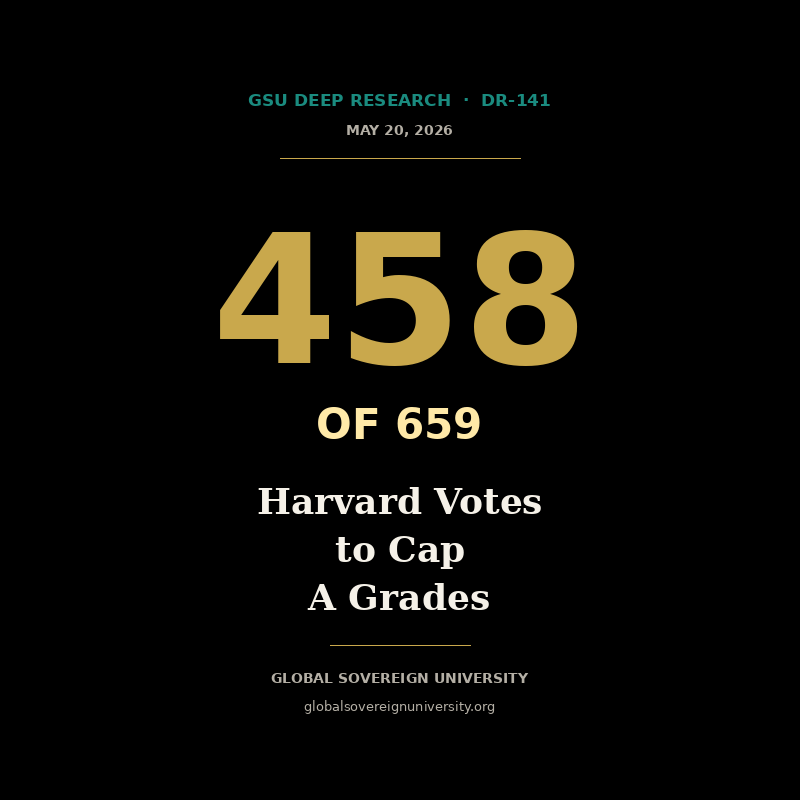
      GSU published DR-141 on the empirical collapse of the modern university. Hours later, Harvard faculty voted 458 of 659 to cap A grades at 20 percent of a course plus four. Same day. The institutions are now voting to confirm the case

      GSU and You: A Declaration to Serve the Billions the World Forgot'

      Global Sovereign University (GSU) was founded to provide free, accessible education to billions globally who have been failed by traditional systems, aiming to empower individuals regardless of their background, location, or past. It serves four key populations—the "Forgotten" elders, "Expectable" under-resourced students, citizens "Taken" by systems of dependency, and "Lost" souls seeking purpose—by connecting them through technology like its AI tutor GENO and a mentorship program, all while promoting self-reliance and verified competence over traditional diplomas. GSU sees itself not as a school, but as a "sovereign education ecosystem" committed to fostering individual independence and a quiet revolution of the human mind.

      The Great Education Exodus — And What It Means for the Future

      Something unprecedented is happening in American education. Parents are leaving traditional schools in record numbers—not out of apathy, but out of purpose. They are trading zip-code-assigned schooling for homeschooling, trade programs, and models that actually prepare children for real life. This isn't a crisis; it's a correction. Families are demanding education that teaches how to think, not just what to think.

      What Is a Civilization Builder? The Heart of Global Sovereign University

      Retired professionals with decades of experience are stepping forward to guide the next generation. We call them Civilization Builders—and they're changing lives one lesson at a time.