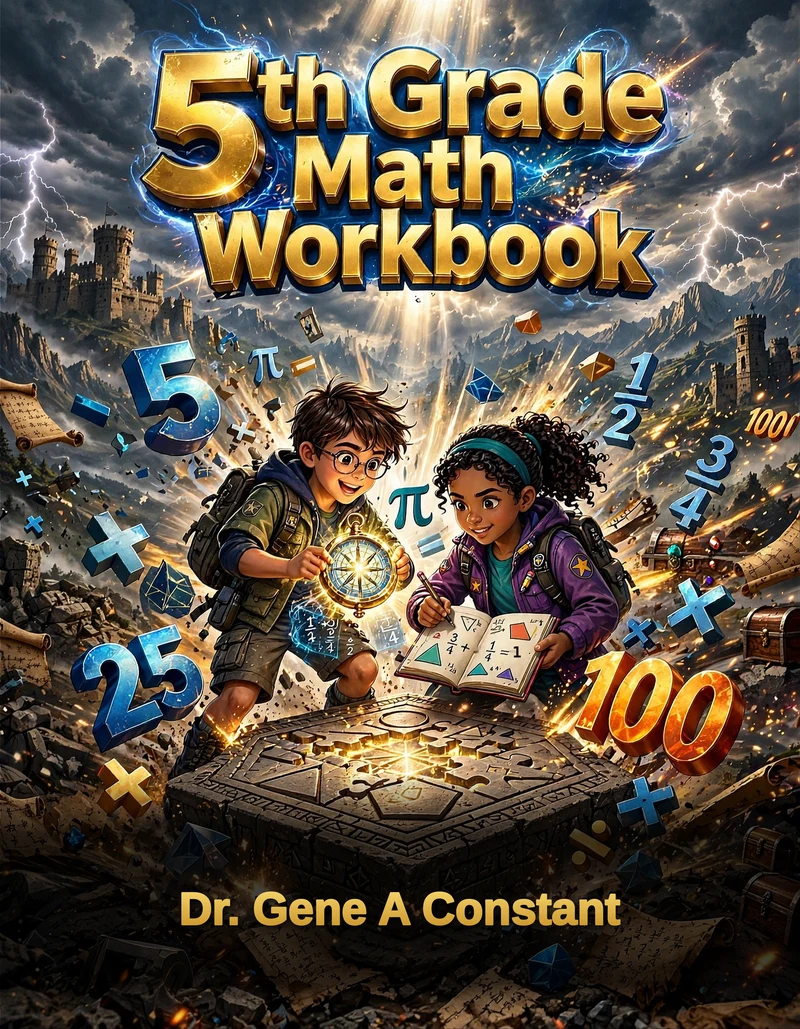
5th Grade Math Workbook: Real-World Problem Solving
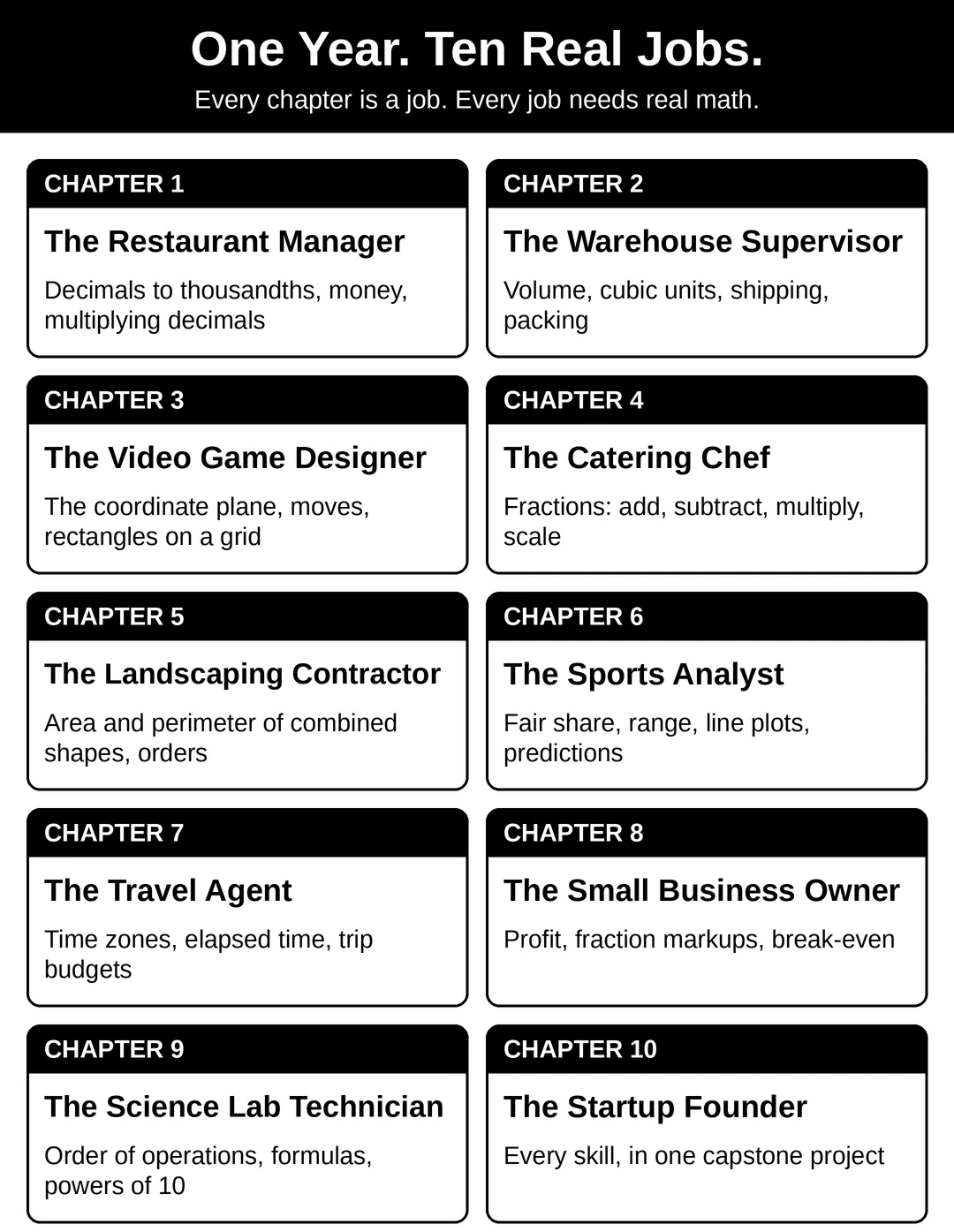
Ten real jobs. One year of fifth-grade math. Every problem has a reason.
A full year of fifth-grade math built around ten real jobs, from restaurant manager to startup founder: 667 problems with room to work every one, a complete answer key, and free online help.
Contents
Paperback, 144 pages, 8.5 x 11 inches, black and white, with 667 problems and a complete answer key.
Free With This Book · Welcome to Your Workbook · The Six Rooms · One Year. Ten Real Jobs. · Meet GENO
Chapter 1: The Restaurant Manager. You are promoted to manager of the family diner. You read supplier prices to the thousandth of a dollar, total the day's receipts, price bulk orders, and stretch into tips and taxes.
Chapter 2: The Warehouse Supervisor. You supervise a busy distribution center. You find the volume of boxes and storage bays, figure shipping costs by dimensional weight, and pack trucks without wasting space.
Chapter 3: The Video Game Designer. You design levels at a game studio. You place characters on a coordinate grid, track every move, measure distances along the grid lines, and draw safe zones and boundaries.
Chapter 4: The Catering Chef. You are head chef for a catering company. You combine ingredients with unlike denominators, figure leftovers, and scale recipes up for a 150-guest wedding and down for a small party.
Chapter 5: The Landscaping Contractor. You run a landscaping company planning a backyard makeover. You break odd-shaped yards into rectangles, measure edging and fencing, and turn square feet into pallets, bags and cubic yards.
Chapter 6: The Sports Analyst. You are the data analyst for a sports team. You find fair-share averages, spot consistent players and outliers, read line plots with fractions, and project season totals.
Chapter 7: The Travel Agent. You plan trips at a travel agency. You convert times between time zones, find arrival times for long flights, and total trip budgets in the thousands of dollars.
Chapter 8: The Small Business Owner. You open your own candle business. You find revenue, costs and profit, set prices with fractional markups and discounts, find your break-even point, and project a year of sales.
Chapter 9: The Science Lab Technician. You work in a science lab where precision is everything. You follow the order of operations, put values into formulas, and use powers of ten and growth patterns.
Chapter 10: The Startup Founder. In this capstone you launch an app company. You fund it, schedule a team across time zones, price the app, study your users, plan the office and project your first two years.
Extra Practice and Review · Math at Work: Real Cases and Teaching Cases · Math Dictionary · Practice These Words · Your Math Toolbox Card · Answer Key · The Grade Level Check · About the Author
Welcome to Your Workbook
This year, you become a problem solver who uses mathematics in the real world. Instead of pages of numbers that never go anywhere, you will take on ten real jobs: restaurant manager, warehouse supervisor, video game designer, catering chef, landscaping contractor, sports analyst, travel agent, small business owner, science lab technician and startup founder. Every job needs the same thing from you: careful, honest math.
How to Use This Book
Each chapter is one job. It opens with The Scenario, which puts you in the role, and The Skill, which explains the mathematics. Worked Examples, in outlined boxes, show every step of a solution, and the Practice problems give you room to work each one. Every chapter ends with an Action Report that pulls its skills together. A few sections are marked Stretch. They reach a little beyond fifth grade, so try them when you are ready, and ask a grown-up or GENO for help.
How to Show Your Work
Every problem has a box for your work. Use it! The process matters as much as the answer, because it is how you find your own mistakes. Step 1, Read Carefully: what information is given, and what are you trying to find? Step 2, Plan: which operation or formula will you use? Step 3, Calculate: work neatly and line up your digits and decimal points. Step 4, Check: does the answer make sense, and did you write the unit?
For Grown-Ups
The Answer Key at the back gives every answer to every problem, and every one was computed by computer from the numbers printed in the problems. The Free With This Book page opens a free campus with games, a refresher class and GENO, our free tutor. The Grade Level Check at the back of the book is a free, private way to see where your child is in reading and math.
Chapter 1: The Restaurant Manager
Chapter Goal: Use decimals to thousandths and money math to run a busy diner.
Congratulations! You have just been promoted to Restaurant Manager at the family diner. Every day you will read food costs to three decimal places, total the day's receipts, price bulk orders, and set menu prices. One decimal point in the wrong place can turn a profit into a loss, so careful decimal work is the most important skill a manager has.
Section 1: Reading the Receipts: Decimals to Thousandths
The Scenario. Your food supplier sends invoices with prices to the thousandth of a dollar. Coffee beans cost $7.425 per pound. Cooking oil costs $3.875 per gallon. Reading these precise decimals helps you track costs and spot errors.
The Skill: Decimal Place Value. Place value continues to the right of the decimal point. The first place is tenths (0.1), the second is hundredths (0.01), and the third is thousandths (0.001). In money, hundredths are cents, and a thousandth of a dollar is a tenth of a cent. To compare decimals, line up the decimal points and compare digits from left to right. To round to the nearest cent, look at the thousandths digit: 5 or more rounds up, 4 or less rounds down.
Worked Example: Understanding $7.425. 7 is in the ones place: $7.00 4 is in the tenths place: $0.40 2 is in the hundredths place: $0.02 5 is in the thousandths place: $0.005, half a cent Total: $7.00 + $0.40 + $0.02 + $0.005 = $7.425 Buy 100 pounds and that half cent becomes 50 cents!
Worked Example: Comparing $3.875 and $3.85. Line up the decimal points: 3.875 and 3.850. Ones: both 3. Tenths: both 8. Hundredths: 7 is greater than 5. Answer: $3.875 > $3.85, so Supplier A is more expensive.
Worked Example: Rounding $4.627 to the Nearest Cent. The nearest cent is the nearest hundredth. The thousandths digit is 7, which is 5 or more, so round up. Answer: $4.627 rounds to $4.63.
Worked Example: Writing $12.345 in Expanded Form. 12.345 = 10 + 2 + 0.3 + 0.04 + 0.005 Or: (1 × 10) + (2 × 1) + (3 × 0.1) + (4 × 0.01) + (5 × 0.001)
Practice: Decimal Place Value
- What is the value of the 6 in $45.678?
- Write 23.456 in expanded form.
- Round $7.834 to the nearest cent.
- Compare using <, >, or =: 5.67 ___ 5.670
- What digit is in the thousandths place of 12.345?
- Round $9.999 to the nearest cent.
- Order from least to greatest: 4.52, 4.502, 4.520, 4.052
- Write in standard form: 8 + 0.3 + 0.05 + 0.007
- Compare using <, >, or =: 6.125 ___ 6.15
- Round $12.5849 to the nearest cent.
- What is the value of the 9 in 34.789?
- Order from greatest to least: 7.08, 7.008, 7.8, 7.080
- Write 156.025 in expanded form.
- Round $0.9995 to the nearest cent.
- Compare using <, >, or =: 0.305 ___ 0.350
- Coffee costs $8.457 per pound and tea costs $8.475 per pound. Which costs less?
- What digit is in the hundredths place of 67.891?
- Round 45.6789 to the nearest tenth.
Section 2: Daily Totals: Adding and Subtracting Decimals
The Scenario. At closing time you total the day's receipts. The lunch shift earned $1,234.56 and the dinner shift earned $2,456.78. You also subtract expenses: $345.67 for a food delivery and $123.45 for supplies.
The Skill: Line Up the Decimal Points. When you add or subtract decimals, line up the decimal points so tenths sit under tenths and hundredths under hundredths. If the numbers have different numbers of decimal places, write zeros at the end so every number has the same number of places. Then add or subtract column by column from right to left, regrouping as you do with whole numbers.
Worked Example: Adding $1,234.56 + $2,456.78. Line up the decimal points and add from right to left. Answer: $3,691.34
Worked Example: Adding Different Decimal Places: 45.6 + 23.45 + 8.125. Write zeros so each number has three places: 45.600 + 23.450 + 8.125 Answer: 77.175
Worked Example: Subtracting $500.00 − $123.45. Line up the decimal points. Regroup across the zeros. Answer: $376.55
Worked Example: Finding the Day's Net Revenue. Revenue: $3,691.34 Expenses: $345.67 + $123.45 = $469.12 Net: $3,691.34 − $469.12 = $3,222.22
Practice: Adding and Subtracting Decimals
- Add: 45.67 + 23.456
- Add: 123.4 + 56.78 + 9.012
- Subtract: 500.00 − 234.56
- Lunch sales were $1,567.89 and dinner sales were $2,345.67. What were the total sales?
- Add: 7.8 + 12.34 + 0.567
- Subtract: 1,000 − 456.789
- Food costs were $234.56, $178.90 and $345.67. What was the total?
- Revenue was $3,456.78 and expenses were $1,234.56. What was the net revenue?
- Add: 0.125 + 0.875 + 0.5
- Subtract: 250.00 − 67.89
- Three orders cost $12.45, $8.90 and $15.67. What is the total?
- The budget is $2,500. You spent $1,678.45. How much remains?
- Add: 99.99 + 88.88 + 77.77
- Subtract: 1,234.567 − 890.123
- Sales were $1,234.56 on Monday, $1,456.78 on Tuesday and $1,345.67 on Wednesday. What was the total?
- You had $5,000. You paid expenses of $456.78, $234.56 and $789.12. How much remains?
- Add: 6.7 + 8.91 + 2.345
- Subtract: 10,000 − 4,567.89
Section 3: Bulk Orders: Multiplying Decimals
The Scenario. You order 24.5 pounds of chicken at $4.25 per pound. How much will it cost? Multiplying decimals precisely is essential for accurate ordering.
The Skill: Multiplying Decimals. Multiply as if there were no decimal points. Then count the total number of decimal places in both factors, and place the decimal point in the answer so it has that many places. Estimate first so you can tell whether the answer makes sense.
Worked Example: Multiplying 24.5 × $4.25. Step 1: Multiply as whole numbers: 245 × 425 = 104,125. Step 2: Count decimal places: 1 (in 24.5) + 2 (in 4.25) = 3. Step 3: Place the decimal point 3 places from the right: 104.125. Answer: $104.125, which a bill rounds to $104.13. Estimate check: 25 × 4 = 100, so about $100 makes sense.
Worked Example: Multiplying a Whole Number by Money: 15 × $6.75. 15 × 675 = 10,125. Two decimal places. Answer: $101.25
Worked Example: Multiplying Two Decimals: 2.5 × 3.4. 25 × 34 = 850. Decimal places: 1 + 1 = 2. Answer: 8.50, which is 8.5
Worked Example: A Weekly Beef Order: 45.5 pounds at $5.85 per pound. 455 × 585 = 266,175. Decimal places: 1 + 2 = 3. 266.175, so the cost is $266.18 rounded to the nearest cent.
Practice: Multiplying Decimals
- Multiply: 3.4 × 5.6
- Multiply: 12.5 × 4
- You buy 24 pounds at $3.75 per pound. What is the total cost?
- Multiply: 0.25 × 0.4
- Multiply: 15.5 × 2.5
- You order 36 gallons at $2.45 per gallon. What is the cost?
- Multiply: 8.125 × 8
- Multiply: 4.5 × 4.5
- You order 18.5 pounds of chicken at $4.25 per pound. What is the cost, to the nearest cent?
- Multiply: 0.6 × 0.7
- Multiply: 6.25 × 3.2
- A cook works 28.5 hours at $12.50 per hour. What does the cook earn?
- Multiply: 2.5 × 2.5 × 2.5
- You order 55 gallons of oil at $3.875 per gallon. What is the cost?
- Multiply: 0.125 × 80
- Multiply: 100 × 0.065
- Multiply: 1,000 × 0.437
- Multiply: 3.75 × 0.1
Section 4 (Stretch): Tips and Taxes with Percents
Stretch section. Percents are usually taught in 6th grade. Everything here uses the decimal skills from Section 3, so give it a try, and ask a grown-up or GENO if you get stuck.
The Scenario. A customer's bill is $85.00. They want to leave a 20% tip, and the sales tax is 8%. You need the tip, the tax and the total.
The Skill: Percent Means Per Hundred. Percent means per hundred. To change a percent to a decimal, divide by 100, which moves the decimal point two places to the left: 20% = 0.20, 8% = 0.08, 15% = 0.15. To find a percent of an amount, multiply the amount by that decimal. A quick way to find 10% is to move the decimal point one place to the left. Then 5% is half of 10%, and 20% is double 10%.
Worked Example: A 20% Tip on $85.00. 20% = 0.20 $85.00 × 0.20 = $17.00
Worked Example: 8% Tax on $85.00. 8% = 0.08 $85.00 × 0.08 = $6.80
Worked Example: The Total Bill. Food: $85.00 Tax (8%): $6.80 Tip (20% of the food): $17.00 Total: $108.80
Worked Example: The 15% Shortcut on $60. 10% of $60 = $6.00 (move the decimal one place left). 5% is half of that: $3.00. 15% = $6.00 + $3.00 = $9.00
Practice (Stretch): Percents, Tips and Tax
- Change 25% to a decimal.
- Change 7.5% to a decimal.
- Find 20% of $45.00.
- Find a 15% tip on $80.00.
- Find 8% tax on $125.00.
- The bill is $65. Find an 18% tip.
- Change 6.25% to a decimal.
- Find 10% of $234.50.
- The food is $95.00, tax is 8% and the tip is 20% of the food. What is the total?
- Find 25% of $180.00.
- The food costs $120 and tax is 7%. What is the total with tax?
- Use the shortcut to find 15% of $55.00.
- The bill is $78.50. Find a 20% tip.
- Change 0.5% to a decimal.
- Find 6% tax on $450.00.
- A server earned $156 in tips on $780 in sales. What percent was that? (Hint: 10% of $780 is $78.)
Chapter 1 Action Report: The Restaurant's Daily Summary
Complete this manager's end-of-day report using all of your Chapter 1 skills.
Action Report
- Revenue: breakfast $567.89, lunch $1,234.56 and dinner $2,345.67. What was the total revenue?
- Round the total revenue to the nearest dollar.
- Yesterday's revenue was $4,102.50. Which day earned more, yesterday or today?
- You ordered 35.5 pounds of beef at $6.75 per pound. What was the cost, to the nearest cent?
- You ordered 28 pounds of chicken at $4.125 per pound. What was the cost?
- The produce deliveries cost $234.56, $178.90 and $145.67. What was the total?
- Stretch: Table 5's food bill was $145.00. Find the 8% tax.
- Stretch: Table 5 left a 20% tip on the food. How much was the tip?
- Stretch: What did Table 5 pay in all (food + tax + tip)?
- Total expenses for the day were $1,567.89. Using today's total revenue, what was the net profit?
The answers to every problem, and Chapters 2 through 10, are in the book.