New Book · Privacy & Security
The Privacy Blueprint
Shielding Yourself and Those You Love
Your address, phone number, birthday and relatives are scattered across hundreds of places, and companies are paid to put the pieces together. This is a calm, step-by-step plan for taking that profile apart and keeping it from coming back.
DR. GENE A CONSTANT, DBA · REVISION 2
CALIFORNIA RESIDENTS: ONE REQUEST, EVERY REGISTERED DATA BROKER
Since January 1, 2026, California residents can use DROP, the state’s free Delete Request and Opt-out Platform, to send a single deletion request to every data broker registered with the state. Since August 1, 2026, those brokers have been required to check the platform at least every 45 days and act on the requests waiting for them.
It does not reach companies that are not registered brokers, and it does not remove public records, so the rest of the plan still matters. Go straight to the official source, not an ad or a paid filing service:
Twelve Chapters. One Blueprint.
From exposed by default to protected by default.
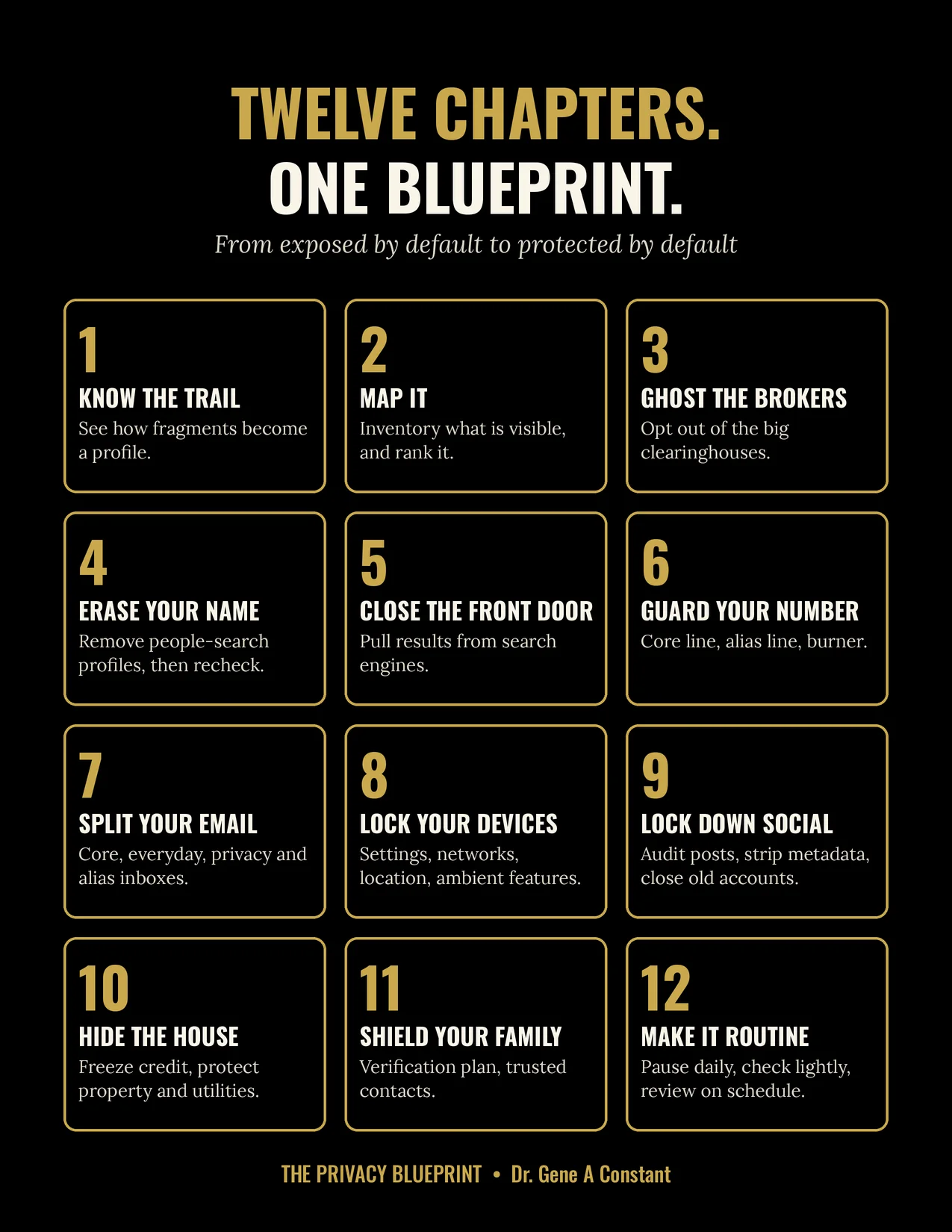
What’s Inside
Each chapter is one layer of protection. Work through them in order, or start where your exposure is worst.
The Anatomy of Exposure
Privacy rarely disappears in one dramatic event; it leaks away in ordinary fragments that others connect into a profile. The goal is control, not secrecy.
Mapping Your Digital Footprint
Before removing anything, build an inventory of what is visible and where, and turn a vague worry into a prioritized map.
The Ghost Protocol: Data Brokers Part I
Reach the major data clearinghouses, use your privacy rights, and weaken the connections they sell.
Erasing Your Name: Data Brokers Part II
Remove people-search profiles, document reappearances, and keep them from rebuilding.
Taking Back Search Results
Use removal tools, learn the difference between de-indexing and deletion, and work on results and sources at once.
Communication Sovereignty
A protected core line, alias and temporary numbers, and verification habits that keep urgency from winning.
Compartmentalized Email Protocols
Separate a protected core inbox from everyday, privacy and alias addresses so no single account maps you.
Fortifying Your Devices
Lock down settings, networks, location and ambient features so your devices follow your choices.
The Social Media Lockdown
Audit old posts, tighten audiences, strip photo metadata, and close the legacy accounts behind you.
Financial and Real Estate Opacity
Public records, credit freezes, account protections, and the quiet household systems that expose an address.
Securing Those You Love
A family system for children, elderly relatives and partners, with trusted contacts and a plan for when something goes wrong.
The Daily Sovereign Routine
A daily pause, a light regular check, and scheduled reviews that keep you protected by default.
Start Today: The Daily Pause
Before you answer an unexpected call, message, account alert, friend request, payment request or login prompt, ask three questions from Chapter 12:
Real Cases Behind the Plan
The book closes with four real, sourced cases, plus three teaching cases made up for practice.
The Broker Who Sold an Address
The 1999 Amy Boyer case and the 2003 New Hampshire ruling that a data broker owes a duty of care to the people it sells.
The Judge’s Front Door
How a home address found online led to a 2020 attack on a federal judge’s family, and the 2022 federal law that followed.
The Map Made of Morning Runs
How a 2017 fitness heat map, built from ordinary workouts, revealed military bases around the world.
The Account That Unlocked Everything
How a writer lost his devices, email and family photos in 2012 through linked accounts and weak recovery.
The Book
- 12 chapters, 180 pages, 8.5 x 11 paperback, Revision 2
- The Six Rooms introduction and the twelve-step blueprint
- Four real case studies and three teaching cases
- A 30-term privacy dictionary
- A tear-out Daily Sovereign Routine card and a Removal Log page
Paperback coming soon through IngramSpark. Have a question about protecting your information? Ask GENO, our free tutor.
Want the research behind the book? Read DR-153: The Privacy Landscape in 2026, our free research paper on what changed in 2025 and 2026.
Global Sovereign University is a 501(c)(3) nonprofit and book sales are its only income. A purchase is not a tax-deductible donation.