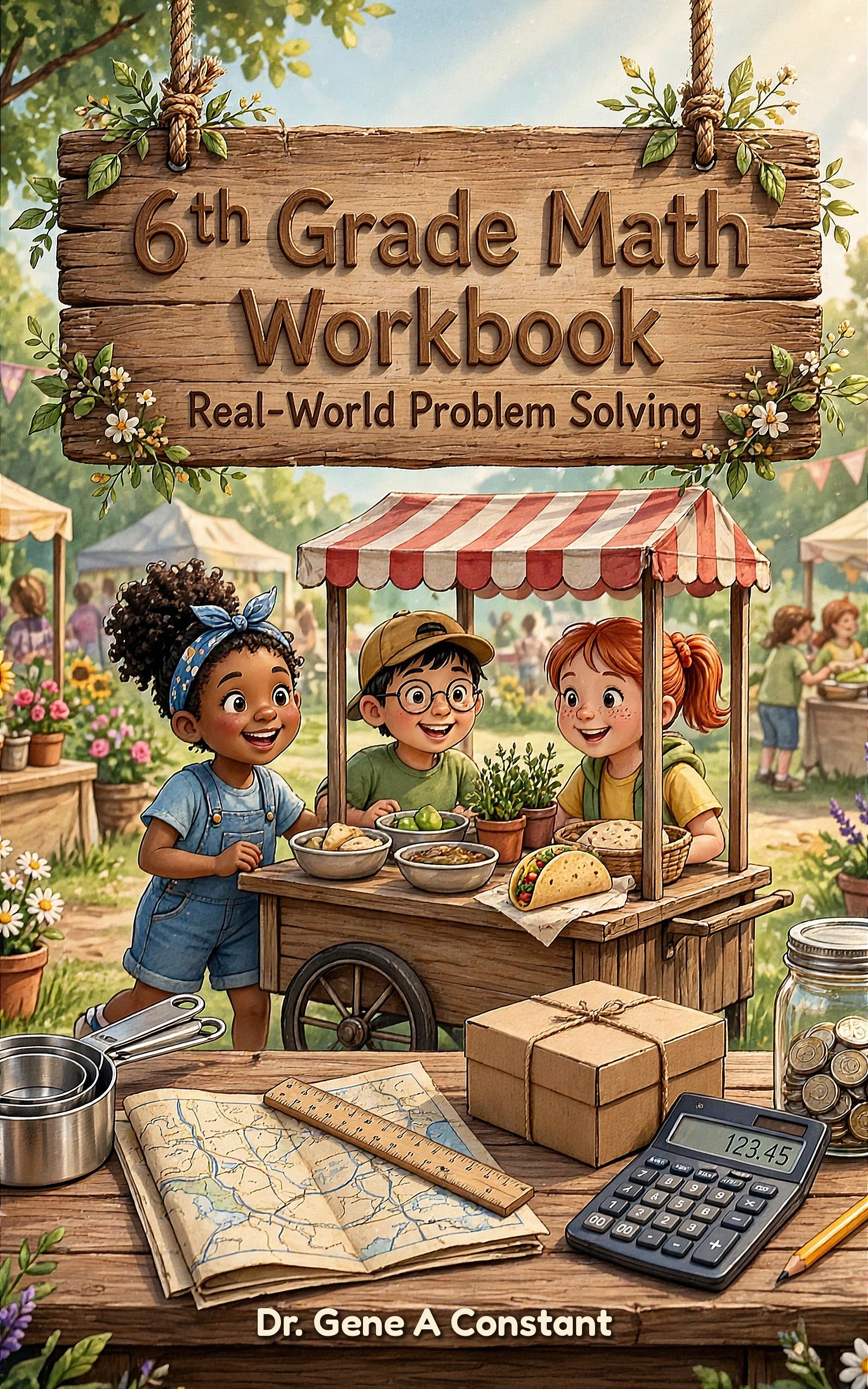
6th Grade Math Workbook: Real-World Problem Solving
Ten real jobs. One year of sixth-grade math. Every problem has a reason.
A full year of sixth-grade math built around ten real jobs, from nutritionist to entrepreneur: 353 problems with room to work every one, a complete answer key, ten free lesson plans and a free online class.
Contents
Paperback, 150 pages, 8.5 x 11 inches, black and white, with 353 problems and a complete answer key.
Free With This Book · Welcome to Your Workbook · The Six Rooms · One Year. Ten Real Jobs. · Meet GENO · Your Badge Chart · A Parent’s Guide
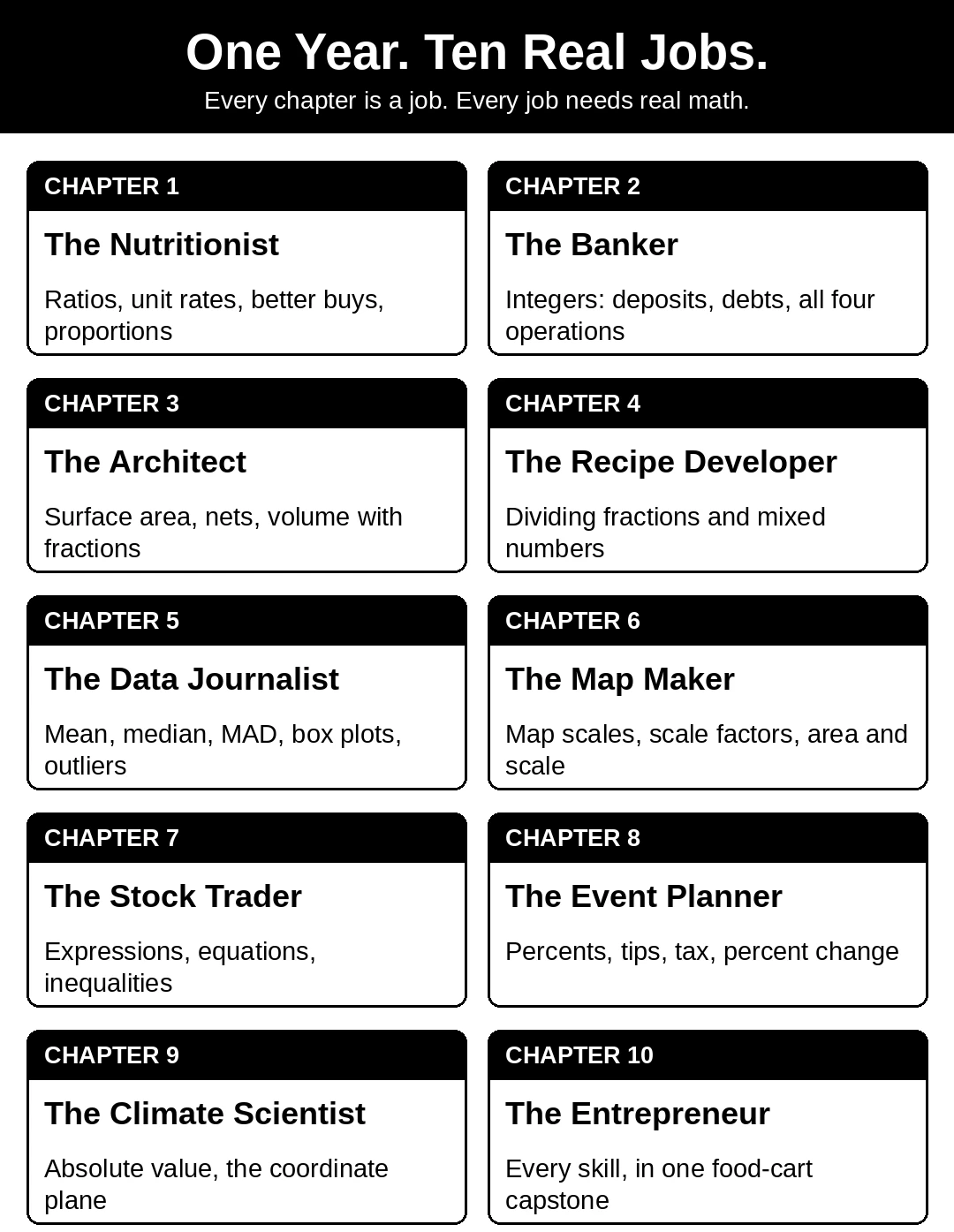
Chapter 1: The Nutritionist. Compare amounts with ratios, find unit rates and better buys, and solve proportions to scale a meal plan up or down.
Chapter 2: The Banker. Read negative numbers as debts and withdrawals. Order integers on a number line, then add, subtract, multiply and divide them to keep an account balanced.
Chapter 3: The Architect. Find the surface area of rectangular prisms, read and draw nets, and find volume when the edges are fractions.
Chapter 4: The Recipe Developer. Divide fractions by whole numbers, by other fractions and by mixed numbers, and use division to find servings, portions and batches.
Chapter 5: The Data Journalist. Find the mean, median, mode and range, measure spread with the mean absolute deviation, and build a five-number summary for a box plot.
Chapter 6: The Map Maker. Read and write map scales, find missing lengths in similar figures with a scale factor, and see why area grows by the square of the scale factor.
Chapter 7: The Stock Trader. Turn words into algebraic expressions, evaluate expressions by substitution, solve one-step equations and write and solve one-step inequalities.
Chapter 8: The Event Planner. Find a percent of a number, find the whole when you know a part and its percent, and find the percent increase or decrease between two amounts.
Chapter 9: The Climate Scientist. Find absolute value, compare and order rational numbers, plot points in all four quadrants and find distances between points on the coordinate plane.
Chapter 10: The Entrepreneur. Use ratios, integers, percents, algebra, geometry and statistics together to plan, launch and judge a small business.
Extra Practice · Mixed Reviews · Final Mastery Check · Math at Work: Real Cases and Teaching Cases · Barter Math and the Barter Club · Math Dictionary · Practice These Words · Your Math Toolbox Card · Answer Key · The Grade Level Check · About the Author
Free Grade 6 Class
The free Grade 6 Mathematics class teaches all ten chapters of this book online. A child can read each lesson or press Listen to hear it, open the worked examples one step at a time, and finish with five quick questions that give a hint and another try. No account is needed, and progress stays on your own device.
Free Lesson Plans for This Book
Ten free, downloadable lesson plans, one for each chapter. Each is a 45-minute lesson written word for word for the parent, with a hands-on hook, a worked example to do together, five solo problems with answers, a next-day review, and a free GSU game or GENO prompt to hand off the teaching. You do not need to be a math person to teach them.
- Lesson 1: The Balanced Plate · Ratios, unit rates and proportions (PDF)
- Lesson 2: Below Zero at the Bank · Integers and integer operations (PDF)
- Lesson 3: Wrap It and Fill It · Surface area, nets and volume (PDF)
- Lesson 4: How Many Scoops? · Dividing fractions and mixed numbers (PDF)
- Lesson 5: The Honest Headline · Mean, median, MAD and box plots (PDF)
- Lesson 6: Shrinking the World · Scale drawings and scale factors (PDF)
- Lesson 7: The Sealed Jar · Expressions, equations and inequalities (PDF)
- Lesson 8: The Party Budget · Percents and percent change (PDF)
- Lesson 9: Above and Below Zero · Absolute value and the coordinate plane (PDF)
- Lesson 10: Your Own Food Cart · Every Grade 6 skill in one business (PDF)
Welcome to Your Workbook
This year, you become a problem solver who uses mathematics in the real world. Instead of pages of numbers that never go anywhere, you will take on ten real jobs: nutritionist, banker, architect, recipe developer, data journalist, map maker, stock trader, event planner, climate scientist and entrepreneur. Every job needs the same thing from you: careful, honest math.
How to Use This Book
Each chapter is one job. It opens with The Scenario, which puts you in the role, then teaches the skill one section at a time. Worked Examples show every step of a solution, and the Practice problems give you room to work each one. Every chapter ends with an Action Report: one real assignment that uses the whole chapter. Chapter 10 is a capstone: you plan, budget, design and run your own food cart.
For Grown-Ups
The Answer Key at the back gives every answer to every problem, and every answer was checked by computer. A one-page Parent’s Guide gives an open-and-go, 36-week plan. The Grade Level Check at the back of the book is a free, private way to see where your child is in reading and math.
Chapter 1: The Nutritionist
Build balanced meal plans with ratios, unit rates and proportions
The Healthy Living Clinic helps families eat better on a real budget. Every client gets a meal plan with the right balance of protein, carbohydrates and fat, a shopping list that does not waste money, and recipes sized for the people at the table. The clinic’s nutritionist is on vacation for the month. You are the nutritionist now, and the first client walks in this morning.
What you will learn: write a ratio three ways and simplify it; find a unit rate; decide which of two packages is the better buy; solve a proportion; scale a recipe or plan up and down.
Why this matters. A ratio is a rule that stays true as things grow or shrink. A meal that is two parts protein to three parts carbohydrates keeps that balance whether it feeds one person or forty. The same thinking finds the cheaper box of cereal, the right dose for a patient’s weight and the right amount of rice for a family of six.
Section 1.1: Understanding Ratios
A ratio compares two amounts. If a meal has 30 grams of protein and 45 grams of carbohydrates, the ratio of protein to carbohydrates is 30 to 45. You can simplify a ratio the same way you simplify a fraction: divide both numbers by their greatest common factor.
Key idea. Three ways to write a ratio: 30 to 45 · 30:45 · 30/45 · 30:45 simplifies to 2:3 (divide both numbers by 15) · Order matters: protein to carbs (2:3) is not the same as carbs to protein (3:2)
Worked Example: A Three-Part Ratio. A patient’s lunch has 40 g protein, 60 g carbohydrates and 20 g fat. Write the ratio: 40:60:20. The greatest common factor of 40, 60 and 20 is 20. Divide each number by 20: 2:3:1. For every 1 gram of fat, the lunch has 2 grams of protein and 3 grams of carbohydrates.
Practice
- A salad has 4 cups of lettuce and 2 cups of spinach. What is the ratio of lettuce to spinach in simplest form?
- A protein shake has 25 g protein and 35 g carbohydrates. Write the ratio of protein to carbohydrates in simplest form.
- A client eats 2,400 calories a day: 600 from protein, 900 from carbohydrates and 900 from fat. Write the ratio of protein to carbohydrates to fat in simplest form.
- A breakfast plate has 2 eggs, 3 strips of bacon and 4 pieces of toast. Write the ratio of eggs to bacon to toast. Can it be simplified?
- A healthy ratio of omega-3 to omega-6 fats is about 1:4. A client eats 8 g of omega-6. How much omega-3 should go with it?
Section 1.2: Unit Rates
A rate compares two different kinds of amounts, like calories and servings or dollars and pounds. A unit rate tells how much for ONE: one serving, one ounce, one hour. The word per always signals a rate.
Key idea. Unit rate = total amount ÷ number of units · Examples: 30 grams per ounce · 15 calories per minute · $3 per bar
Worked Example: Protein per Ounce. A 24-ounce tub of protein powder holds 720 grams of protein. Divide the total by the number of ounces: 720 ÷ 24. 720 ÷ 24 = 30. The powder has 30 grams of protein per ounce.
Practice
- A box of 12 protein bars costs $36. What is the cost per bar?
- A 6-ounce chicken breast has 42 grams of protein. How many grams of protein per ounce?
- A meal delivery service sends 21 meals for $189. What is the cost per meal?
- A runner burns 2,400 calories during a 3-hour race. How many calories per hour?
- A client walks 4.5 miles in 90 minutes. What is the speed in miles per hour?
Section 1.3: Solving Proportions
A proportion says that two ratios are equal. To find a missing number, you can scale one ratio up to match the other, or cross-multiply: if a/b = c/d, then a × d = b × c.
Key idea. a/b = c/d means a × d = b × c · Set up both ratios in the same order: oats/servings = oats/servings
Worked Example: Scaling a Dose. A dose is 5 mg for every 20 pounds of body weight. How much for a 140-pound patient? Set up the proportion: 5/20 = x/140. Cross-multiply: 5 × 140 = 20 × x, so 700 = 20x. Divide both sides by 20: x = 35. The patient gets 35 mg.
Practice
- A smoothie recipe uses 2 bananas for 3 servings. How many bananas for 12 servings?
- 4 ounces of chicken has 28 g of protein. How much protein is in 10 ounces?
- 3 cups of flour make 24 cookies. How many cups of flour make 40 cookies?
- 6 eggs cost $2.40. How much do 15 eggs cost at the same price?
- 100 grams of pasta has 350 calories. How many calories are in 175 grams?
Section 1.4: Better Buys and Bigger Batches
When two packages are different sizes, compare their unit prices. The lower price per unit is the better buy, as long as you will really use it all. To feed more people, scale every amount by the same factor.
Worked Example: Which Vitamins Cost Less?. Brand A: 20 vitamins for $15. Brand B: 50 vitamins for $35. Brand A: $15 ÷ 20 = $0.75 per vitamin. Brand B: $35 ÷ 50 = $0.70 per vitamin. Brand B is the better buy by 5 cents a vitamin.
Practice
- Which is the better buy: 6 ounces of almonds for $4.50 or 10 ounces for $7.00?
- A recipe feeds 6 people with 1.5 pounds of meat. How much meat feeds 10 people?
- The ratio of water to rice is 2:1. How much water do you need for 3.5 cups of rice?
- A client burns 3 calories per minute walking. How many minutes to burn 225 calories?
- A heart beats 72 times per minute. How many beats is that in 2.5 hours?
Chapter 1 Action Report: The Clinic Meal Plan
Your first client is training for a long walk across her state. She needs a plan she can follow and afford.
- Her plan uses a protein to carbohydrate to fat ratio of 3:4:1. She eats 45 g of protein at lunch. How many grams of carbohydrates and of fat go with it?
- Protein powder A costs $45 for 30 servings. Powder B costs $38 for 25 servings. Which is the better value per serving?
- A quinoa recipe makes 8 portions with 2 cups of quinoa. She is cooking for a 20-person celebration. How many cups of quinoa?
- Groceries cost $4.50 per meal. She eats 3 meals a day for 7 days. What is her weekly food budget?
The answers to every problem, and Chapters 2 through 10, are in the book.