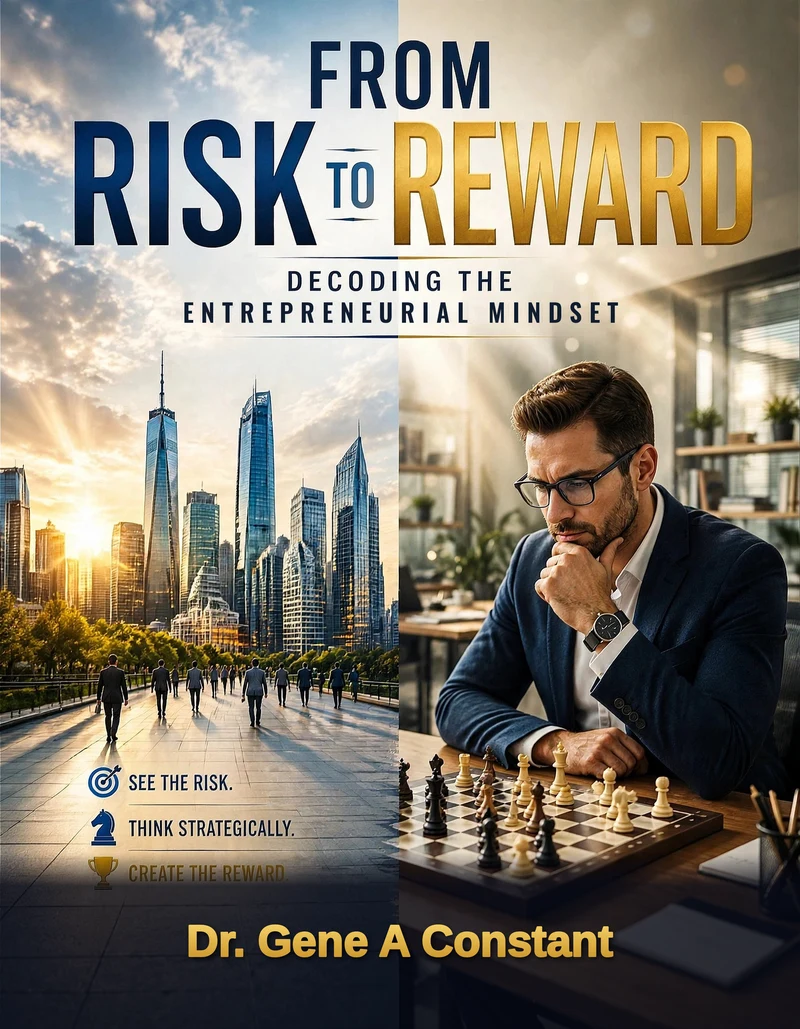
From Risk to Reward: Decoding the Entrepreneurial Mindset
Every business is a bet. Learn the questions owners ask before the money is spent.
Dr. Gene A Constant teaches the entrepreneurial mindset: risk and uncertainty, affordable loss, cash flow, pricing, small bets and failure as data, with four real cases and free online tools.
Contents
Paperback, 176 pages, 8.5 x 11 inches, with four real case studies, three teaching cases and The Owner’s Toolkit of free online tools.
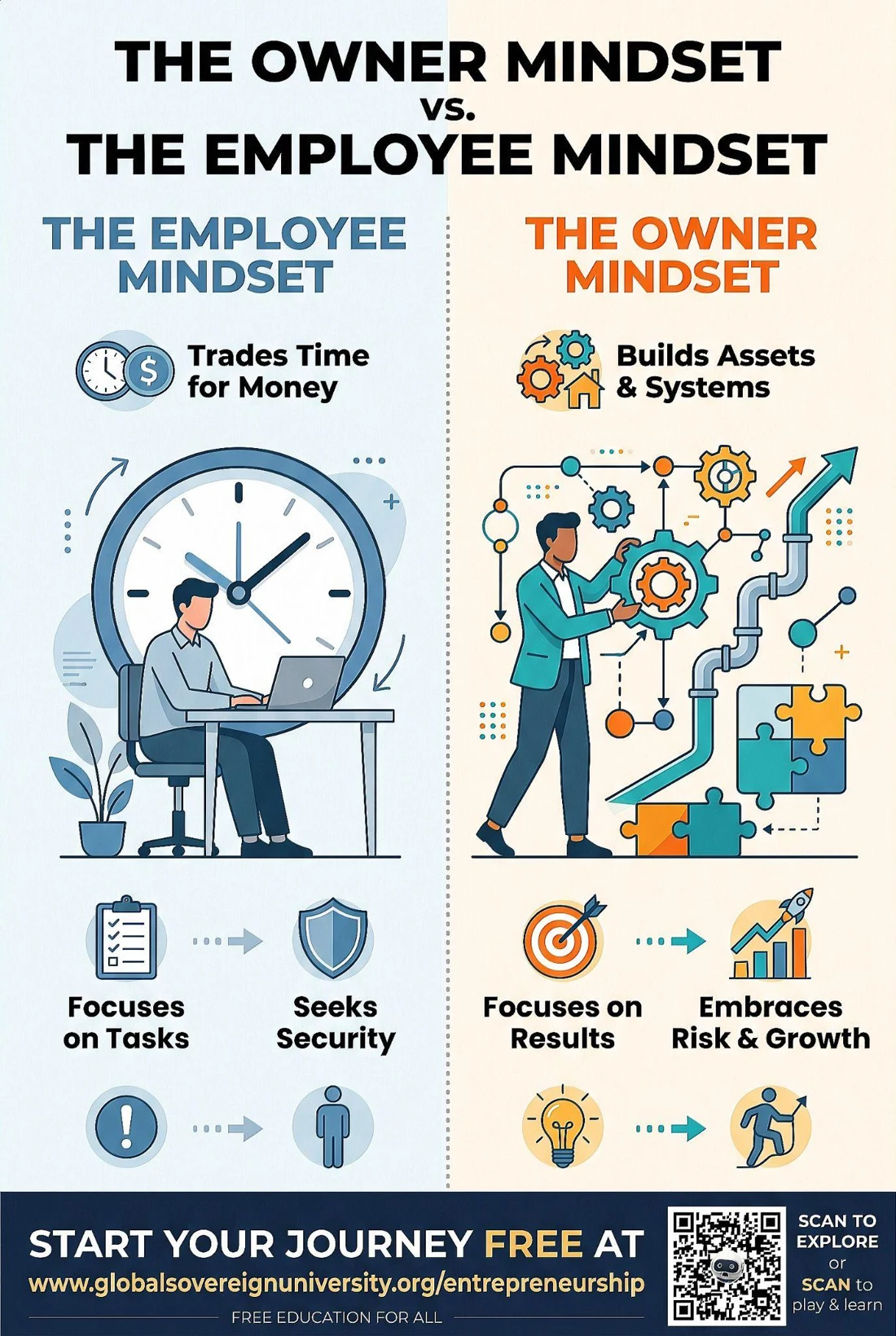
Free With This Book: The Owner’s Toolkit · The Six Rooms: A Look Inside · The Owner Mindset
Chapter 1: The Owner’s Question. Two people can look at the same opportunity and ask different questions: what will I get, or what happens if this does not work the way I expect? This chapter shows the difference between a compliment and a purchase, and why ownership begins with taking responsibility for the result.
Chapter 2: Two Ways of Seeing the Same Job. Two people can do the same work side by side and see two different jobs. This chapter follows the whole chain of value, from the customer's experience to payroll, and shows why the owner carries the risk that is left after everyone else is paid.
Chapter 3: What Risk Really Is. Risk is an unknown you can measure across many cases; uncertainty is an unknown you cannot. This chapter uses base rates and the outside view to show where a new business should begin looking for trouble.
Chapter 4: Your Brain on Uncertainty. A loss can feel about twice as powerful as an equal gain, and that pull bends owner decisions through fear, sunk costs and overconfidence. This chapter replaces courage alone with guardrails: a checklist, a pre-mortem and the outside view.
Chapter 5: Start with What You Can Afford to Lose. Instead of asking what return you need, ask what you can afford to lose and what you already have. This chapter shows how affordable loss keeps an owner in the game long enough to learn.
Chapter 6: Run It a Thousand Times. A single forecast is not the future. This chapter tests a plan with ranges, low and high cases, and many simulated futures to find the plan-breaker, the one number that can sink everything.
Chapter 7: Cash Is Oxygen. Profit asks whether you created more value than you used; cash asks whether you can pay today's bills. This chapter shows how a business can be profitable on paper and broke in the bank, and how owners protect the cash that keeps it alive.
Chapter 8: The Price of Value. A sandwich that costs $4 and sells for $6 carries a 50 percent markup but only a 33 percent margin. This chapter untangles markup and margin, works backward from the margin a business needs, and turns break-even into a visible number of sales.
Chapter 9: Small Bets, Big Learning. Building the whole business before learning whether anyone wants it is the costliest way to find out. This chapter uses the minimum viable product to test demand, price and delivery before money is committed to space and equipment.
Chapter 10: Reading the Market. A business starts with a painful, payable problem, not a product. This chapter shows how to tell a complaint from a demand and how to test an idea through customer conversations instead of pitches.
Chapter 11: Failure as Data. Owners act before they can be certain, so some setbacks are sure to come. This chapter uses structured post-mortems to separate decisions from outcomes and turn disappointment into evidence for the next test.
Chapter 12: The Owner’s Character. Resilience is not pretending that losses do not hurt; it is staying effective when they do. This chapter treats trust as capital built from kept promises, and defines reward before growth defines it for you.
Case Studies: Real Cases · Teaching Cases · Keep Going · The From Risk to Reward Dictionary · Practice These Words · The Grade Level Check · About the Author
Chapter 1: The Owner’s Question
Two people can stand in the same room, look at the same opportunity, and see entirely different things.
Imagine a local café looking for someone to help on Saturday mornings. The job is simple enough: greet customers, take orders, wipe tables, restock cups, and close the register at the end of the shift. One person reads the advertisement and asks, “What does it pay?”
That is a reasonable question. Pay matters. Bills are real. Time has value. A job is an agreement: I give you my effort, and you give me a predictable amount of money in return.
Another person reads the same advertisement and wonders, “How many customers come through on Saturdays? What do they buy most often? How much does the café make on a cup of coffee after beans, milk, labor, rent, card fees, and waste? Why is there always a line at eight-thirty but empty tables at eleven? Could pre-orders make the morning smoother? Could the café sell more without adding much cost?”
Neither person is smarter by definition. Neither is more worthy. They are simply asking different questions.
The first person is viewing the situation primarily through the lens of work. The second is viewing it through the lens of ownership.
Employees and owners both work. Often, owners work longer hours, especially at the beginning. Employees can be highly skilled, deeply responsible, and essential to the success of a business. Owners can be careless, unprepared, or wrong. This is not a story about one group being better than another.
It is a story about where your attention goes.
Employee thinking begins with the role: What am I expected to do? What will I earn? What hours will I work? What benefits come with the job? These are practical questions because an employee usually exchanges a defined contribution for defined compensation. If sales are weak one afternoon, the employee is still generally paid for the shift. If the owner guessed wrong about demand, ordered too much inventory, or signed an expensive lease, the employee may feel the effects eventually, but the first financial impact lands elsewhere.
Owner thinking begins one step earlier and reaches several steps further. What problem are we solving? Who will pay to have it solved? What will it cost to deliver the solution? When will the cash arrive? What happens if the sales estimate is wrong? How much can we lose before this opportunity becomes a threat rather than a bet?
That last question is the owner’s question.
Not, “Will this work?”
Almost anything can work under the right conditions. A product can find the right customer. A struggling shop can find a better location. A small service business can discover an overlooked niche. A bad month can be followed by a great one.
The owner’s question is more useful because it is more honest: “What happens if this does not work the way I expect?”
That question does not make a person negative. It makes a person prepared.
Suppose the café owner believes Saturday traffic will rise if the shop begins offering breakfast sandwiches. The optimistic story is easy to tell. People are busy. They like coffee and breakfast together. Nearby offices may place group orders. Sales could grow.
But ownership requires more than a good story. It requires a complete one.
How much will the grill cost? Will the kitchen need new permits? How many sandwiches must be sold each day to cover the added ingredients, labor, electricity, packaging, and equipment? Will the owner need to pay suppliers before customers pay the café? What happens to unsold food at the end of the day? If the idea fails, can the equipment be used for something else or sold? Can the owner test demand before committing to a full menu?
An owner does not stop believing in the opportunity. An owner puts the opportunity under pressure.
This habit is useful whether you own a company today or not. A freelancer owns the relationship between effort, price, and income. A manager who understands how the business makes money becomes more valuable. A student deciding whether to spend money, take a course, or begin a side project is already making small capital-allocation decisions. A parent teaching a child to earn, save, and sell is teaching the earliest form of ownership.
Ownership is not limited to having a business license or calling yourself a founder. It is a willingness to take responsibility for the result.
Consider a familiar problem. A customer complains that an order arrived late.
An employee may think, “The delivery company made a mistake. That is not my department.”
An owner asks, “Why did the customer experience our business as unreliable? Was the shipping promise clear? Did we send the order on time? Did we choose the right carrier? Should we have updated the customer sooner? How often does this happen? What will it cost us if that customer never returns?”
The owner may not personally drive the delivery truck. But the owner sees the whole chain. That is the difference.
The same pattern appears in money.
An employee sees a sale and may think, “The company made $100.”
An owner sees a sale and asks, “How much of that $100 is actually ours?”
If the product cost $35, the payment processor took $3, shipping cost $12, packaging cost $2, a salesperson earned a commission, and part of the rent, software, insurance, and payroll must be covered, the sale may be far less profitable than it first appears. In some cases, a business can be busy, admired, and losing money on every transaction.
This is why owners learn to be suspicious of impressive-looking numbers. Revenue is not profit. Profit is not cash. Growth is not always health. A full calendar is not always a good business. We will return to these distinctions throughout this book because they separate businesses that merely look alive from businesses that can survive.
The owner’s mindset is also different in how it treats uncertainty.
Someone with an employee mindset may wait for certainty before acting: a guaranteed customer, a perfect plan, enough savings, and a clear answer.
Yet business rarely offers guarantees. The market changes. Competitors react. Costs rise. Customers say one thing and buy another. A plan that looked solid in January may need revision by March.
Owners do not succeed because they know the future. They succeed because they learn how to make decisions without pretending they know it.
They reduce what can be reduced. They test before they scale. They price carefully. They preserve cash. They ask for deposits. They make small bets before making large ones. They build relationships that give them more options. And when something goes wrong, as it eventually will, they look for the lesson hidden inside the loss.
This is not reckless confidence. It is disciplined courage.
There is a popular image of the entrepreneur as a person who leaps from a cliff and builds the airplane on the way down. It is dramatic, but it is poor advice. Most durable owners do not leap blindly. They look down first. They check what they can afford to lose. They ask what resources they already have. They begin with a version small enough to survive, then improve it through contact with the real world.
The employee asks, “What will I get if I do this?”
The owner asks, “What must be true for this to work, what could break it, and what can I do next with what I have?”
Both questions have their place. You should know what your work is worth. You should expect fair pay. But if you want to build something of your own, or even make wiser decisions inside someone else’s organization, you must learn to ask the second set of questions too.
That is the good news: owner thinking is not a personality type reserved for risk-loving people. It is not an inherited trait possessed only by people who grew up around money or business owners. It is a collection of habits. You can practice noticing costs. You can learn to distinguish hope from evidence. You can calculate a break-even point. You can test an idea before spending heavily. You can make a plan for the downside without giving up on the upside.
Every owner starts somewhere. For me, that somewhere was not a boardroom, an investment pitch, or a grand business plan. It was fifth grade, with a small idea, limited resources, and a lesson about customers that has stayed with me ever since.
My first business did not begin with a loan, a logo, or a spreadsheet. It began in fifth grade with a small idea, a few dollars, and the belief that if I could make something other kids wanted, I might be able to sell it.
At that age, I did not use words like “market research,” “unit economics,” or “customer demand.” I certainly did not understand cash flow. I understood allowance money, the disappointment of spending it too quickly, and the excitement of finding a way to earn more.
The opportunity appeared in an ordinary place: school.
Like most fifth graders, my classmates loved small things that felt personal. Bright colors. Names written in unusual lettering. Little items that could be traded, shown off, or slipped into a pencil case. I noticed that several students had become interested in decorative friendship bracelets and keychains. Some made them at home. Others wished they could.
I saw an opening.
Using a few basic supplies, I began making simple braided bracelets. Nothing about them was revolutionary. The materials were inexpensive. The designs were limited by what I could make with my hands after school. But I offered something that mattered: choice.
Customers could choose colors. They could ask for their initials. They could pick a style that matched a favorite sports team, a backpack, or a friendship group. To me, it felt like I was selling bracelets. Looking back, I was really selling the small but powerful feeling of having something made for you.
That was my first lesson: people do not always buy the object. They buy what the object means to them.
A bracelet made from thread might be worth very little in raw materials. But a bracelet in your favorite colors, made for you and delivered before Friday, can feel more valuable. The difference is not in the thread. It is in the customer’s experience.
At first, I made several bracelets before anyone had ordered them. This seemed sensible to me. I thought a table full of finished products would prove that I was serious. I spent time choosing colors, tying knots, and making different designs. Then I brought them to school, expecting them to disappear immediately.
Some sold. Many did not.
The problem was not that the bracelets were bad. The problem was that I had guessed wrong about what people wanted.
I had made colors I liked. I had made styles I thought looked good. I had built inventory before I had enough evidence of demand. That is a mistake adults make every day on a much larger and more expensive scale. A restaurant orders too much food because the owner assumes a new menu item will be popular. An online store buys hundreds of units because a product looks exciting at a trade show. A software company spends months building features customers never asked for.
My fifth-grade version of the mistake was smaller, but the lesson was the same: your enthusiasm is not proof of demand.
A few classmates looked at the bracelets and said, “Those are nice.”
At first, I counted that as interest.
Then I learned the difference between a compliment and a purchase.
“Those are nice” is not the same as “Can you make me one in blue and green? I’ll pay you tomorrow.”
One is encouragement. The other is evidence.
The more I listened, the clearer the market became. People did not necessarily want what I had already made. They wanted to choose. One friend wanted school colors. Another wanted a bracelet with two specific colors for a sibling. Someone else wanted a keychain instead of something to wear. A few wanted to know whether I could make matching sets for friends.
So I changed how I worked. Instead of making a pile of products and hoping they would sell, I began taking orders.
That simple change improved almost everything.
I wasted fewer materials because I made more of what people had already requested. I spent less time producing items that sat unsold in my bag. I could tell customers when their order would be ready. And because they had chosen the colors themselves, they cared more about receiving it.
Without knowing it, I had moved from guessing to testing.
I also discovered the uncomfortable part of being the person responsible for the result: when you make a promise, people remember.
If I told someone I would bring their bracelet on Thursday, Thursday mattered. If I forgot the right color, made the wrong size, or failed to finish it, there was no manager to blame and no department to send the problem to. The disappointment belonged to the customer, but the responsibility belonged to me.
That was a surprisingly serious feeling for a fifth grader.
It also taught me that reliability is part of the product. The bracelet had to be good enough, but so did the experience around it. Was the order right? Was it ready when promised? Was the price clear? Did I treat the customer fairly?
Many businesses underestimate this. They believe they are selling food, landscaping, accounting, clothing, consulting, software, or repairs. They are selling those things. But they are also selling trust. A customer needs to believe that the business will do what it says it will do.
At some point, I faced another owner’s problem: pricing.
The first price I chose was based mostly on what felt reasonable. I wanted people to buy, and I did not want anyone to think I was charging too much. That instinct is common, especially among new owners. We worry that asking for a fair price will make people say no. So we set prices low enough to feel safe.
But low prices can create their own problem.
Materials cost money. Time costs something too, even if a fifth grader does not yet have a payroll or rent to pay. A bracelet that takes thirty minutes to make is not a good deal if the price barely covers the supplies. And if an order is customized, mistakes become more costly. One wrong color or broken strand can turn a small profit into no profit at all.
I did not create a formal cost sheet. I did not calculate labor by the hour. But I started to understand that a sale was not simply money coming in. Some of that money had to replace what I had used. Some had to cover mistakes. Some had to make the effort worthwhile.
That is the beginning of margin.
It is also the beginning of a truth every owner must learn: being busy is not the same as making money.
There were days when I had several requests and felt successful because people wanted what I made. But if I took too long, priced too low, or used more materials than expected, the activity did not create much reward. I was learning the first version of a question that would become central to business: after every cost is counted, what remains?
Of course, the business was tiny. There were no employees, no lease, no tax filings, no supplier contracts, and no investor asking for a forecast. The downside was limited.
If I made something nobody wanted, I lost some materials and some time. That mattered to me, but it did not put my family at risk.
And that limited downside was exactly what made the experience valuable.
I had made a small bet. I had used resources I could afford to lose. I had learned from real customers instead of from my imagination. I had adjusted the offer, improved the process, and discovered that earning money felt different when I had created the value myself.
That is why early ventures matter, even when they are modest. A lawn-mowing route, a weekend baking project, tutoring, reselling old items online, designing flyers for local businesses, or making bracelets in fifth grade can teach habits that no motivational speech can replace. You begin to see the connection between a problem, a customer, a promise, a cost, and a result.
You also begin to understand that ownership is not magic. It is observation followed by action.
I did not know whether my little bracelet business would work when I started. I could not predict how many orders I would get, which colors would be popular, or whether anyone would pay at all. But I did not need certainty to begin. I needed a small enough experiment, attention to what happened next, and the willingness to change course.
That remains the pattern.
The owner’s question is not reserved for giant decisions. It begins in small moments: Should I make ten before anyone asks, or should I take orders first? Should I charge what feels comfortable, or should I understand my costs? Is this customer being polite, or are they prepared to pay? If I promise Friday, what will it take to deliver on Friday?
Those questions shaped a fifth-grade project. They can also shape a career, a side business, a family company, or the organization you lead.
The scale changes. The mindset does not.
That is what this book is about.
It is not a promise that every idea will succeed. No honest business book can make that promise. Markets can change without warning. A strong competitor can enter at the wrong moment. A supplier can fail. Costs can rise. Customers can delay payment, change their habits, or decide that the problem you hoped to solve is not painful enough for them to spend money on.
Ownership does not remove uncertainty. It teaches you how to meet uncertainty with clearer questions, better numbers, smaller commitments, and more useful actions.
The goal is not to become fearless. Fear has a purpose. It can warn you that the stakes are too high, the plan is too vague, or the downside has not been considered. The goal is to become less confused by fear. Instead of letting it stop you completely, you will learn to ask what it is trying to tell you.
Are you afraid because the opportunity is truly dangerous? Or because you have not yet tested it?
Are you worried about failing publicly? Or do the economics genuinely fail when you count every cost?
Are you holding back because you lack information that can be gathered? Or because you are waiting for a guarantee that business will never provide?
Those distinctions matter. They separate caution from paralysis, and courage from carelessness.
This book will give you a practical way to think through the decisions owners face. Some of those decisions will involve a business you already operate. Others may involve an idea you are considering, a side project you want to test, a family enterprise, a freelance practice, or a team inside a larger organization. The setting may differ, but the underlying questions are remarkably similar.
Who is the customer?
What problem matters enough to solve?
What will the customer actually pay?
What will it cost to deliver the promise?
When will cash arrive?
What can go wrong?
What can you afford to lose if it does?
What evidence would tell you to continue, change direction, or stop?
These are owner questions. You will see them return throughout the book because they are not questions you answer once. They are questions you revisit as conditions change.
We will begin by looking more closely at the two ways of seeing work. You will learn why an employee can be excellent at a job while still missing the financial pressures that sit behind it, and why an owner must see the entire system. Revenue, costs, wages, rent, inventory, debt, payment timing, customer expectations, and risk are connected. A decision that looks simple from one position can look very different from another.
You will also learn that ownership is not a title. It is a discipline of responsibility.
If a customer’s order arrives late, the owner asks what happened across the full chain. If sales rise but cash disappears, the owner investigates instead of celebrating too soon. If a product receives compliments but not purchases, the owner does not confuse encouragement with demand. My fifth-grade bracelet business taught me these lessons in small form. I made inventory before I had enough evidence. I learned to take orders rather than guess. I discovered that a promise to deliver on Thursday mattered as much as the colors in the bracelet itself.
The examples will get larger as we go, but the principles remain close to those early lessons.
Next, we will separate risk from uncertainty. People often use the two words as if they mean the same thing, but they do not. Risk involves outcomes whose odds can be estimated with some confidence. Uncertainty involves situations where the future is much harder to measure because the relevant information is missing, changing, or unknowable.
That difference changes how you make decisions.
If you understand the odds, you can prepare around them. You can insure against certain losses, build a reserve, price for expected problems, or choose a safer route.
When the future cannot be known in advance, a different response is needed. You test. You keep your commitments reversible where possible. You avoid betting more than you can afford to lose. You build options instead of pretending to have certainty.
You will learn why knowing the real odds does not have to make you timid. In many cases, it does the opposite. Vague fear is often larger than measurable danger. Once you understand the base rates, the likely range of outcomes, and the factors you can influence, you can act with open eyes.
But clear facts alone do not make clear decisions. Each of us brings a human brain to business, and the human brain has predictable blind spots.
Losses tend to hurt more than equivalent gains feel good. That is why a person may cling to an unwise investment simply because admitting the loss feels painful. We become overconfident when early results go well. We may continue funding a failing plan because of the time, money, or pride already invested. We notice the founders who succeeded and overlook the many who used similar strategies and disappeared quietly.
None of these habits makes you foolish. They make you human.
The important question is what you do about them. You will learn practical ways to slow down poor decisions: checklists that force you to count costs, pre-mortems that ask how a plan could fail before you commit, and outside views that challenge the story you most want to believe. Good owners do not assume they are immune to bias. They build simple systems that make bias less expensive.
From there, the book turns from thinking about uncertainty to acting within it.
You will learn why experienced founders often start not with a distant forecast of riches, but with the resources already in their hands. Who do you know? What can you do? What do you have access to? What amount of money, time, reputation, and energy can you put at risk without putting your life in danger?
This is the principle of affordable loss. It is one of the most useful ideas in entrepreneurship because it gives you a place to begin before you have perfect information. Rather than asking only, “How much could I make?” you will learn to ask, “What can I reasonably lose to find out?”
That question would have helped the fifth-grade version of me explain why taking bracelet orders was smarter than making a large pile of inventory. The potential gain was modest, but so was the possible loss. The experiment was small enough to survive. That made it easier to learn.
You will also learn how to think in ranges rather than single, confident forecasts. A forecast that says you will sell exactly 500 units next month may look precise, but precision is not the same as accuracy. Owners must prepare for a range of plausible outcomes: a strong month, an expected month, and a difficult month.
We will use scenarios and simple simulations to make this practical. You will learn to identify the one number most likely to break a plan. Sometimes it is the price customers will accept. Sometimes it is the cost to acquire a customer. Sometimes it is the time between sending an invoice and receiving payment. Often, the most dangerous assumption is hiding in plain sight because it has never been tested.
Cash will receive special attention because cash is the oxygen of a business. A company can show a profit on paper and still run out of money before it can pay wages, suppliers, or rent. You will learn why payment terms matter, how to calculate runway, and why rapid growth can become dangerous when every new sale requires cash before the customer pays.
Then come the practical economics of ownership: pricing, margin, markup, break-even points, and the value of your own time. Many owners price based on what competitors charge, what feels fair, or what they fear customers will reject. Those inputs matter, but they are not enough. A price must also support the business you are trying to build.
You will learn to test ideas before committing heavily, to distinguish real demand from polite interest, and to decide whether a disappointing result calls for persistence, adjustment, or a full change of direction. You will learn how to conduct a post-mortem without blame so that failure becomes data rather than a verdict on your ability.
Finally, this book will ask you to consider the kind of owner you want to be.
Skill matters. Numbers matter. But character matters too. Customers remember whether you keep your word. Employees remember whether you treat them fairly when times are difficult. Partners remember whether you told the truth when it would have been easier not to. Reputation is not decoration around a business. It is capital. It affects who will work with you, buy from you, refer you, extend credit, and give you another chance.
Each chapter ends with The Owner’s Move, one action you can take that week. These are not theoretical homework assignments. They are small acts of ownership: examining an assumption, running the numbers, asking a customer a better question, testing a low-cost version of an idea, or reviewing a decision before it becomes expensive.
Several chapters also connect to free tools from Global Sovereign University. You will be able to see how a business can be profitable and broke at the same time, run a forecast through many possible futures, work through owner decisions with changing numbers, and trace the consequences of a choice before making it. When you are ready, you can also test what you have learned and earn a free, serial-numbered certificate.
You do not need to have all the answers before you begin.
You need a willingness to look honestly at the questions.
The next page is where that practice starts.
Chapters 2 through 12, the case studies and the dictionary continue in the book.