
The Privacy Blueprint: Shielding Yourself and Those You Love
Privacy is not simply about secrecy. It is about control.
A calm, step-by-step plan for taking your scattered personal data apart and keeping it from coming back: data brokers, people-search sites, search results, phones, email, devices, social media, credit freezes, and protecting the people you love.
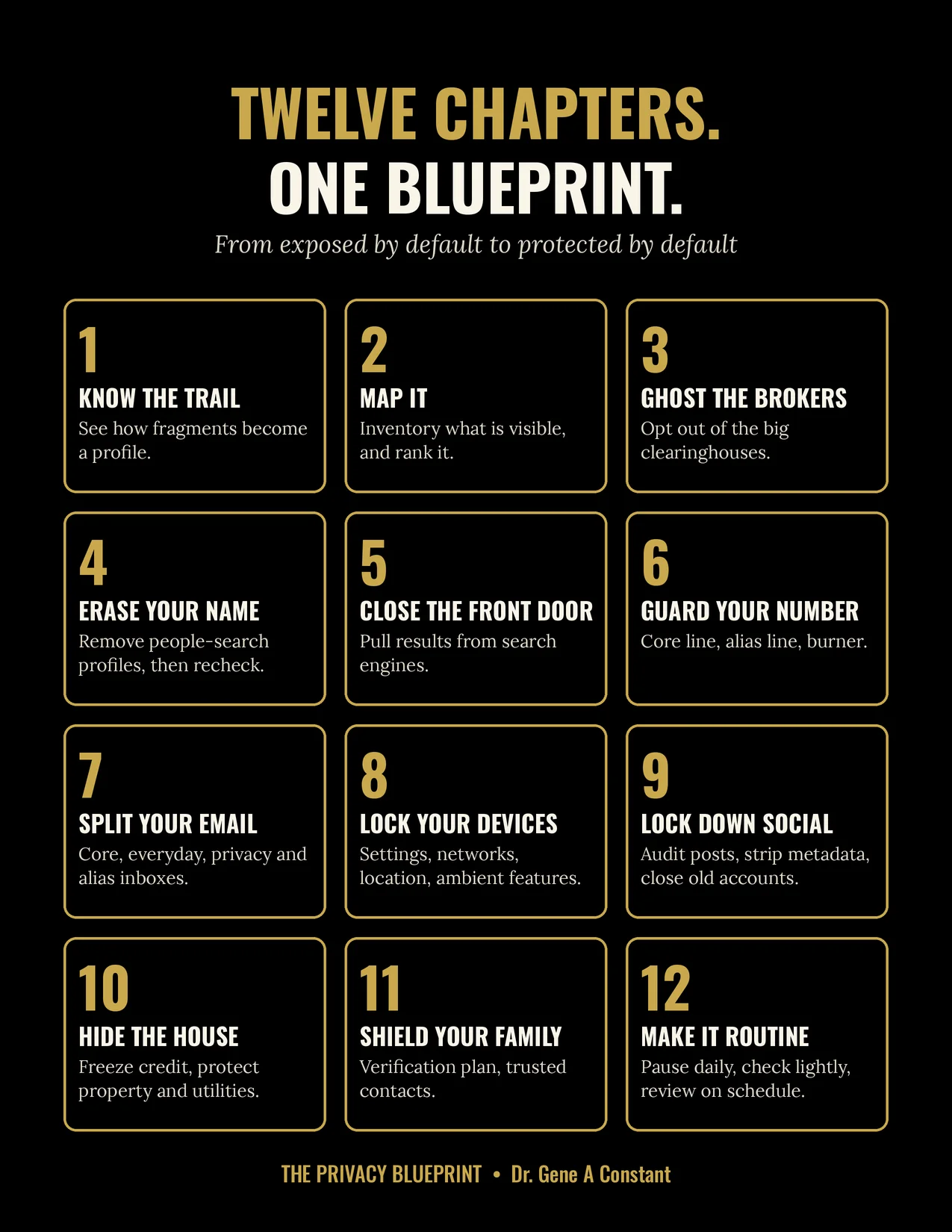
Inside the Book
180 pages · 8.5 x 11 paperback · Revision 2 · ISBN 979-8-1830-4746-2
Table of Contents
- Chapter 1: The Anatomy of Exposure
- Chapter 2: Mapping Your Digital Footprint
- Chapter 3: The Ghost Protocol: Data Brokers Part I
- Chapter 4: Erasing Your Name: Data Brokers Part II
- Chapter 5: Taking Back Search Results
- Chapter 6: Communication Sovereignty
- Chapter 7: Compartmentalized Email Protocols
- Chapter 8: Fortifying Your Devices
- Chapter 9: The Social Media Lockdown
- Chapter 10: Financial and Real Estate Opacity
- Chapter 11: Securing Those You Love
- Chapter 12: The Daily Sovereign Routine
Also inside: Before You Begin (a safety page), The Six Rooms, four real case studies, three teaching cases, a 30-term privacy dictionary, the Daily Sovereign Routine card and a Removal Log.
Chapter 1: The Anatomy of Exposure
Privacy rarely disappears in a single dramatic event. More often, it is scattered in tiny, ordinary fragments: a delivery address entered during checkout, a phone number provided for a loyalty discount, a birthday shared to unlock a coupon, a photograph posted from a restaurant, a change-of-address form submitted after a move. Each action seems harmless when viewed alone. Together, they form a data trail: a record of where you have been, what you buy, whom you know, what you value, and where you may be vulnerable.
A data trail is the collection of digital and administrative traces created as you move through modern life. Some traces are intentional. You create them when you open a bank account, register to vote, sign a lease, create a social-media profile, or order a package. Others are produced quietly in the background. Your phone may report its approximate location to apps. A website may place cookies in your browser. A retailer may connect your purchases through a loyalty program. A smart television may record viewing behavior. A fitness app may collect movement patterns, device identifiers, and health-related data.
None of these systems sees the whole person. That is the important distinction. A grocery store may know your purchasing habits but not your employment history. A public-record database may know your current address but not your preferred email provider. A social platform may know your relationships, interests, and browsing behavior within its services but not necessarily your utility account details.
The privacy problem begins when separate pieces are connected.
A name is one piece. A past address is another. A mobile number, an email address, a birth month, a relative’s name, a property record, and a public social-media post can each appear insignificant. But when those fragments are assembled, they can become a highly detailed profile. Data brokers, advertisers, identity thieves, hostile acquaintances, scammers, and automated systems all benefit from this assembly process, though their motives differ.
Think of your information as a jigsaw puzzle scattered across hundreds of tables. You may believe the pieces are too dispersed to matter. Yet many organizations are in the business of gathering those pieces, sorting them, and selling access to the completed picture.
This is why privacy is not simply about secrecy. It is about control. You may not be trying to hide from the world. You may simply want to decide who gets your home address, which companies can associate your purchases with your name, whether a stranger can locate your relatives, or how easily someone can impersonate you. Those are reasonable boundaries. In a data-driven economy, maintaining them requires intention.
Your trail generally falls into four overlapping categories.
The first is volunteered data. This is information you give directly: your name on a form, your email address during an online purchase, your phone number at a pharmacy, your job title on a networking site, or a family photo shared publicly. Volunteered data is often exchanged for convenience, access, discounts, or connection. The trade can be legitimate, but it is rarely as limited as it appears. A store may need an email receipt address, for example, but that does not necessarily mean it needs permission to use that address for long-term behavioral advertising or to enrich a consumer profile through third parties.
The second is observed data. This is collected from your behavior rather than directly provided by you. A website can observe which pages you visit, how long you remain there, what device you use, and whether you arrived from an ad or a search engine. A mobile application may observe when you open it, your approximate location, or which features you use. Your internet service provider, app developers, advertising networks, and platform operators can each observe different portions of your activity.
The third is inferred data. This is often the least visible and, in some ways, the most consequential. Inferred data is what a company concludes about you from the information it already has. A retailer might infer that you recently moved based on purchases of boxes, furniture, cleaning supplies, or home-improvement products. An advertiser may infer that you are interested in parenting, travel, debt relief, fitness, or a particular political issue based on browsing and engagement patterns. These conclusions may be wrong, but they can still shape what ads, offers, prices, and solicitations you receive.
The fourth category is public and administrative data. Property records, business registrations, court filings, professional licenses, voter records where legally available, and other government-held documents can create a durable paper trail. These records often exist for valid civic reasons. The issue is that public access in the digital age is no longer limited to a person visiting a county office during business hours. Records can be copied, indexed, republished, merged with commercial data, and made searchable from anywhere in seconds.
A useful way to understand your exposure is to follow one ordinary event.
Imagine that you move to a new home. You update your address with a utility provider, shipping services, financial institutions, your employer, schools, and subscriptions. You may file a forwarding request, update a driver’s license, connect internet service, order furniture, join a neighborhood group, and post a photo from your new front porch. Each organization has a different reason to know where you live. But each update creates a potential connection point.
A marketer may learn that a household recently moved and target it for home-security systems, insurance, lawn care, furniture, or internet plans. A people-search site may eventually link the new address to your name and prior addresses. A fraudster who already has an old email address may use a current address as a verification detail in a phishing attempt. A stranger with access to a family member’s public social profile may identify your new neighborhood through photos, tags, or comments.
The lesson is not that moving, shopping, or participating in ordinary life is unsafe. The lesson is that every transaction has a data afterlife.
Your data trail also has a time dimension. Information persists. An account you abandoned years ago may still contain an old phone number, date of birth, contact list, or profile photo. A previous address may remain attached to your name in a broker database long after you leave. A social-media post that feels forgotten can be copied, cached, quoted, screenshotted, or indexed. Even data that is inaccurate can be difficult to remove once it spreads.
This persistence helps explain why privacy work can feel overwhelming at first. You are not dealing with one leak or one website. You are dealing with accumulation. The goal of this book is not to promise an impossible state of perfect invisibility. It is to reduce unnecessary exposure, break harmful connections between data points, limit future collection, and make your personal information harder to exploit.
That process begins with a change in perspective. Instead of asking, “What do I have to hide?” ask better questions:
“What information does this service truly need?”
“Who else may receive it?”
“Could this detail be used to identify, locate, impersonate, or manipulate me?”
“Is there a less revealing alternative?”
“Will I remember to remove or update this later?”
These questions create a pause between convenience and disclosure. That pause is one of the strongest privacy tools you possess.
As you continue through this book, you will build a practical system around that pause. You will map what is already visible, identify the brokers and people-search sites that package personal records, request removals, separate your public-facing contact details from your core identity, and reduce the constant background leakage from devices and social platforms. Later chapters will extend these protections to financial accounts, property records, children, elderly relatives, and the people whose information is connected to yours.
For now, begin with one simple observation: your trail is not your identity. It is a collection of records created by systems that profit from collecting, interpreting, and sharing information. Because it was built piece by piece, it can also be reduced piece by piece. The first step is learning to see the trail clearly.
Once you can see your data trail as a collection of connected fragments, the next question becomes unavoidable: who is collecting the pieces, and why?
The answer is not limited to a single company, industry, or government office. Modern data exploitation grew because personal information became valuable in ways that were once difficult to imagine. A mailing address used to be useful mainly for sending mail. A phone number was a direct line to a household. A purchase receipt was a record held by one store. Today, those same details can be combined with location patterns, browsing activity, household characteristics, likely income range, interests, relationships, and predictions about future behavior.
The raw material is ordinary life. The business model is connection.
Data exploitation is the practice of collecting, combining, analyzing, sharing, selling, or using personal information in ways that create value for an organization, often far beyond the original purpose for which the information was provided. Sometimes that use is visible and expected. If you buy a pair of shoes online, it is reasonable for the retailer to use your address to deliver the package and your email to send a receipt. But the boundaries become less clear when that retailer uses purchase data to categorize you, shares information with advertising partners, uploads customer lists to social-media platforms, or enables other companies to target you based on a profile you never saw.
The central shift was not simply that more information became digital. It was that digital information became cheap to store, easy to copy, and profitable to compare.
In earlier decades, records were often separated by physical barriers. A county property record might exist in a filing cabinet. A store’s customer list might be maintained on paper behind a counter. A magazine subscription company could have a mailing database, but using it required printing labels, paying postage, and accepting that the data would quickly become outdated. Information was still collected, sold, and misused, but the process had friction. It took time, labor, and money to assemble a detailed picture of someone.
Digital systems removed much of that friction.
As businesses shifted from paper records to databases, every interaction became easier to log. Loyalty programs connected purchases to a persistent customer profile. Online accounts connected browsing behavior to email addresses. Smartphones created a stream of location-adjacent information through apps, wireless networks, Bluetooth signals, and device identifiers. Social networks encouraged people to publish their relationships, milestones, photos, preferences, and opinions voluntarily. Public records moved online, where they could be searched and copied at scale.
Then came the systems designed to merge those sources.
A data broker may acquire information from public records, surveys, retail transactions, online tracking systems, warranty cards, subscription services, commercial partners, and other sources. It may use matching techniques to decide that several records belong to the same person or household. The match does not need to be perfect to be useful to a marketer. A shared name, previous address, email pattern, device identifier, or household relationship can be enough to make a likely connection.
This is why a single retail loyalty card registration can have a longer reach than most people expect. You may sign up because the store offers a discount on groceries, fuel, or household goods. The retailer can then connect repeated purchases to a phone number or email address. It may identify broad patterns: a household that buys pet food, baby products, gluten-free items, gardening supplies, school-lunch snacks, or moving boxes. Those patterns may be used internally, shared with service providers, or added to broader marketing systems. Once a profile is associated with an address, a phone number, or an email, it can become easier for other systems to recognize the same person elsewhere.
The profile is not always a neat folder labeled with your name. Often, it is a cluster of identifiers. One company may know you as an email address. Another may know you through a mobile advertising identifier. A third may know your home address and estimated household income. An advertising platform may connect those identifiers through uploaded customer lists, browser cookies, app activity, or shared data partnerships. What emerges is not necessarily a single master file held by one all-powerful institution. It is a network of overlapping profiles that can recognize and reinforce one another.
That distinction matters because it explains why deleting one account rarely ends the flow. You may close an app, unsubscribe from a retailer, or remove your name from one people-search website, only to find similar information elsewhere. The underlying data may have been collected before you acted. It may have been copied to other systems. It may have come from a separate source entirely, such as a public record, an old account, a marketing list, or information supplied by someone connected to you.
The rise of data exploitation also changed the meaning of “free.”
Many digital services appear free because users do not pay with money at the point of use. Instead, they may pay with attention, behavioral data, contact information, and permission to be measured. A free quiz, weather app, photo editor, game, coupon service, or personality test may collect more information than its basic function requires. The app may ask for location access, contact access, tracking permission, or the ability to connect with a social-media account. It may share information with analytics companies, advertisers, cloud providers, or partners described vaguely in a long privacy policy.
This does not mean every free service is malicious or every data-sharing practice is improper. Some collection is necessary for fraud prevention, security, functionality, customer support, and legal compliance. The problem is proportionality. Does a flashlight app need access to your precise location? Does a retailer need your date of birth to email a receipt? Does a website need permission to follow you across unrelated sites long after you leave its page?
When the information requested exceeds the service being offered, convenience may be concealing an extraction system.
The most troubling forms of exploitation often arise from inference. As discussed earlier, inferred data is what organizations conclude rather than what you explicitly disclose. You may never state that you are preparing to move, experiencing financial stress, caring for an elderly parent, trying to conceive, recovering from an illness, or considering a career change. Yet patterns of searches, purchases, locations, subscriptions, and engagement can lead systems to assign you to categories that suggest those circumstances.
These categories can affect what you see. You may receive ads for high-interest loans, insurance products, legal services, political campaigns, diet programs, or medical services. You may be placed into a marketing segment labeled “likely mover,” “new parent,” “budget-conscious household,” “frequent traveler,” or “financially distressed.” The label may be inaccurate, outdated, or based on someone else in your household. Still, it can shape how companies approach you.
In some cases, the consequences extend beyond advertising. Data can be used in fraud scoring, risk assessments, tenant screening, identity verification, employment-related processes, insurance decisions, and other systems that influence real opportunities. Rules vary by country, state, industry, and the type of data involved, but the broader principle remains: information collected for one context can travel into another.
A person who enters an email address to receive a discount may not expect it to become one thread in a wider profile. A family member who publicly congratulates someone on a birthday may not realize that the post confirms a relationship and age range. A photo taken outside a home may seem harmless until a street number, school logo, vehicle plate, or location metadata turns it into a map for a stranger.
This is why data exploitation is not only a technical issue. It is a human issue. It creates opportunities for manipulation, discrimination, harassment, stalking, scams, and identity theft. It can make a difficult moment more vulnerable. A scammer who knows your former address, relatives’ names, utility provider, and recent move may sound more convincing than a random caller. An abusive former partner may use people-search tools and public records to locate a new residence. A criminal may use exposed details to answer security questions, impersonate a customer, or construct a phishing message that feels personal.
The systems that enable this are often designed to be invisible. You see the advertisement but not the profile that selected you. You see the search result but not the chain of databases that produced it. You receive a suspicious call but not the list from which your number was obtained. This invisibility can make the problem feel abstract until it becomes personal.
But invisibility is not inevitability.
The purpose of understanding this landscape is not to create fear or encourage you to withdraw from ordinary life. You do not need to stop shopping, communicating, moving, using technology, or participating in your community. You need to recognize that personal information has value, that organizations compete to acquire it, and that every unnecessary disclosure can become another connection point.
Privacy work begins by reducing those connection points. It means giving a retailer only the information it truly needs. It means questioning permissions before tapping “allow.” It means separating your public-facing contact details from your most important accounts. It means removing information from broker databases where possible and limiting what can be gathered in the future.
Before any of those actions can be taken, however, you need a clear picture of what is already visible. The next step is to stop guessing about your exposure and begin mapping it.
The most serious privacy threats are often the ones you do not immediately see.
A locked front door gives a clear signal: someone must physically cross a boundary to enter your home. Digital exposure works differently. A stranger may never need to approach you, contact you, or break into an account to learn a surprising amount about your life. They may begin with information that is publicly searchable, commercially available, casually shared by another person, or leaked through systems you use every day.
This is what makes privacy risk so difficult to judge. The danger is rarely contained in one detail. A home address alone may be public in some places. A phone number alone may be listed in an old directory. A birthday message on social media may seem ordinary. But when these fragments are connected, they can enable actions that would otherwise be much harder: impersonation, fraud, targeted manipulation, harassment, stalking, account takeover, or the mapping of an entire family network.
Consider the difference between a generic scam and a tailored one.
A generic scammer sends thousands of messages that say, “Your account has been suspended. Click here.” Most people recognize the message as suspicious. A tailored scammer may know your name, former address, mobile number, bank’s name, recent purchase category, or the names of relatives connected to you online. Their message might refer to a package delivery after you have moved, an unfamiliar charge at a store where you actually shop, or an urgent account update connected to a real utility provider.
The scammer does not need access to your bank account to make the message convincing. They only need enough accurate context to lower your guard.
This is called social engineering: the use of personal details, urgency, familiarity, or fear to persuade someone to reveal information, send money, install software, or take another action that benefits the attacker. It is one of the clearest examples of why exposure matters. The data itself is not always the final prize. Often, it is the tool used to obtain something more valuable.
A criminal who knows your phone number may attempt to convince a mobile carrier that they are you. If successful, they may try to transfer your number to a device they control, an attack commonly known as SIM swapping. With control of a phone number, an attacker may receive text-message verification codes for email, financial, retail, or social-media accounts. This is one reason later chapters will move beyond SMS-based two-factor authentication and toward authenticator applications and hardware security keys.
A criminal who knows your previous addresses, date of birth, or family relationships may also be better equipped to answer outdated security questions. Many systems still ask questions such as, “What street did you grow up on?” or “What is your mother’s maiden name?” Yet these are not truly secrets. They are often recoverable through public records, social-media posts, genealogy sites, people-search databases, or the profiles of relatives who have no idea that their information is being used as a verification tool.
The threat is not limited to financially motivated criminals.
For some people, exposure creates personal safety risks. A former partner, hostile acquaintance, obsessive stranger, or harasser may use people-search sites to locate a current address, identify relatives, discover a workplace, or connect old and new contact information. A public post may reveal a child’s school, a recurring commute, a favorite gym, or a vacation schedule. A property record may expose a home address that someone has deliberately tried to keep private. A casual comment from a friend, such as “So happy you are finally settled in your new neighborhood,” can confirm a move to someone who should not know where you live.
This is why privacy should never be framed as something only people “with something to hide” need. Privacy is a safety boundary. It protects people who are escaping abuse, working in public-facing roles, caring for vulnerable relatives, raising children, managing health concerns, rebuilding after financial hardship, or simply trying to live without being constantly profiled and reachable.
Your risk level may not be the same as someone else’s. A teacher, health-care worker, judge, journalist, nonprofit employee, business owner, survivor of domestic abuse, law-enforcement professional, or public official may face heightened exposure because their name, employer, license, address, or professional role is easier to locate. But even those without a visible public role can become targets through ordinary circumstances. Fraudsters do not need celebrity-level information. They need usable information.
Another unseen threat is the error embedded in data systems.
People often assume that the information held about them is accurate because it appears in a polished search result or commercial profile. In reality, broker databases and people-search websites can be wrong. They may attach the wrong relative to your profile, confuse you with someone who has a similar name, list an outdated phone number, associate you with a former roommate, or report addresses where you never lived.
Inaccurate information can still cause harm. It can lead strangers to contact the wrong person, make a profile appear more revealing than it is, or pull you into another person’s digital trail. It can also make removal more complicated. If a people-search site lists an incorrect address beside your name, you may need to demonstrate that the profile represents you while avoiding the urge to provide more information than necessary. This balance will be important when you begin submitting opt-out requests in later chapters: verify only what the site already displays whenever possible, and do not hand over additional details simply because a form asks for them.
Errors also reveal a deeper truth about the data economy. These systems do not need to understand you perfectly to profit from approximating you. An advertising platform does not need a complete biography to decide which promotion to show. A broker does not need every household relationship to be correct for a profile to look convincing to a casual visitor. A scammer does not need certainty; they only need enough details to make you hesitate.
Data breaches add another layer of risk. A breach occurs when information held by an organization is exposed, accessed, stolen, or improperly disclosed. The affected organization may be a retailer, insurer, school, hotel, medical provider, employer, social platform, government agency, or software company. Breaches can expose names, email addresses, passwords, addresses, birth dates, account numbers, purchase histories, health-related information, or identity documents, depending on the incident.
You cannot personally prevent every breach. An organization may fail to secure data after you provide it for a legitimate reason. What you can do is reduce the damage a breach can cause. If every account uses the same email address, phone number, and password pattern, one leak can create a route into many parts of your life. If your retail accounts, banking accounts, medical accounts, and social profiles all point back to the same core contact details, they become easier to connect. Compartmentalization, the practice of separating identities and contact channels by purpose, reduces that chain reaction.
This is why a public-facing phone number, masked email alias, unique password, and strong account recovery settings are not signs of paranoia. They are structural protections. They ensure that a compromise in one area does not automatically expose every other area.
Location is another threat that is often misunderstood. Most people think of location sharing as a map pin they consciously send to a friend. In practice, location can leak through photographs, application permissions, fitness routes, ride-sharing histories, public check-ins, Bluetooth signals, device settings, and the background details visible in an image. A photo may show a street sign, school crest, workplace badge, apartment number, or familiar storefront. Even without GPS metadata, the visible environment can reveal more than intended.
Patterns can be more revealing than individual locations. A single post from a coffee shop may not matter. Repeated posts from the same area at similar times can suggest where you live, work, exercise, worship, or take your children. A fitness tracker route may reveal the starting point of a morning run. A public event photo may identify the people in your social circle. A child’s sports schedule can reveal a predictable family routine.
The solution is not silence or isolation. It is awareness. Before sharing, ask whether the content exposes a location, routine, relationship, or identifying detail that does not need to be public. Later, you will learn to strip photo metadata, limit audience settings, and reduce the visibility of connection networks. For now, recognize that digital privacy includes the physical world. Information online can shape what happens offline.
There is also a quieter cost to constant profiling: manipulation without direct deception. When companies build predictions about your needs, fears, finances, interests, or life stage, they can tailor offers and messages designed to influence your choices. You may be shown debt-relief ads during a financial crisis, expensive products after searching for a medical concern, or emotionally charged political content because an engagement system predicts that it will hold your attention.
Not every targeted advertisement is harmful. Some may be useful. The concern is that you rarely know which assumptions led to the message, whether the underlying profile is accurate, who paid to reach you, or what other audiences were excluded from seeing the same offer. Privacy gives you room to make decisions without every uncertainty, transition, or vulnerability becoming a marketable signal.
The aim of this book is not to convince you that every website, app, business, or person is a threat. That mindset would be exhausting and unrealistic. The goal is to help you distinguish between necessary disclosure and unnecessary exposure.
Necessary disclosure supports a purpose you understand: giving a shipping address to receive a package, providing identification to open a regulated financial account, sharing emergency contact information with a child’s school. Unnecessary exposure occurs when more information is collected, retained, linked, or shared than the situation requires.
That distinction will guide every action ahead. You will not eliminate every record of your existence, nor should you have to. You will reduce the information that is easy to exploit, remove what can be removed, separate what should not be linked, and create safer defaults for the future.
Before you can do that effectively, you need evidence rather than assumptions. The next chapter begins that practical work: mapping your digital footprint, locating what is visible, and turning a vague sense of exposure into a clear, manageable privacy inventory.