Math at Home
The grocery aisle, the restaurant bill, the tape measure and the family card table are classrooms.
Three practical parts from Math as a Language by Dr. Gene A Constant: routines to practice at home, signs that show whether a learner understands or has only memorized, and steps to move a learner from tricks to reasoning.
Ways to build math literacy at home
From Chapter 8: Math in the Living Room
Fluency grows from short, frequent conversations about real numbers, not from worksheets. Each routine below takes five minutes and needs nothing but what is already in the house.
The unit pricing game
Bigger is not always cheaper. Divide the price by the amount to find the cost of one unit, then compare. Play it in the aisle: one shopper picks, the other checks with the shelf tag.
Say it out loud: “$4.99 for 18 ounces is a little under 28 cents an ounce.”
Play it at the top of this pageConversational tip estimation
Ten percent is the bill with the decimal moved one place left. Twenty percent is double that. Fifteen percent is ten percent plus half of it.
Structural measurements
Measure a real room together. Length times width gives the floor area; flooring is sold by the box, and builders add about 10% for cuts and mistakes. Six inches is half a foot, so 12 feet 6 inches is 12.5 feet.
Strategic board gaming
Every board game is a math lesson if someone asks why. Before each move, ask: what are my choices, what is my opponent likely to do next, and what are the odds? With two dice, 7 comes up most often (6 ways out of 36), while 2 and 12 have only 1 way each. Count spaces instead of guessing, and plan two moves ahead.
The Thinking Games: Odds On, Last Stone and moreCheckers with a PurposeThe Owner’s GambitDiagnostic signs: rote memorization or math literacy?
From Chapter 9: Spotting Literacy vs. Rote Memorization
A correct answer can hide memorized steps. Watch how a learner gets there. The same learner may sit in one column for fractions and the other for whole numbers.
| When a learner is… | Rote memorization looks like | Math literacy looks like | Try asking |
|---|---|---|---|
| Solving a problem in real time | Hunts for a keyword such as “total” or “left” and grabs an operation. Stalls when the wording changes. | Pictures the situation first: what is changing, what is being compared, what is being asked. | “Tell me the story in your own words before you write anything.” |
| Calculating in their head | Runs the paper method in their head, carrying and borrowing, and loses track. | Uses friendly numbers: 49 × 21 is about 50 × 20, so about 1,000. Rounds, then repairs. | “What’s a friendly number close to that?” |
| Tracking an error | Cannot say where it went wrong; starts over from the top or waits to be told. | Checks the answer against an estimate and finds the step where the meaning slipped. | “Is that answer reasonable? How would you know?” |
| Adapting to something new | Says “we haven’t learned that yet” when a familiar idea appears in a new form. | Recognizes the old idea in new clothing and reasons from what it means. | “Where have you seen something like this before?” |
| Explaining | Recites the steps: “You keep, change, flip.” | Explains why: “Dividing by one half asks how many halves fit, so the answer doubles.” | “Why does that step work?” |
A five-minute check at the kitchen table
- Explain 43 − 18 without saying “borrow.” Listening for: one ten renamed as ten ones.
- Which is greater, 0.5 or 0.45? Listening for: tenths and hundredths, not “45 is bigger than 5.”
- Show three-quarters in two different ways. Listening for: a drawing, 0.75, 75%, or three quarters of a dollar.
- Is 49 × 21 closer to 100, 1,000 or 10,000? Listening for: an estimate, without paper.
- Make up a story for 12 ÷ 3. Listening for: sharing or grouping, in the learner’s own words.
How to pivot the learning paradigm
From Chapter 10: Pivoting the Learning Paradigm
Moving a learner off tricks and onto reasoning happens in steps. Change one habit at a time and keep each change for a few weeks.
Ask what it means before asking which steps
Open every problem with “What is happening here?” Accept the answer in plain words first. The calculation comes second.
Map the process
Draw the problem as a short map: what is known, what is asked, and the relationship that connects them. A learner who can map a problem can solve one they have never seen.
Anchor ideas to pictures
Use the same few visual anchors again and again: the number line for comparing and counting on, the bar model for parts and wholes, the area model for multiplication and fractions.
Retire the tricks one at a time
Replace each shortcut with the idea it hides.
“Add a zero”Every digit shifts one place left, ten times the value“Borrow”Rename one ten as ten ones“Keep, change, flip”How many of these fit into that?Talk it out, and revise out loud
Have the learner explain while working. Let them hear adults say “wait, that doesn’t look right” and fix it. Mistakes become information, not verdicts.
Reason about the whole system
Estimate first, check for sense last, and ask “what changes if…?” What happens to the answer if the price doubles, or the room is a foot longer?
Measure progress by explanation
Speed is not the goal. Count the problems a learner can explain, and the new kinds of problems they can attempt without being shown.

Step up to the plate with GENO
Free games that practice the ideas in Math as a Language. No login, no cost.
The book behind the games: Math as a Language, Chapter 1 free.
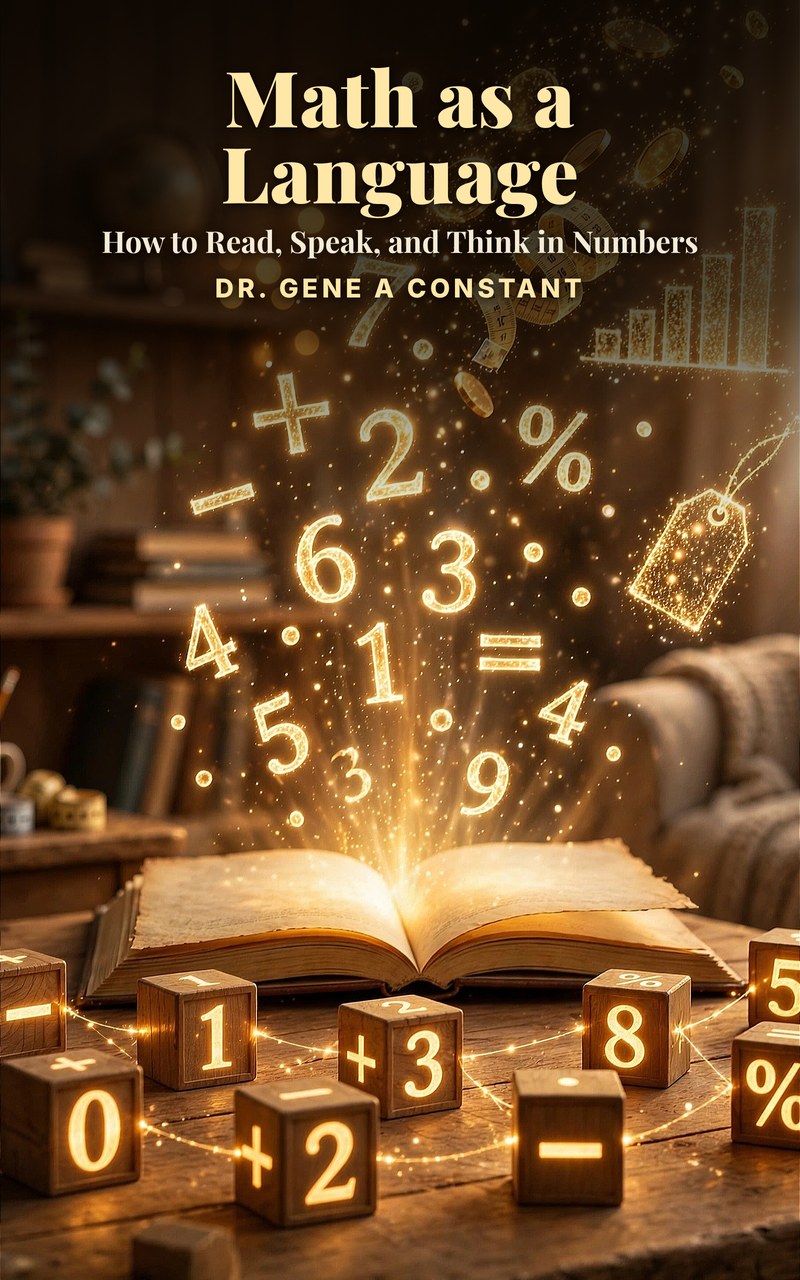
The whole idea, in one book
Chapters 8, 9 and 10 of Math as a Language go further than this page. Chapter 1 is free to read.
Read Chapter 1 free