4th Grade Math Workbook: Real-World Problem Solving
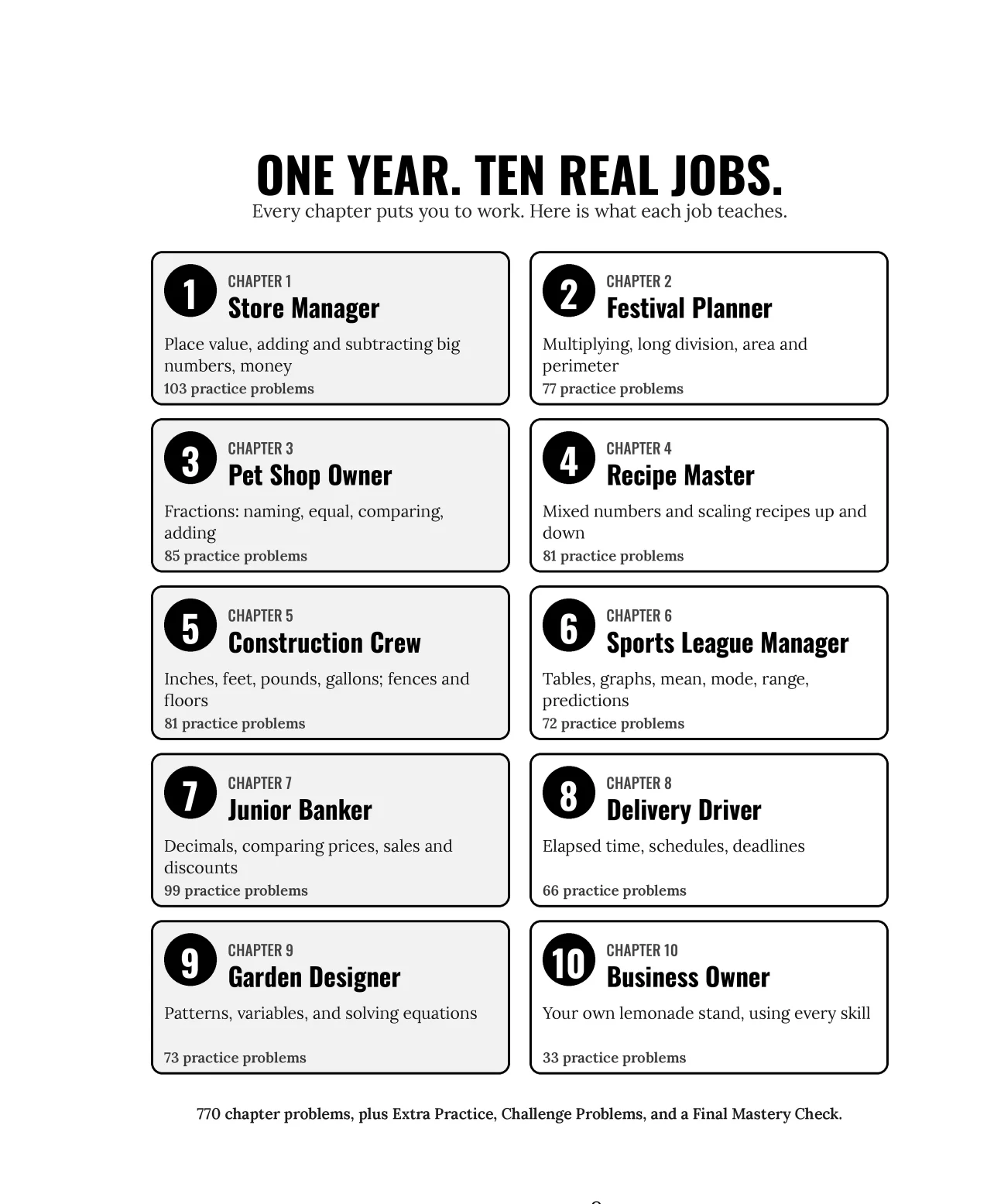
Ten real jobs. One year of fourth-grade math. Every problem has a reason.
A full year of fourth-grade math built around ten real jobs, from store manager to lemonade stand owner: 770 chapter problems with room to work every one, a complete answer key, a free ten-lesson class and a free certificate.
Contents
Paperback, 172 pages, 8.5 x 11 inches, black and white, with 770 chapter problems, Extra Practice, Challenge Problems, a Final Mastery Check and a complete answer key.
Welcome to Your Workbook · The Six Rooms · One Year. Ten Real Jobs. · Your Free GSU Toolkit · The Grade Level Check · Meet GENO
Chapter 1: The Classroom Store. You are hired to manage the Classroom Store, a student-run shop that sells supplies to the whole school. You count thousands of items, round for reports, add deliveries, subtract sales, and balance the cash register to the penny.
Chapter 2: The Festival Planner. You lead the planning committee for the school's Fall Festival, the biggest event of the year. You multiply to order prizes and seats, divide money fairly among charities, and measure area and perimeter to lay out the grounds.
Chapter 3: The Pet Shop Owner. You own Paws & Fins Pet Shop, where fractions decide how much each animal eats and how the shop's space is shared. You name fractions, find equivalent ones, compare them, and add and subtract them to keep every animal fed and every tank clean.
Chapter 4: The Recipe Master. You run the school cafeteria kitchen, where every recipe must be doubled for big events or cut down for small ones. You convert between mixed numbers and improper fractions, add and subtract them, and multiply fractions to scale recipes up and down.
Chapter 5: The Construction Crew. You join the crew building a new playground for the elementary school. You convert inches, feet, and yards, find perimeter for fences and area for surfaces, and convert pounds, tons, gallons, and cups to order the right materials.
Chapter 6: The Sports League Manager. You manage a youth sports league, where the standings decide who makes the playoffs. You read data tables and bar graphs, find the mean, mode, and range, and use data to make fair predictions.
Chapter 7: The Savings Account. You open a junior savings account and become the family's smartest shopper. You read, compare, add, subtract, and multiply decimals, and you learn to figure out sales and discounts so you always know which deal is really better.
Chapter 8: The Delivery Driver. You drive for Express Delivery, where every package has a deadline. You find how much time passes between two clock times, plan routes and schedules, work backward from a deadline, and convert between hours, minutes, and seconds.
Chapter 9: The Garden Designer. You design gardens for Green Thumb Landscapes, where plants are set out in patterns that grow row by row. You find and extend patterns, use letters to stand for numbers, solve equations to find what is missing, and discover the rule behind an input-output table.
Chapter 10: The Business Plan. You open your own lemonade stand and run it as a real business. Every skill in the book comes together: startup costs, recipe scaling, pricing and profit, hours and customers, sales data, growth patterns, and the layout of your stand.
Extra Practice and Review · Math Dictionary · Math at Work: Five Teaching Cases · Your Math Toolbox Card · Answer Key · About the Author
Welcome to Your Workbook
This year, you become a problem solver who uses mathematics in the real world. Instead of working through pages of numbers that never go anywhere, you will take on ten real jobs: store manager, festival planner, pet shop owner, recipe master, construction worker, sports league manager, junior banker, delivery driver, garden designer, and finally the owner of your very own lemonade stand. Every problem in this book is something a person in that job would actually need to figure out, and every skill you learn is one you will use for the rest of your life.
How to Use This Book
Each chapter is one job. It opens with The Scenario, which puts you in the role, and The Skill, which explains the mathematics. Worked Examples, in outlined boxes, show every step of a solution, and the Practice problems give you room to work each one yourself. Each chapter ends with an Action Report that uses all of its skills together. At the back of the book you will find Extra Practice, Challenge Problems, a Cumulative Review, and a Final Mastery Check, followed by a Math Dictionary, five teaching cases, a Math Toolbox Card to cut out, and a complete Answer Key.
How to Show Your Work
Every problem has a box for your work. Use it! The process matters as much as the answer, because it is how you find your own mistakes. Step 1, Read Carefully: what information is given, and what are you trying to find? Step 2, Plan: which operation will you use, and can you estimate first? Step 3, Calculate: write each step, line up your numbers neatly, and label your work. Step 4, Check: does your answer match your estimate, and does it make sense?
Worked Example. Showing Your Work Problem: The store sold 1,234 pencils on Monday and 2,456 on Tuesday. How many in all? Estimate: 1,200 + 2,500 = 3,700. Calculate: 1,234 + 2,456 = 3,690. Check: 3,690 is close to 3,700. Answer: 3,690 pencils.
For Grown-Ups
The Answer Key at the back gives every answer to every problem, and every one was computed and checked by computer before this book was printed. Each chapter title has a QR code that opens that chapter's free online lesson at Global Sovereign University, where your child can hear the chapter read aloud and try hands-on Mini-Workshops. The Free GSU Toolkit page lists everything else waiting online, and GENO, our free tutor, is ready to help any hour of the day or night.
Chapter 1: The Classroom Store
Chapter Goal: Use place value and multi-digit operations to run a school supply business.
Free lesson: The Classroom Store. Hear the chapter read aloud, try the hands-on Mini-Workshops, and check yourself. No account.
Congratulations! You have just been hired as the manager of the Classroom Store, a student-run business that sells school supplies to your entire school. Running a store takes careful mathematical thinking every single day. You will track thousands of items, handle real money, decide when to order more, and make sure every customer leaves happy. A store manager who cannot count, compare, add, and subtract quickly loses money, and a manager who can do all four keeps the shelves full and the register right. Let's open for business!
Section 1: Taking Inventory: Understanding Large Numbers
The Scenario. The school district just delivered your starting inventory: 3,256 pencils, 1,847 erasers, 2,093 notebooks, 4,125 sticker sheets, and 5,678 index cards. You need to record these quantities accurately in your inventory system. One mistake could mean running out of supplies in the middle of the school year or wasting the store's money on items you do not need.
The Skill: Place Value. Place value means that the position of each digit decides how much it is worth. In the number 3,256, the 3 is in the thousands place, so it means 3,000. The 2 is in the hundreds place, so it means 200. The 5 is in the tens place, so it means 50. The 6 is in the ones place, so it means 6. Understanding place value is what lets you read, write, compare, and round large numbers without mistakes.
Worked Example. Breaking Down 3,256 Standard form: 3,256 Expanded form: 3,000 + 200 + 50 + 6 Word form: three thousand, two hundred fifty-six Each digit is worth something different because of WHERE it sits. The 3 is worth 3 × 1,000 = 3,000.
Worked Example. Comparing 4,256 and 4,265 Compare from left to right, starting with the biggest place. Thousands: both have 4, so keep looking. Hundreds: both have 2, so keep looking. Tens: 5 is less than 6. Answer: 4,256 < 4,265. The first place that is different decides which number is larger.
Worked Example. Rounding 4,783 to the Nearest Hundred Step 1: Find the hundreds digit. It is 7. Step 2: Look at the digit just to its right, in the tens place. It is 8. Step 3: 8 is 5 or more, so round up. Answer: 4,783 rounds to 4,800. If the tens digit had been 4 or less, the answer would round down to 4,700.
Worked Example. Rounding 6,549 to the Nearest Thousand Step 1: Find the thousands digit. It is 6. Step 2: Look at the hundreds digit. It is 5. Step 3: 5 is 5 or more, so round up. Answer: 6,549 rounds to 7,000.
Practice: Place Value
- Write 5,384 in expanded form.
- What is the value of the digit 7 in 6,742?
- Compare using <, >, or =: 4,256 ___ 4,265
- Write the number that has 8 thousands, 3 hundreds, 0 tens, and 5 ones.
- Order from least to greatest: 3,842; 3,824; 3,482; 3,248
- Write 2,456 in word form.
- Round 4,783 to the nearest hundred.
- Which is greater, 6,099 or 6,100? Explain your reasoning.
- Write the smallest 4-digit number you can make using 7, 2, 9, and 4, using each digit once.
- Write the largest 4-digit number you can make using 3, 8, 1, and 6, using each digit once.
- A shipping box holds 8 thousands, 12 hundreds, 4 tens, and 3 ones worth of items. Write the total in standard form. (Hint: regroup the 12 hundreds!)
- The store sold 3,456 items last month and 3,564 items this month. Which month had more sales?
- Write 9,007 in expanded form. (Watch out for the zeros!)
- Round 6,549 to the nearest thousand.
- What number is 100 more than 4,967?
- Compare using <, >, or =: 7,890 ___ 7,809
- In the number 45,678, what is the value of the 5?
- Order from greatest to least: 5,678; 5,687; 5,768; 5,867
- Round 3,450 to the nearest hundred. (Hint: what happens when the digit to the right is exactly 5?)
- What number is 1,000 less than 8,234?
- The district warehouse is holding 24,608 pencils for next year. What is the value of the digit 4 in that number?
- Your inventory sheet lists 5,678 index cards and 5,687 sticker sheets. Which item does the store have more of?
- The principal wants every count rounded to the nearest hundred for the school newsletter. Round 3,256 pencils, 1,847 erasers, and 2,093 notebooks.
- A box label reads: 3 thousands, 0 hundreds, 9 tens, 2 ones. How many items are in the box?
Section 2: Monday Restock: Multi-Digit Addition
The Scenario. Two deliveries arrived this morning! You had 1,347 pencils in stock. Delivery #1 brought 2,456 more pencils, and Delivery #2 brought another 1,234. Before you can sell a single pencil, you need your new inventory total. Accurate addition is how a manager knows what is really on the shelves.
The Skill: Addition With Regrouping. When a column adds up to 10 or more, you regroup (some people say carry) the extra ten to the next place to the left. Always estimate first, so you can tell whether your exact answer makes sense. A good estimate rounds each number to a convenient place, adds those, and gives you a target to check against.
Worked Example. Adding 1,347 + 2,456 Step 1, estimate: round to the nearest hundred. 1,300 + 2,500 = 3,800. Step 2, add each column from right to left. Ones: 7 + 6 = 13. Write 3, regroup 1 ten. Tens: 1 + 4 + 5 = 10. Write 0, regroup 1 hundred. Hundreds: 1 + 3 + 4 = 8. Write 8. Thousands: 1 + 2 = 3. Write 3. Answer: 3,803 pencils. That matches the estimate of 3,800.
Worked Example. Adding Three Numbers: 1,347 + 2,456 + 1,234 Method 1: add two at a time. 1,347 + 2,456 = 3,803, then 3,803 + 1,234 = 5,037. Method 2: stack all three numbers and add each column. Answer: 5,037 pencils in all.
Worked Example. Adding Money: $1,234.56 + $2,789.34 Key rule: line up the decimal points! Add the cents: 56 + 34 = 90 cents. Add the dollars: 1,234 + 2,789 = 4,023 dollars. Answer: $4,023.90
Worked Example. Checking with an Estimate Problem: 4,892 + 3,567 Estimate: 5,000 + 4,000 = 9,000. Exact: 4,892 + 3,567 = 8,459. Check: 8,459 is close to 9,000, so the answer makes sense.
Practice: Multi-Digit Addition
- Calculate: 2,456 + 1,378
- Calculate: 3,847 + 2,956
- The store has 1,245 red pens. A delivery brings 2,367 more. How many red pens does the store have now?
- Calculate: 456 + 789 + 234
- The store earned $1,456 on Monday, $2,378 on Tuesday, and $1,892 on Wednesday. What were the total earnings for the three days?
- Calculate: 5,678 + 3,456
- Three deliveries brought 2,456, 3,789, and 1,234 items. How many items arrived in all?
- Estimate first by rounding to the nearest thousand, then calculate exactly: 4,892 + 3,567
- The store had 3,456 notebooks. It received 1,234 more on Tuesday and 2,567 more on Thursday. What is the new total?
- Calculate: 6,789 + 2,345 + 1,876
- The store's three busiest days brought in $4,567, $5,234, and $3,899. What were the total sales for those three days?
- Calculate: 7,654 + 2,789
- You combine the supplies from three storage boxes holding 2,345, 1,876, and 3,459 items. How many items do you have?
- Calculate: 8,234 + 567 + 3,491
- Add: $234.56 + $567.89 + $123.45
- Four boxes of erasers hold 1,250, 1,340, 1,125, and 1,285 erasers. How many erasers are there in all?
- Calculate: 9,999 + 1. What happens to every place?
- The store made five bank deposits this week: $456.78, $523.45, $398.67, $612.34, and $445.89. What was the total deposited?
- Calculate: 4,567 + 3,892 + 2,541
- What is the total of the whole starting inventory: 3,256 pencils, 1,847 erasers, 2,093 notebooks, 4,125 sticker sheets, and 5,678 index cards?
- The store received 1,250 pencils on Monday, 875 on Tuesday, and 1,125 on Wednesday. How many pencils arrived over the three days?
- The school book fair sold 2,345 tickets on Friday and 1,987 on Saturday. How many tickets did it sell in all?
- The parent group donated $1,250.00 and the PTA donated $875.50 for new supplies. How much money did the store receive?
Section 3: The Big Sale: Multi-Digit Subtraction
The Scenario. It is the Back-to-School Sale! You started the day with 5,037 pencils and sold 2,789 of them by lunchtime. How many pencils are left? Knowing your current inventory keeps you from disappointing customers who come in after lunch wanting to buy supplies.
The Skill: Subtraction With Regrouping. When the top digit in a column is smaller than the bottom digit, you regroup (some people say borrow) from the next place to the left. It works just like breaking a ten-dollar bill into ten one-dollar bills: you have the same amount of money, just in smaller pieces. When the next place is a zero, you keep going left until you find a place you can regroup from.
Worked Example. Subtracting 5,037 − 2,789 Estimate: 5,000 − 3,000 = 2,000. Ones: 7 − 9 will not work. Regroup 1 ten: the tens digit 3 becomes 2, and the ones become 17. 17 − 9 = 8. Tens: 2 − 8 will not work. The hundreds digit is 0, so regroup 1 thousand: the thousands become 4 and the hundreds become 10. Now regroup 1 hundred: the hundreds become 9 and the tens become 12. 12 − 8 = 4. Hundreds: 9 − 7 = 2. Thousands: 4 − 2 = 2. Answer: 2,248 pencils remain. That is close to the estimate of 2,000.
Worked Example. Subtracting from Zeros: 6,000 − 3,456 Regroup through every zero: 6,000 becomes 5 thousands, 9 hundreds, 9 tens, and 10 ones. Now subtract: 10 − 6 = 4, 9 − 5 = 4, 9 − 4 = 5, 5 − 3 = 2. Answer: 2,544
Worked Example. Making a Reorder Decision Current stock: 2,248 pencils. Reorder point: 2,000 pencils (the level where you order more). 2,248 − 2,000 = 248 pencils above the reorder point. But the sale is still going! If you expect to sell 300 or more pencils this afternoon, you will drop below 2,000. Decision: place the reorder now, so you do not run out.
Worked Example. Checking Subtraction with Addition Problem: 7,234 − 4,567 Answer: 2,667 Check: 2,667 + 4,567 = 7,234. It matches, so the answer is right. If the check does not match, work the problem again.
Practice: Multi-Digit Subtraction
- Calculate: 5,234 − 2,678
- The store had 4,567 erasers and sold 1,789. How many erasers remain?
- Calculate: 6,000 − 3,456
- The register held $8,456. The cashier gave out $3,789 in change. How much money remains in the register?
- Calculate: 7,234 − 4,567
- The store started the week with 5,000 notebooks. It sold 2,347 on Monday and 1,456 on Tuesday. How many notebooks are left?
- Calculate: 9,000 − 4,567
- The reorder point for markers is 1,500. The store had 4,234 markers and sold 2,856. Does the store need to reorder? By how many is it above or below the reorder point?
- Calculate: 8,234 − 3,789
- The store had 6,543 items. It sold 2,345, then customers returned 123. What is the current inventory?
- Calculate: 7,006 − 2,789
- The store's yearly budget is $10,000. It has spent $7,234. How much of the budget remains?
- Calculate: 5,003 − 1,678
- Last year the store's total sales were $45,678. This year they were $52,345. How much more did the store sell this year?
- Calculate: 8,040 − 3,567
- Subtract: $500.00 − $267.89
- Calculate: 10,000 − 6,543
- The store started the week with 8,500 items. Daily sales were 1,234; 1,456; 1,789; 1,123; and 1,567. How many items remain at the end of the week?
- Calculate: 9,001 − 5,678
- The store had a $25,000 budget. Its expenses were $8,456, $7,234, and $5,678. How much budget remains?
- The store had 3,500 folders. A teacher bought 1,275 for the whole fourth grade. How many folders are left?
- Last year the store sold 12,480 pencils. This year it sold 14,105. How many more pencils did it sell this year?
Section 4: Counting the Register: Money Math
The Scenario. The store closes at 3:00 PM, and it is time to count the register. You started the day with $1,234.56 in the drawer. Customers paid a total of $6,789.34, and you gave back $3,456.78 in change. How much should the register hold now? If the count does not match, a mistake happened somewhere, and a good manager finds it.
The Skill: Decimal Operations With Money. Money uses decimals. The digits after the decimal point are cents: the first is dimes (tenths of a dollar) and the second is pennies (hundredths of a dollar). The most important rule is to always line up the decimal points before you add or subtract, so that dollars add to dollars and cents add to cents.
Worked Example. Balancing the Register Starting amount: $1,234.56 Plus customer payments: $6,789.34 Subtotal: $8,023.90 Minus change given: $3,456.78 The register should hold $4,567.12. If the actual count does not match, there is an error somewhere.
Worked Example. Making Change: A Customer Pays $100 for a $67.89 Purchase Method 1, subtract: $100.00 − $67.89 = $32.11. Method 2, count up: $67.89 to $67.90 is 1 cent; $67.90 to $68.00 is 10 cents; $68.00 to $70.00 is $2; $70.00 to $100.00 is $30. Total: 1¢ + 10¢ + $2 + $30 = $32.11. Both methods agree.
Worked Example. Adding Several Days of Sales Monday $234.56, Tuesday $567.89, Wednesday $345.67 Line up the decimal points and add. Total: $1,148.12
Worked Example. Finding How Much More Is Needed Goal: raise $5,000 for new display shelves. The store has $3,678.90. $5,000.00 − $3,678.90 = $1,321.10 still needed.
Practice: Money Math
- Add: $45.67 + $123.89
- Subtract: $234.56 − $78.90
- The register holds $456.78. You take in $234.56 in sales. What is the new total?
- A customer pays $100.00 for a $67.89 purchase. How much change does the customer get?
- Add: $45.67 + $89.12 + $34.56
- The register holds $1,234.56. You give $567.89 in change. How much remains?
- Calculate: $456.78 + $234.56 + $789.12
- Subtract: $1,000.00 − $678.90
- Monday sales were $2,345.67 and Tuesday sales were $3,456.78. What were the combined sales?
- A customer's total is $89.99. She pays with a $100 bill. How much change is due?
- The register started with $500. It took in $2,345.67 in sales and gave out $1,234.56 in change. What is the register total now?
- The store needs $5,000.00 for new shelves and has $3,678.90. How much more does it need?
- Calculate: $250.00 + $675.50 − $123.89
- A teacher made three purchases: $45.99, $67.50, and $123.75. What was the total?
- The store had $2,500.00. It spent $456.78, $234.56, and $189.99 on supplies. How much is left?
- Weekly earnings were $1,234.56, $1,567.89, $1,345.67, $1,456.78, and $1,789.34. What was the total for the week?
- A customer pays $50.00 for a $23.47 item. How much change is due?
- The store's bank balance is $4,567.89. The manager deposits $1,234.56, then withdraws $500.00. What is the new balance?
- A calculator is priced at $199.99, and the sales tax is $16.50. What is the total due?
- The store had a $10,000.00 budget. Its expenses were $2,345.67, $3,456.78, and $1,234.56. How much remains?
- A customer buys a notebook for $3.49 and a pack of pens for $4.25, and pays with a $10 bill. How much change does he get?
- Use counting up to find the change: a $6.35 purchase is paid with a $20 bill.
Chapter 1 Action Report: Store Manager's Weekly Summary
Complete this manager's report using ALL of your Chapter 1 skills. Show your work for every problem, because a manager's report is only as good as the math behind it.
Inventory Report, Financial Report, and Analysis
- TOTAL INVENTORY: The store has 3,456 pencils, 2,789 pens, 4,123 markers, and 1,892 erasers. What is the total number of writing supplies?
- WEEKLY SALES: The store sold 1,234 pencils on Monday, 987 on Tuesday, 1,456 on Wednesday, 876 on Thursday, and 1,547 on Friday. How many pencils were sold this week?
- REMAINING STOCK: The week started with 8,456 pencils, and the store sold the total from problem 2. How many pencils remain?
- REORDER CHECK: The reorder point is 1,500 pencils. Based on problem 3, does the store need to reorder? By how much is it above or below the reorder point?
- DAILY REGISTER: The register started at $567.89, took in $4,567.34 in payments, and gave out $2,345.67 in change. What is the ending balance?
- WEEKLY REVENUE: Sales were Monday $1,234.56, Tuesday $987.34, Wednesday $1,567.89, Thursday $876.54, and Friday $2,345.67. What was the total weekly revenue?
- PROFIT: Take the weekly revenue from problem 6 and subtract weekly expenses of $4,567.00. What was the weekly profit?
- BUDGET STATUS: The monthly budget is $25,000. The store spent $5,678.90 in Week 1 and $6,234.56 in Week 2. How much of the budget remains?
- PLACE VALUE: The store's inventory ID number is 48,052. Write it in expanded form and in word form.
- COMPARISON: Store A sold 4,567 items, Store B sold 4,657 items, and Store C sold 4,576 items. Rank the stores from most to least sales.
- ROUNDING: For the monthly report, round the total inventory of 12,847 items to the nearest thousand.
- ESTIMATION: Estimate 4,892 + 3,178 by rounding each number to the nearest thousand, then calculate the exact answer. How close was your estimate?
The answers to every problem, and Chapters 2 through 10, are in the book.