
50 Ways to Learn a Trade: From the First Cut to the Final Inspection
From the first cut to the final inspection: fifty free ways to build your trade.
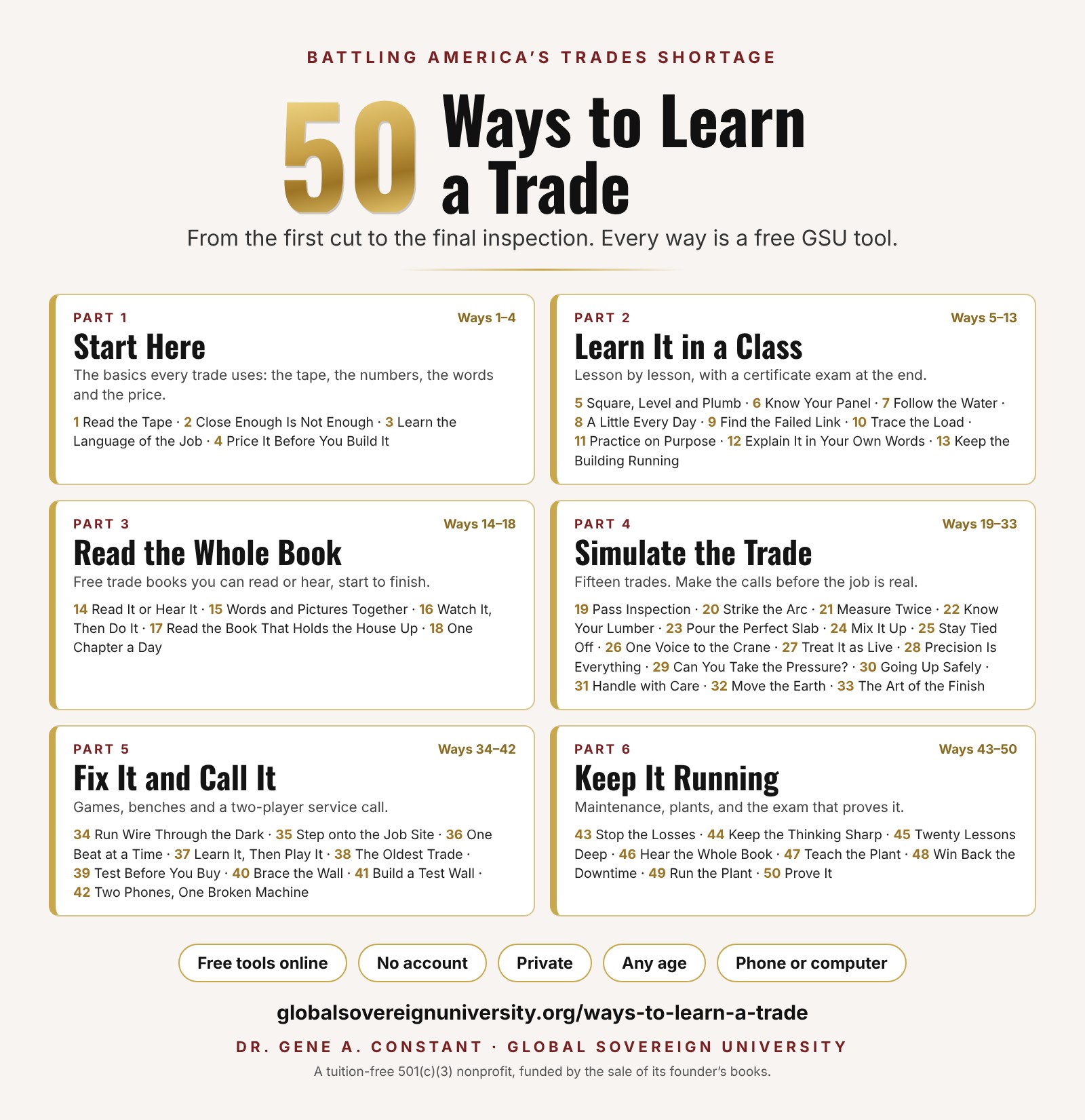
Fifty free ways to learn a trade, each with a short story, the research behind it, practice on the page and a QR code that opens a free GSU tool: classes with certificate exams, fifteen trade simulators, free trade books, diagnostic benches and The Call-In.
Contents
Paperback, 140 pages, 8.5 x 11 inches, black and white. Every chapter has a QR code that opens a free GSU tool, and every one of the 50 ways is also free at globalsovereignuniversity.org/ways-to-learn-a-trade.
Welcome · A Note to the Helper
Part 1. Start Here. The basics every trade uses: the tape, the numbers, the words and the price. 1. Read the Tape; 2. Close Enough Is Not Enough; 3. Learn the Language of the Job; 4. Price It Before You Build It.
Part 2. Learn It in a Class. Lesson by lesson, with a certificate exam at the end. 5. Square, Level and Plumb; 6. Know Your Panel; 7. Follow the Water; 8. A Little Every Day; 9. Find the Failed Link; 10. Trace the Load; 11. Practice on Purpose; 12. Explain It in Your Own Words; 13. Keep the Building Running.
Part 3. Read the Whole Book. Free trade books you can read or hear, start to finish. 14. Read It or Hear It; 15. Words and Pictures Together; 16. Watch It, Then Do It; 17. Read the Book That Holds the House Up; 18. One Chapter a Day.
Part 4. Simulate the Trade. Fifteen trades. Make the calls before the job is real. 19. Pass Inspection; 20. Strike the Arc; 21. Measure Twice; 22. Know Your Lumber; 23. Pour the Perfect Slab; 24. Mix It Up; 25. Stay Tied Off; 26. One Voice to the Crane; 27. Treat It as Live; 28. Precision Is Everything; 29. Can You Take the Pressure?; 30. Going Up Safely; 31. Handle with Care; 32. Move the Earth; 33. The Art of the Finish.
Part 5. Fix It and Call It. Games, benches and a two-player service call. 34. Run Wire Through the Dark; 35. Step onto the Job Site; 36. One Beat at a Time; 37. Learn It, Then Play It; 38. The Oldest Trade; 39. Test Before You Buy; 40. Brace the Wall; 41. Build a Test Wall; 42. Two Phones, One Broken Machine.
Part 6. Keep It Running. Maintenance, plants, and the exam that proves it. 43. Stop the Losses; 44. Keep the Thinking Sharp; 45. Twenty Lessons Deep; 46. Hear the Whole Book; 47. Teach the Plant; 48. Win Back the Downtime; 49. Run the Plant; 50. Prove It.
The 30-Day Plan · Answers · Research Sources · The Dictionary · My Notes · The Grade Level Check · About the Author
Welcome
This book gives you 50 ways to learn a trade. You do not need to use them all. You do not need to go in order. Pick one that fits you today, and start there.
Many people are looking for a path that does not begin with years of debt. The skilled trades are one of the oldest and most honest of those paths: you learn by doing, you are paid for what you can do, and your work stands where everyone can see it.
GSU does not just talk about the trades. We put the tools in your hands: classes with certificate exams, whole trade books you can read or hear, fifteen trade simulators, diagnostic benches, and a two-player game where one of you is at the machine and the other is on the phone. Every way in this book is free, and every one was tested on the day this book was built.
A GSU certificate is a Certificate of Comprehension. It shows you read and understood the material. It is not a trade license. Licenses come from your state and your apprenticeship. This book helps you get ready for them.
Every chapter has the same parts, so you always know what comes next.
- A Short Story: A person who tried this way. Each one is a teaching case, made up to show how it works.
- What It Is: The way to learn, in plain words.
- Why It Works: The research behind it. Every source is listed at the back of the book.
- Try It Now, on Paper: Practice right here. Write in this book. It is yours. The answers are at the back.
- Do It with GSU: Point your phone’s camera at the code. It opens a free tool from Global Sovereign University.
- For the Helper: Tips for the person who helps you.
- I Can Do This: Check the boxes when you are done, and write the date.
If you can, learn with a helper: a family member, a friend, a tradesperson, or anyone who will practice with you. Chapter 42, The Call-In, is built for two.
There is a 30-day plan at the back of this book. It gives you one small step a day.
Safety comes first in every trade. This book teaches the knowledge and the math. Real electrical, gas, roofing and structural work belongs to trained and licensed people, and you should work beside them until you are one.
Chapter 1. Read the Tape
A Short Story
Darius is twenty. He gets hired as a helper on a remodel crew. On day one, the lead carpenter calls out, "Cut me a stud at ninety-two and five-eighths." Darius stares at the tape. So many little lines. He guesses, and the stud comes out short. Wood costs money.
That night he practices on a scrap of board. Inches first, then halves, quarters, eighths and sixteenths. By Friday he calls the numbers back before he cuts. By the end of the month, the lead hands him the tape and lets him measure for the whole crew.
Darius is not a real person. His story is a teaching case, made up to show how this works.
What It Is
Every trade starts with the tape measure. Each inch is split into halves, quarters, eighths and sixteenths. The shorter the mark, the smaller the piece. You also change units all day: inches to feet, feet to yards, cups to gallons.
Measurement Master is GSU's free practice for reading a tape and converting units.
Why It Works
Researcher Wendy Millroy worked beside a crew of carpenters for months. She found they used real geometry and measurement every day, with methods school never taught them. Measuring is not a small skill. It is the first floor of every trade, and anyone can learn it with practice.
Try It Now, on Paper
- How many sixteenths are in one inch? ______
- Which is longer, 5/8 inch or 9/16 inch? ______
- 7 feet 4 inches = ______ inches
- 96 inches = ______ feet
Answers are at the back of the book.
Do It with GSU
Point your phone's camera at the code below. It opens Measurement Master: tape measure reading and unit conversions, the foundation skill for every trade.
Open Measurement Master → (In the book, this is a QR code.)
For the Helper
Hand the learner a real tape. Call out a length, like "Show me 32 and 3/16." Let them find it. Then switch. Ten minutes a day with a real tape beats an hour with a worksheet.
I Can Do This
- ☐ I found 5/8 inch on a real tape measure.
- ☐ I changed feet and inches to inches.
Date: ____________
Source for this chapter: Millroy, W. L. (1992). An ethnographic study of the mathematical ideas of a group of carpenters. Journal for Research in Mathematics Education Monograph No. 5. National Council of Teachers of Mathematics.
Chapters 2 through 50, the 30-day plan, the answers and the research sources continue in the book.