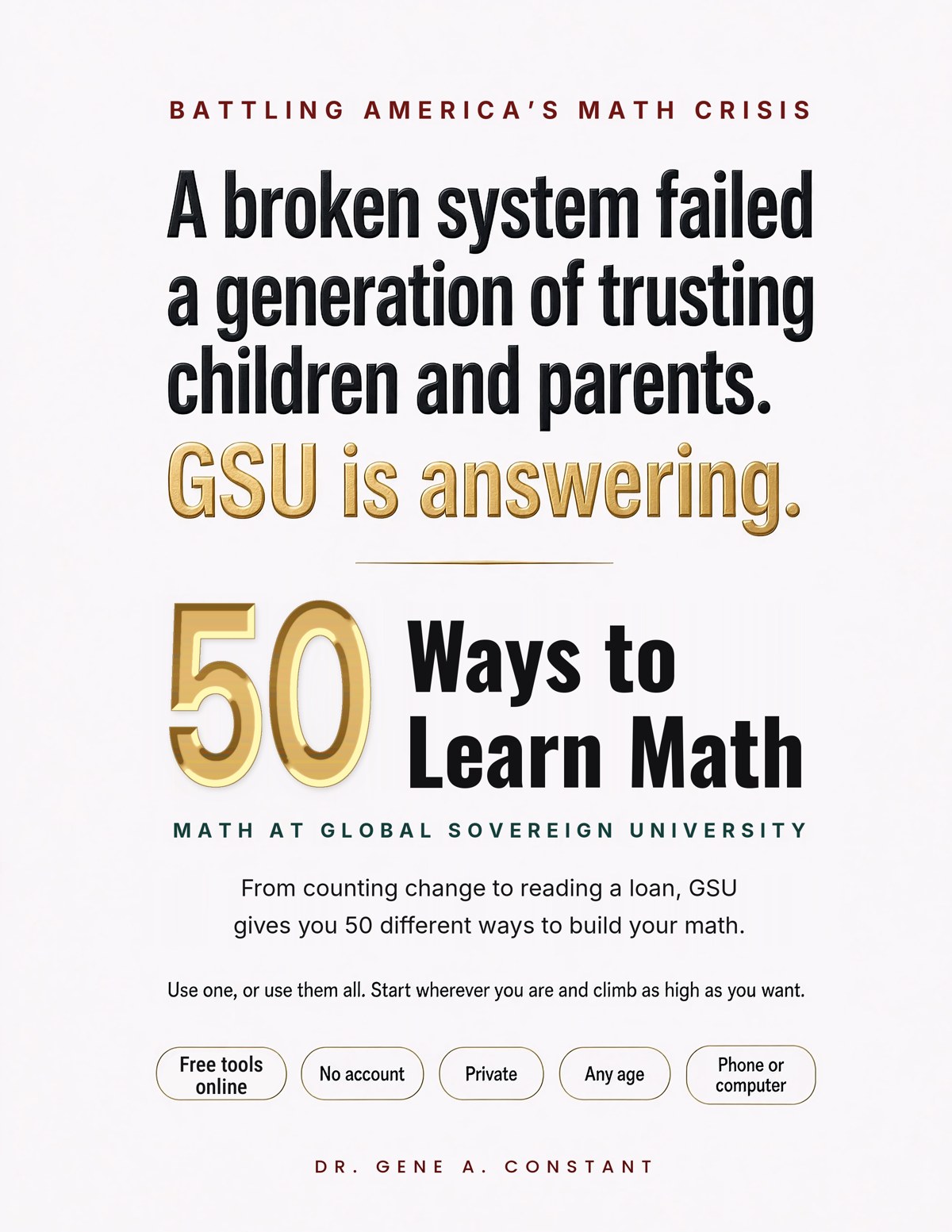
50 Ways to Learn Math: From Counting Change to Reading a Loan
From counting change to reading a loan: fifty free ways to build your math.
Fifty free ways to learn math, each with a short story, the research behind it, practice on the page and a QR code that opens a free GSU tool: graded classes with certificates, games, skill builders, money math and help with math anxiety.
Contents
Paperback, 138 pages, 8.5 x 11 inches, black and white. Every chapter has a QR code that opens a free GSU tool, and every one of the 50 ways is also free at globalsovereignuniversity.org/ways-to-learn-math.
Welcome · A Note to the Helper
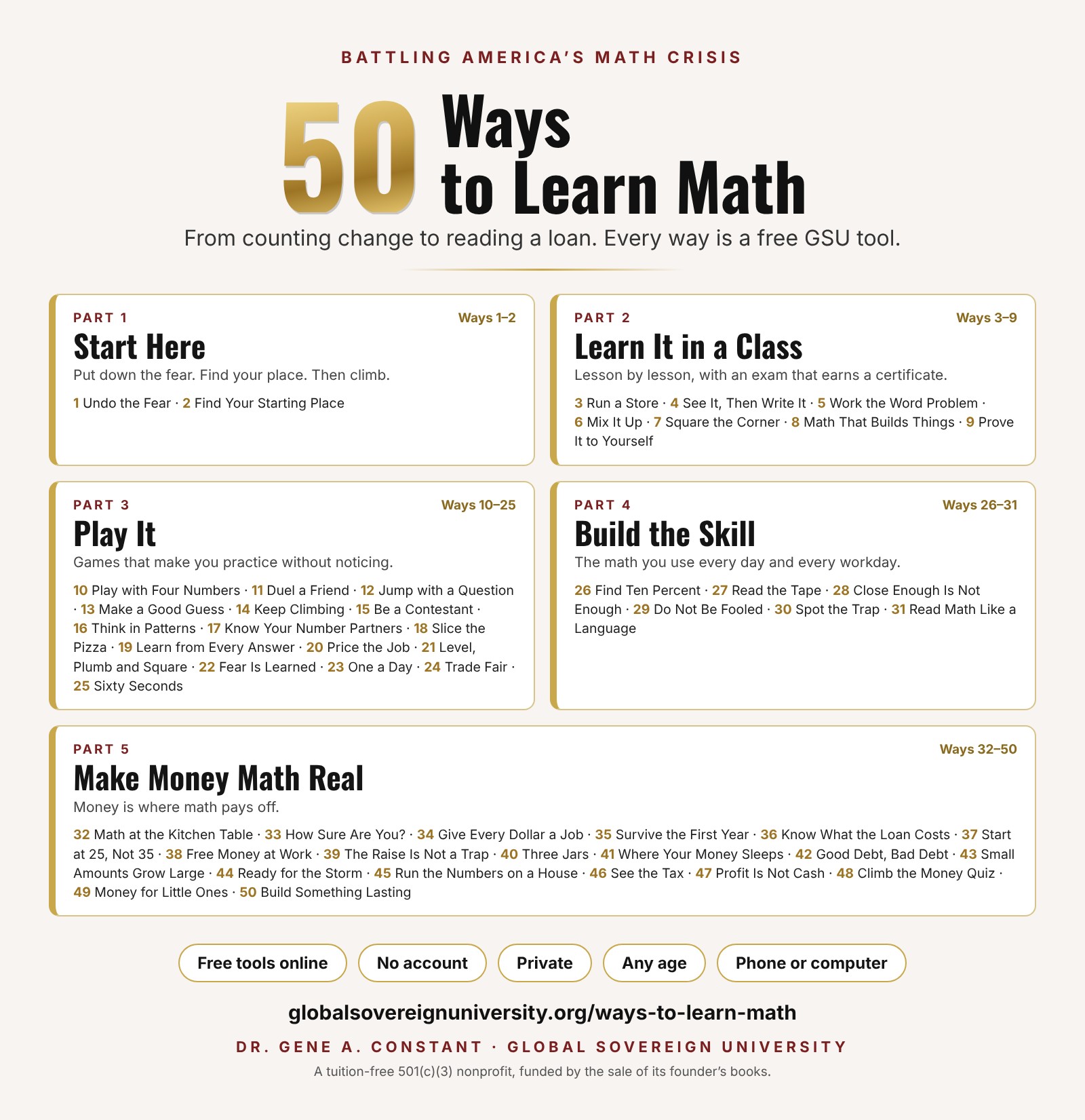
Part 1. Start Here. Put down the fear. Find your place. Then climb. 1. Undo the Fear; 2. Find Your Starting Place.
Part 2. Learn It in a Class. Lesson by lesson, with an exam that earns a certificate. 3. Run a Store; 4. See It, Then Write It; 5. Work the Word Problem; 6. Mix It Up; 7. Square the Corner; 8. Math That Builds Things; 9. Prove It to Yourself.
Part 3. Play It. Games that make you practice without noticing. 10. Play with Four Numbers; 11. Duel a Friend; 12. Jump with a Question; 13. Make a Good Guess; 14. Keep Climbing; 15. Be a Contestant; 16. Think in Patterns; 17. Know Your Number Partners; 18. Slice the Pizza; 19. Learn from Every Answer; 20. Price the Job; 21. Level, Plumb and Square; 22. Fear Is Learned; 23. One a Day; 24. Trade Fair; 25. Sixty Seconds.
Part 4. Build the Skill. The math you use every day and every workday. 26. Find Ten Percent; 27. Read the Tape; 28. Close Enough Is Not Enough; 29. Do Not Be Fooled; 30. Spot the Trap; 31. Read Math Like a Language.
Part 5. Make Money Math Real. Money is where math pays off. 32. Math at the Kitchen Table; 33. How Sure Are You?; 34. Give Every Dollar a Job; 35. Survive the First Year; 36. Know What the Loan Costs; 37. Start at 25, Not 35; 38. Free Money at Work; 39. The Raise Is Not a Trap; 40. Three Jars; 41. Where Your Money Sleeps; 42. Good Debt, Bad Debt; 43. Small Amounts Grow Large; 44. Ready for the Storm; 45. Run the Numbers on a House; 46. See the Tax; 47. Profit Is Not Cash; 48. Climb the Money Quiz; 49. Money for Little Ones; 50. Build Something Lasting.
The 30-Day Plan · Answers · Research Sources · The Dictionary · My Notes · The Grade Level Check · About the Author
Welcome
This book gives you 50 ways to learn math. You do not need to use them all. You do not need to go in order. Pick one that fits you today, and start there.
You are not alone if math feels hard. In 2024, the Nation’s Report Card found that 39 percent of eighth graders and 24 percent of fourth graders in the United States scored below its most basic level in math. Most of those students did not fail. They were failed. Math can be learned at any age.
Every chapter has the same parts, so you always know what comes next.
- A Short Story: A person who tried this way. Each one is a teaching case, made up to show how it works.
- What It Is: The way to learn, in plain words.
- Why It Works: The research behind it. Every source is listed at the back of the book.
- Try It Now, on Paper: Practice right here. Write in this book. It is yours. The answers are at the back.
- Do It with GSU: Point your phone’s camera at the code. It opens a free tool from Global Sovereign University.
- For the Helper: Tips for the person who helps you.
- I Can Do This: Check the boxes when you are done, and write the date.
If you can, learn with a helper. A helper can be a friend, a family member, a neighbor or a tutor. If you do not have a helper yet, you can still use every chapter. GENO, GSU’s free tutor, can help you any time.
There is a 30-day plan at the back of this book. It gives you one small step a day. Ten to fifteen minutes is enough.
You already use more math than you think: when you shop, cook, drive, build or pay a bill. This book helps you see it, name it and grow it.
Chapter 1. Undo the Fear
A Short Story
Tanya is fifty-one. She runs the front desk at a busy clinic. She is quick, kind and sharp. But when a patient asks her to work out a payment plan, her chest gets tight. Her face gets hot. She hands the form to someone else.
In fourth grade, a teacher made her stand at the board while the class watched. She got the answer wrong. She decided that day that she was "not a math person." For forty years, she believed it.
One evening, Tanya reads that math fear is learned, and that it can be unlearned. She writes her worry on a sheet of paper. Then she works one small problem. Then another. A month later, she builds a payment plan by herself.
Tanya is not a real person. Her story is a teaching case, made up to show how this works.
What It Is
Math anxiety is fear or dread when you face numbers. It is real. It is common. And it is not proof that you are bad at math.
Fear takes up room in your thinking. It is like trying to carry groceries while someone hands you a heavy box. Your hands are full before you start. When the fear gets smaller, your mind has room to work.
Why It Works
Researcher Mark Ashcraft found that math anxiety hurts math scores because worry uses up working memory, the space your brain uses to hold numbers while you think. In another study, students wrote about their worries for ten minutes before a test. Their scores went up. Writing the worry down cleared space to think.
Try It Now, on Paper
First, write one sentence about how math makes you feel. No one has to see it.
My math feeling: ______________________________________________
Now try these. Take your time. There is no clock.
- 10 + 7 = ______
- 25 + 25 = ______
- You have $20. You spend $8. How much is left? ______
Answers are at the back of the book.
Do It with GSU
Point your phone's camera at the code below. It opens The Math Anxiety Cure. It explains why so many people believe they are bad at math, and how to undo it, for yourself or your child.
Open The Math Anxiety Cure → (In the book, this is a QR code.)
For the Helper
Never time this learner at first. Never ask them to work in front of others. Say "Show me how you thought about it" instead of "That's wrong." If you feel nervous about math yourself, keep it to yourself. Fear spreads, and so does calm.
I Can Do This
- ☐ I wrote down my math feeling.
- ☐ I worked three problems with no clock.
Date: ____________
Source for this chapter: Ashcraft, M. H. (2002). Math anxiety: Personal, educational, and cognitive consequences. Current Directions in Psychological Science, 11(5), 181-185. Ramirez, G., & Beilock, S. L. (2011). Writing about testing worries boosts exam performance in the classroom. Science, 331(6014), 211-213.
Chapters 2 through 50, the 30-day plan, the answers and the research sources continue in the book.