60 Resources to Create or Grow Your Business
Forge Your Future: Turn Your Skill Into Your Own Business. Sixty free GSU tools, one per chapter, with a QR code for each.
A guide to sixty free tools at Global Sovereign University for anyone who wants to start or grow a business: classes, certificate exams, games, simulators and guides, one per chapter. It opens with two big ideas, the Cross-Industry Translator and Forge Your Future, and carries six case-study rooms, teaching cases and verified real cases. 196 pages.
Welcome
Sixty free tools at Global Sovereign University for anyone who wants to start or grow a business, one tool per chapter: classes, exams with certificates anyone can check, games, simulators, calculators and guides. You need no account and give no name. The book is 196 pages: two big ideas, five parts, six case-study rooms, teaching cases and verified real cases, a QR code for every tool, and Forge Your Future, where it all becomes one plan. Chapter 1, the book’s biggest idea, is below.
The tools in this book live on this website. Start at The Entrepreneur Hub, open The Dictionary of Equivalence (the tool this chapter teaches) or go straight to Forge Your Future. Free, no account.
Chapter 1: The Cross-Industry Translator
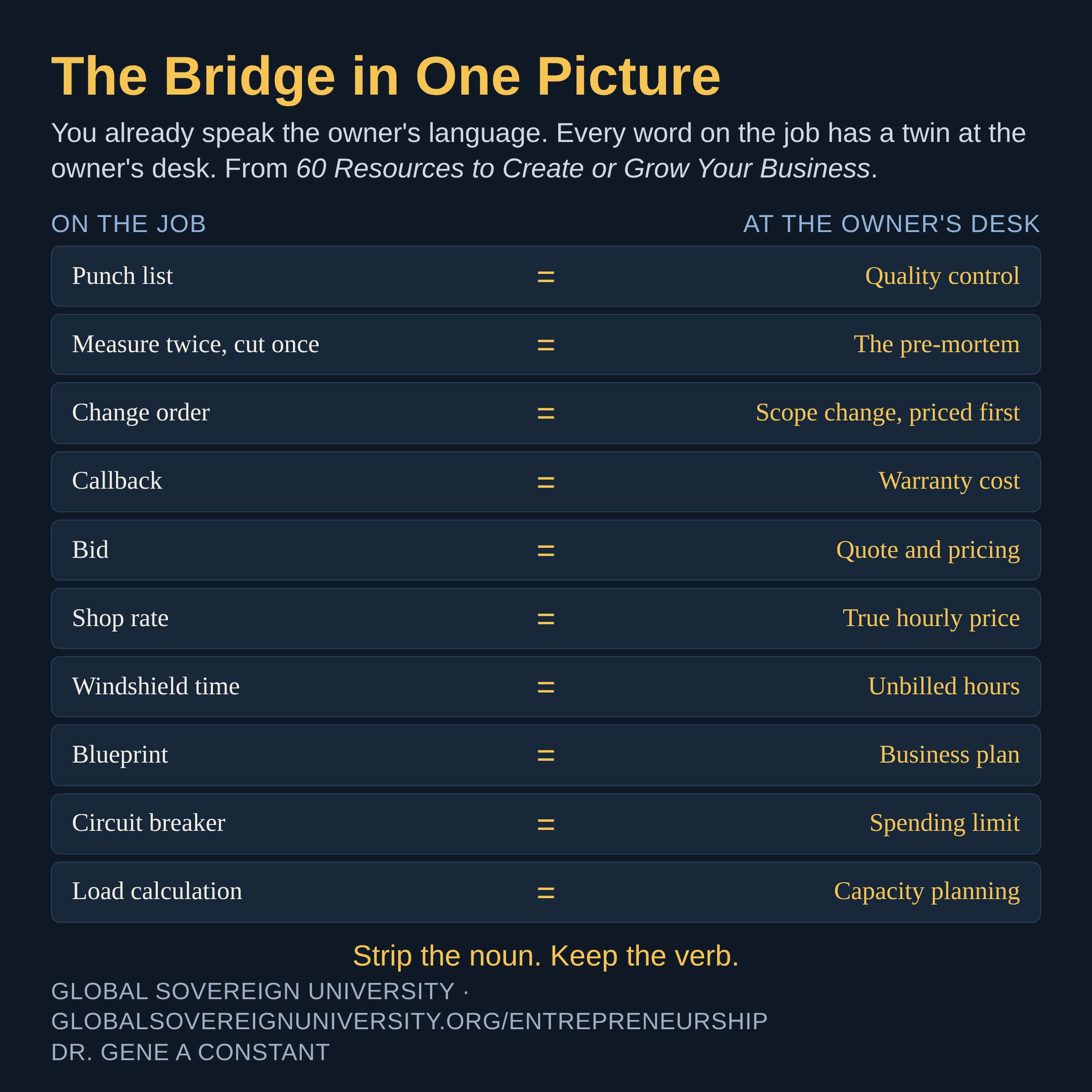
Bridging worlds. Strip the noun. Keep the verb. The single biggest idea in this book. Every word at the owner’s desk has a twin you already know on the job site, and every method that works in one industry can be borrowed by another. Learn to translate, and the owner’s world stops being a foreign country. Adapted from Chapter 8 of The Frankenstein Methodology by Dr. Gene A Constant.
What it is
The Cross-Industry Translator is the habit of taking a method that works in one world and putting it to work in another. It has three parts: explain your plan in the listener’s own words, borrow the mechanism and not the label, and get people from different trades to work as one crew. Its tool is the Dictionary of Equivalence, a free GSU page that pairs words you already use on the job with their twins at the owner’s desk, each linked to a free GSU tool.
What you will learn
- Why the business words you find intimidating are names for work you already do
- How to borrow a method from another industry without copying its costume
- How to explain your plan to a banker or a customer in their words, with nothing hidden
- How to get a crew, a subcontractor and a bookkeeper pulling the same direction
Try this first
- Open the Dictionary of Equivalence and find three words from your own trade.
- Read one entry’s owner’s move and do it this week.
- Pick one industry you know nothing about and read one article from its trade magazine.
The owner’s angle
Owners are not smarter than tradespeople. They have a different vocabulary for the same physical truths. A wall that is not plumb and a business that is not standardized fail the same way. Once you can translate, the owner’s world stops being a foreign country and becomes the next room of the house you are already building.
Teaching case
A realistic illustration, not a real person or business. A plumber keeps losing the first hour of every job hunting for fittings. She reads about restaurant kitchens and finds mise en place: every ingredient set out before the first order. She borrows the verb, not the noun. Every evening her truck is stocked for tomorrow’s jobs from a printed list. Her first hour now belongs to the customer, and she fits in one more job a week.
Three skills of a translator
The chapter this idea comes from has three parts. Each is a skill you can practice. Together they turn a skilled worker into an owner who can learn from anywhere.
- Speak the listener’s language. Explain the same plan in the words of the person across the table. Same facts, same numbers, same risks.
- Strip the noun, keep the verb. Ignore what another industry calls a method. Copy what it does, and put it to work in yours.
- Make experts work as one. Give the crew, the subs and the office one measure, one board and one table.
Skill 1: Speak the listener’s language
Inside your own crew you talk fast and plain. Out loud on the job, a change order is a change order and a callback is money walking out the door. When you sit across from a banker, an insurance agent, a city inspector or a homeowner, the same truths need different words. The chapter this idea comes from shows a team translating its own sharp term, “Logic Inversion,” into the plain business phrase “Outcome-Based Planning.” Same plan. Different listener.
This book teaches the honest version of that skill. Translating means the listener hears every fact, every number and every risk, in words they already use. Concealing means choosing words so the listener will not look closely. The first builds trust. The second is a lie with a nice haircut, and at GSU it is never the move.
One more warning from the chapter: never start thinking in the soft words yourself. Keep your own plan in the sharp language of the job site, where a crack is a crack. Translate on the way out the door, not on the way into your head.
Try it. Write one sentence about your business the way you would say it to your crew. Then write it the way you would say it to a loan officer. Read both. If the loan officer’s version leaves out a risk, it is not a translation yet.
Skill 2: Strip the noun, keep the verb
The heart of the chapter is one rule: strip the noun and keep the verb. Every industry dresses its best methods in its own costume. A pit crew, an army and a factory all have names for things that would mean nothing in your shop. Underneath the costume is a verb, something the method does, and verbs travel.
- Find a problem. Name it in plain words: “we lose the first hour of every job.”
- Ask who solved it. Which industry lives or dies on this exact problem? Kitchens, pit crews, hospitals, airlines.
- Strip the noun. Ignore their label. Write down only what the method does.
- Keep the verb. Put that action to work in your trade, in your own words, at your own scale.
Three borrowings from the chapter: a Formula 1 pit crew’s single release person became a hospital’s “Trauma Traffic Controller” (one person decides when the work is done and the patient or car can go). A military situation report became a bank support team’s “Flash Update” (short, fixed-format updates when everyone is under pressure). A factory’s unfinished stock became software’s “technical debt” (half-done work is not free; it quietly piles up and costs you later).
Real case, verified: the pit stop that changed a hospital
Great Ormond Street Hospital for Children in London saw that its smoothest teamwork fell apart in the short trip from the operating room to intensive care. Its doctors studied how the Ferrari Formula 1 pit crew handled a car: fixed roles, a checklist, one person clearly in charge, and practice until the routine was second nature. They rebuilt the patient handover the same way. In the study that followed, the average number of technical errors per handover fell from 5.42 to 3.15, and the average number of times key information was left out fell from 2.09 to 1.07. The noun was a race car. The verb was a handover with one person in charge. Your version: one person on every job decides when it is truly finished and signs the punch list. Source: “Patient handover from surgery to intensive care: using Formula 1 pit-stop and aviation models to improve safety and quality,” Paediatric Anaesthesia, vol. 17, no. 5 (May 2007), pp. 470–478. A real case from published sources; only organizations are named.
Real case, verified: the car line that came from a meat plant
Ford Motor Company built cars by moving workers around a car that stood still. The company’s own 1922 account says the idea for the moving assembly line came in a general way from the overhead trolley that Chicago meatpackers used to carry beef past a row of butchers, each making one cut. The company tried it first on one small part, the flywheel magneto, around April 1, 1913. Assembly time for that part fell from about twenty minutes to about thirteen. Only then did it move to the whole car. The noun was a side of beef. The verb was bringing the work to the worker. Notice the second lesson too: they tested the borrowed idea on one small part before betting the plant. Source: My Life and Work (1922), chapter on production.
The habit: Intellectual Trespassing
The chapter urges a habit it calls Intellectual Trespassing: reading the trade magazines and journals of industries you have no business being in. Owners who only read about their own trade see the same ideas their competitors see. Owners who trespass find methods nobody in their town has tried. Fifteen minutes a week is enough. Pick an industry that lives or dies on something you struggle with: speed, safety, scheduling, customer trust or waste. Read one article and ask three questions: What problem does this industry face that I also face? What do they do about it, once I strip away their words? What is the smallest test of that action I could run in my business next week?
Watch for false friends. Some words mean different things in different fields; check the word before you trust it. Crash: a wreck, a market collapse, or a computer that stops. Float: a valve in a toilet tank, or money in transit between accounts. Bond: how bricks overlap, or a loan to a government or company. Draw: a payment from a construction loan, or a plan on paper. Cure: concrete gaining strength, or the time allowed to fix a broken contract.
Skill 3: Make different experts work as one
A business that grows past one person becomes a meeting of different experts: the crew, the subcontractors, the office, the bookkeeper, the supplier. Each speaks its own language and guards its own turf. The chapter offers four tools to make them one team. One shared measure, Time-to-Truth: how fast is an idea proven right or wrong? Everyone is judged by how quickly they test ideas against reality instead of arguing about them. Swap seats for a day: put the office person on the job site and the lead carpenter at the scheduling desk. One board in the middle: one whiteboard, one schedule, one shared sheet that everyone can see. Mix the seating: at meetings and at lunch, do not let the crews sit in their own corners. Small-shop version: once a month, everyone who touches a job stands at one board for fifteen minutes and answers one question: what did we prove right or wrong this month?
The Cognitive Bridge: twenty bridges from the job site
The corporate words that sound intimidating are new names for physical truths you already work with. Each entry has four parts: the trade term, its business twin, the bridge that proves they are the same mechanism, and the owner’s move. The first six are below; the book carries all twenty, from the step-down transformer to water hammer.
Plumb and square = Standard operating procedures
Electrical, framing. If the foundation is not square and the walls are not plumb, every course built on them multiplies the error, and you end up living on shims and patches. If a business’s core routines are not true and written down, growth only magnifies the chaos. Both demand a true baseline before you add weight.
Owner’s move: Before you spend on marketing to build a second story, write down and check your quoting, scheduling and finishing routines until they run the same way every time.
Circuit breaker = The stop-loss limit
Electrical. A breaker cuts the power when a circuit draws more than its wires can carry, before the house burns. A stop-loss limit halts a project when its losses reach a number you set in advance, before the business burns. Both are set before trouble, and both trip without a debate.
Owner’s move: For every new project, write down the trip point: the dollars or weeks you will lose before you stop. Decide it while you are calm.
The kerf = Transaction costs
Carpentry. The kerf is the wood the blade turns to sawdust; you can never get two full four-foot pieces from an eight-foot board. Card fees, software subscriptions and taxes eat a slice of every sale the same way. Both losses must be measured before the cut, not discovered after.
Owner’s move: Price from what you keep after fees, taxes and subscriptions, never from the gross invoice.
Grounding wire = The LLC and separate accounts
Electrical. A ground wire does not make the tool run better; it gives a dangerous fault a safe path away from the person holding it. A limited liability company does not make money either; it can give a business debt or lawsuit a path that is not your personal savings. Rules differ by state.
Owner’s move: Keep business and personal money in separate accounts. Mixing them can cut the ground wire and leave your own savings exposed.
Scaffolding = Short-term debt
Framing. Scaffolding is rented to reach heights you could not reach otherwise, and it comes down as soon as the building can stand on its own. Short-term debt is borrowed to reach a level of work you could not fund otherwise, and it should be paid off as soon as the cash flow stands on its own. Both are dangerous left up for good.
Owner’s move: Borrow only for things that earn money, set the payoff date before you borrow, and never use a loan to cover everyday bills.
Load-bearing wall = The anchor client
Framing. Take out a load-bearing wall without temporary shoring and the roof comes down. Lose a client who brings in a large share of your income, without a backup, and the cash flow comes down. Both need shoring before anything changes.
Owner’s move: If one customer brings in more than about a fifth of your income, start building other customers now, before you need them.
The rest of Chapter 1 continues in the book: fourteen more bridges, the Dictionary of Equivalence from the job site to the owner’s desk, Spin the Bridge and the Craft Key.