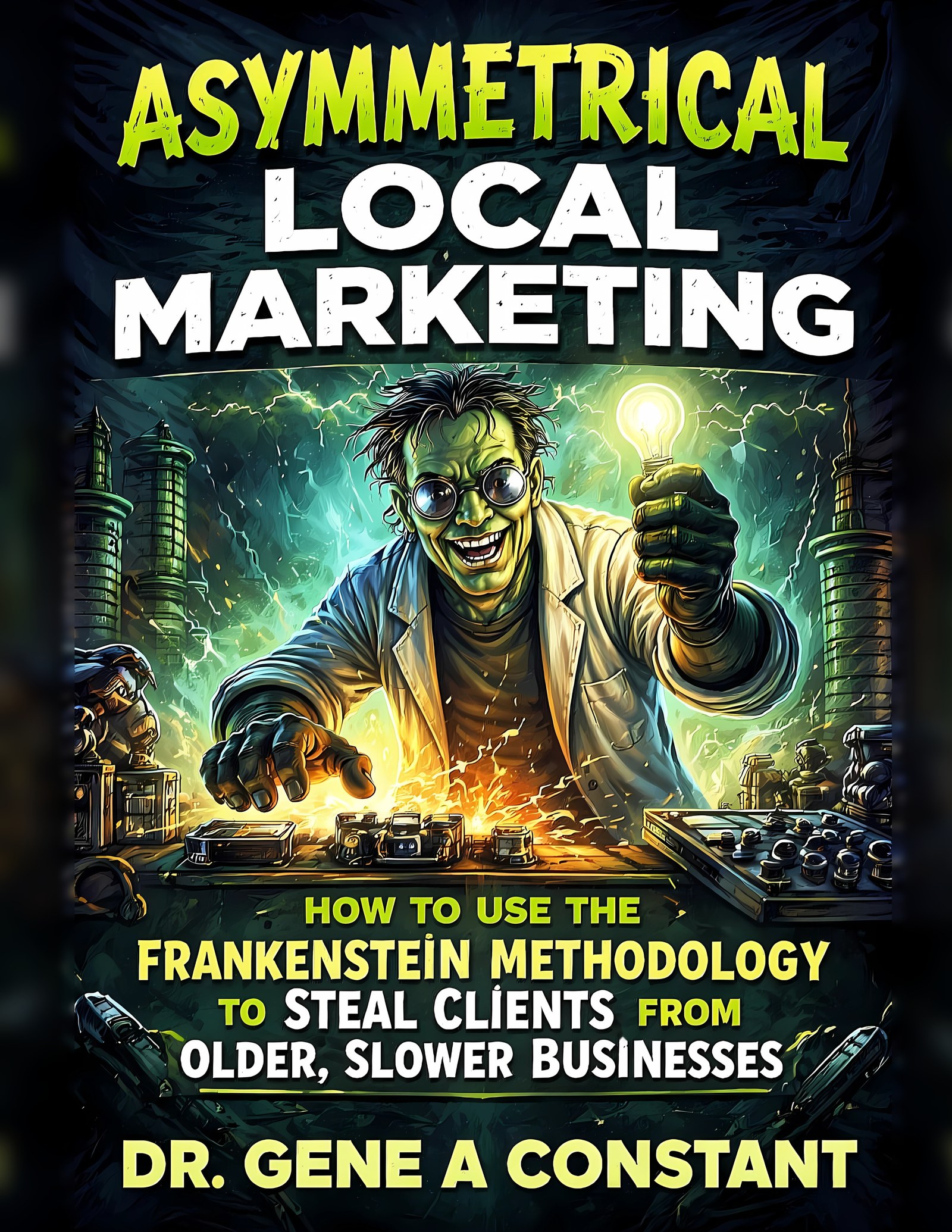
Asymmetrical Local Marketing
How to Use the Frankenstein Methodology to Steal Clients from Older, Slower Businesses.
A playbook for the small local-service business that is tired of losing work to a bigger, older, slower rival: answer first, set a time you can keep, price with a menu instead of a money tunnel, keep the promise at the door, and own a neighborhood before a city. Ten chapters, six illustrated rooms, a premise analysis with current market research, three case studies, and two free tools: Forge Your Future and The 9:47 Race.
Welcome
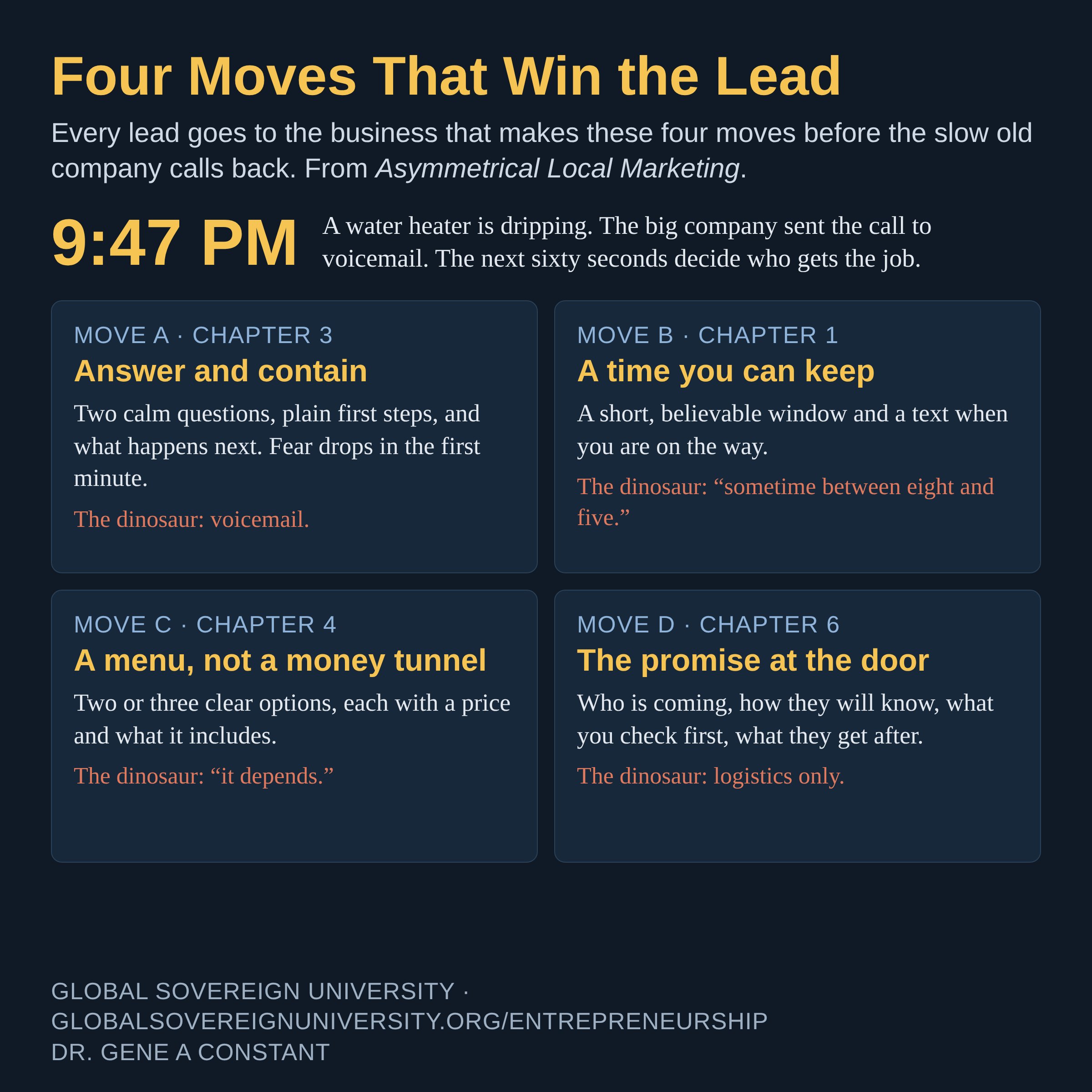
At 9:47 on a Thursday night a water heater starts dripping, and the big company in town sends the call to voicemail. This book is about who gets that job. Asymmetrical Local Marketing is a playbook for the small local-service business that is tired of losing work to a bigger, older, slower rival: answer first, set a time you can keep, price with a clear menu, keep the promise at the door, and own a neighborhood before you try to own a city. The whole book is 150 pages: six illustrated rooms, a Premise Analysis that tests the book against current market research, ten chapters each ending with Your Move This Week, nine Deep Research boxes, three case studies and a 37-term dictionary. Chapter 1 is below in full.
Free with this book on this website: Forge Your Future, the business-plan workshop that holds the GSU Founders Award at five gold stars and opens pages 2 to 4 of the book; The 9:47 Race, the book’s own game, with the Dinosaur Audit on the same page; Open for Business: The Main Street Game; The Frankenstein Methodology; and The Entrepreneur Hub. No account, no cost.
Chapter 1: The Stagnant Target: Exposing Local Market Weaknesses
Walk through any mid-sized town and you will find the same business model repeated like a chain of fossils in sediment. The truck lettering is sun-faded. The website looks like it was built during the era of dial-up. The office phone rings into a void, or it gets answered by someone juggling three tasks and a bad mood. On the surface, these companies look established. In reality, they are brittle.
The local dinosaurs are not “bad businesses.” Many of them are competent at the craft itself. They can solder, frame, diagnose, and repair. They have survived recessions, new competitors, and changing neighborhoods. But their survival strategy has been the same for decades: do good work, rely on referrals, keep overhead low, avoid anything that smells like change. That strategy worked when customers had fewer options and slower expectations. It fails in a world where a homeowner can order dinner, book a hotel, and get a telehealth appointment in minutes. The trades are one of the last sectors where customers still tolerate friction, and only because they feel trapped.
Your advantage begins with understanding the dinosaur’s anatomy. Not the marketing slogans. Not the branded polo shirts. The hidden organs. The operational habits that make them slow, inconsistent, and quietly expensive to do business with. Once you can see the pattern, you stop feeling intimidated by their age in the market. You realize age is the weakness.
Start with the command center: the phone.
Most older trade businesses are built around a single bottleneck, a human gatekeeper. The owner’s cell phone. The receptionist at the desk. The spouse who “helps with the office.” That person controls the calendar, dispatch, estimates, and often payments. The bottleneck is rarely malicious; it is simply overloaded. Calls come in while they are handling invoices. Messages pile up while they are ordering parts. They take down notes on paper, or in a scattered mix of notebooks, sticky notes, and text messages.
This creates a predictable failure loop. A homeowner calls at 11:30 a.m. during a work break. No answer. They leave a voicemail. The business calls back at 4:45 p.m., when the homeowner is in traffic or picking up kids. The homeowner does not answer. Now both sides feel irritated, and the business tells itself, “People never pick up.” The homeowner tells themselves, “These guys are impossible to reach.” The lead decays overnight and gets handed to whoever responds first tomorrow, which is often not the dinosaur.
The dinosaur interprets this as normal. “That’s just how it is in the trades.” It is not. It is an operational choice disguised as fate.
Next, examine scheduling. Traditional scheduling is a patchwork of half-promises. “We’ll be there sometime between 9 and 2.” “We’ll call when we’re on the way.” The customer is expected to absorb the uncertainty because that is how it has always been. But uncertainty is not a neutral inconvenience. It is a cost. It forces customers to miss work, rearrange childcare, or sit in their house listening for a truck. In the customer’s mind, the actual repair is only part of the transaction. The other part is the disrespect of their time.
The dinosaur’s calendar system is rarely built to reduce this friction. It is built to protect the contractor from the chaos of the day. Jobs run long, parts are missing, and traffic exists, so the contractor uses wide windows as a defensive tactic. It makes sense for the contractor. It feels like a hostage situation to the customer.
Then there is the estimating ritual, which is often less like a professional process and more like a weather forecast delivered from the gut.
The dinosaur shows up, looks around, and says things like, “It shouldn’t be too bad.” Or, “We won’t know until we open it up.” Sometimes that is true. Often it is laziness disguised as complexity. The customer is not asking you to predict the universe. They are asking you to reduce uncertainty. Older businesses frequently refuse to do this until the last possible moment, because their systems are not built for clarity. They are built for plausible deniability.
And when the price arrives, it is commonly wrapped in defensiveness. “Material costs are crazy right now.” “It’s just what it costs.” “If you want it done right…” The dinosaur thinks this language protects margin. It actually triggers suspicion. It teaches the customer that the contractor expects conflict, and therefore may be the kind of person who creates it.
Look deeper and you’ll see why this happens: many older businesses are not selling outcomes. They are selling time. Hours. Trips. “Service calls.” Time-based selling encourages vague communication because the business profits from extension. Even honest contractors become hesitant to define a clear finish line when their pricing model rewards ambiguity. The customer can feel that.
Now inspect invoicing and payment.
The dinosaur’s paperwork is usually either literal paper or a clunky digital imitation of paper. The invoice is handwritten, or it is emailed as a PDF days later. Payment is “check or cash,” sometimes card “with a fee.” Receipts are inconsistent. Warranties are verbal. If a customer needs documentation for insurance or a landlord, they enter a maze. None of this feels like craftsmanship. It feels like being dragged backward in time.
The most expensive organ in the dinosaur body is the one that never shows on an invoice: internal memory.
Older businesses run on what the owner remembers. Which customer is picky. Which property has an odd shutoff valve. Which supplier has the part. Which technician is good at what. The business doesn’t document, automate, or systematize because it has always relied on the owner’s brain as the operating system. That works until the brain gets tired, the phone never stops, and the business becomes a permanent emergency.
When the owner is the operating system, everything becomes fragile. If they are on a ladder, they cannot answer the phone. If they are driving, they cannot schedule efficiently. If they are sick, the business stalls. This is why so many dinosaurs sound stressed when you call. The stress is not personality. It is architecture.
There is also an invisible cultural trait in these companies: contempt for marketing and modern customer experience, even while relying on them.
Ask an older contractor about online reviews and you’ll often get a shrug. “We don’t need that.” But the same contractor will complain that “people are shopping around” more than they used to. They are noticing the new behavior while refusing the new game. They want the old trust model in a new trust environment.
Thirty years ago, trust moved through neighbors, family, and community reputation. Now trust moves through screens first. The customer might still ask a neighbor, but they will also check your reviews, your website, your responsiveness, and how professional you feel before they ever meet you. Dinosaurs hate this because it forces them to be visible in a way they cannot control with a handshake.
And here is the critical point: they mistake “control” for “trust.”
The old model is built on the contractor holding power. The contractor decides when they respond. The contractor decides when they arrive. The contractor decides when they explain. The contractor decides when they invoice. The customer waits. When there were few options, customers complied. Now customers are quietly hunting for any operator who treats them like a person with a schedule and a brain.
This is why the dinosaurs often have a certain tone. Slightly dismissive. Slightly rushed. Not evil, just conditioned by decades of being the scarce resource. But scarcity has shifted. Skill is still scarce, yes, but attention and responsiveness are now weapons. The customer is not only hiring hands. They are hiring certainty.
Finally, consider the dinosaur’s growth strategy, because it explains everything else.
Most older local businesses grow by adding chaos, not by improving systems. They hire another tech, buy another truck, and hope the owner’s brain can stretch to cover the expansion. When it cannot, the business becomes louder, slower, and less consistent. The owner responds by tightening control, which makes everything worse. Customers experience longer wait times, missed calls, and more rescheduling. Meanwhile, the company tells itself it is “busy,” as if busy is proof of health.
Busy is often proof of leakage.
All these weaknesses create an opening that is almost unfair once you see it. You do not need to outspend the dinosaur. You do not need to be bigger. You only need to be structurally different. You need to build a business whose default behavior matches modern expectations: rapid response, clear scheduling, transparent pricing logic, simple payment, and proactive communication.
In other words, your first job is not to become a better technician than the dinosaur. Your first job is to become a better organism.
Once you can identify these outdated operations and methods in the wild, you start to recognize a simple truth: the dinosaur’s market share is not protection. It is inertia. And inertia is exactly what the Frankenstein Methodology is designed to exploit.
If you want to steal clients from local dinosaurs, you cannot start by thinking like a contractor. You have to start by thinking like a customer who has already been trained by Amazon, Uber, DoorDash, and every other frictionless machine in modern life. The trades did not escape this conditioning. They only lagged behind it. That lag creates a unique emotional cocktail in the customer: urgency, skepticism, and fatigue.
They call a plumber because water is where it should not be. They call an electrician because something smells hot. They call an automotive shop because their car is making a sound that translates in the brain as, “This could get expensive.” This is not a casual purchase. It is stress spending. And stress spending amplifies every friction point. What a customer might tolerate in a restaurant becomes intolerable when their kitchen is flooding.
Most older businesses misread this. They think the customer is upset about the problem itself. The customer is upset about the problem plus the fog that surrounds the process of solving it. Tradition fails not because the dinosaur cannot fix the pipe, but because it cannot reduce uncertainty.
Start with the first pain point: the customer cannot make contact in a way that feels normal anymore.
In the dinosaur model we just dissected, the phone is the command center and also the bottleneck. The modern customer does not experience that as a neutral limitation. They experience it as disrespect. Not always consciously, but viscerally. They have been trained that if they reach out to a business, they should get some form of acknowledgment quickly, even if the solution comes later. When the phone rings into a void, it signals one of three things: the business is overwhelmed, the business is disorganized, or the business does not care. The customer does not know which, so they assume the worst.
Then comes the voicemail ritual, which feels like sending a message into space. “Leave your name, number, and a brief description…” The customer does it, and then they wait. Ten minutes. An hour. Four hours. By that point, the stress that triggered the call has mutated into a different emotion: suspicion. They are not thinking, “These guys must be busy.” They are thinking, “If they are like this now, what will it be like when they have my money?”
And the quiet truth is that many of them do not even leave the voicemail. They hang up and call the next company. The dinosaur never knows a lead existed. It blames a slow season or “people shopping around,” but the loss happened at the first ring. This is why responsiveness is not a customer service detail. It is a market share extraction tool.
The second pain point is scheduling uncertainty, the hostage-window problem.
Older businesses treat time windows as normal: “We can be there between 9 and 2.” They say it like they are offering flexibility. The customer hears it like a demand for surrender. It forces them to take a day off work, rearrange childcare, or sit in their home in a constant state of anticipation. This is not a small inconvenience. It is a direct transfer of cost from the contractor to the customer.
And notice what happens psychologically: the customer starts negotiating against you before you even arrive. Not on price, but on trust. They become less patient, less generous, and more alert for signs they are being taken advantage of. If you show up at 1:45 after promising a 9 to 2 window, you technically kept your word, but you still created six hours of low-grade resentment. Resentment becomes the lens through which your entire visit is judged.
The dinosaur believes this is unavoidable because jobs run long and the day is unpredictable. That is partially true. But the modern customer is not demanding perfection. They are demanding communication. They will tolerate uncertainty if it is handled with respect. A simple text update, a tighter ETA, a confirmation workflow, a “you are next” message. In other industries, this is standard. In the trades, it is treated like luxury. That gap is where you slip in like a knife.
The third pain point is the estimating fog: vague language, vague boundaries, and an invisible finish line.
Dinosaurs commonly speak in ambiguity because ambiguity protects them. “It shouldn’t be too bad.” “We won’t know until we open it up.” “Could be the whole thing.” The customer hears: “I am about to enter a money tunnel and I do not know where it ends.” Even when uncertainty is legitimate, the dinosaur rarely explains it like a professional. They do not give ranges with logic. They do not outline decision points. They do not say, “Here is what we know, here is what we need to inspect, and here is what it will cost to find out.”
So the customer has to do mental labor. They have to interpret tone. They have to guess whether you are competent or just hedging. They have to decide if you are hiding something. This is exhausting, and exhaustion makes people defensive. A defensive customer questions every line item and every recommendation. That friction slows the job, creates conflict, and increases the chance of a bad review. It becomes a self-fulfilling prophecy: the dinosaur communicates defensively because it expects conflict, and the customer becomes conflict-ready because of the defensive communication.
The fourth pain point is the hourly-rate paradox, where the customer senses a conflict of interest even when none exists.
Selling time instead of outcomes creates a permanent trust problem. The customer hears “hourly rate” and immediately wonders, “How many hours will it take, and do they benefit from it taking longer?” The dinosaur may be honest, but honesty does not erase structural suspicion. When the pricing model rewards duration, the customer cannot fully relax. They watch the clock. They watch the technician’s pace. They feel like they are in a taxi with a meter running and no map.
This is why traditional trades get so many questions that are not really questions. “How long do you think this will take?” “Do you really need to do that part?” “Is there a cheaper way?” The customer is not being difficult. They are trying to restore control in a system that removed it.
The fifth pain point is payment friction and paperwork time travel.
The modern customer is used to paying in seconds. They are used to clear receipts, digital records, and documentation that is easy to forward to a spouse, a landlord, an insurer, or a property manager. Then they meet the dinosaur and are told, “Check or cash,” or “Card with a fee,” or worse, they are handed a handwritten invoice with half-legible notes and no clear warranty language.
This triggers a subtle but devastating reaction: the customer begins to doubt the professionalism of the work itself, even if the work is excellent. Because the paperwork is part of the product. It is the customer’s proof that the transaction happened cleanly. When the back end is sloppy, the customer assumes the front end might be sloppy too.
And there is another layer here. Many customers need an audit trail now. They are reimbursing through home warranties. They are expensing repairs for rental properties. They are managing household budgets with apps. When you cannot deliver clean documentation, you are not just inconvenient. You are incompatible with how modern adults manage their lives.
The sixth pain point is silence after the job, the emotional hangover of uncertainty.
Older businesses often vanish once they get paid. No follow-up. No “everything still working?” message. No maintenance reminders. No warranty documentation that feels real. The dinosaur thinks this is efficient: onto the next job. The customer experiences it as abandonment. If something goes wrong a week later, they hesitate to call because they already expect friction. The relationship never solidifies, so the customer stays available to competitors.
This is where “busy is proof of leakage” shows up in the wild. Dinosaurs must constantly hunt for new work because they do not retain in a structured way. Their retention system is hope: hope the customer remembers them, hope the customer has the magnet on the fridge, hope the neighbor mentions their name. Hope is not a system. Hope is what you rely on when you refuse to build one.
The seventh pain point is the vibe at the door, the trust test that happens in the first ten seconds.
The customer has already made a judgment before you say a word. You can feel it. They open the door and scan: your truck, your uniform, your posture, your facial expression, your tools, your cleanliness, your confidence. In a world where trust moved through screens first, the in-person moment is not just a service call. It is a confirmation. “Are you who you claimed to be online? Are you as professional as your reviews suggested? Am I safe letting you into my home?”
The dinosaur often fails this test in small ways that compound. A rushed greeting. Muddy boots with no boot covers. A sarcastic comment about the problem. A distracted attitude while searching for tools. None of this is catastrophic, but it creates micro-doubt. Micro-doubt forces the customer to supervise you emotionally. Even if they do not hover, they feel the need to. That drains their energy and reduces their satisfaction.
Remember the earlier point: the old model is built on the contractor holding power. But the modern customer is not just buying hands. They are buying certainty. The door moment is where certainty is either delivered or destroyed.
The final pain point is the one most contractors never name because it sounds too abstract: the customer is tired of managing adults.
This is the hidden reason modern people pay premiums for frictionless experiences. They do not want to chase someone for a callback. They do not want to remind you of the address twice. They do not want to wonder if you are coming. They do not want to mediate between technicians, parts suppliers, and schedules. They want a competent organism to absorb the complexity.
The dinosaur offloads complexity onto the customer by default. The customer becomes the dispatcher, the project manager, the accounts payable department, and the quality control inspector. That is why even a “fair price” can feel expensive. They are paying with money and mental bandwidth.
When you stack these pain points, you get a simple picture: tradition fails at the exact places modern customers assign the most value. Not in the craft, but in the experience surrounding the craft. And the moment you see that clearly, you stop trying to out-muscle the dinosaurs with louder ads or lower prices. You aim at the soft tissue.
You build a business that answers. That schedules like a modern company. That prices with logic. That documents cleanly. That follows up automatically. That walks to the door like a professional, not a person who is doing the customer a favor.
That is the asymmetry. The dinosaurs are still fighting for dominance with skill and tenure. You are going to fight with speed, clarity, and certainty. And once you understand the customer’s pain points, you can design your entire operation to feel like relief.
The most profitable weakness in a local dinosaur is not that they miss calls or scribble invoices on paper. Those are symptoms. The real weakness is deeper and far more reliable: they will not adapt until they are forced, and by the time they are forced, it is usually too late.
This is what makes the opportunity almost unfair. You are not competing against their skill. You are competing against their psychology, their identity, and the structure of a business that was built to survive in a slower world. When you understand why they will not change, you stop waiting for them to “get with the times.” You realize they are structurally incapable of moving quickly, even when they can see the threat.
The first reason is the one they will never say out loud: the old model still pays them.
A dinosaur can be slow, vague, hard to reach, and slightly unpleasant, and still collect revenue because the demand for trades is real and the supply of competent operators is limited. People need heat. People need water. People need their car to start. This creates a dangerous illusion: if the phone keeps ringing eventually, the business assumes the way it operates must be acceptable.
This is why “busy” becomes a drug. As you saw earlier, busy is often proof of leakage, but to the dinosaur it feels like validation. If they are booked out for two weeks, they interpret it as dominance, not as a warning sign that the system is strained and customers are being silently repelled. They do not measure the leads that died at the first ring. They do not see the people who hung up rather than leave a voicemail. They do not hear the resentment created by the hostage-window scheduling. They only see the jobs that survived the friction.
In other words, their feedback loop is delayed and distorted. A business can be losing the future while still cashing checks in the present.
The second reason is pride disguised as principle.
Older tradespeople often have a deep identity investment in being the person who handles problems with their hands, not with “apps” or “marketing.” The craft is real. It is physical. It requires competence. So anything that feels soft, digital, or promotional is treated as suspect. The dinosaur will say, “I’m a plumber, not a tech company,” as if that sentence ends the conversation.
But notice what is hidden inside it. That statement is not about operations. It is about status. They are defending the idea that the craft should be enough. That a good reputation should travel by word of mouth, like it did in a smaller, slower community where everyone knew everyone. The modern world insults that belief. Screens mediate trust now. Reviews, response times, and documentation compete with skill. The dinosaur experiences this as unfair, which makes them resentful, which makes them refuse the very tools that would protect them.
This is why they often speak with contempt about customers being “needy” or “impatient.” It is not that customers changed overnight. It is that the dinosaur’s identity is threatened by the new standard. If a homeowner expects an instant confirmation text and a clean digital receipt, the dinosaur hears, “My handshake is not enough.” That hurts. So they retreat into a moral stance: “People these days want everything.”
The third reason is that adaptation feels like risk, and risk feels irresponsible when you have a business to protect.
From the outside, it looks obvious. Install scheduling software. Set up automated messages. Take online payments. But inside the dinosaur business, the owner is already carrying a constant emergency. Remember the earlier point: the owner’s brain is the operating system. When your business is held together by internal memory and constant improvisation, any change feels like pulling a load-bearing beam out of a collapsing house.
They do not think, “This will make us more efficient.” They think, “This will break something.” And they are not entirely wrong. When your current system is chaos that you personally know how to navigate, adding a new tool can expose how fragile everything really is. A scheduling tool forces you to define windows. Automated reminders force you to commit to communication. Digital payment forces you to standardize invoices. Standardization forces you to confront the places where you have been relying on gut feel.
It is easier to keep improvising, especially when the work keeps coming in.
This is where complacency becomes self-reinforcing. The dinosaur is busy, so they have no time to improve. They have no time to improve, so they stay busy in the worst way, constantly putting out fires that their own disorganization creates. They confuse this with productivity. In reality, they are trapped in a loop.
The fourth reason is that older businesses often confuse being established with being trusted.
They believe tenure equals credibility. “We’ve been here thirty years.” They put it on the truck lettering, on the invoice, and on the website that looks like it was built during the era of dial-up. They use age like armor.
But what they miss is the shift you already saw in the earlier sections: trust now moves through screens first. A modern customer might respect that you have been around, but they will still read your reviews, judge how quickly you respond, and scan your digital presence for signs of competence and safety. A thirty-year claim does not override a missed call. It does not erase a vague estimate. It does not compensate for a sloppy invoice.
The dinosaur does not see this as a systems problem. They see it as a marketing problem, which is why their solutions are often cosmetic. They might slap a “Call Now” button on the website but still route calls into the same void. They might ask a niece to post on Facebook occasionally but never change the underlying client experience. They treat the screen as an advertisement, not as the first stage of trust delivery.
And when they do attempt change, they often do it in the most painful way: they bolt new tools onto old habits without rebuilding the organism. That is why you see dinosaurs with online booking links that never get confirmed, or automated texts that sound robotic but still lead to vague scheduling. They dip a toe in modernity, have a bad experience, and then use it as proof that “those systems don’t work.”
The fifth reason they will not adapt is that their business model rewards them for staying reactive.
A reactive business can make good money. Service calls. Emergency fees. After-hours charges. Hourly rates with open-ended timelines. This model thrives on uncertainty, which you saw in the earlier discussion of the estimating fog and the hourly-rate paradox. If the customer is confused, the contractor has more room. More room to charge. More room to extend. More room to make judgment calls without scrutiny.
Even honest operators are shaped by the incentives of their model. If you profit from the customer not knowing exactly what will happen next, clarity feels like giving away leverage. So when you propose clear packages, subscription models, or transparent ranges with decision points, the dinosaur’s nervous system interprets it as self-sabotage.
They say things like, “Every job is different,” which is true, but also frequently used as a shield against building clean offers. It is easier to stay in the world of custom quotes and verbal agreements, where everything is flexible and nothing is accountable. The problem is that the modern customer reads that flexibility as danger.
The sixth reason is generational workflow inertia, the “we’ve always done it this way” trap.
Many dinosaur businesses are not just owners. They are families. A spouse handles the office. A cousin runs parts. A long-time technician has been doing things his way for fifteen years. The systems are social. They are habits reinforced by relationships. Changing the system is not like swapping a tool. It is like renegotiating roles inside a small tribe.
When you bring in automated scheduling, you might be threatening the spouse’s role as the gatekeeper. When you implement standardized pricing packages, you might be threatening the senior tech’s autonomy. When you require photos and documentation for every job, you might be threatening the owner’s belief that “we don’t need all that.”
So the resistance is not about software. It is about identity and hierarchy. A dinosaur might tolerate inefficiency because efficiency would require uncomfortable conversations and power shifts. They would rather keep the chaos that everyone knows than introduce clarity that forces change.
The final reason they will not adapt is the most important for you as the sovereign operator: they do not believe the customer experience is the product.
They believe the repair is the product. The invoice is an afterthought. The follow-up is unnecessary. The communication is optional. The scheduling is “just how it goes.” They have never had to treat certainty as a deliverable.
But as you saw in the pain points, modern customers are tired of managing adults. They want a competent organism to absorb complexity. That means the experience around the repair is not decoration. It is value. It is relief. It is the thing they will pay extra for, because it buys back their mental bandwidth.
The dinosaur cannot easily understand this because they still see themselves as the scarce resource. In their mind, the customer should tolerate friction because the contractor is doing something difficult and necessary. They are not entirely wrong about the difficulty, but they are wrong about the market reality. Scarcity is not only skill. Scarcity is responsiveness, clarity, and follow-through. Scarcity is certainty delivered quickly.
This is why complacency is your opportunity.
You are entering a market where most competitors are not actively trying to beat you. They are trying to survive the day. They are not designing experiences. They are improvising. They are not building systems. They are relying on memory. They are not measuring the leads that evaporate in the dark. They are sleeping at 2:00 AM while the customer’s stress is awake and searching.
And here is the most important strategic implication: you do not need them to fail. You only need them to stay the same.
If the dinosaur remains slow, you win by being fast. If the dinosaur remains vague, you win by being clear. If the dinosaur remains difficult to reach, you win by answering. If the dinosaur remains manual, you win by automating the parts customers hate while keeping the craft human and excellent.
That is the asymmetry. Their complacency creates a stable target. And a stable target is exactly what the Frankenstein Methodology is built for: stitching modern systems onto old markets in a way the old guard cannot copy quickly, because copying would require them to become a different organism.
They will eventually try, but they will try late, and they will try superficially. They will buy the tool without changing the architecture. You are going to do the opposite. You are going to change the architecture first, then use tools as force multipliers.
You are not waiting for the dinosaurs to go extinct. You are simply walking around them, taking the clients who are already exhausted by friction, and giving them something that feels like relief.
Your Move This Week
- Call your own business at 11:30 a.m. and again at 9:30 p.m. What happens each time?
- Which of the dinosaur habits in this chapter does your own business still have?
- Pick one competitor. List three places where a customer would feel friction dealing with them.