Autonomous Maintenance
The seven steps that move daily care of the machine into the hands of the people who run it. Book 5 of Zero Breakdowns: The TPM Series.
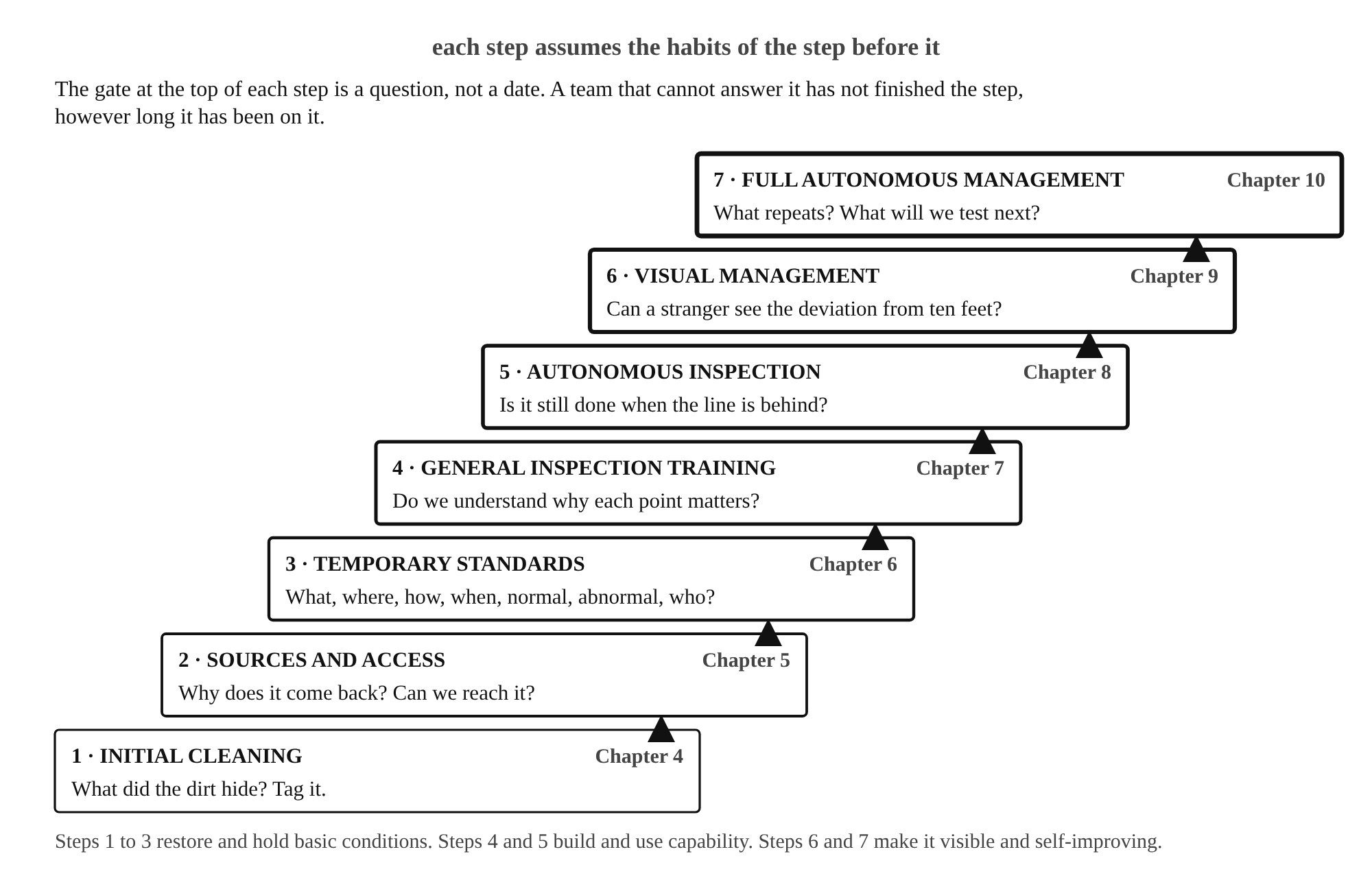
A machine covered in dust and oil cannot tell you anything. Clean it, and it starts to talk. Autonomous Maintenance walks the seven steps on one carton packer, PK-2, from the first clean to the digital twin, with one rule for everything found: restore, tag, stop or call. Fourteen chapters, fourteen Deep Research pieces, three real cases, two teaching cases, a 54-term dictionary and five free tools.
Welcome
A machine covered in dust and oil cannot tell you anything. Clean it, and it starts to talk. Autonomous Maintenance is the pillar of Total Productive Maintenance that lives closest to the machine, and this book walks its seven steps on one carton packer, PK-2, from the first clean to the digital twin. The whole book is 284 pages: three foundation chapters, the seven steps in order, four chapters on the connected plant, fourteen Deep Research pieces, three real cases and two teaching cases, a 54-term dictionary, The Steward’s Card, The Supervisor’s Card and The First Thirty Days. Chapter 1 is below in full.
Free learning tools for this book live on this website and need no account: The Tag Hunt (the first clean of a machine), The Sound Bench (nine machine sounds, four levels), The Seven-Step Walk (one real machine through the seven gates), The Steward’s Bench (eight conditions: restore, tag, stop or call) and The Climber’s Passport (the competence record of Chapter 13).
Contents
- The Evolution of TPM and the Operator’s Role
- The Philosophy of Extreme Ownership
- The Hidden Costs of Micro-Stoppages
- Step 1: Initial Cleaning—Cleaning is Inspection
- Step 2: Eliminating Sources of Contamination and Inaccessible Areas
- Step 3: Establishing Cleaning, Lubrication, and Inspection Standards
- Step 4: General Inspection Training
- Step 5: Autonomous Inspection Execution
- Step 6: Standardization and Visual Management
- Step 7: Full Autonomous Equipment Management
- AM in the AI-Augmented Workspace
- Digital Twins and the Feedback Loop
- Skill Mapping and Competency Diagnostics
- Overcoming Cultural Resistance and Sustaining AM Gains
After the chapters: Deep Research, Case Studies, The Autonomous Maintenance Dictionary, The Steward’s Card, The Supervisor’s Card, The First Thirty Days.
Chapter 1: The Evolution of TPM and the Operator’s Role
For much of industrial history, maintenance was defined by reaction. A machine ran until it failed, and when it stopped, someone was called to repair it. This approach was understandable in an era of simpler equipment, abundant labor, and relatively forgiving production schedules. It was also expensive, disruptive, and deeply limiting.
The earliest maintenance paradigm can be summarized in a single phrase: “Run it until it breaks.” In breakdown maintenance, equipment received attention only after a functional failure had already occurred. A belt snapped, a bearing seized, a motor overheated, a hydraulic line burst, or a tool crashed. Production stopped, operators waited, supervisors escalated, and maintenance technicians were expected to restore operation as quickly as possible.
This model created a clear division of labor. Operators operated. Maintenance personnel repaired. The machine itself became a boundary between two groups of people who often worked in the same facility but viewed the asset from entirely different perspectives. An operator might know that a press had been “sounding rough” for several shifts, that a conveyor needed an occasional kick to start, or that a packaging machine leaked oil near the drive side. Yet unless the equipment stopped completely, these conditions were frequently accepted as normal. The machine was still running. Production targets still mattered. The problem, in the traditional view, belonged to maintenance.
Breakdown maintenance did not merely respond to failure; it unintentionally trained organizations to tolerate deterioration. Small abnormalities became background noise. A loose fastener, a faint vibration, a small air leak, or a thin layer of accumulated dust did not appear urgent when compared with an immediate production order. But mechanical systems rarely fail without warning. Most catastrophic failures begin as minor, visible, audible, or detectable defects. The warning signs may be subtle, but they exist.
A bearing does not usually seize without first experiencing lubrication degradation, contamination, misalignment, excessive load, or gradual surface damage. A hydraulic hose does not typically burst without showing signs of abrasion, aging, loose fittings, or pressure instability. An electrical enclosure does not suddenly become unreliable without some preceding combination of heat, dust, moisture, vibration, or poor connection quality. In a breakdown-centered environment, these early signals are often ignored because the organization has normalized the idea that maintenance begins when the machine can no longer operate.
The consequences extend far beyond the duration of the repair itself. When equipment fails unexpectedly, the organization loses productive time, often at the most inconvenient moment. Maintenance teams may lack the required spare part, diagnostic information, access equipment, or specialized expertise. A rushed repair may restore function without addressing the underlying cause. Quality losses may occur when a machine drifts out of condition before failing. Safety risks increase as people work under pressure to restart production. Delivery commitments may be missed, and overtime becomes routine rather than exceptional.
Perhaps most damaging, breakdown maintenance traps skilled technicians in a cycle of emergency work. Instead of analyzing recurring failure patterns, improving machine design, conducting precision maintenance, or building preventive systems, technicians spend their days responding to alarms. Their knowledge becomes concentrated around crisis response. They become organizational heroes for repairing a failed asset quickly, even though the greater achievement would have been preventing the failure from happening at all.
From Breakdown to the Calendar
As industrial systems became more complex and the cost of downtime became more visible, organizations began to move toward preventive maintenance. Preventive maintenance introduced the idea that equipment should be serviced according to a planned schedule rather than only after failure. Lubrication intervals, belt changes, inspections, component replacements, and calibration activities were scheduled based on time, operating hours, production cycles, or manufacturer recommendations.
This was a major improvement. Planned work is safer than emergency work. A scheduled bearing replacement can be completed during a planned shutdown, with the proper tools, spare parts, lockout procedures, and skilled personnel available. A lubrication task performed at the right interval can prevent metal-to-metal contact and prolong component life. Regular inspections can identify wear before it becomes destructive.
Yet preventive maintenance also had limitations. A calendar-based plan can lead to unnecessary work when components are replaced before their useful life has ended. At the same time, a fixed interval cannot always account for actual operating conditions. Two identical motors may have radically different lifespans if one operates in a clean, temperature-controlled environment and the other runs beside a washdown station, under high load, with frequent starts and stops. A schedule is useful, but it does not automatically reveal the health of the specific machine in front of the operator.
Preventive maintenance also often preserved the same cultural divide created by breakdown maintenance. The maintenance department owned the maintenance plan. Operators remained responsible for production. In many facilities, preventive tasks were performed during planned downtime by technicians who knew the equipment technically but were not always present when subtle changes first appeared during daily operation.
This separation left valuable knowledge unused. Operators are closest to the machine. They see its behavior across every shift, every product changeover, every startup, and every minor interruption. They know how the machine sounds when it is healthy. They notice when a guard begins to rattle, when a cylinder hesitates, when a coolant stream weakens, or when a feeder requires more adjustment than usual. But unless the system gives them ownership, training, and a clear method for acting on those observations, that knowledge remains informal and often disappears at shift change.
From the Calendar to Condition
The next evolution was predictive or condition-based maintenance. Rather than servicing equipment only after failure or strictly according to a schedule, predictive maintenance uses condition data to determine when intervention is needed. Vibration analysis, thermography, oil analysis, ultrasound, motor-current monitoring, process trends, and other techniques can reveal deterioration while equipment is still operating.
Condition-based methods changed the maintenance conversation. Instead of asking, “How long has this bearing been installed?” teams could ask, “What is the actual condition of this bearing?” Instead of replacing a component because a calendar says it is due, the organization could use evidence to plan intervention at the point of greatest value and lowest risk.
Today, this capability is increasingly enhanced by connected sensors, edge computing, artificial intelligence, and digital systems that can identify patterns across large volumes of operational data. These tools are powerful, but they do not eliminate the need for human observation. In fact, they make frontline stewardship more important.
A sensor can report an elevated temperature, but it cannot always determine whether the cause is a blocked lubrication line, a misaligned guard restricting airflow, a loose electrical connection, a dirty heat exchanger, or a process condition outside the machine’s normal range. An algorithm can flag abnormal vibration, but someone must verify whether a fastener has loosened, whether a floor anchor is damaged, whether contamination has entered the housing, or whether the measurement device itself has shifted.
Where Autonomous Maintenance Enters
This is where Total Productive Maintenance, and particularly Autonomous Maintenance, represents a decisive shift rather than simply another maintenance technique. TPM does not treat maintenance as the exclusive responsibility of a specialized department. It recognizes equipment reliability as a shared operational responsibility. It connects production, maintenance, engineering, quality, and leadership around the pursuit of stable, capable, and continuously improving equipment.
Autonomous Maintenance does not turn operators into maintenance technicians, nor does it ask them to perform work beyond their training, authorization, or safety boundaries. Instead, it gives operators responsibility for the basic conditions that allow equipment to function reliably: cleanliness, lubrication, visual inspection, tightening within defined limits, abnormality detection, and disciplined reporting.
The distinction is essential. A technician may rebuild a gearbox, diagnose a complex servo fault, align a precision shaft, or modify a hydraulic circuit. An operator, properly trained and supported, ensures that the gearbox exterior is clean enough to reveal leaks, that lubrication points are accessible and serviced according to standard, that unusual noise is reported early, and that loose guards, worn hoses, and missing fasteners do not become invisible parts of the environment.
In this model, cleaning is not housekeeping. It is inspection. Lubrication is not a casual task. It is protection of asset life. A visual check is not a bureaucratic requirement. It is an opportunity to discover a defect while it is still small, inexpensive, and safe to correct.
The historical movement from breakdown maintenance to preventive and predictive methods reveals a clear lesson: equipment reliability cannot be achieved by maintenance departments alone. The closer an organization gets to the source of abnormalities, the earlier it can act. The people who operate the equipment are already at that source. Autonomous Maintenance gives them the structure, skills, authority, and support to become active stewards rather than passive witnesses.
That shift changes the meaning of ownership. The operator no longer says, “The machine is making a strange noise, but maintenance has not been called yet.” Instead, the operator recognizes the noise as an abnormal condition, records it, contains the risk when necessary, and initiates the correct response. The maintenance technician no longer spends every shift racing from one urgent failure to another. Instead, the technician increasingly becomes a teacher, problem solver, reliability specialist, and coach.
This is the foundation on which the TPM house is built: not a collection of checklists, sensors, or slogans, but a shared belief that reliable equipment begins with disciplined daily care at the point of operation.
The TPM House
The shared belief described at the end of the previous section must be translated into an operating system. Good intentions alone do not prevent a bearing from failing, eliminate chronic minor stops, or ensure that abnormalities discovered on one shift are understood and acted upon by the next. Total Productive Maintenance provides that operating system. Its most widely used visual representation is the TPM house.
Like any house, TPM depends on structural balance. A roof without supporting pillars cannot stand. Pillars built on an unstable foundation eventually crack. And a well-built structure is meaningless if the people inside do not understand its purpose. The TPM house gives an organization a way to see that equipment reliability is not produced by one department, one project, or one piece of technology. It is the result of several connected disciplines working together toward a common outcome.
The roof of the TPM house represents the outcomes the organization is trying to achieve. These are often expressed through measures such as productivity, quality, cost, delivery, safety, morale, and environmental performance. Some organizations use the shorthand PQCDSM: Productivity, Quality, Cost, Delivery, Safety, and Morale. Others add sustainability, energy efficiency, or customer responsiveness. The exact labels matter less than the central idea: equipment health is not an isolated maintenance concern.
A machine that runs reliably contributes to productivity because it produces more available operating time. It contributes to quality because it remains within stable operating conditions rather than drifting toward defects. It contributes to cost because emergency repair, overtime, scrap, expedited parts, and lost capacity are reduced. It contributes to delivery because production schedules become more predictable. It contributes to safety because people are less likely to work under breakdown pressure or around deteriorated equipment. Finally, it contributes to morale because employees can spend less time managing preventable chaos and more time performing skilled, meaningful work.
Overall Equipment Effectiveness, or OEE, sits close to this roof because it connects several of these outcomes in a single measure. OEE combines availability, performance, and quality. Availability asks whether the equipment was ready to run when needed. Performance asks whether it ran at its intended speed. Quality asks whether it produced acceptable output. A machine can appear busy for an entire shift and still have poor OEE if it experiences repeated short stops, reduced speed, or frequent quality losses.
This is why TPM does not define success as simply repairing machines quickly. A rapid repair after a major breakdown may be necessary and commendable, but it is not the highest expression of maintenance excellence. The stronger goal is to create equipment conditions in which breakdowns, micro-stoppages, speed losses, and defects become increasingly rare. In a mature TPM environment, the organization does not wait for losses to become dramatic enough to demand attention. It develops the ability to see deterioration early and remove it systematically.
The Pillars
The pillars of the TPM house represent the major practices that support these outcomes. Although organizations may name or group the pillars differently, the classic model includes Autonomous Maintenance, Planned Maintenance, Focused Improvement, Quality Maintenance, Early Equipment Management, Training and Education, Safety, Health and Environment, and TPM in administrative functions.
Autonomous Maintenance is one of the most visible pillars because it places care at the point where equipment is operated. It is the discipline through which operators learn to restore and maintain basic equipment conditions. They clean, inspect, lubricate, identify abnormalities, perform approved minor adjustments, and escalate issues that exceed their authority or skill level. This pillar changes the daily relationship between operator and asset.
Its purpose is not to transfer maintenance work carelessly onto production employees. Nor is it a cost-cutting mechanism disguised as empowerment. Autonomous Maintenance is a structured process for preventing the small conditions that cause larger failures. It ensures that operators, who are closest to the equipment every day, have the knowledge and standards needed to recognize what is normal and what is not.
Planned Maintenance is the complementary pillar. While Autonomous Maintenance focuses on daily basic care and early detection, Planned Maintenance organizes the work that requires specialized technical capability, deeper diagnostics, shutdown coordination, precision tools, or component replacement. Maintenance technicians use preventive schedules, condition-monitoring information, failure history, engineering judgment, and reliability analysis to plan interventions before functional failure occurs.
The two pillars must never compete. If Autonomous Maintenance is strong but Planned Maintenance is weak, operators may identify abnormalities that remain unresolved because no effective repair system exists. If Planned Maintenance is strong but Autonomous Maintenance is weak, technicians may repeatedly repair damage caused by contamination, poor lubrication, loose components, or neglected basic conditions. The strongest organizations create a clear handshake between the two. Operators detect, contain, document, and maintain basic conditions. Maintenance specialists diagnose, restore, improve, and teach.
Focused Improvement, sometimes called Kobetsu Kaizen, is another essential pillar. It addresses losses that are chronic, complex, or costly enough to require cross-functional problem solving. A single operator may notice that a conveyor intermittently jams at one transfer point. A technician may observe that the drive chain stretches faster than expected. Quality personnel may see a recurring defect after startup. Individually, each observation may appear small. Together, they can reveal a persistent system problem.
Focused Improvement brings the right people together to analyze the loss, identify root causes, test countermeasures, and standardize successful changes. It moves the organization beyond temporary fixes. Rather than repeatedly cleaning spilled material beneath a feeder, a team may redesign the chute, alter the transfer angle, improve sealing, or install a visual indicator that reveals buildup before it becomes a stoppage. The purpose is not merely to work harder around a problem. It is to remove the problem’s source.
Quality Maintenance extends the same logic to product quality. Equipment condition and product quality are inseparable. A worn guide, unstable temperature, loose fixture, contaminated sensor, deteriorated cutting tool, or inconsistent air pressure may first appear as a minor equipment condition. Eventually, it can become a dimensional defect, a seal failure, a cosmetic flaw, or a performance issue in the finished product.
Quality Maintenance identifies the machine conditions that must remain controlled to prevent defects. These may include torque settings, temperatures, pressures, alignment positions, cycle times, sensor distances, fluid levels, or tool wear limits. Operators play a vital role because they observe these conditions during normal operation. When they understand the relationship between a basic condition and a quality outcome, inspection becomes more meaningful. They are no longer checking an item simply because a sheet requires it. They are protecting a known quality characteristic.
Early Equipment Management brings TPM upstream into equipment design, procurement, installation, and commissioning. This pillar recognizes that many maintenance difficulties are designed into a machine before it ever reaches the production floor. A lubrication point placed behind a fixed guard, a filter mounted at an unsafe height, a sensor hidden beneath piping, or a panel requiring special access equipment will create recurring losses throughout the asset’s life.
The experience of operators and maintenance technicians should therefore shape the design of new equipment. They know which panels are difficult to remove, which cleaning tasks consume excessive time, which components fail repeatedly, and which access points create safety concerns. Their lessons should become design requirements: easy-to-clean surfaces, visible gauges, accessible lubrication points, standardized fasteners, clear diagnostic displays, and layouts that allow inspection without unnecessary exposure to hazards. In modern cyber-physical environments, this also includes accessible sensor placement, reliable data connections, and digital interfaces that support rather than burden frontline work.
Training and Education form another pillar because TPM cannot be sustained by assigning new responsibilities without building capability. Operators need practical knowledge of the equipment they operate. Maintenance technicians need coaching and teaching skills in addition to technical depth. Supervisors need to understand how to protect time for inspections and improvement rather than treating every AM activity as lost production time. Managers need to read loss data correctly and avoid rewarding short-term output at the expense of deteriorating asset conditions.
Competence must be demonstrated, not assumed. An operator who has attended a lubrication briefing is not automatically capable of identifying the correct point, lubricant, quantity, frequency, contamination risk, and safety procedure. The TPM house requires progressive development: teach the task, observe performance, verify understanding, provide feedback, and grant authority appropriate to demonstrated skill. This principle becomes even more important as digital tools, smart sensors, augmented reality, and AI-supported diagnostics enter the workplace. Technology expands capability only when people understand how to use, question, and validate it.
The Safety, Health, and Environment pillar makes clear that no reliability objective justifies unsafe work. A clean machine is safer because leaks, damaged guards, trip hazards, exposed wiring, and abnormal heat become visible. A well-organized workplace reduces searching, awkward reaching, and improvised work. But TPM must never encourage employees to inspect, clean, lubricate, or tighten equipment while ignoring energy isolation, machine guarding, chemical handling, confined-space rules, or other established controls. Autonomous does not mean unsupervised. Ownership does not mean taking risks beyond one’s authorization.
Finally, TPM extends beyond the production asset itself. Administrative and support functions influence equipment reliability in ways that are easy to overlook. Purchasing affects spare-part quality and lead time. Stores management affects whether critical parts are available when planned work is scheduled. Engineering affects the maintainability of modifications. Production planning affects whether teams have realistic windows for inspection and repair. Human resources and training groups affect capability development. Digital systems teams affect the accuracy and usability of data. A machine may be physically located on the shop floor, but the system that keeps it healthy reaches across the entire organization.
The Foundation
Beneath all of these pillars lies the foundation of the TPM house: stable basic conditions, disciplined standards, workplace organization, and a culture of continuous improvement. Many organizations associate this foundation with 5S: Sort, Set in Order, Shine, Standardize, and Sustain. In TPM, 5S is not cosmetic housekeeping. It makes normal conditions visible. A missing tool, leaking hose, incorrect lubricant, loose fastener, blocked access path, or out-of-place spare becomes easier to detect when the workplace has a clear standard.
The foundation also includes leadership behavior. If managers praise employees only for production volume while dismissing inspections as delays, the TPM house will weaken. If supervisors permit repeated temporary repairs without root-cause analysis, deterioration will become normalized. If technicians are expected to solve every problem alone, operator ownership will never develop. Leaders must reinforce the message that time spent preventing failure is productive time, even when its value is not immediately visible on an hourly output report.
Autonomous Maintenance occupies a central place in this structure because it connects the foundation to every other pillar. It gives daily life to the TPM house. Through AM, an operator’s observation of a small leak can become a maintenance work order, a focused-improvement project, a quality safeguard, a safety correction, a training opportunity, and eventually a design requirement for future equipment.
The next step is to understand how this role changes the operator’s identity. The operator is not merely the person who starts the machine, watches the cycle, and calls for help when something fails. Within the TPM house, the operator becomes the frontline steward of equipment condition: the first to see change, the first to protect basic conditions, and an essential partner in the organization’s reliability system.
The Frontline Steward
The TPM house becomes real only when its principles are visible in daily behavior at the machine. That is the work of the frontline steward.
A frontline steward is not simply an operator who performs an added checklist at the beginning or end of a shift. The term describes a different relationship with equipment. The operator understands that the machine’s condition is neither invisible nor someone else’s concern. Its cleanliness, lubrication state, accessible fasteners, guard condition, noise level, vibration, temperature, fluid behavior, and response to normal controls are all part of the operator’s operating environment. They are conditions to be observed, protected, and acted upon within clearly defined boundaries.
This is the practical identity created by Autonomous Maintenance. The operator remains responsible for safe, stable production, but stable production is no longer treated as separate from equipment care. Production and basic equipment condition become inseparable. A machine cannot produce safely, consistently, or efficiently if it is allowed to accumulate dirt, leaks, looseness, blocked lubrication paths, damaged components, and unresolved minor abnormalities. The steward recognizes that every small condition has a trajectory. A faint leak can become contamination. Contamination can become wear. Wear can become instability, quality loss, a micro-stoppage, or a breakdown.
The idea is simple, but it challenges a long-established habit. In a traditional workplace, an operator may see a problem, mention it informally, and continue running. If the problem becomes severe enough, maintenance is called. The equipment is viewed as something operated by one group and repaired by another. This arrangement seems efficient because it keeps each person in a familiar role. In reality, it creates a gap precisely where reliability is won or lost: the interval between the first sign of deterioration and the eventual failure.
Frontline stewardship closes that gap.
The operator is present when the machine starts cold in the morning, when it reaches normal operating temperature, when raw material changes, when a product format shifts, and when output begins to drift. The operator sees the equipment under the real conditions that technicians and engineers may observe only periodically. This proximity creates a unique form of expertise. It is not a substitute for technical maintenance knowledge, but it is indispensable operational knowledge.
An experienced operator may not initially describe a problem in the language of vibration spectra, lubrication regimes, or pneumatic response curves. Yet that operator may know that “the left-side clamp is slower after the second break,” that “the conveyor gives a small jump before it stops,” or that “the pump sounds different after washdown.” These observations matter. They are early data. When an organization teaches operators how to convert such observations into clear, repeatable abnormality reports, informal knowledge becomes a reliable input to the maintenance system.
This is one reason Autonomous Maintenance begins with restoring basic conditions. Before operators can judge abnormality confidently, they must be able to see normality. A machine covered with oil, dust, product residue, old labels, and accumulated grime conceals its own condition. Leaks disappear into stains. Cracks hide behind debris. Loose bolts blend into a dirty surface. Heat discoloration, abrasion marks, damaged wiring, and worn hoses may remain unnoticed until their consequences are no longer small.
Initial cleaning changes this. It brings the operator into close physical contact with the asset and requires a slower, more deliberate look. As surfaces are cleaned, abnormalities emerge. A hose that appeared dirty may actually be chafed. A dark patch on a gearbox may reveal an active oil leak. A guard that seemed merely noisy may have missing fasteners. A lubrication fitting may be inaccessible, damaged, or incorrectly identified. Cleaning, therefore, is not a low-skill activity assigned to the least experienced person. It is the first inspection discipline of a frontline steward.
Ownership Has Limits
The steward’s role also requires a disciplined understanding of limits. Empowerment without boundaries is not ownership; it is risk. Operators should never be expected to enter guarded areas, defeat safety devices, work on energized electrical systems, open pressurized lines, or make repairs for which they have not been trained and authorized. The purpose of AM is not to erase the distinction between operator and maintenance technician. It is to create a strong partnership between them.
A useful division is based on the nature of the work. Operators own basic conditions and early detection. They clean according to standard, inspect accessible areas, apply approved lubrication where authorized, identify visible deterioration, perform designated minor adjustments, and report abnormalities accurately. Maintenance technicians own specialized diagnostics, precision work, repairs beyond defined limits, complex adjustments, engineering changes, and corrective actions requiring advanced technical expertise. Supervisors protect the time and resources required for these activities. Engineers and reliability professionals remove recurring causes and improve equipment design.
When this division is clear, the relationship between operations and maintenance changes fundamentally. The operator does not “hand off” a problem and forget it. The operator provides meaningful information: where the condition was observed, when it began, what changed, whether it affects safety or quality, and whether it has worsened. The technician does not arrive merely as an emergency responder. The technician diagnoses the issue, restores the required condition, and helps the operator understand what signs to watch for in the future.
This creates a learning loop. Consider a packaging machine that begins stopping briefly because cartons are not consistently detected at an infeed sensor. In a weak system, the operator may repeatedly reset the machine, a technician may clean the sensor when called, and the issue may return later. In a stewardship model, the operator notes the frequency and context of the stops, inspects the accessible sensor area, and identifies a recurring buildup of dust and adhesive residue. The maintenance technician confirms that the sensor mounting bracket also permits slight movement. Together, they correct the immediate condition. A focused-improvement effort may then address the contamination source, improve the bracket design, and establish a simple inspection point that prevents recurrence.
The outcome is more than a repaired sensor. The organization gains knowledge about how the loss began, how it was detected, and how it can be prevented. That is the essence of TPM: turning individual observations into organizational capability.
For frontline stewardship to work, abnormalities must be treated as valuable signals rather than inconvenient interruptions. This requires an environment in which speaking up is expected and supported. If operators are criticized for reporting a leak, a loose guard, or a slight change in sound, they will quickly learn to remain silent until the problem becomes impossible to ignore. If they are praised only for maintaining output despite deteriorating conditions, the organization rewards concealment rather than reliability.
Leaders must therefore respond carefully. An abnormality report should not trigger blame: “Why did you stop the machine?” or “Why are you creating maintenance work?” The better questions are: “What did you observe?” “What is the risk if we do nothing?” “What can we safely contain now?” and “What does this tell us about the equipment’s basic condition?” Such questions reinforce curiosity, evidence, and responsible escalation.
The physical workplace must support this behavior as well. Cleaning tools, approved lubricants, inspection aids, tags, spare fasteners, reference photographs, and reporting devices need to be available at the point of use. A standard that requires an operator to search ten minutes for a grease gun, obtain permission to access a digital system, or walk across the plant for a simple tag is unlikely to be sustained. The design of the work environment sends a powerful message about whether equipment care is genuinely valued.
Visual management makes the steward’s work easier. Clearly marked lubrication points, fluid-level indicators, match marks on adjustment settings, color-coded gauge zones, transparent covers where safe and appropriate, and photographs of normal conditions reduce ambiguity. A well-designed visual control allows a person to recognize a deviation quickly, often without needing to interpret a complex document. As the AM process matures, the goal is for important abnormalities to be recognizable almost immediately, not hidden inside a complicated inspection routine.
Digital Tools Strengthen the Role; They Do Not Replace It
Digital tools can strengthen this role, but they cannot replace it. A tablet can guide an inspection, capture a photograph, time-stamp an observation, and route a work request to the correct planner. A connected sensor can identify a rising temperature or unusual vibration trend. An augmented-reality display can show the correct inspection point or overlay a prior image of normal condition. Yet every digital system depends on a physical truth. Sensors can become dirty, misaligned, disconnected, or poorly calibrated. Algorithms can identify patterns, but they require accurate context. The operator remains the person who can look at the asset, use trained senses, and determine whether the digital signal corresponds to reality.
This role becomes especially important as facilities move toward AI-augmented maintenance. The operator is not displaced by automation; the operator becomes a data validator and a first responder to early warnings. When a system flags a bearing temperature increase, the steward checks the accessible lubrication condition, observes the housing, listens for unusual sound, verifies whether the operating load has changed, and records findings. That physical confirmation helps distinguish a developing mechanical issue from a sensor problem, an unusual process condition, or a temporary operating variation.
Frontline stewardship is therefore both practical and cultural. It asks operators to care for the machine in a disciplined way, but it also asks the organization to trust their observations, invest in their competence, and act on the information they provide. It asks technicians to share knowledge rather than protect it. It asks supervisors to defend time for inspection and restoration of basic conditions. It asks leaders to measure success not only by output today, but by the health of the equipment that must produce tomorrow.
When this shift takes hold, the operator’s daily work acquires a broader meaning. The operator is no longer waiting beside a machine for the next fault to occur. The operator is actively preventing that fault, making normal conditions visible, and contributing to the shared intelligence of the TPM system. This is the frontline steward: close enough to notice change, capable enough to respond correctly, disciplined enough to follow standards, and empowered enough to ensure that small abnormalities do not become accepted features of the workplace.