Catastrophizing: A 30-Day Workbook to Break Free from Worst-Case Thinking
Your mind multiplies the danger and divides your ability to cope. This workbook reverses both.
A 30-day workbook that takes worst-case thinking apart one day at a time, with writing exercises, a 90-second breathing pause, evidence tests and a personal protocol card. Practical tools drawn from CBT and ACT.
Day 1: Defining the Beast
Welcome to your first day. Before you can break free from worst-case thinking, you have to look it directly in the eye and understand its anatomy.
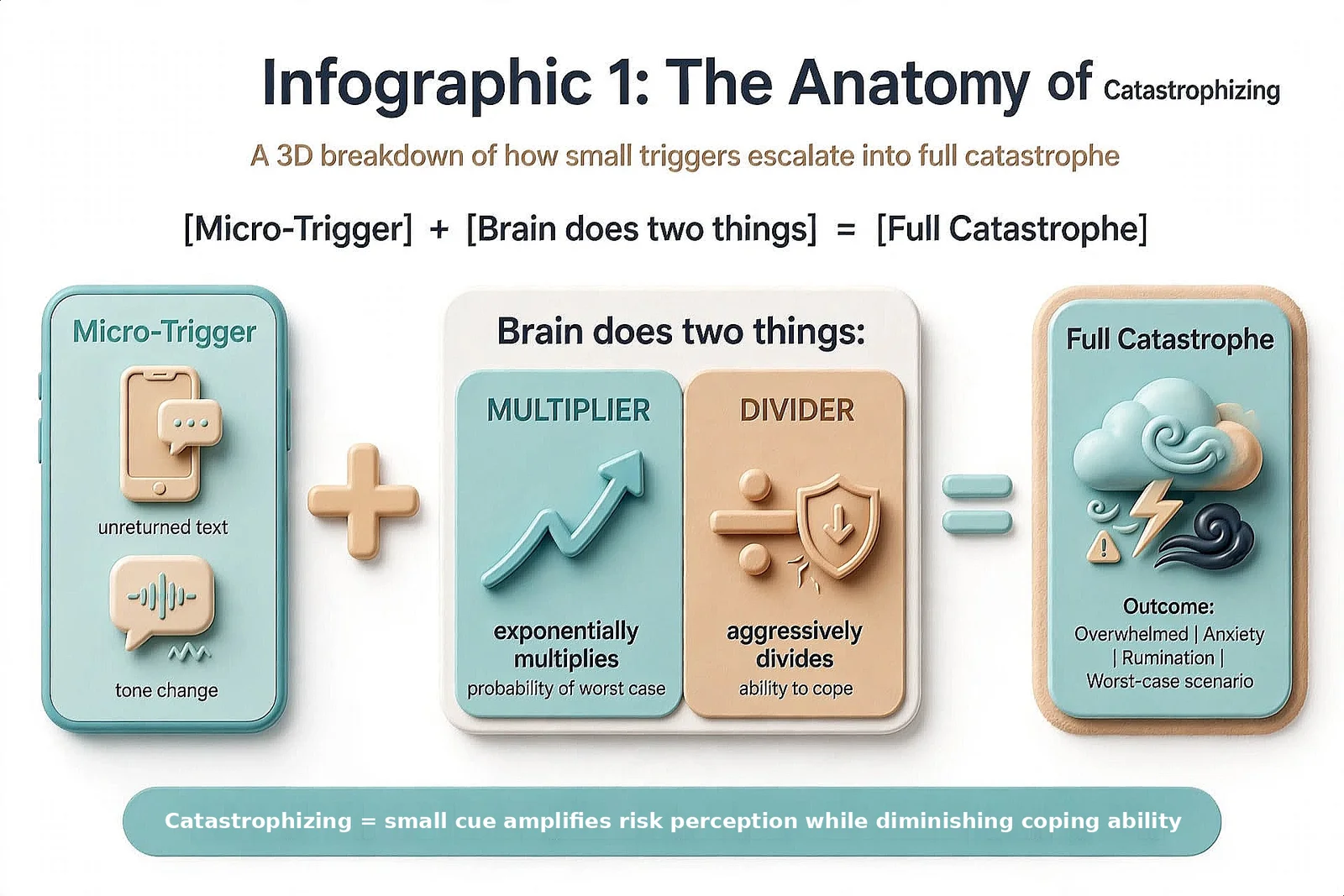
Catastrophizing is not just “being a pessimist” or “overthinking.” Clinically, it is a sophisticated cognitive distortion where your brain does two distinct, destructive things simultaneously: it exponentially multiplies the probability of a worst-case scenario, and it aggressively divides your ability to cope with it.
When these two forces combine, a minor inconvenience or an ambiguous comment instantly transforms in your mind into a life-altering catastrophe. Today, we are going to dissect how your brain builds these mental emergencies out of thin air.
Step 1: The Inciting Incident (The Micro-Trigger)
Catastrophizing always starts small. It is usually triggered by a mundane, neutral, or ambiguous event—an unreturned text, a subtle change in a supervisor’s tone, a slight physical ache, or a delayed email.
Write down a recent, seemingly minor event that unexpectedly sent your mind into a tailspin.
Step 2: The Avalanche Chain Reaction
This is where your brain takes the micro-trigger from Step 1 and straps a rocket to it. Trace the exact steps of your mental leap. How did your mind bridge the gap between a tiny uncertainty and a full-scale disaster?
(e.g., “My boss asked to see me at 4:00 PM → I am getting fired → I won’t be able to pay my rent → I will lose my home and end up on the street.”)
- Link 1 (The Trigger):
- Link 2 (The First Assumption):
- Link 3 (The Escalation):
- Link 4 (The Ultimate Catastrophe):
Step 3: The Multiplier and Divider Audit
Look back at the chain reaction you just wrote in Step 2. Answer the following two diagnostic questions about your thought process:
- Question A (The Multiplier): Realistically, what was the actual mathematical probability that Link 2 would lead to Link 4? Did your brain treat a low-probability possibility as an absolute certainty?
- Question B (The Divider): At what point in the chain reaction did your brain completely erase your coping skills, your past resilience, and your resourcefulness, painting you as entirely helpless?
Step 4: Naming the Beast
Catastrophizing loses a significant amount of its paralyzing power the moment it is dragged out of the abstract fog and labeled for what it is: an automated glitch in threat assessment.
Write a brief, objective summary of the illusion you mapped out today. Acknowledge that while your nervous system reacted as if a tiger was in the room, you were actually just wrestling with a shadow.
In the workbook, every step has room to write your answers. Days 2 through 30 continue in the complete book.