CONNECT. TRADE. THRIVE.
No cash? You still have value.
A practical handbook for trading without money: price what you do, find the person who needs it, keep a written ledger, and build trust with strangers. Four true case studies. Every chapter can be read aloud.
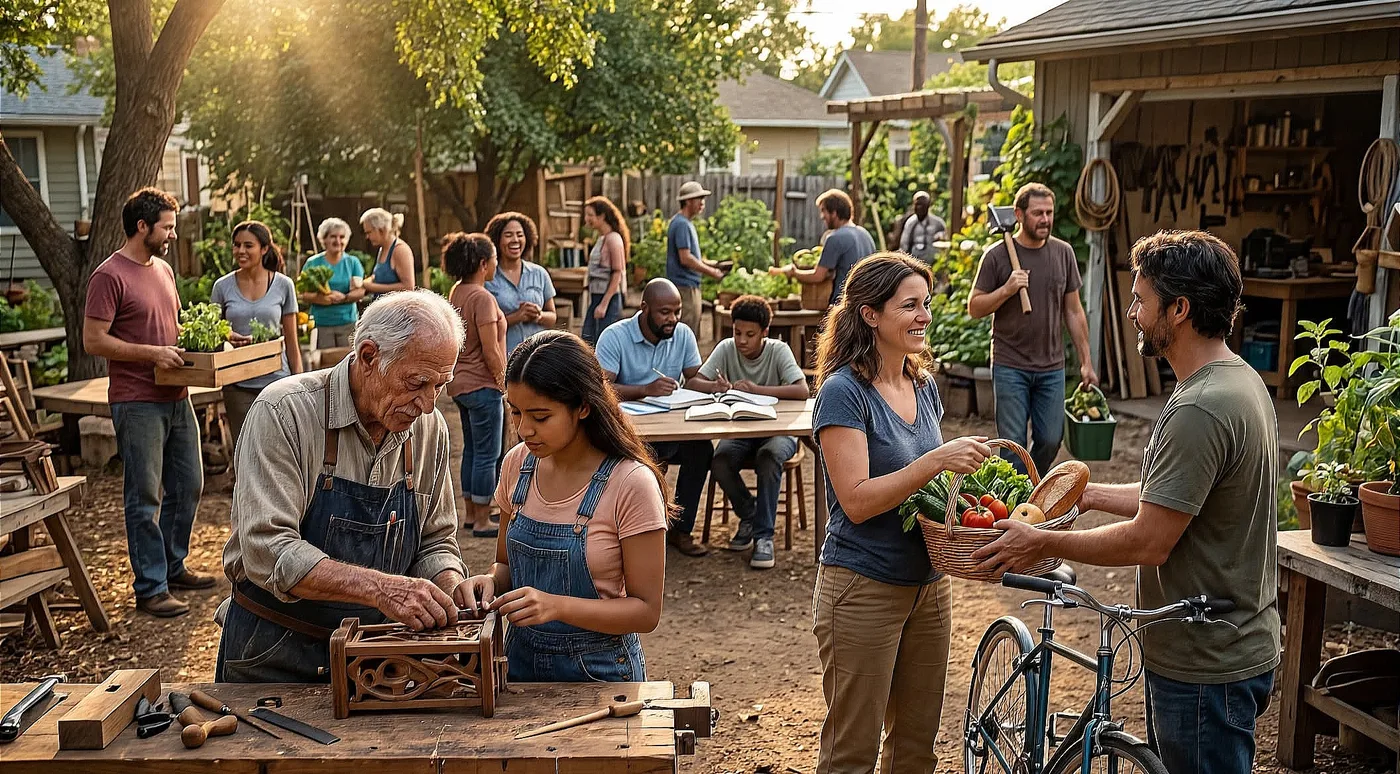
Welcome to the Global Barter Revolution
Not long ago, the idea of trading without money sounded like a quaint throwback, the kind of thing people associated with village markets, childhood swaps, or a neighborly “I’ll help you move if you watch my kids this weekend.” Yet the modern world quietly recreated the need for barter in plain sight. The more connected we became, the more people discovered the same uncomfortable truth: access to money is not the same as access to value.
A talented graphic designer in one country could be unemployed while a small business owner elsewhere desperately needed branding. A retired math teacher could have time and expertise to spare while a teenager across the ocean struggled with algebra and had no budget for tutoring. A farmer might have more produce than they could sell at a fair price, while an apartment dweller in a distant city wished they could get fresh food without paying inflated markups. The value existed. The match existed. What didn’t exist was a system that let value travel as easily as a message.
That gap is where the Global Barter Exchange began: not as a nostalgic return to the past, but as a practical answer to a modern problem. The vision was simple to describe and hard to execute: create a place where anyone could post what they offer, name what they need, and be matched to the right person anywhere on Earth, without requiring cash, cards, or crypto. Not “maybe someday,” not “if you know the right people,” but as a reliable, everyday way to exchange.
The earliest prototype of the Exchange didn’t start with software. It started with a pattern people kept repeating in every community, in every language. Someone would say, “I can do this,” and someone else would respond, “I need that.” The conversation was always the easy part. The hard part was trust, fairness, and follow-through. Barter failed not because people didn’t want to trade but because they couldn’t consistently answer a few essential questions:
How do I know the other person is real?
How do we agree on equal value without an argument?
How do we track what was promised, what was delivered, and what’s still owed?
How do we keep dangerous, illegal, or exploitative trades out?
When you look at it that way, the origin story becomes less about a sudden invention and more about a careful assembly of solutions. The Global Barter Exchange was built around the idea that trust is the true currency. Money is just one way of measuring trust at scale. If you can build trust through other means, you can trade through other means.
The first big step was shifting the focus from “finding a bargain” to “finding a mirror.” Traditional marketplaces push people to browse endlessly, compare prices, and haggle for advantage. The Global Barter Exchange aimed for something different: the Trading Mirror concept. Instead of shouting into a crowded market and hoping the right person hears you, you describe what you offer and what you seek, and the system looks for someone whose needs reflect your offer and whose offer reflects your needs.
A mirror match doesn’t eliminate negotiation, but it dramatically increases the odds that both people leave the exchange feeling respected rather than squeezed.
This wasn’t just a feature. It was a philosophy. The Exchange grew from the belief that most people do not want to “win” a trade; they want a trade that works. They want to feel safe, understood, and fairly treated. They want clarity. They want to know that their time and skills matter, even if their bank account is thin.
As word spread, another truth became obvious: global barter would only work if the platform treated identity and credibility as first-class requirements. In local barter, reputation travels through gossip and familiarity. On a worldwide platform, familiarity disappears. The Global Barter Exchange responded by building identity verification and credentials into the foundation, which is where GSU-verified credentials entered the picture.
GSU verification wasn’t designed to turn the platform into an elite club. The point was the opposite: to let ordinary people prove what they can do and who they are, without needing traditional gatekeepers. A certified caregiver could show qualifications. A language tutor could verify fluency. A mechanic could document training. And when formal credentials didn’t exist, the system still allowed people to build credibility through consistent, logged, completed trades. The goal was a world where trust is portable, so a person’s reliability doesn’t vanish the moment they cross a border or switch careers.
But trust isn’t only about credentials. It’s also about records. Early community barter groups often collapsed under the weight of vague promises: “I’ll get to it next week." “I thought you said you’d include delivery." “I did the work, but you never sent your part.” Multiply that by thousands of trades across time zones and languages, and you get chaos.
That is why the Exchange introduced the Trustline Ledger as a core tool rather than an optional add-on. A ledger sounds old-fashioned, but it solves a modern problem: memory is fragile, screenshots can be faked, and misunderstandings multiply when people are busy. The Trustline Ledger was envisioned as a simple, shared record of what was agreed upon, when it was delivered, and how both parties rated the experience. Not a weapon for public shaming, but a structure that rewards reliability and makes patterns visible. In a system built without money, the record of your word matters immensely.
As the Exchange expanded beyond small circles, the team encountered another barrier that money-based systems rarely address: language. Barter depends on nuance. “Lightly used” means different things to different people. So does “professional quality,” “two hours of tutoring,” or “help me set up my website.” Miscommunication could turn good intentions into conflict.
The vision required a translator, a tutor, and a guide all at once, which led to GENO AI Tutor. Its purpose was never to replace human judgment but to make barter easier to understand and safer to complete across borders. Supporting 83 languages, GENO could help people phrase offers clearly, convert vague descriptions into concrete terms, suggest fair ways to define scope, and remind both sides of important safety steps. In practice, it became the calm, multilingual voice that nudged trades toward clarity: “List what is included.” “State the condition honestly.” “Agree on a meeting place.” “Confirm delivery method.” The more global the community became, the more essential this kind of guidance proved.
Still, even the best tools cannot rescue a system that refuses to set boundaries. From the beginning, the Global Barter Exchange had to decide what it would not allow.
The platform’s vision depended on safety and legitimacy, which meant clear rules: adults only, legal trades only, and zero tolerance for scams. That clarity protected people who were new to barter and prevented the Exchange from becoming a shadow marketplace. Forbidden items were not treated as a grey area or an “ask forgiveness later” loophole. They were a firm line, because trust collapses when a community tolerates harm.
Those rules weren’t merely legal protection; they were part of the moral architecture of the Exchange. Barter can be incredibly empowering, but only when participants feel secure enough to participate. A platform that claims to help people thrive cannot do so by looking away from exploitation.
The vision, then, was never “a world without money” as a slogan. It was “a world where money is not the gatekeeper to dignity.” Money would still exist outside the Exchange. People would still use it. But inside this system, value could be recognized in forms that markets often ignore: patience, craftsmanship, mentorship, local knowledge, creativity, emotional labor, and the kind of practical help that keeps households and communities functioning.
Over time, the Exchange attracted people for different reasons. Some were trying to survive a rough season: a job loss, a move, a medical bill, an economic downturn. Others were already stable but wanted to expand their options, meet people, and trade smarter. Some joined because they believed in the idea of a more human economy. And some simply joined because they had extra capacity and hated seeing it wasted. Different motives, same mechanism: post what you offer, state what you seek, find your trading mirror, and let trust do the work money usually forces.
This is how the Global Barter Exchange moved from a concept to a living network. It treated barter not as an emergency measure but as a permanent pathway for exchanging value. It paired global reach with verification, a ledger with accountability, and an AI tutor with clarity. Most importantly, it treated every trade as more than a transaction. Each completed exchange became a small proof that people can cooperate without a traditional price tag attached.
If you’ve ever felt that your skills were real but undervalued, or that your needs were valid but temporarily out of reach, the origin of this Exchange is, in a way, your story too. It began the moment enough people realized that value was everywhere, and access was the problem. The Global Barter Exchange was built to solve that problem at scale so that wherever you are, what you can do and what you can offer can finally meet what you need.
If trust is the true currency of the Global Barter Exchange, then the next question is obvious: what exactly are we measuring when we trade?
Money has trained most of us to treat value as if it were a single number printed on a tag. It feels clean and final. Twenty dollars. Two hundred. Two thousand. But money is not value itself. It is a shortcut for negotiating value quickly with strangers. It works well when the world is stable and the market can reliably price things. It works less well when life is messy, when needs are urgent, when skills are overlooked, or when access to cash is uneven.
That difference, between value and the money used to represent it, is where barter becomes more than an old-fashioned alternative. It becomes a new lens.
Think about the designer from the earlier example: talented, ready to work, but unemployed. In a money-only economy, the designer’s ability can sit idle for months because employers are cautious, budgets are frozen, or gatekeepers demand a particular resume. Yet on the other side of the world, a small business owner might desperately need branding to attract customers. The value is real on both sides, but money keeps the door locked. Barter opens it by asking a different question: not “How much does it cost?” But “What can we do for each other that makes life better?”
The same is true for the retired math teacher. Traditional markets often treat time after retirement as a period of shrinking relevance. Yet that teacher may hold decades of skill, patience, and methods that help students finally understand what once felt impossible. When a teenager needs help and has no budget for tutoring, the market says no. Barter says, “Tell me what you can offer. There is almost always something.”
The farmer with surplus produce is another clear example. A price-based system can create absurd outcomes: food wasted in one place while healthy meals feel unreachable in another. Barter doesn’t magically solve distribution, but it changes incentives. If the farmer can trade produce for website help, equipment repair, language lessons, or even just a ride to town, then the surplus becomes a bridge rather than a burden. Value starts moving again.
The point is not that money is bad. The point is that money is limited. It recognizes only what it can price. Barter recognizes what people can do.
To rethink trade beyond money, it helps to notice how often we already barter without calling it that. We trade favors with friends. We swap childcare with neighbors. We bring food to someone who is sick, and later they return the kindness when we need support. These exchanges rarely feel like transactions because they run on relationship and trust. But as the world became more mobile and more digital, many people lost the tight networks that made this kind of exchange easy. We moved for work. We lived farther from family. We met strangers constantly but trusted fewer people. Money filled the gap because money doesn’t require relationships. You can pay and walk away.
The Global Barter Exchange tries to rebuild what money replaced, without pretending we all live in the same village. It does that by making relationships possible at scale, then reinforcing them with structure: GSU-verified credentials to reduce uncertainty, the Trustline Ledger to reduce forgetfulness and conflict, clear rules to reduce harm, and GENO AI Tutor to reduce miscommunication. These tools do not eliminate human complexity, but they make cooperation more realistic among people who have never met.
Once you step into a barter economy, you begin to see that value has layers.
There is practical value. This is the easiest to recognize: a repaired bicycle, a translated document, a haircut, a set of shelves installed, a logo designed. The outcome is visible. It works. It solves a problem.
There is skill value. Two hours of tutoring is not the same as two hours of casual conversation. The difference is expertise, preparation, and the ability to guide someone from confusion to competence. Skill value often gets flattened in money markets, especially when people underprice themselves out of desperation or when a platform pushes prices downward in a race to the bottom. In barter, skill value can be protected by defining scope clearly: what exactly will be taught, what materials are included, how progress will be measured, and what counts as completion.
This is exactly the kind of clarity GENO nudges people toward when it asks you to specify what is included rather than relying on vague promises.
There is time value. Not all hours are equal, and anyone who has tried to schedule life around shift work, caregiving, commuting, or chronic health issues knows this. An hour you can offer on a weekday morning might be worthless to someone who is only free on weekends. An hour of emergency help is not the same as an hour of relaxed assistance next month. Time has context. In a money economy, urgency is often punished by higher prices. In barter, urgency can be negotiated through reciprocity: “I can help you today, but I will need your part of the exchange by Friday,” or “I can do this quickly if you can deliver your offer sooner.” The exchange becomes less about extracting profit and more about aligning real lives.
There is access value. A person who lives near a government office, a specialty store, a safe meeting location, or a hard-to-find resource holds a kind of value that never shows up on a resume. So does someone who understands local systems: how to register a business, where to find affordable materials, and which services are trustworthy. In global trade, access can be more important than money. It can save weeks of frustration. It can prevent costly mistakes. A well-connected person may be able to provide introductions, referrals, and navigation support that is worth far more than a typical fee.
There is emotional value, which many markets ignore entirely. Listening, coaching, accountability, companionship for isolated adults, help organizing a home after a difficult season, guidance through a stressful transition, and patient support for someone learning a new tool. These are legitimate forms of value when they are offered ethically and within the platform’s rules. They require maturity, boundaries, and clear expectations. They are also the kinds of exchanges that build community rather than merely moving goods.
Rethinking value also means rethinking fairness.
One of the fears people carry into barter is the fear of being cheated. Money feels like protection because it is standardized. You pay and you get the thing. But anyone who has paid for a poor service, bought a product that broke, or been charged hidden fees knows money does not guarantee fairness. It only guarantees that a payment occurred. That is why the earlier origin story emphasized that barter fails not because people dislike trading, but because they struggle with trust, agreement, and follow-through.
The Global Barter Exchange answers those weaknesses directly. You are not asked to trust blindly. You are asked to trust the tools.
GSU-verified credentials help you evaluate whether someone can do what they claim. The Trustline Ledger helps you see whether they have a history of delivering. Clear rules, including adults only and legal trades only, draw bright lines so that participation does not expose you to predation or criminal risk. Zero tolerance for scams is not a slogan; it is the foundation that makes everything else possible. When a community is serious about safety, more people are willing to offer their skills, including professionals who might otherwise avoid barter because they worry it will be chaotic.
But fairness is not just about weeding out bad actors. It is also about making good agreements.
Money-based trade often encourages people to hide weaknesses. A seller wants the highest price, so they emphasize benefits and downplay flaws. Barter works better when people can be honest without fear of losing everything. If you admit a chair has scratches, you might still trade it for something that matters to you more than perfection. If you admit your English is still developing, you might trade for conversation practice while offering something else you are strong at. Barter invites a more human kind of negotiation: “Here is what I can truly offer. Here is what I truly need. Let’s make this work.”
This honesty is one reason the Trading Mirror concept matters so much. Traditional marketplaces can turn every interaction into a contest. Who can get the better deal? Who can pressure the other side? Mirror matching changes the posture. It starts by looking for mutual fit, not maximum advantage. When both sides have something the other genuinely wants, the conversation becomes less about winning and more about designing an exchange that respects both realities.
That design mindset becomes crucial when value is not perfectly symmetrical. In money terms, it is easy to imagine that a new laptop is worth “more” than three hours of tutoring. But in real life, three hours of tutoring might be the difference between passing an exam or failing it, between earning an opportunity or losing it. Meanwhile, the laptop might be sitting unused in a closet. Money pricing can miss these personal stakes. Barter makes room for them. It allows value to be subjective without being sloppy, as long as both parties agree on clear terms.
That is the deeper revolution: a shift from price to purpose.
When you trade beyond money, you stop asking, “What is the market rate?” as the only question. You start asking, “What is the real impact?” You trade for outcomes: a skill gained, a problem solved, a burden reduced, a door opened. You begin to see your own capacity differently, too. The things you dismissed as “not worth much” in a cash economy can become powerful in a trust-based one. Your patience. Your bilingual ability. Your knack for fixing things. Your knowledge of how to navigate local services. Your talent for teaching. Your ability to make someone feel less overwhelmed.
And because the Exchange is global, that value can travel farther than your neighborhood ever could.
When value is allowed to move without money as the gatekeeper, people who have been stuck begin to move again. Not just economically, but personally. They gain confidence by proving they can contribute. They build networks that outlast a single transaction. They discover that “I have nothing to offer” is usually a story money told them, not a fact.
This does not mean barter is effortless. It requires clarity, boundaries, and follow-through. It requires you to name what you offer without shrinking it and to name what you need without shame. It asks you to treat your word like something with weight, because in a system where money is not the guarantee, your reliability becomes the guarantee.
That is why this chapter begins with origins and trust. Beyond money is not a fantasy of a perfect world. It is a practical reorganization of how we recognize value. Once you understand that, the next steps become much easier: creating a profile, verifying credibility, posting offers and requests, and using tools like GENO and the Trustline Ledger to turn good intentions into completed trades.
In other words, beyond money is not the absence of structure. It is the presence of a better one.
By now, the picture should feel clear: the Global Barter Exchange is not a sentimental throwback. It is a modern system built to move value when money cannot and to move it safely when distance, language, and unfamiliarity would normally make trust impossible. The remaining question is personal and practical: what does this actually do for you?
CONNECT. TRADE. THRIVE. empowers you by turning what you already have into real leverage. Not leverage in the sense of pressure or advantage over others, but leverage in the sense of traction. It helps you turn skills into outcomes, spare capacity into progress, and everyday resources into opportunities you can actually reach.
Most people underestimate what they can offer because money taught them to. In a cash economy, value is often validated only when a boss hires you, a client pays you, or a market decides your talent fits a profitable category. CONNECT. TRADE. THRIVE. flips that dynamic. It starts by asking a simpler question: “What can you do, what do you have, and what do you need?” Then it helps you connect those answers to someone else’s life in a way that produces a clear, trackable exchange.
Think back to the examples that opened this chapter. The unemployed graphic designer does not need to wait for a hiring cycle to end before their skills matter. They can offer branding, social media templates, a resume refresh, product photography touch-ups, or a small-business logo package and request something that stabilizes their life in return: language lessons, interview coaching, childcare hours, laptop repair, or even help setting up a portfolio site. The retired math teacher does not need to rely on a tutoring market that ignores them. They can trade patient, high-quality instruction for help with technology, home maintenance, transportation, or healthy meals. The farmer with surplus produce does not need to accept waste as normal. They can turn abundance into support: a repaired fence, a new set of marketing photos, a translated listing, a bookkeeping session. In each case, the Exchange does not create value out of nothing. It removes the locked door that kept value from reaching the person who needed it.
This is where the Trading Mirror matters as more than a clever feature. Traditional marketplaces make you compete for attention. You post, you wait, you bargain, you compromise, and you often end up negotiating with someone who only half wants what you offer. Mirror matching aims for a stronger starting point: mutual desire. When you find someone who genuinely needs what you can give and who has what you genuinely need, you no longer have to sell yourself like a billboard. The conversation changes. It becomes less “convince me” and more “design the exchange.”
That design mindset is the first empowerment: you are no longer stuck begging for access. You become a builder of solutions.
The second empowerment is credibility you can carry. In a local community, reputation travels through familiarity. Online, familiarity disappears, which is why so many platforms feel risky. CONNECT. TRADE. THRIVE. addresses that by treating identity and reliability as foundational, not optional.
GSU-verified credentials are part of that foundation. They give you a way to prove what you can do without relying on traditional gatekeepers. If you are a caregiver with training, you can show it. If you tutor languages, you can demonstrate proficiency. If you have professional skills but an unconventional path, verification helps you be taken seriously on the strength of what you can actually do, not only on what fits a standard resume.
And if you do not have formal credentials, you are not excluded. The platform recognizes that many real skills are learned through life, work, and persistence. In those cases, completed trades and consistent follow-through become their own form of proof.
That is where the Trustline Ledger becomes personal power. It is easy to hear “ledger” and think of paperwork. In practice, it is a reputation engine that rewards the behavior you want to be known for: clarity, delivery, fairness, and reliability. Every completed trade strengthens your standing. Every agreement recorded reduces the chance of misunderstandings. The ledger also protects you from the most exhausting form of conflict: the argument about what was promised.
When two people agree on a trade, they are often imagining two different things without realizing it. One person thinks “two hours of tutoring” includes a personalized study plan and homework review. The other imagines casual help with a few questions. One person thinks “lightly used” means nearly new. The other means “still works.” These are not always scams. They are often human assumptions. The Trustline Ledger empowers you to replace assumption with clarity: what exactly is included, when it will happen, how it will be delivered, and what completion looks like.
The third empowerment is language and guidance without shame. Barter depends on nuance, and in a global space nuance is where deals either become beautiful or fall apart. GENO AI Tutor exists for that reason. It is not there to make decisions for you. It is there to make your decisions easier to communicate and harder to misunderstand.
Imagine you are the designer negotiating with a small business owner in another country. The owner writes, “Need brand help, urgent.” "Urgent" can mean “today,” “this week,” or “before my next product launch.” GENO can prompt both of you to define urgency: “What is the deadline? What deliverables are required? What files will be provided? What revisions are included?” Or imagine the farmer listing produce. Without support, a listing might say “fresh vegetables available,” which leaves everything open to interpretation. GENO can help translate that into specifics: quantity, type, harvest date, packaging, pickup method, and storage needs. It helps people who are new to barter sound confident and clear, not because they are pretending to be experts, but because they have a guide.
This kind of support matters even more when someone feels vulnerable. Many people hesitate to ask for what they need. They fear looking desperate or being judged. GENO and the platform structure together create a more neutral frame: needs are normal here. Requests are not confessions. They are part of the design of exchange.
The fourth empowerment is safety through boundaries. A system that claims to empower people but leaves them unprotected is not empowerment; it is exposure. That is why the rules you encountered earlier are not background noise. Adults only. Legal trades only. Zero tolerance for scams. Clear bans on forbidden items. These boundaries are the reason the community can remain a place for opportunity rather than exploitation.
On many platforms, safety is treated as something the individual must figure out alone: "Be careful,” “meet in public," and “use your judgment.” CONNECT. TRADE. THRIVE. does not replace judgment, but it does reduce the burden. When a community is built with bright lines, you spend less energy wondering what you might be walking into. You can focus on finding a fair exchange, not on dodging hidden hazards.
That brings us to a fifth empowerment that is quieter, but often more life-changing: dignity.
Money-based systems can make people feel invisible the moment their budget tightens. Needs do not disappear when income does. In fact, they often grow. But the market tends to treat “can’t pay” as “doesn’t matter.” Barter does the opposite. It insists that if you are human, you have value to exchange, even if that value is not currently recognized by a paycheck.
Dignity shows up when a teenager who cannot afford tutoring can still offer something meaningful, such as help with video editing, beginner tech support, language exchange, or consistent accountability on a shared goal. Dignity shows up when someone who has been out of the workforce can still contribute through reliability, care, organization, or teaching. Dignity shows up when a person in a new country, still learning the language, can trade cultural knowledge, cooking, repair skills, or childcare support while they build a new life. Barter is not charity when it is mutual. It is partnership.
And partnership, repeated over time, becomes a network.
That is the sixth empowerment: your world gets larger. Not in the abstract sense of “more followers,” but in the practical sense of more doors you can knock on. One successful trade often leads to another because trust is contagious when it is earned. A small business owner who receives good branding may recommend the designer to others inside the Exchange. A student who improves with the retired teacher may connect the teacher to another family who can offer transportation or home repairs. A farmer who trades produce for a website update might later trade again for packaging design or bookkeeping. Each completed exchange creates a thread, and enough threads become a support system.
CONNECT. TRADE. THRIVE. empowers you, then, by giving you a repeatable method:
Name what you offer without shrinking it.
Name what you need without shame.
Find a trading mirror rather than chasing random attention.
Use verification, the ledger, and clear terms to protect both sides.
Let GENO help you communicate across languages and expectations.
Follow through, log completion, and build a reputation you can carry.
That method is simple, but it changes how you move through the world. You stop waiting for permission to be valuable. You start practicing value in public, with structure, safety, and accountability. And you begin to discover that thriving beyond money is not a fantasy reserved for a few. It is a skill, a system, and a community you can step into, one clear trade at a time.