
Desirable Difficulty: Not Because It Was Easy
Why the struggle you feel when you learn is often the sign that you are learning, and how to use it.
Twelve chapters on why the hard moments of learning are often the ones that make it last: pull it out, spread it out, mix it up, guess first, and ask how sure you are. Includes a 30-day practice plan, seven real research cases and a 30-term dictionary.
Contents
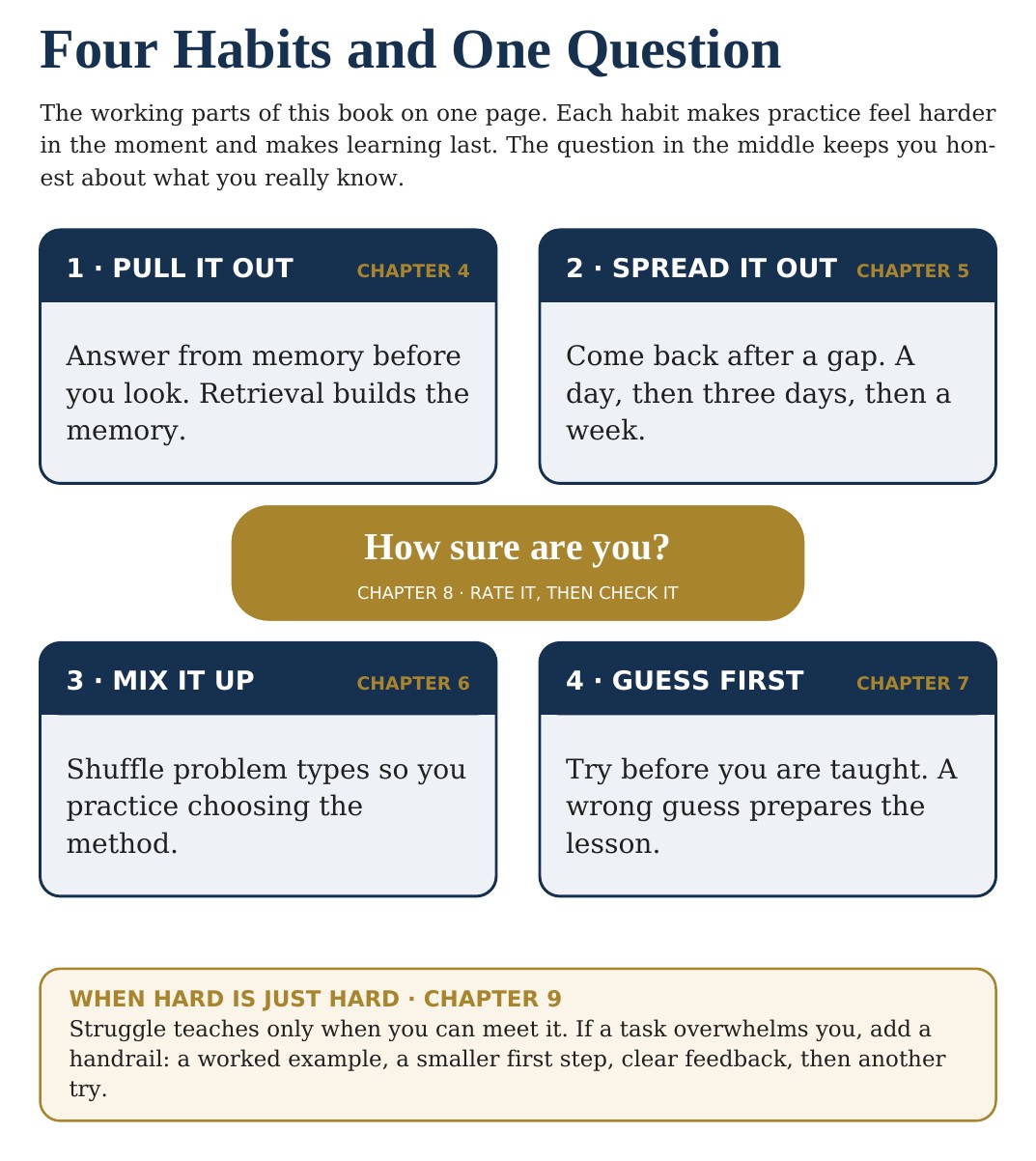
Paperback, 180 pages, 8.5 x 11 inches, black and white. Before you begin: A Note on Care, The Six Rooms, and Four Habits and One Question.
1. The Lie of Easy. Fast-and-easy promises have taught us to treat struggle as proof that we are failing. This chapter separates performance from learning and argues that the first hard moment is not the end of the story.
2. Your Brain Is Built to Forget. Forgetting is not a flaw in your mind; it is how memory works. Ebbinghaus showed that we lose the most soon after learning, and that knowing this changes how you review.
3. The Rereading Trap. Rereading and highlighting feel productive because familiar words feel understood. Erin's color-coded textbook shows how recognition can pass for knowledge until a test asks you to produce it.
4. Pull It Out. Pulling an answer out of your own memory strengthens it more than reading it again. Mr. Alvarez turns short, low-stakes questions into the practice that makes history stick.
5. Spread It Out. The same practice works better spread across days than packed into one marathon. Priya rebuilds a corporate training around spacing and short returns instead of one long session.
6. Mix It Up. Practicing one problem type at a time feels smooth, but real life arrives mixed. Coach Bennett's hitters stop looking great in practice and start hitting in games when the pitches are shuffled.
7. Guess First. Trying to answer before you are taught, even wrongly, prepares the mind for the lesson. Ms. Chen opens her physics class with a pendulum and a prediction instead of a formula.
8. How Sure Are You? Feeling sure and being right are not the same thing. This chapter shows how to rate your confidence, check it against results, and learn to know when you know.
9. When Hard Is Just Hard. Not every struggle teaches. A new developer named Eli, left alone in a tangled codebase, shows the difference between difficulty that builds skill and difficulty that only overwhelms.
10. Mistakes That Teach. Errors made with high confidence, once corrected, can become the lessons we remember best. Lena's sales team learns to treat confident mistakes as the start of better rules.
11. At Work and at the Kitchen Table. Learning proves itself when it transfers to a new situation. Nia, facing a new system at work and a spelling list at home, uses the same habits in both places.
12. Not Because It Was Easy. The author's own road from an eighth-grade departure to a doctorate. Not because learning became easy, but because the work of learning belongs to the learner, even when it is hard.
At the back: The 30-Day Practice Plan, Research Cases, The Desirable Difficulty Dictionary, The Grade Level Check, 27 Free Ways to Learn to Read, the Global Barter Exchange, About the Author, and Not Because It Was Easy.
Chapter 1. The Lie of Easy
We have built a culture that treats effort like a design flaw.
Scroll through any feed long enough and the message becomes impossible to miss. Learn a language in thirty days. Master coding over a weekend. Read three hundred books a year. Memorize anything with one strange trick. Get the degree, the promotion, the body, the business, the life you want, preferably before lunch and without feeling uncomfortable.
The promise is always the same: if learning feels hard, you are doing it wrong. It is a seductive promise. It is also a lie.
I understand why people want to believe it. I have sat at tables with adults who were embarrassed to admit they did not understand a form at work. I have watched students stare at a blank page as if the page had accused them personally. I have known the hot, private shame of being behind, of suspecting that everyone else received some instruction manual for life that I missed.
When I left school in eighth grade, I did not have sophisticated language for what had happened. I did not say, “I have become alienated from the institutional structures of education.” I said, in one form or another, “School isn’t for me.”
That sentence is a trap.
Sometimes school truly is failing a student. Schools can be rigid, careless, under-resourced, cruel, and blind to the burdens students carry home with them. A child can be hungry, exhausted, grieving, working, raising siblings, translating for parents, or simply trying to survive a world that has made concentration feel like a luxury. We should not turn structural failures into individual moral failures.
But neither should we accept the poisonous conclusion that difficulty proves incapacity.
At thirteen or fourteen, I confused struggle with a verdict. If reading took me longer than it seemed to take someone else, I took that as evidence that I was not a reader. If a math problem did not yield quickly, I assumed mathematics belonged to another species of person. Every hard task appeared to be a test of whether I possessed some fixed substance called intelligence. When I could not perform smoothly, I withdrew.
That is what the myth of easy does. It does not merely make people impatient. It makes them misinterpret the normal sensations of learning.
Real learning is often slow at the beginning. It is awkward. It makes you aware of what you cannot yet do. It asks you to hold incomplete ideas in your mind without running away from them. It requires repetition after the thrill has worn off. It asks you to make mistakes in public, or at least on paper, where you cannot pretend they did not happen.
None of that sells particularly well.
“Feel confused for a while” is not a popular slogan. “Forget it, retrieve it, fail at it, return to it later” will not dominate an advertisement. Yet those experiences are not signs that learning has gone off the rails. Very often, they are signs that it has finally begun.
The marketplace prefers ease because ease is easy to package. A product can promise a shortcut. A video can be consumed in thirty seconds. An app can congratulate you for maintaining a streak. There is nothing wrong with tools, and there is nothing shameful about wanting efficiency. The problem begins when convenience is mistaken for transformation.
Watching a person explain a skill is not the same as possessing the skill. Nodding along to a lecture is not the same as being able to explain the idea tomorrow without notes. Highlighting a page is not the same as being able to use its argument when the question is phrased differently. Finishing a module, earning a badge, and clicking “complete” may document exposure. They do not guarantee learning.
Exposure feels good because it is smooth. You recognize a word, a face, a formula, a phrase. Recognition gives the mind a small burst of relief: I know this. But recognition can be a terrible witness. It tells you only that something looks familiar while it is sitting in front of you. It does not tell you whether you can produce it when the page is closed, the teacher is silent, the customer is waiting, or the patient is in front of you.
That distinction has consequences far beyond school.
A technician who has watched a safety training video may feel prepared until an alarm goes off at 2:00 a.m. A new manager may recognize every term in a leadership handbook and still freeze during a difficult conversation. A parent may understand, in theory, that children need consistency and still struggle to apply that principle during a grocery-store meltdown after a twelve-hour day. Knowledge that remains comfortable, passive, and context-bound is fragile knowledge.
We keep buying the fantasy that learning should feel like downloading because the alternative can feel insulting. People hear “learning is hard” and assume the message is “you are not smart enough.” I mean the opposite.
Learning is hard because your brain is not a bucket. You do not pour information in and keep it forever. You build memory through use. You build judgment through comparison. You build fluency through effortful attempts, correction, and return. The struggle is not proof that you are defective. It is often the work itself.
That phrase matters: often, not always.
There is a difference between a productive challenge and needless suffering. There is a difference between working hard and being abandoned. A student asked to solve a problem with the necessary background knowledge may be doing valuable cognitive work. A student handed material full of unfamiliar terms, unclear directions, and no feedback may simply be overwhelmed. We will need that distinction later, because not every difficulty is desirable. Some difficulty teaches. Some difficulty merely crushes.
But our current problem is not that we have too much respect for effort. It is that we have forgotten what effort is for.
We talk endlessly about talent, potential, and motivation. We talk less about the plain mechanics of returning to a thing after it has become unpleasant. We celebrate the polished performance and hide the ugly middle: the missed questions, the false starts, the drafts marked up in red, the hours when nothing seems to stick.
That middle is where people quietly decide who they are.
The gifted student who has never needed to study can arrive at the first truly demanding course and experience panic. For years, speed came easily. Answers appeared quickly. Praise followed. Then the work changes. The reading gets denser. The problems require several steps. A first poor grade lands like a diagnosis: Maybe I was never smart after all.
Meanwhile, an adult learner walks into a night class after a full day of work. She may be tired. She may be older than everyone else in the room. She may have forgotten much of what she learned years ago. But she expects friction. She does not enjoy every minute of it. That is not the point. She has made a different interpretation. Difficulty does not mean stop. Difficulty means slow down, ask a question, try again tomorrow.
One learner has been trained to protect an identity. The other has begun to build a practice.
I eventually had to build one too.
The route from an eighth-grade dropout to a doctorate was not a straight climb powered by inspirational music. It was full of remedial work, uncertainty, financial strain, embarrassment, and moments when I wanted to disappear rather than reveal what I did not know. I did not wake up one day transformed into the kind of person for whom hard things were easy. I became someone who could remain present when hard things were hard.
That is a smaller claim than genius. It is also a more useful one.
You do not need to be fearless to learn. You do not need to enjoy confusion immediately. You do not need to pretend that the struggle is beautiful while you are in the middle of it. You need a more accurate story about what the struggle means.
When the work feels effortful, do not rush to conclude that you are failing. Ask a better question: Is this effort asking my mind to do something worth learning?
If it is, stay with it.
The smooth path may feel reassuring, but reassurance is not the same as growth. The next pages will make the case that certain forms of difficulty do something remarkable: they make learning more durable precisely because they demand more from us in the moment. The goal is not to make education miserable. The goal is to stop mistaking comfort for competence.
Easy is not the enemy. Sometimes clarity, support, and well-designed instruction make learning easier in the best possible sense. But effortless is not the standard. Friction is not a scandal. And the first hard moment is not a verdict on who gets to become educated.
It may be the moment you begin.
What, exactly, does it mean to say that friction can be useful?
It does not mean that pain is automatically noble. It does not mean that a confusing teacher, a broken system, or a mountain of busywork deserves our gratitude because it made us tougher. I have no patience for educators or managers who create needless obstacles and call the result rigor. A locked door is not a lesson. Neither is humiliation. Neither is exhaustion so severe that the mind has no room left to think.
Useful difficulty has a specific job. It makes the learner do mental work that strengthens later recall, understanding, or application.
The psychologist Robert A. Bjork gave this principle a name in 1994: desirable difficulties. The phrase has since been repeated so often that it can sound like a motivational poster, but Bjork’s point was more precise, and more demanding. Some conditions make performance look worse while learning is taking place. They slow us down. They increase errors. They make us feel less certain. Yet those same conditions can produce stronger, more durable learning over time.
That is the puzzle at the heart of education: what feels best during practice is not always what works best after practice.
Think about the difference between walking down a familiar hallway and finding your way through a city you have never visited. The hallway requires almost nothing from you. Your body knows the route. Your attention can drift. In a new city, you must notice landmarks, make decisions, recover from wrong turns, and revise your sense of direction. The second experience is less pleasant in the moment, but it is far more likely to leave you with a usable map.
Memory works in a similar way.
When information is presented clearly, repeated immediately, and kept directly in front of us, it can feel as though we know it. Sometimes we do. But often, we are borrowing the support of the environment. The notes are there. The answer choices are there. The teacher’s voice is still in our ears. The page itself is quietly doing part of the remembering for us.
Remove those supports, and the truth appears.
Can you explain the idea with the book closed?
Can you solve the problem when it is mixed in with other problems?
Can you remember the procedure next week, next month, or in a crisis, when no one is standing beside you to point at the next step?
Those questions can feel harsh. They are not meant to be cruel. They are meant to distinguish temporary familiarity from knowledge that can travel.
Bjork’s work asks us to separate two things that are commonly confused: performance and learning. Performance is what you can do right now, under the conditions of practice. Learning is the relatively lasting change that allows you to do something later, under different conditions. Performance is immediate and visible. Learning is delayed and partly hidden.
That is why learners can be fooled so easily.
A student may reread a chapter and feel fluent because each sentence comes more easily on the second pass. A piano player may repeat the same measure ten times and improve rapidly while the music is still open in front of them. A trainee may answer every question correctly when the examples all follow the same pattern. In each case, performance is improving. But whether that improvement survives depends on what the learner has actually had to do.
Did they retrieve the information from memory?
Did they discriminate between similar ideas?
Did they make choices without being told which rule applied?
Did they return after enough time had passed for the knowledge to become slightly difficult to reach?
Or did they simply follow a path that had been made smooth for them?
The answer matters because smoothness can create confidence without creating capacity.
This is not an argument against good instruction. Clear explanations matter. Worked examples matter. Demonstrations matter. A person cannot retrieve or apply what they have never encountered. We begin, often, by making things visible. We model. We name. We break a skill into parts. We give learners a foothold.
But then, if we want learning to last, we gradually remove some of the supports. We ask the student to explain the concept in their own words.
We make the apprentice diagnose the problem before we reveal the fix.
We let a few days pass before asking the employee to use the new procedure. We mix old material with new material so that the learner must decide what applies.
We permit a pause long enough for effort to enter the room.
That effort is fuel.
I did not understand this when I was young. Back then, I believed that quickness was intelligence. The students who answered first seemed smarter. The people who read a page once and appeared to understand it seemed born for school. I noticed my own hesitation, the extra time I needed, the questions I was afraid to ask, and treated each one as evidence against myself.
What I could not see was that speed and strength are not the same thing.
A person may move quickly through material because they already possess the background knowledge that makes it meaningful. Good for them. A person may move quickly because the task is too easy. Or because they have learned to imitate the surface of competence. They can repeat the phrase, recognize the formula, mimic the procedure. But when the setting changes, the performance disappears.
Meanwhile, the person who pauses, searches, makes an error, receives feedback, and tries again may look slower. They may feel slower. Yet they are building something more stable than a polished first impression.
That was one of the hard-earned lessons of returning to education later. I had to stop using the feeling of difficulty as my scoreboard. If I judged every study session by whether it felt smooth, I would choose the least effective methods every time. I would reread notes because rereading soothed me. I would avoid questions because questions exposed me. I would stay with familiar material because it protected me from the ache of not knowing.
But protection was not progress.
The work changed when I began asking myself different questions. Not, “Did this feel easy?” Not even, “Did I spend enough hours on it?” Instead: “What did I have to pull from my own mind?” “Where did I get stuck?” “What will I be able to do when these notes are gone?”
Those questions moved me from consuming information to working on it.
This distinction matters especially for adults returning to school, because many carry an old wound into the classroom. They have spent years believing that capable people understand immediately. So when they encounter difficulty, they do not see a normal stage of learning. They see confirmation of a humiliating identity: too old, too slow, not academic, not college material.
That interpretation can end a person’s education before the course has really begun.
The more accurate interpretation is less flattering to our desire for instant success, but far more hopeful. You are not necessarily struggling because you cannot learn. You may be struggling because learning requires you to do something your mind has not yet automated.
There is dignity in that.
When a learner tries to recall a concept and comes up blank, the blankness feels like failure. But if they then search, receive the answer, and return to the idea later, that moment can become part of a stronger memory. When they attempt a difficult problem before seeing the solution, the wrong attempt can prepare the mind to understand why the right answer is right. When they practice several related skills in mixed order, the confusion can force them to notice distinctions they would otherwise miss.
The discomfort is not magical. It works only when the learner is engaged with material they can eventually manage, and when correction follows. Difficulty without feedback can harden confusion. Difficulty far beyond a learner’s preparation can become defeat. We will return to those guardrails because they are essential.
For now, hold on to the central idea: a learning experience should not be judged solely by how it feels while it is happening.
The most effective practice often carries a small sting. It asks you to reach rather than merely recognize. It lets forgetting begin, then interrupts it. It makes you choose among possibilities rather than march through one predictable routine. It reveals the gap between what you thought you knew and what you can actually produce.
That gap is not an indictment. It is a map.
A good teacher, coach, parent, supervisor, or learner does not use that map to shame the person standing in front of it. They use it to decide what to practice next.
The promise of desirable difficulty is not that the road will become pleasant. The promise is better than that. It is that the roughness of the road can mean something. The moment when you have to stop, think, reach back, test yourself, and try again is not empty suffering. Under the right conditions, it is the brain being asked to build a route it can travel later.
And that is how a person who once walked away from school can eventually learn to stay.
Not because the work became easy.
Because the difficulty stopped meaning, “You do not belong here,” and began to mean, “You are doing the kind of work that makes belonging possible.”
The difference between the gifted dropout and the night schooler is not intelligence.
That is the first thing we need to get straight, because our culture has done enough damage with the opposite story.
One learner may have spent years being praised for quick answers. The other may have spent years being told, directly or indirectly, that school was not built for them. One arrives at difficulty with a record of success. The other arrives with a record of interruptions, missed chances, and reasons to doubt. But when the work finally becomes demanding, the decisive question is not who was called smart first.
It is who has learned what to do when smart no longer feels like enough.
I have seen the gifted dropout in many forms. Sometimes they are eighteen years old, sitting in the back row of an introductory college course, stunned that the professor expects more than remembering what was said in class. Sometimes they are older, successful by every visible measure, and quietly avoiding a new responsibility because they cannot tolerate being a beginner. Sometimes they are the student who has always been able to get by with a good memory, a fast mind, and a few frantic hours the night before an exam.
For years, school confirmed their identity. They did not need to develop a method because they had results. They listened once and remembered. They skimmed the chapter and passed. They wrote the paper the night before and earned praise for being “naturally talented.”
Praise can be a gift. It can also become a cage.
When all the praise is attached to effortless performance, the learner receives an unspoken lesson: intelligence is what happens without visible effort. Needing help is suspicious. Studying is for people who do not get it. Errors are embarrassing because they threaten the identity everyone has helped build.
Then college, graduate school, a technical job, a licensing exam, or any serious adult responsibility arrives and changes the rules.
The volume increases. The material becomes less forgiving. The problems no longer announce which formula, procedure, or principle should be used. A person can no longer survive on recognition and speed. They must retrieve, connect, discriminate, practice, revise, and persist.
For the first time, the gifted learner may meet a question that does not yield. And because nobody taught them that difficulty is normal, they interpret the experience as catastrophe.
“I guess I’m not actually smart.”
That sentence has ended more educations than any single bad grade.
Consider a student I will call Daniel. In high school, Daniel was the person teachers remembered. He read quickly, spoke confidently, and could make a last-minute project look polished. He earned excellent grades with almost no visible study. Family members called him brilliant. Friends asked for his help before tests. He believed, with understandable sincerity, that academic success was something he either had or did not have, and he had it.
His first semester of college began well enough. Then came organic chemistry. Daniel did what had always worked. He attended lectures. He highlighted the textbook. He reread his notes late at night. When the professor worked through sample problems, Daniel followed every step and felt the familiar relief of recognition. “That makes sense,” he thought.
But the exam did not ask him to recognize the professor’s examples. It asked him to generate solutions. It presented unfamiliar versions of familiar problems. It required him to decide which principle mattered before he could begin.
Daniel froze.
His first exam grade was low enough to rattle him. His second was worse. The course was not telling him that he lacked potential. It was telling him that his old methods had reached their limit. But Daniel did not hear it that way. He heard a verdict.
He stopped going to office hours because he did not want anyone to see that he was lost. He avoided study groups because he could not bear the possibility that other students understood more than he did. He told people the professor was unclear, which may even have been partly true. But he did not change what he was doing. Rereading remained safer than testing himself. Highlighting remained safer than attempting a problem cold. Avoidance remained safer than being a novice in public.
By the end of the year, Daniel had withdrawn.
This is not a story about laziness. It is a story about interpretation.
Daniel had never built a relationship with productive struggle. His ability had protected him from needing one. Every early success had been real, but it had also concealed a missing skill: how to continue after the first clean answer failed to appear.
Now place beside him the night schooler.
Her name might be Rosa. She is thirty-eight. She works all day at a distribution center, where she has become the person newer employees seek out when the inventory system refuses to cooperate. She has two children, a commute, bills that do not care whether she has an exam on Thursday, and a history with school that does not feel uncomplicated.
She did not leave school because she lacked ambition. Life asked for labor before education had finished asking for attention. She has carried the belief that she is “not academic” for so long that it sometimes sounds like fact.
Still, she enrolls in an evening class because she wants a credential that could lead to a better role at work.
On the first night, she sits near the door. Not because she plans to leave, exactly, but because old instincts are practical. The instructor begins using terms she does not know. Other students appear to nod. Rosa copies the terms down carefully, then goes home worried that she has made a terrible mistake.
The difference is not that Rosa enjoys this feeling. She does not.
The difference is what she does next.
The next morning, before the house fully wakes, she takes out her notes and tries to write what she remembers without looking. There are gaps everywhere. She looks up the terms. At lunch, she uses index cards. A few days later, she tries again. At first, the cards seem to prove only that she has forgotten. But Rosa does not treat forgetting as a personal insult. She treats it as information: this one needs another pass.
When the instructor gives a short quiz, Rosa misses four questions. She feels the sting of it. Then she writes down which concepts she missed and asks a question after class. The following week, she misses two. Two weeks after that, she can explain the idea to a coworker who is taking the same course.
Rosa is not more virtuous than Daniel. She is not necessarily more intelligent. She may have less free time, more stress, and more reason to be exhausted. What she possesses is a different working theory of struggle.
Daniel hears difficulty and thinks, “This exposes me.”
Rosa hears difficulty and, after some understandable frustration, begins to think, “This shows me where to work.”
That shift is not a personality trait reserved for certain people. It can be taught. It can be practiced. It can be rebuilt even after years of avoiding challenge.
The night schooler does not succeed because hardship has made her magically immune to discouragement. Hardship often makes learning harder. Fatigue is real. Poverty is real. Caregiving is real. A person cannot simply grit their teeth through every barrier that institutions create and call the result resilience. Rosa needs clear instruction, useful feedback, time, and support. She needs teachers who do not confuse intimidation with standards. She needs a course designed to help a learner build from what they know toward what they do not yet know.
But within those conditions, she has one powerful advantage: she does not require the work to flatter her before she begins it.
She has learned, or is learning, that competence is built through contact with what she cannot yet do.
This is why I distrust the easy categories we use for learners. “Gifted.” “Struggling.” “Natural.” “Not academic.” These labels can describe a moment, perhaps. They should never be allowed to write a future.
The student who has always succeeded effortlessly may need to learn how to fail productively. The student who has always struggled may need evidence that struggle does not mean permanent limitation. Both need better tools. Both need environments that demand effort without making a spectacle of suffering. Both need permission to be unfinished.
The real dividing line is not between those who learn quickly and those who learn slowly. It is between those who believe difficulty is a stop sign and those who can learn to see it as a signal.
Slow down.
Look closer.
Try to pull it from memory.
Find out where the gap is.
Come back tomorrow.
That is not glamorous. It will not fit neatly into a slogan about genius. But it is how people become capable.
My own path depended on learning this lesson late. I had already spent years treating struggle as proof that I did not belong in academic spaces. Returning to school did not erase that reflex. There were still rooms where I felt exposed, readings that made me feel slow, and questions I was sure everyone else understood except me.
What changed was not that I became fearless. What changed was that I stopped granting fear the authority to interpret the evidence.
A difficult assignment was no longer proof that I should leave. A blank answer was no longer proof that I was incapable. It was a place to begin work.
The gifted dropout and the night schooler live in all of us. One wants to preserve the image of being naturally good. The other is willing, however imperfectly, to become good through practice. When the work gets hard, the first voice will tell you to protect yourself by quitting, hiding, or returning to what feels familiar.
Listen instead for the second voice.
It may be tired. It may be uncertain. It may not sound impressive at all.
But it knows the truth.
You do not have to be instantly good at a thing to keep going.
You only have to stop mistaking the first hard moment for the end of the story.
Chapters 2 through 12, the 30-Day Practice Plan, the research cases and The Desirable Difficulty Dictionary continue in the book.