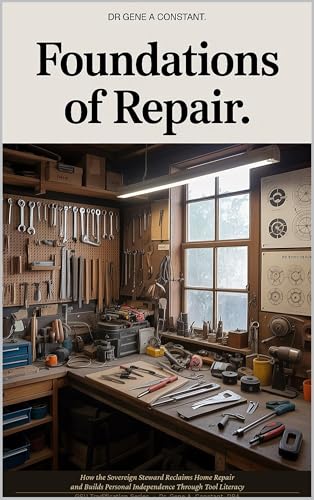
Foundations of Repair: How the Sovereign Steward Reclaims Home Repair, Beats the Throwaway Culture, and Builds Personal Independence Through Tool Literacy and Practical Maintenance
You are not holding a manual. You are holding the visa to the inside of everything you own.
The inside of your belongings was never off-limits. Twenty chapters of tool literacy, the three diagnostic questions, safe-small-reversible repair method, and the steward's mindset that turns every failure from a forced purchase into an informed choice.
The Sovereign Hand — Why Fixing What You Own Is the First Step Toward Personal Independence
Redefining Ownership: From Consumer to Steward
Most people believe ownership is a receipt.
You pay, you carry the object home, you place it on a shelf or plug it into a wall, and you call it yours. In the consumer version of reality, the story ends there. The rest of the object's life is treated as someone else's responsibility: the manufacturer's, the warranty department's, the technician's, or the replacement model's. The object is yours in the legal sense, but not in the practical sense. You possess it, yet you do not command it.
Stewardship begins the moment you notice the gap between possession and command.
A steward does not simply hold property; a steward holds responsibility. That word can sound heavy, as if it were an extra burden attached to everything you buy. But stewardship is not a penalty. It is a transfer of power back to the owner. It is the decision to treat an object as a small territory under your protection, something you can understand, maintain, and restore. When you adopt that posture, ownership stops being passive and becomes active. You stop waiting for the world to keep your things running. You start participating in the life of your tools, appliances, clothing, and devices.
In the Efficiency Classroom, this distinction matters because it changes what a student believes they are allowed to do. A consumer is trained to be careful, not competent. Be careful with the device. Be careful with the furniture. Be careful with the appliance. "Careful," in this context, means do not open it, do not touch the wrong part, and do not change anything. Keep it pristine until it fails, and when it fails, move it along the conveyor belt: complaint, disposal, replacement.
A steward is careful in a different way. Careful means attentive. It means you notice early symptoms: the odd sound, the stiffness, the wobble, the heat where there used to be none, and the charging cable that must be held at a certain angle. A steward does not ignore small signals because small signals are the language of longevity. You do not need to be a genius to hear them. You only need permission to take them seriously.
Modern consumer culture quietly revokes that permission. It tells you that the inside of your belongings is not for you. It places warning labels, security screws, proprietary fasteners, glued seams, and sealed casings between your hands and the mechanisms that serve you. It is not simply a matter of safety. It is a philosophy of control. If you cannot open the object, you cannot verify its condition. If you cannot verify its condition, you cannot judge whether you are being treated fairly, whether the product is made well, whether the repair quote is honest, or whether the failure was inevitable or engineered.
This is why redefining ownership is the first step toward personal independence. Independence is not a mood. It is not a slogan. It is a measurable reduction of dependency. Every time you can diagnose a problem without guessing, every time you can tighten a connection instead of buying a new one, and every time you can replace a ten-dollar part instead of a two-hundred-dollar device, you reduce your reliance on systems that do not prioritize your well-being. You build sovereignty in small, repeatable acts.
It helps to say it plainly: the consumer mindset treats failure as a cliff. One day the object works. The next day it doesn't. The only action available is replacement.
The steward mindset treats failure as a process. Things rarely go from healthy to dead in a single instant. They drift. They loosen. They accumulate dust and friction. They dry out. They corrode. They fatigue. And because failure is gradual, stewardship can intervene gradually. You do not need heroics. You need habits: inspection, cleaning, tightening, lubrication, calibration, and the willingness to learn the names of parts.
That last piece sounds small, but it is foundational. A consumer speaks in vague terms: the thingy, the piece, the part inside. A steward begins to build vocabulary. Vocabulary is not trivia; it is leverage. If you can name something, you can search for it. If you can search for it, you can find a diagram. If you can find a diagram, you can plan a repair. This is why later in the book we will treat troubleshooting as a kind of Trivium, moving from knowing the parts to reasoning through causes to implementing the fix. But that method only takes root when the owner stops treating the object like a sealed mystery.
Stewardship also changes the emotional relationship with your belongings. The consumer posture is oddly fragile. When something breaks, it feels like betrayal. You paid for it. It should have worked. Anger follows, then resignation. The object becomes an inconvenience, then trash.
A steward still feels disappointment when something fails, but not betrayal. A steward expects wear and plans for it. That expectation is not pessimism. It is maturity. It is the same mindset a gardener has toward weather. Storms happen. Plants struggle. The gardener does not take it personally; the gardener responds. What the steward gains is a calm readiness: the quiet confidence that most problems have a shape, and most shapes have a solution.
This is where personal independence becomes visible. Not as bravado, but as a posture in daily life. Consider how many micro-dependencies are built into an ordinary household. A dead smoke detector chirps at 2:00 a.m., and no one sleeps until someone figures out a battery. A clogged sink turns cooking into a problem. A chair wobbles and becomes an argument about who leaned back too far. A phone that will not charge forces a rushed trip to a store, which forces a purchase, which forces a new case, a new cable, and a new set of compromises.
The consumer asks, “What do I have to buy to make this problem go away?” The steward asks, “What is the simplest action that restores function?”
That question is a compass. It points toward repair, but it also points toward discernment. Stewardship does not mean saving everything. It means you become the kind of person who can decide. Sometimes replacement is rational. Sometimes the cost of time exceeds the cost of money. Sometimes safety demands professional help. The point is not that a steward never buys new things. The point is that a steward is not cornered into buying by ignorance or intimidation.
A useful way to think about stewardship is that you are taking custody of the object's second life. The first life is what it does when it is new, when every surface is smooth and every tolerance is tight. The second life begins when reality arrives: grit in hinges, strain in cords, heat in circuits, soap scum in drains, tiny impacts, and repeated cycles. The second life is where most value actually sits because it is the longer life. And it is the life consumer culture tries to steal from you by telling you that maintenance is advanced and repair is dangerous.
In the Efficiency Classroom, we reverse that story. We treat maintenance as ordinary, like brushing your teeth. We treat repair as teachable, like cooking. We treat tools as literacy, not as a personality type. You do not have to be “a mechanical person.” You have to be a person who owns things in a world where things fail. Stewardship is simply accepting the reality that ownership includes upkeep and then realizing that upkeep can be learned.
This is also why stewardship is not only practical; it is moral. When you keep an object alive, you reduce demand on extraction, manufacturing, shipping, and disposal. You shrink the hidden trail behind your comfort. But the ethical argument becomes stronger when it is personal. Repair teaches patience. It teaches respect for materials. It teaches that convenience is not free; it is merely paid for somewhere else, often by someone you will never meet.
The shift from consumer to steward can begin with a single choice: the next time something fails, do not immediately exile it to the trash or the “I'll deal with it later” pile. Put it on a table. Look at it like a system, not a curse. Ask three questions.
What is it supposed to do?
What is it doing instead?
What changed recently?
These questions are simple, almost childish, and that is their strength. They move you from frustration to observation. Observation is the doorway into repair. And repair is the doorway into sovereignty.
Because the sovereign hand is not defined by strength. It is defined by willingness. Willingness to look closely. Willingness to learn the names of things. Willingness to take responsibility for what you already paid for. The moment you do, ownership stops being a transaction and becomes a practice.
You do not become a steward someday after you have a workbench and a wall of tools and a perfect garage. You become a steward the first time you refuse to outsource your attention. You pick up what is yours, you study it, and you decide that the life of your belongings will no longer be determined solely by the moment they fail.
That decision is small, but it is the seed of independence. And like any seed, it grows best when you give it a place to take root: a habit, a workspace, a logbook, a handful of core tools, and a new definition of what it means to own something.
Personal Agency Through Repair
Personal agency is a simple idea that becomes radical the moment something stops working.
In theory, agency means you can act. In practice, it means you can act without begging the world for permission. That difference matters. A person can be surrounded by options and still feel powerless if every option requires an expert, a purchase, an appointment, or a system they do not control. This is why repair belongs in the same category as literacy and cooking. It is not a hobby. It is the ability to meet ordinary life with ordinary competence.
The consumer mindset quietly trains you to trade agency for convenience. When things work, you feel free. When they fail, your freedom collapses into a narrow corridor: find a replacement, find a professional, or endure the inconvenience until you can do one of the first two. The object becomes a gatekeeper. Your schedule rearranges itself around a dead device, a leaking faucet, a zipper that won't close, and a lamp that flickers like a warning. If you've ever thought, “I can't do anything until this is fixed,” you have already felt how quickly small failures can steal autonomy.
Repair restores agency because it restores options.
The point is not that you must personally fix everything. The point is that you can approach a failure as a negotiator instead of a hostage. When you can identify what is wrong, even roughly, you are no longer at the mercy of guesswork or sales pressure. You can decide whether the solution is a five-minute adjustment, a ten-dollar part, a careful cleaning, a temporary workaround, or a professional service. The power is not in doing every repair yourself; the power is in being able to choose intelligently.
This is where the three questions from the end of the previous section stop being abstract and become practical tools.
What is it supposed to do?
What is it doing instead?
What changed recently?
Those questions are an agency machine. They take you from emotion to evidence. They turn “It's broken” into “It's failing in this specific way.” And specificity is leverage. The moment you can describe a failure with clarity, you have already taken the first step out of helplessness.
Consider the most common modern ritual: the charging cable that only works at a certain angle. Most people treat it like bad luck, like weather. They prop the phone against a book, hold the plug in place with a thumb, or buy a new cable and hope. Sometimes that works. Sometimes it doesn't. But the more important point is what's happening in the mind: the person is improvising around the failure rather than confronting it.
A steward runs the three questions. The device is supposed to charge consistently. Instead, it charges intermittently. What changed recently? The cable has been yanked out of the port, the phone has been used while charging, the plug has been bent, and the port has been exposed to pocket lint.
Now the problem has shape. Intermittent charging is often not a “mysterious electronics issue.” It is frequently a mechanical connection issue.
It can be lint packed into the port. It can be a loose cable end. It can be a worn connector. It can be strain relief tearing inside the cable. And notice what just happened: the moment the problem has possible causes, you can do something besides shop.
This is why agency through repair often begins with the smallest victories. Cleaning a charging port carefully. Replacing a cable before it fails completely. Learning that “angle dependence” is a symptom, not a personality trait of technology. Each small victory teaches a larger lesson: systems obey rules, and you are allowed to learn them.
In the Efficiency Classroom, we treat that lesson as foundational. The class is not built around memorizing brand-specific procedures. It is built around cultivating a student's sense of permission. Permission to open a thing when it is safe. Permission to look closely. Permission to test, to compare, to ask “why” without being dismissed. A student who believes they are allowed to investigate becomes a student who can solve.
This is also why we will later treat troubleshooting as a Trivium, moving from Grammar to Logic to Rhetoric. Agency begins in Grammar, in naming what you see. If you can't name the plug, the cord, the strain relief, the port, the screws, the housing, the switch, or the hinge, you are forced into vague thinking. Vague thinking creates dependence because it requires someone else to translate reality for you. But when you can name the parts, you can point to the right thing. You can search for the right diagram. You can ask a better question. You can resist being misled.
The next layer of agency is the ability to withstand the emotional discomfort of not knowing. That discomfort is where most people quit. It shows up as a tightness in the chest when a screw doesn't turn, when a plastic clip resists, when a panel won't lift. The mind offers protective stories: “This is delicate.” “I'll make it worse.” “This is not for me.” “I'm not a mechanical person.” Those stories feel like caution, but they are often just fear wearing a safety vest.
Repair builds cognitive resilience because it forces you to practice staying calm in the presence of uncertainty. You learn to slow down. You learn to look for hidden fasteners. You learn to apply gentle, consistent force instead of panic strength. You learn to stop and observe, then continue. This is not merely a technique. It is a temperament. And once you have it, it transfers to other domains. A person who can keep a level head while disassembling a stubborn object can often keep a level head while handling stubborn life.
Agency also grows when you realize how much of “expertise” is simply procedure plus patience.
A professional technician is valuable not because they possess magic but because they have seen patterns. They know that a wobbling chair is often a loose fastener. They know that a squeaking hinge wants cleaning and lubrication. They know that a dripping faucet might be a worn washer or cartridge. They know that a device that overheats might be dust-choked. They know which failures are dangerous and which are annoying.
Those patterns can be learned. Not all at once, and not without humility, but they can be learned. Every time you repair something, you gain a mental library entry. The next time a similar symptom appears, you recognize it earlier. That early recognition is agency at a higher level: preventive agency. Instead of reacting to failure, you begin to anticipate it.
This is where stewardship stops being merely reactive and becomes a way of living. You start hearing small signals and treating them as information rather than interruptions. The odd sound becomes a clue, not a curse.
The stiffness becomes a prompt, not a nuisance. The heat becomes a warning, not a mystery. You are no longer living in a house full of ambushes. You are living in a system you understand well enough to manage.
There is a social dimension to this as well. Dependence is not only financial; it is relational. When no one in a household has repair agency, every failure becomes a crisis meeting. Who will call? Who will pay? Who will take time off? Who will sit at home waiting for the service window that lasts all day? Objects begin to govern the family calendar. A home can become strangely fragile, not because it lacks wealth, but because it lacks capability.
Even modest repair competence changes the atmosphere. The household becomes less reactive. Problems get handled earlier. People argue less about blame because the focus shifts from “Who caused this?” to “What is the simplest action that restores function?” That question, introduced earlier as a compass, becomes a culture.
This is also why repair creates a particular kind of confidence that does not require bragging. It is quiet because it is earned. When you have successfully restored function with your own hands, you carry a different posture into the world. You are harder to intimidate. You are less likely to be rushed. You read warnings and instructions more critically, not as an obedient consumer, but as a responsible steward. You become the kind of person who checks first, who tests assumptions, who asks one more question.
And because repair often costs little but returns much, it changes the way you experience money. Not in the sense of becoming cheap, but in the sense of becoming free. A person who can fix small problems has fewer forced purchases. Fewer forced purchases means fewer urgent trips. Fewer urgent trips means fewer rushed decisions. Agency compounds. The savings are real, but the deeper gain is that life stops feeling like a series of small extortions.
None of this means you should treat every broken object as a moral test. Stewardship, as we said, is not martyrdom. Sometimes the correct decision is replacement. Sometimes the correct decision is to pay a professional because time is scarce or the risk is real. Agency does not demand that you do everything. Agency demands that you remain the decision-maker.
That is the sovereign element in the sovereign hand. Sovereignty is not isolation; it is self-governance. It is the ability to look at what you own, including what fails, and respond with more than frustration. It is the ability to intervene in the second life of your belongings instead of surrendering that life to ignorance.
So the next time something breaks, notice the moment when your mind tries to rush you toward exile: the trash can, the shopping cart, the helpless sigh. Pause. Put the object on a table. Ask the three questions again. Then add a fourth, quieter question, the one that builds agency like a muscle.
“What can I do next that is safe, small, and reversible?”
Safe means you won't shock yourself, cut yourself, or cause damage by ignoring obvious risks. Small means you are not trying to rebuild an engine on your first day. Reversible means you can back out if you learn you are wrong. That fourth question turns repair into a practice instead of a gamble. It gives you a first step that does not require courage as a personality trait, only courage as a decision.
And once you have a first step, you have agency. Once you have agency, you have momentum. Once you have momentum, independence stops being an idea and becomes a habit you can repeat any time the world tries to sell you your own helplessness.
Sovereignty Lab: Evaluating Something You Can Fix Today
Choose one object. Not the most dramatic one, not the most expensive one, and not the one that already fills you with dread. Choose something small enough to sit on a table and ordinary enough that you have been tolerating its flaw. The phone cable has to be held at an angle. The chair that wobbles. The drawer that sticks. The lamp that flickers when you bump the table. The zipper that separates. The faucet handle that squeaks when you turn it.
The point of this lab is not to prove that you are talented. It is to prove the claim the chapter has been making: that ownership is a practice, that agency can be built, and that repair begins with attention. You are going to take the four questions from the end of the previous section and turn them into a repeatable evaluation you can use for the rest of your life.
Start by setting the stage in a way that supports calm. Put the object in good light. Clear enough space to rotate it and set down any parts without losing them. If you have a small container or cup for screws, place it nearby now, before you need it. This is not perfectionism; it is reducing friction. Friction is not only a force that wears on machines. It is also what wears on patience.
Now run the questions, but write the answers down. A scrap of paper is enough. The act of writing slows your mind down and turns vague irritation into a description that has edges.
1. What is it supposed to do? State it as a function. Not “be a phone charger,” but “deliver power from outlet to device consistently.” Not “be a chair,” but “support weight without movement at the joints.” Not “be a zipper,” but “join two edges under tension without separating.”
2. What is it doing instead? Describe the symptom without interpreting it yet. “Charges only when the plug is angled.” “Rocks left to right.” “Snags at the midpoint.” “Flickers when touched.” Avoid the word “broken.” Broken is a conclusion. You are collecting evidence.
3. What changed recently? This is where memory becomes a diagnostic tool. Was it dropped? Was it moved? Was it used differently? Was it cleaned? Was it stored in heat? Was it yanked, bumped, overloaded, or exposed to water? If you cannot identify a change, that is information too. Some failures are not triggered by a single event but by slow accumulation: dust, looseness, and fatigue.
4. What can I do next that is safe, small, and reversible? This is the question that keeps repair from becoming a gamble. You are not committing to a full teardown. You are choosing a first move you can undo.
Before you touch anything, do a quick risk scan. Does this involve mains electricity, gas, or a pressurized system? If yes, the safe first step may be to stop and choose a different object for today. Sovereignty is not recklessness. It is self-governance, and a self-governed person respects real hazards. You can build skill without betting your health.
If your object is safe for basic handling, begin with the simplest class of interventions: inspection, cleaning, and tightening. These three actions solve an astonishing percentage of household failures, and they do so without requiring specialized parts.
Inspection means you look for the obvious before you chase the obscure. Turn the object slowly in your hands. Look for gaps where there should be tight seams. Look for discoloration, scorching, or melted plastic near power connections.
Look for shiny rubbed areas where something is rubbing that should not. Look for a missing footpad on a chair or appliance. Look for a crack at a hinge. Look for a screw that has backed out just enough to announce itself.
Cleaning means you remove the things that do not belong: lint, dust, hair, grit, dried soap, old adhesive, and corrosion bloom. Cleaning is often the most underappreciated form of repair because it looks too easy to be real. But remember the earlier point: failure is a process. Dirt is not cosmetic. Dirt is a mechanical actor.
Tightening means you restore clamping force. Many objects are not "weak"; they are merely loose. Chairs, door handles, cabinet pulls, shelf brackets, drawer slides, and even some electronics failures are just fasteners that have been quietly unthreading themselves through vibration and repeated use.
Pick one of these interventions as your safe, small, reversible first step and apply it with patience. While you work, practice the steward's vocabulary habit introduced earlier. If you do not know the name of a part, describe it precisely and make up a temporary name in your notes. “Left hinge pin,” “rear right screw,” “plastic clip near the switch.” Naming is not trivia; it is how you keep track of reality.
Here are a few high-probability targets that tend to produce quick victories, especially for a first lab.
If you chose the charging cable or device charging problem, inspect both ends. Look at the cable strain relief where the wire enters the plug. If you see a sharp bend, exposed wire, or a spot that feels thinner, you may have an internal break. That is information that guides your next decision, even if you do not repair the cable itself. Then inspect the device port. Pocket lint can pack in so tightly that it becomes a false “bottom,” preventing the connector from seating fully. Your safe first step here is inspection and gentle cleaning. Power the device off if possible. Use a non-metal pick, such as a wooden toothpick, to tease lint out carefully, little by little, without forcing anything. You are not digging a hole; you are removing a plug. When you think it is clean, test. Does the connector seat more firmly? Does charging become stable? If yes, you just bought back function with attention alone. If no, you still gained clarity: the symptom likely lives in the cable, the charger, or the internal port wear.
If you chose a wobbling chair or table, turn it upside down or lay it on its side safely. Put your hand on each joint and apply gentle pressure. You are feeling for movement at connections. Loose fasteners often reveal themselves by allowing a joint to flex. Your safe, small, reversible step is tightening. Tighten screws or bolts snugly, not violently. If a screw spins without tightening, that is diagnostic gold. It means the threads in the wood may be stripped, or the screw is the wrong size, or the hole has widened. Do not escalate yet. Simply note it. The goal today is evaluation, not heroic reconstruction. When you flip the chair back and test it, pay attention to the change. Even partial improvement confirms you have found the territory where the problem lives.
If you chose a sticking drawer, empty it halfway so you are not fighting weight. Slide it in and out slowly and listen. Where does it resist? Does it scrape? Does it tilt? Your first step is inspection and cleaning. Look at the drawer runners. Remove crumbs, grit, and hair. Then check alignment. A drawer that is overloaded can rack slightly and start rubbing. Sometimes the fix is simply redistributing weight. That counts. A steward fixes the system, not just the symptom.
If you chose a flickering lamp, this can involve mains electricity, so keep your “safe” standard high. A safe first step that does not require opening anything is to unplug it and inspect the cord for damage, especially near the plug and where it enters the lamp base. Then inspect the bulb seating. With it unplugged and cooled, remove the bulb and reinstall it snugly. If the flicker persists, stop and seek a qualified repair or replace the lamp, because intermittent electrical faults can be a fire hazard. Sovereignty includes the ability to say, “This is beyond today's safe scope.”
As you perform the first intervention and test, keep your emotions under observation. The earlier section named the moment of discomfort: the tightness when something resists, the fear of breaking it further. In this lab, you are not trying to eliminate that sensation. You are training yourself not to obey it blindly. When you feel the urge to rush, pause. When you feel the urge to force, reduce force and increase observation. Ask, “What am I missing?” Hidden fasteners exist. Clips exist. Parts have an order. Your job is to learn the habit of seeking the order.
Now record the outcome in three lines.
What I observed: Write two to five specific facts. “Lint packed in port.” “One screw backed out.” “Drawer runner dirty.” “Cable strain relief cracked.”
What I tried: One to three actions. “Cleaned port with toothpick.” “Tightened rear bolts.” “Cleaned and redistributed drawer contents.”
What changed: Be honest. “Charging stable.” “Wobble reduced.” “No change.” No change is not failure. No change is a result, and results are how you learn without guessing.
Finally, make the steward's decision, the one that proves you are no longer cornered into buying by ignorance or intimidation. Choose one of four next steps and write it down.
1. Done: The function is restored, and the object returns to service.
2. Maintain: Function improved, but you will add it to a maintenance habit (monthly tightening, periodic cleaning).
3. Repair plan: You need a part or a more involved procedure. Write what you think you need and what you will look up next.
4. Escalate: Safety or complexity requires professional help or replacement. Write why, without shame.
This lab is called “Evaluating Something You Can Fix Today” because evaluation is the hinge between consumer behavior and stewardship. A consumer either tolerates a flaw until it becomes a crisis or replaces the object as soon as it becomes annoying. A steward evaluates, intervenes early, and keeps options open.
If you completed even one cycle of this process, you have already done the most important thing in the chapter: you refused to outsource your attention. You took an ordinary failure and turned it into information. You made one safe, small, reversible move. Whether you restored full function or not, you practiced sovereignty.
And that practice compounds. The next time something fails, your first response will be less panic and more procedure. Put it on the table. Ask the questions. Look closely. Take the smallest step that makes the system speak. That is how the sovereign hand is built: not in a single grand repair, but in the habit of meeting the world's small breakages with calm, competent curiosity.