The Industry 5.0 Field Manual: Applied Learning for Cyber-Physical Systems
One conveyor, ten chapters, a procedure and a checklist for each: the connected plant walked through on the floor. Book 12 of Zero Breakdowns: The TPM Series.
The conveyor was talking three weeks before it stopped, and a $6,000 gearbox became a $90,000 event because no one connected the facts. The Industry 5.0 Field Manual follows that one machine, CV-14, through the ten chapters of the connected plant: Digital Thread, state-aware triggers, the diagnostic ladder, risk-ranked backlogs, AR, OPC UA and scaling. Ten chapters, ten Deep Research boxes, three real cases, two teaching cases, a 43-term dictionary, The Field Card and four free tools.
Welcome
The conveyor was talking three weeks before it stopped. The gearbox ran four degrees warm on the second shift, an operator heard a growl under loaded acceleration, the motor current wobbled on rapid starts, and none of those facts were connected. The Industry 5.0 Field Manual follows that one machine, CV-14, through the ten chapters of the connected plant and shows what a plant that keeps an honest Digital Thread does at every step. It is the practical companion to TPM 2.0 and carries the same ten chapter names by design. The whole book is 206 pages: ten chapters, each ending with a worked example on CV-14, a Field Procedure, a Checklist and a free tool; ten Deep Research boxes; three real cases and two teaching cases; a 43-term dictionary; and The Field Card. Chapter 1 is below in full.
Free learning tools for this book live on this website and need no account: The Retrofit Planner (one real machine’s first retrofit), The AR Checklist Builder (one work instruction the way Chapter 7 demands), The Cyber-Physical Skill Ladder (a crew measured against the ten chapters) and The Field Cases Bench (five CV-14 decisions that grade the reasoning, not the guess).
Contents
- The Conveyor Was Talking Three Weeks Before It Stopped (The Maintenance Paradigm Shift)
- Eight Pillars, One Memory (Foundations of TPM 2.0: The Eight Pillars Reimagined)
- Sensors Where It Hurts, a Reflex at the Edge, Memory in the Cloud (Architecting the Virtual Replica)
- The Trigger Follows the Mechanism (Real-Time Telemetry and Condition-Based Monitoring)
- From Trend to Decision Window to Next Controlled Move (Predictive and Prescriptive Analytics)
- Likelihood, Consequence and the Backlog That Moves (Risk-Based Thinking in Maintenance Strategy)
- The Overlay Is Only a Graphic Until It Carries Evidence (AR, VR, and Autonomous Maintenance)
- One Identity, Trust Zones and a Language Machines Share (Interoperability: Standards and Security)
- Standardize the Decisions, Not the Machines (Scaling the Twin: From Single Asset to Smart Factory)
- Keep the Thread Honest (Horizon 2030: Industry 5.0 and the Future of Reliability)
After the chapters: Deep Research, Case Studies, The Field Manual Dictionary, The Field Card.
Chapter 1: The Conveyor Was Talking Three Weeks Before It Stopped
For decades, industrial maintenance was organized around a simple bargain: run the machine until it breaks, then restore it as quickly as possible. The bargain looked efficient because it minimized visible maintenance activity. It also buried cost until the line stopped, the customer order slipped, and the plant discovered that a minor defect had become a production event.
Run-to-failure survives because failure is obvious. A seized bearing is obvious. A snapped chain is obvious. A motor that trips its overload relay is obvious. The subtle degradation that precedes those failures is not obvious when the plant has no mechanism to capture, compare, and act on changing conditions.
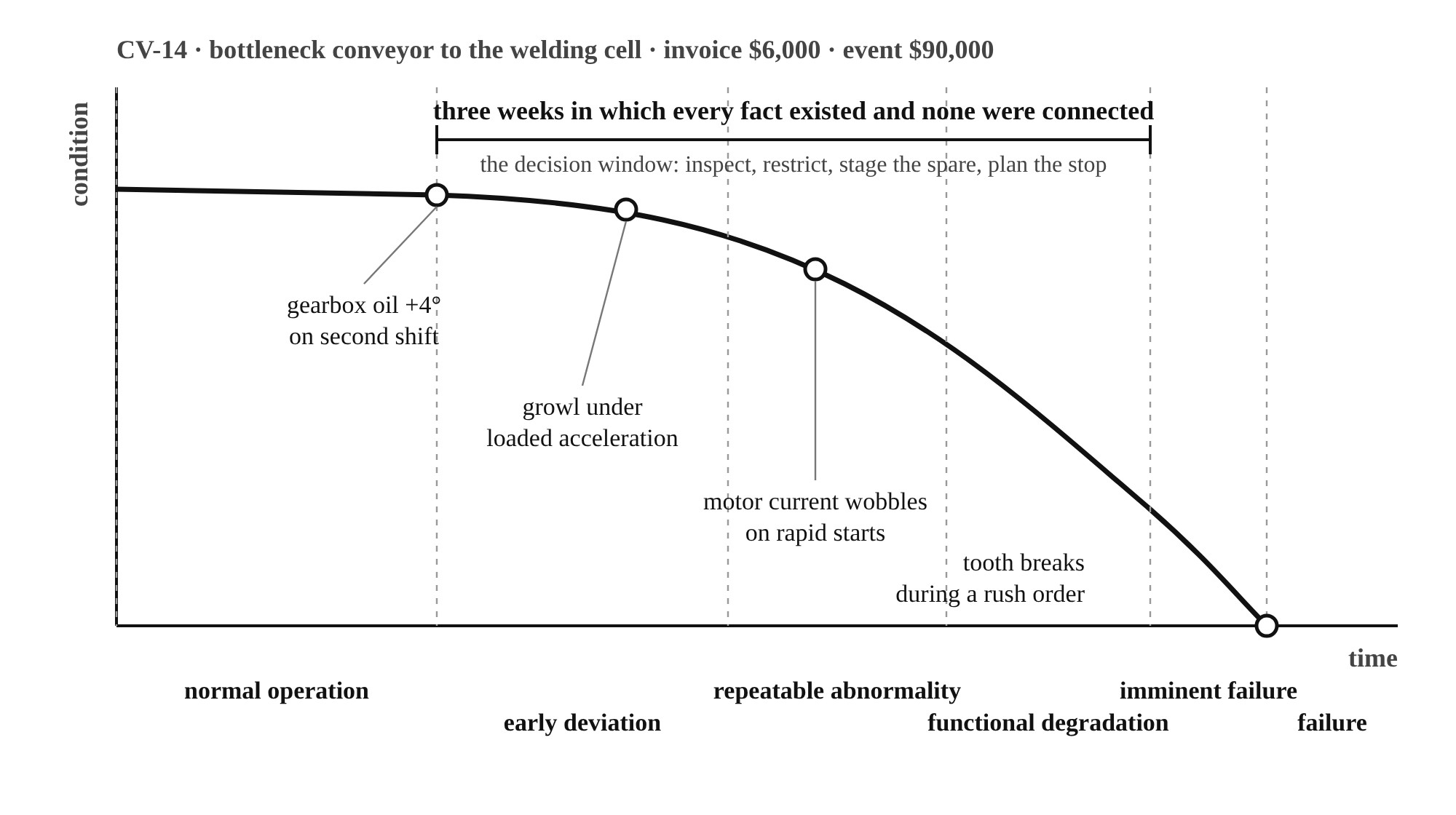
That is the central maintenance problem. Equipment does not move from healthy to failed in one clean step. It passes through states: normal operation, early deviation, repeatable abnormality, functional degradation, imminent failure, and failure. The interval between those states may be months in a lightly loaded pump or minutes in a high-speed packaging line. A maintenance organization that sees only the final state is not managing reliability. It is managing damage.
Consider a conveyor feeding stamped parts into a welding cell. The conveyor gearbox begins developing gear-mesh wear. Nothing stops. The line still meets target. Yet the vibration spectrum changes under heavy load, lubricant temperature rises by four degrees during the second shift, and the motor current becomes slightly less stable during rapid starts. None of these signals alone demands an emergency response. Together, they describe a machine leaving its normal operating envelope.
In a run-to-failure environment, those facts are scattered or ignored. One operator notices a faint growl. A technician adds oil during a weekend callout. The maintenance planner sees no open work order because no failure code was entered. The production supervisor attributes the slower starts to a material issue. Three weeks later, a gearbox tooth breaks during a rush order. The conveyor stops, the welding cell starves, upstream stamping racks up work-in-process, and downstream assembly loses its planned sequence.
The repair invoice will show a gearbox, labor, and perhaps expedited freight. That invoice is not the cost of failure. The cost includes lost output, overtime, disrupted sequencing, scrapped parts caught in the transfer system, emergency contractor support, delayed shipment penalties, and the hours spent recovering a schedule that had no slack. If the cell produces parts for a customer with a just-in-time delivery window, the failure can also trigger premium freight and commercial escalation. A $6,000 gearbox becomes a $90,000 operational event before anyone has written a root-cause report.
This is why downtime must be measured as a flow disruption, not merely as elapsed repair time. Mean time to repair is useful, but it does not tell leaders how deeply the interruption penetrated the system. A twenty-minute stop at a non-bottleneck station with two hours of downstream buffer is not equivalent to a twenty-minute stop at a bottleneck with a queue of scheduled changeovers behind it. The first is maintenance work. The second may be a plant-wide loss event.
The Comforting Calendar
Traditional preventive maintenance attempted to control this risk by replacing parts on a calendar. Every six months, change the belt. Every quarter, inspect the coupling. Every year, rebuild the pump. Calendar-based PM was an improvement over pure reaction because it forced attention onto equipment before failure. But it introduced its own waste and risk.
A belt does not know it is the first day of the quarter. A pump seal does not degrade according to the fiscal calendar. Some components fail early because of contamination, misalignment, improper installation, overload, or process variation. Other components remain serviceable long after their planned replacement date. When technicians open healthy equipment solely because a schedule says so, they consume labor, introduce assembly errors, disturb stable systems, and sometimes create the failure they were assigned to prevent.
The answer is not to eliminate planned maintenance. Lubrication, cleaning, safety checks, statutory inspections, and known wear-item replacement still require disciplined schedules. The answer is to stop treating the calendar as the primary source of truth for every maintenance decision. The primary source of truth must become the actual operating condition of the asset in its current production context.
Real-Time Vigilance and State-Aware Context
Real-time vigilance begins there. It is the operational discipline of detecting meaningful deviation while there is still time to act deliberately. It does not mean flooding a control room with charts. It does not mean attaching sensors to every motor and declaring the plant intelligent. It means establishing a reliable baseline, observing changes against that baseline, connecting those changes to asset state, and triggering the smallest justified action before the condition becomes a failure.
A vibration value without context is weak evidence. A vibration value measured on a loaded gearbox, at 1,450 RPM, after four hours of operation, with ambient temperature at 8 degrees Celsius, using the same sensor position and sampling method as the baseline, is evidence. The difference is State-Aware Context.
Machines behave differently during startup, warm-up, product changeover, idle periods, peak load, washdown, and shutdown. A hydraulic press can show elevated pressure ripple during cold startup without indicating a failing pump. The same ripple after the oil has reached operating temperature can indicate internal leakage, suction restriction, or a degrading compensator. A Digital Twin that does not know the machine state will confuse normal variation with degradation. Operators will receive false alarms, lose trust, and eventually bypass the alerts.
Trust is the scarce resource in Condition-Based Monitoring. The first bad alert does not kill a program. Repeated irrelevant alerts do. Every alarm asks a person to stop what they are doing, investigate, and make a decision. If the system cannot distinguish between a harmless startup transient and a developing defect, it transfers its uncertainty to the workforce. That is not intelligence. It is administrative noise.
A New Chain of Accountability
The maintenance paradigm shift therefore requires a different chain of accountability. Operators become active observers of equipment condition, not passive reporters of breakdowns. Maintenance technicians become diagnosticians who validate signals and eliminate causes, not only responders who restore function. Reliability engineers define failure mechanisms, thresholds, and consequence models rather than compiling static PM libraries. Production leaders protect inspection windows and planned interventions because they understand that a short controlled stop prevents a long uncontrolled one.
The Digital Twin becomes the operating surface where these roles meet. It is not a three-dimensional animation purchased for executive demonstrations. It is a living representation of the asset’s condition, configuration, operating history, known defects, maintenance actions, process demands, and current risk. It receives data from the machine, but it also receives human observations, inspection results, work-order closure evidence, quality outcomes, and changes to operating parameters.
This distinction matters when a line is under pressure. In a conventional plant, a supervisor may tell maintenance, “Keep it running until the weekend.” The instruction is understandable but incomplete. Keep what running? At what risk? Under what load? With what signs of deterioration? What contingency exists if the defect accelerates? A living Digital Twin can answer with evidence: bearing temperature has risen 12 percent over the last 18 production hours, vibration harmonics indicate probable outer-race damage, the asset is feeding the plant bottleneck, and the current projected risk of unplanned failure exceeds the risk of a 45-minute controlled intervention.
That changes the conversation. The decision is no longer maintenance arguing for time against production arguing for output. The decision becomes a visible tradeoff between two quantified operational choices.
Heroics Are Not a System
Real-time vigilance also exposes the hidden weakness of heroic maintenance cultures. Many plants celebrate the technician who restores a failed line at 2:00 a.m. The technician deserves respect. The failure should not be treated as proof that the system works. A plant that repeatedly depends on heroics is consuming skill in the most expensive possible way: under pressure, with poor preparation, limited access to parts, and maximum production consequence.
The stronger standard is uneventful reliability. The bearing is replaced during a planned window. The correct parts are staged. The technician has the diagnostic history, torque values, alignment procedure, and prior intervention records. The repair is verified through post-maintenance telemetry. Production resumes with known condition, not hope.
This is not a distant automation vision. It is a practical shift from responding to failure symptoms toward managing degradation states. The first step is to stop asking, “When did the machine break?” and start asking, “When did the machine first tell us it was changing?”
The Digital Thread
The machine first tells us it is changing through fragments. A temperature trend. A vibration signature. A technician’s note that the coupling guard was warm. An operator’s comment that startup has become less clean after a weekend shutdown. A quality record showing that dimensional variation increases during the final two hours of a long production run. The maintenance problem is not merely collecting these fragments. It is preserving their meaning long enough for someone to act on them.
That is the function of the Digital Thread.
A Digital Thread is the continuous, governed record that connects an asset’s identity, design intent, configuration, operating state, telemetry, human observations, maintenance history, quality performance, and change events across its lifecycle. It gives every relevant fact a place, a timestamp, an owner, and a relationship to the machine’s actual condition.
Without that continuity, plants collect data but lose knowledge.
Take the conveyor feeding stamped parts into the welding cell. Its gearbox vibration rises under heavy load. A technician sees the trend and records “abnormal noise, inspect at next opportunity.” During the next shift, the noise is absent because the line is producing a lighter part mix at lower conveyor loading. The incoming technician sees no active alarm, the line is meeting rate, and the note is buried inside a generic work-order history. Two weeks later, the line is shifted to a heavier product, the gearbox fails, and the investigation starts from zero.
The plant may have possessed the evidence. It did not possess the connection between the evidence.
A proper Digital Thread would tie the technician’s observation to the gearbox asset identifier, exact sensor location, load condition, product family, conveyor speed, lubrication state, ambient temperature, prior repairs, and vibration baseline. It would show that the abnormality occurred only when torque demand exceeded a defined range. It would also show whether the gearbox had been rebuilt, whether the replacement gear set came from a different supplier, whether the lubricant had been changed, and whether a prior alignment correction altered the mechanical load path.
That is State-Aware Context made operational. It turns an isolated observation into a condition record.
The distinction is expensive. A note saying “gearbox noisy” is not enough to plan work. It gives no confidence about severity, repeatability, or likely cause. A state-aware record stating that gear-mesh sidebands increased 38 percent during loaded acceleration, accompanied by elevated oil temperature and current instability after a specific product change, supports a controlled decision. Maintenance can stage parts. Production can identify a lower-risk intervention window. Reliability can determine whether the failure mechanism is gear wear, lubrication breakdown, misalignment, or cyclic overload. Leadership can see the risk of waiting in relation to the cost of interruption.
The Thread Begins Before the Machine Arrives
The thread begins before the machine reaches the plant floor. Design data matters because it establishes intended operating limits. A motor nameplate rating, bearing specification, gearbox ratio, lubrication requirement, permissible vibration range, safety interlock logic, torque settings, and control-program revision are not engineering artifacts to be archived and forgotten. They define what normal operation is supposed to look like.
When that information is separated from the operating record, the plant creates avoidable uncertainty. A maintenance technician troubleshooting a recurring motor trip may know the current draw but not that the motor was changed from a 15-kilowatt unit to an 11-kilowatt unit during a supply shortage. A quality engineer may see rising seal failures on a packaging machine but not know that a heater cartridge was substituted during an emergency repair. A production supervisor may see longer cycle times but not know that the robot path was modified after a tooling collision.
Each team sees an effect. The Digital Thread preserves the changes that explain it.
One Asset, One Identity
This requires disciplined asset identity. One physical asset must have one durable identity across maintenance, production, quality, controls, and finance systems. If production calls it “Line 3 infeed,” maintenance calls it “CV-14,” the controls team identifies it by PLC tag group “CONV_A,” and purchasing records its parts against an obsolete equipment number, the plant has already broken the thread. Data cannot be joined reliably when the asset itself has multiple names and unclear boundaries.
The practical rule is simple: define the asset, define its functional role, and maintain that identity through every system that touches it.
For a bottleneck conveyor, that means more than assigning a label to the motor. The asset hierarchy must show the conveyor as a functional system, then identify its drive motor, gearbox, coupling, drive sprocket, chain or belt, bearings, sensors, variable-frequency drive, and associated controls. The Digital Thread must also recognize the upstream and downstream dependencies. A gearbox failure does not only disable a gearbox. It starves the welding cell, disrupts stamped-part flow, creates work-in-process accumulation upstream, and removes sequence stability from downstream assembly.
A machine’s technical condition and its production consequence must live in the same decision environment.
Configuration Control, Where Twins Die
Configuration control is where many digital twin initiatives fail. The plant installs sensors, builds dashboards, and calculates health scores. Then a technician changes a bearing type, an electrician replaces a drive, a programmer updates a PLC routine, or an operator adjusts a process setpoint. The physical machine changes while the virtual representation remains frozen in the old configuration. From that point forward, the twin is not a twin. It is a historical approximation.
Every meaningful intervention must update the thread. This does not require bureaucratic overload. It requires closure discipline. When a bearing is replaced, the technician records the installed part number, manufacturer, fit condition, lubrication applied, alignment result, torque verification, reason for replacement, and post-repair condition. When a parameter is changed, the change record identifies the previous value, new value, authorization, reason, expected effect, and validation result. When a sensor is moved or replaced, the system records its new location, calibration status, sampling method, and baseline reset requirement.
Those records make later analytics trustworthy. A vibration model cannot learn whether a bearing type is reliable if the plant cannot establish which bearing was installed. A quality model cannot identify the impact of a temperature adjustment if setpoint changes are hidden in shift notes. A reliability engineer cannot compare mean time between failures if repeated repairs are logged under vague codes such as “mechanical issue” or “adjustment.”
Poor data quality is not an IT inconvenience. It is a maintenance cost.
Consider an emergency repair that occurs at 1:30 a.m. A technician replaces a failed proximity sensor to get the line moving. The original sensor had a different sensing range, a different response time, and a different connector design. The replacement works, but it requires a bracket adjustment and a controller input filter change. If the work order closes with “sensor replaced,” the next technician inherits a trap. Months later, the sensor starts producing intermittent false reads during washdown. A new technician orders the original part number, mounts it in the modified bracket, and begins troubleshooting a fault created by undocumented configuration drift.
The direct cost is a sensor and a few labor hours. The operational cost can be a lost shift, scrapped product, repeated callouts, and a line team that loses confidence in the maintenance record. The Digital Thread prevents this by making the repair evidence part of the asset’s living identity rather than an incomplete event in a closed ticket.
Knowledge That Outlives the Veteran
Continuity also protects knowledge during workforce change. Plants routinely lose critical understanding when experienced operators, electricians, millwrights, and process specialists retire or transfer. The loss is often described as tribal knowledge, but the term can disguise the operational failure. If a plant depends on one person remembering that a hydraulic power unit must be warmed at reduced pressure for ten minutes after a cold weekend, that knowledge is not protected. It is a single point of failure.
A Digital Thread captures the observation, the conditions, the rationale, and the verified response. It does not reduce experienced people to data-entry clerks. It gives their judgment persistence. The veteran operator’s insight becomes a reusable operating rule: when ambient temperature is below 10 degrees Celsius, oil temperature is below the established threshold, and pressure ripple exceeds the startup baseline, hold the machine in controlled warm-up mode and inspect the suction filter if the condition persists beyond the defined interval.
That is far more useful than a note saying, “Runs rough when cold.”
The thread must carry negative evidence as well. A technician who inspects a suspected fault and finds no defect has generated valuable information, provided the inspection conditions are recorded. “No bearing damage found” means little. “No abnormal axial play, no lubricant contamination, and no temperature rise after thirty minutes at full-load operation” narrows the diagnostic path. It prevents the next technician from repeating the same intrusive inspection without cause. It also teaches the Digital Twin which hypotheses were tested and rejected.
This is how the Digital Thread controls cost before a failure invoice exists. It reduces duplicate troubleshooting. It shortens diagnosis. It improves parts staging. It prevents configuration drift. It preserves expert judgment. It supports Condition-Based Monitoring with credible context. Most important, it allows the plant to intervene while options remain open.
A failure event removes options. The line is stopped, the crew is reacting, and the cheapest available decision is rarely the best decision. A connected condition history keeps decisions ahead of that point.
The Cost of Missing Context
When context is missing, maintenance decisions become guesses disguised as experience.
The problem rarely announces itself as a data problem. It appears as repeat faults, delayed repairs, arguments between departments, excessive spare-part consumption, and a growing belief that certain machines are simply unreliable. Leaders see rising maintenance cost. Operators see equipment that behaves differently from shift to shift. Technicians see incomplete work orders and intermittent symptoms. Each group is correct. None has the complete condition record required to act with confidence.
The direct consequence is longer downtime. The more serious consequence is that the plant uses downtime badly.
A failed asset with a complete Digital Thread can be isolated quickly. The technician can see its current configuration, recent alarms, operating load, prior interventions, replacement-part history, quality trends, and known open hypotheses. The repair begins with evidence. A failed asset without context begins with exploration. Panels are opened. Components are swapped. Settings are checked against memory rather than verified records. The crew searches for a cause while production waits.
This difference is visible during a line stop.
Return to the conveyor feeding stamped parts into the welding cell. The gearbox fails during a rush order. The motor overload trips, the conveyor stops, and parts begin accumulating upstream. In a plant without continuity, the first question is usually, “What happened?” That question is too broad to be useful. It invites a sequence of unstructured checks: inspect the motor, reset the overload, check the chain tension, look for a jam, call an electrician, call a millwright, check the variable-frequency drive, then discover the gearbox has seized.
By then, the failure has expanded beyond the gearbox. The welding cell has starved. The production schedule has lost sequence. Operators have been reassigned or left waiting. A downstream assembly team may have consumed its buffer and stopped. Material handlers begin moving work-in-process to make room for accumulating stamped parts. Quality inspection faces an irregular mix of product lots. The original mechanical defect becomes a flow-control problem affecting the entire value stream.
A Digital Thread cannot prevent every failure. It can prevent the plant from approaching each failure blind.
If the gearbox condition history had been connected to load state, the plant would have known that abnormal vibration occurred during heavy-product production. If temperature drift, motor-current instability, lubricant additions, and operator observations had been preserved in one state-aware record, the gearbox would not have been treated as healthy merely because it sounded normal while producing lighter parts. The risk would have been visible before the rush order. The repair could have been planned when the consequences were lower.
False Maintenance
Missing context also drives false maintenance. A component is replaced because it is visible, accessible, or historically blamed, not because evidence identifies it as the cause.
A packaging machine begins producing intermittent seal failures near the end of second shift. The quality team reports weak seals. Maintenance checks the heater circuit and finds that temperature is within the displayed setpoint. A technician replaces a heater cartridge. The problem improves for one day, then returns. Another technician replaces a thermocouple. The next week, the maintenance manager authorizes replacement of the sealing jaw assembly. The plant spends labor and parts while scrap continues.
The actual mechanism may be more specific: a previous emergency repair installed a heater cartridge with a different thermal response profile; a controller parameter was adjusted to compensate; the machine now reaches the displayed temperature but cannot hold stable heat transfer during peak cycle demand. The fault is not visible in a static temperature reading. It exists in the relationship between configuration, cycle rate, product material, and temperature recovery time.
Without a Digital Thread, each repair is locally rational. With a Digital Thread, the team can see the change history and test the correct hypothesis. They can compare seal-failure rates by product family, cycle speed, ambient conditions, heater configuration, and controller revision. They can determine whether the quality loss begins after a defined number of cycles, after a material-lot change, or during a specific operating state. Quality loss becomes evidence of equipment condition instead of a separate problem handed to another department.
That separation is one of the most expensive habits in manufacturing.
Production often treats quality loss as a quality issue. Maintenance treats equipment faults as a maintenance issue. Engineering treats parameter changes as an engineering issue. In reality, the machine does not recognize these organizational boundaries. A degrading bearing can create positional variation. Positional variation can create weld defects. Weld defects can trigger rework, inspection holds, and delayed shipment. If the quality record does not connect to the asset condition record, the plant will investigate the defect at the end of the process while the initiating mechanism continues upstream.
Metrics That Lie Politely
The same failure of context corrupts performance metrics.
Mean time between failures can look acceptable when repeated micro-stops are classified as operator adjustments. Overall equipment effectiveness can hide an asset that is consuming increasing attention because the line still recovers after each interruption. Maintenance compliance can look strong because calendar PM tasks are completed, even though the tasks do not address the mechanisms actually degrading. A plant can report green indicators while technicians are manually compensating for equipment that is moving toward failure.
This is why maintenance records must capture functional degradation, not just hard breakdowns.
A recurring five-minute stoppage on a bottleneck conveyor is not minor because the line restarts. If it occurs six times per shift, it disrupts flow, causes repeated acceleration loads, forces operators into recovery behavior, and erodes the buffer needed to absorb normal variation elsewhere. The official downtime record may show only thirty minutes. The production consequence can be much larger because every restart destabilizes sequencing, increases defect risk, and pulls supervisors into short-term intervention.
Missing context turns those micro-stops into noise. A living Digital Twin turns them into a pattern.
The financial effect compounds because poor context produces poor planning. When a technician cannot identify the exact component, configuration, or likely failure mechanism, the planner cannot stage the correct parts and tools. Work orders are issued with vague scopes: “inspect conveyor,” “check vibration,” “repair as needed.” The crew arrives at the asset, diagnoses in real time, discovers that a special puller or replacement coupling is required, and waits for stores or a supplier. The controlled maintenance window becomes an extended outage.
Emergency procurement follows. Expedited freight is approved. A substitute part is installed because the correct part is unavailable. The substitute creates a new configuration difference. If that change is not captured, the plant has now manufactured the next failure investigation.
This is not an administrative defect. It is a reliability defect.
Safety and the Normalized Workaround
Context loss also weakens safety decisions. A machine that requires repeated manual intervention is declaring an abnormal condition, even if no formal alarm exists. When operators routinely clear a photo-eye, tap a sticking valve, reposition a guard, or coax a conveyor through a cold start, the plant is normalizing exposure. The task becomes familiar. Familiarity reduces caution. Eventually, a person performs the workaround under worse conditions, with a different product, at a higher speed, or while fatigued during a recovery shift.
The absence of a recorded condition history makes unsafe work appear isolated. The Digital Thread exposes recurrence. It shows that the same intervention has been performed twelve times in three weeks, always after overnight temperature drops, always at the same conveyor section, and always with a growing startup-current spike. That pattern demands engineering control, not another reminder to “be careful.”
The operational consequence of missing context is therefore not simply that people know less. It is that the plant spends its best people compensating for uncertainty.
Experienced technicians become human databases. Operators learn informal workarounds. Supervisors rely on who is present rather than what the system knows. New employees inherit fragments of instruction without the reasons behind them. During a shift handoff, the outgoing operator may say, “Watch that conveyor. It was acting up earlier.” The incoming operator may understand the warning if both have worked the line for years. A new operator does not know whether “acting up” means noise, slow acceleration, tracking drift, overload trips, product jams, or a safety concern.
A state-aware observation removes that ambiguity. It records what changed, when it changed, under what conditions, what was attempted, and what result followed. It gives the next person a usable starting point.
Every Intervention Improves the Next Decision
The strongest maintenance organizations do not demand perfect data before they act. They establish a discipline in which every intervention improves the next decision. A technician who finds nothing records the conditions of the inspection. An operator who hears a new sound records the operating state. A planner links the part installed to the asset configuration. A quality engineer ties defect patterns to machine state and production conditions. Each action adds evidence or eliminates uncertainty.
That is how a Digital Thread becomes operational leverage. It converts isolated events into managed condition history. It prevents a temporary workaround from becoming accepted practice. It makes degradation visible before the plant has no choice but to react.
The cost of missing context is paid in downtime, scrap, overtime, premium freight, unsafe workarounds, wasted labor, and repeated diagnosis. The deeper cost is loss of control. A plant without continuity does not decide when to intervene. It waits for the machine to decide.