The Knowledge Worker's TPM: Eight Pillars for the Office
Paperwork that waits, approvals that stall and work done twice are the office's breakdowns. Book 6 of Zero Breakdowns: The TPM Series.
A factory has wear and tear. An office has drift. This book carries Total Productive Maintenance from the plant floor to the desk: all eight pillars translated for knowledge work, the seven office wastes, and a thirty-day pilot you can run on one workflow. Twenty chapters, each ending with a Field Procedure and a checklist, plus the free Pilot Board tool. Revision 2, 2026.
Chapter 1: What TPM Is (And Why the Name Confuses Everyone)
Total Productive Maintenance arrives at the desk with a name built for a factory. Underneath the name is one idea the office needs more than the factory ever did: productive capacity is a condition you keep, not an effort you spend.
Someone will always raise their hand at the wrong moment.
It usually happens right after a leader says, “We’re going to do TPM,” and the room has that brief, hopeful pause where people imagine fewer fire drills and a calmer week. Then the hand goes up, and the question lands with complete sincerity: “Are we talking about the building systems? Because Facilities already has a maintenance schedule.”
In a factory, the word "maintenance" points to something you can kick. A press. A conveyor. A bearing that warms up before it seizes. Maintenance is grease, gauges, vibration readings, and the quiet pride of preventing breakdowns that no one else ever sees.
In an office, maintenance points to the closest physical object anyone can think of. The printer that jams. The HVAC that swings between meat locker and greenhouse. The coffee machine with the blinking light. If you have a server closet, someone will mention it. If you do not, someone will still mention it, because “maintenance” has trained us, for decades, to look for a machine.
Three origins of confusion
That trained reflex is the first origin of confusion: the name Total Productive Maintenance sounds like a department, not a discipline. It sounds like something someone else does, somewhere else, to something made of metal. The trouble is that TPM was never just about the metal. Even in its earliest formulations, the machine was the visible surface of a deeper idea: productive capacity does not stay high by accident. It decays. It drifts. It becomes unreliable. It gets noisy around the edges. And if you do not deliberately protect it, you lose output to small, cumulative failures until you wake up one day and call your situation “normal.”
Factories learned that lesson because the losses were loud. A press stops. A line backs up. Overtime spikes. You cannot pretend nothing happened.
Offices lose output in a quieter way. The system doesn’t stop; it just slows. It doesn’t break; it just starts producing more rework. It doesn’t crash; it just starts asking for more of your attention to get the same result. In a knowledge-work environment, that decay looks like ten extra minutes per request because the template is outdated, two extra emails because nobody knows who owns the decision, a recurring meeting that exists only because the original process is unreliable, a CRM full of near-duplicates because the fields were never designed to prevent them, and a shared drive that makes every search feel like a scavenger hunt.
When you hear “maintenance” and your mind jumps to HVAC, you miss the real equipment. In an office, your equipment is everything that helps a team convert time and attention into value without friction: the software, yes, but also the workflow, the naming conventions, the decision rules, the handoffs between roles, the data definitions, the templates, the meeting cadence, and the unwritten agreements about “how we do things here.” Those are not soft concepts. They are components in a production system. They have failure modes. They are worn. And, like machines, they respond to care.
The second origin of confusion is cultural, not linguistic. Knowledge workers are trained to treat their work as thinking, not producing. Thinking is framed as personal, internal, and hard to standardize. Production is framed as external, measurable, and mechanical.
So when a framework shows up with a name that includes “maintenance,” people assume it is aimed at the mechanical world. Even the most supportive manager may silently translate TPM into “more admin.” And the most cynical employee will hear it as “another initiative” that will generate tracking spreadsheets but not reduce any work.
This is where the name misleads. It tells the office, “We are here to preserve equipment.” The office hears, “We are here to protect machines.” But TPM, properly understood, is about preserving the ability to produce value as designed, day after day, without heroics. It is about keeping your system capable.
Capability is the word underneath
Capability is the key word that lives underneath maintenance.
A machine has capabilities: a certain speed, a certain tolerance, and a certain uptime. A process has capability too: a certain cycle time, a certain error rate, a certain predictability. A team has capability: a certain ability to absorb variation, to respond to customers, and to make decisions without escalating everything. Those capabilities erode unless they are maintained. And in offices, erosion tends to masquerade as busyness.
You can see it in the way “work” multiplies around a broken process. When an approval path is unclear, people compensate by adding more people to the email chain. When data is unreliable, people compensate by building parallel spreadsheets. When handoffs are sloppy, people compensate by scheduling meetings to “align.” When responsibilities are ambiguous, people compensate by checking in constantly. These compensations feel like work, and they create activity. But they are not value; they are the system spending energy to overcome its own disorder.
That disorder has a direction. Left alone, systems drift toward entropy. In plain terms, things get messier unless someone spends effort keeping them from getting messier. That is true for factory machines, and it is just as true for shared drives, templates, onboarding checklists, customer records, and the unglamorous routines that make a department dependable.
In many offices, that upkeep is treated as optional, a luxury you do “when things slow down.” But things do not slow down, because the disorder itself generates more work. That is how an organization ends up permanently too busy to fix the reasons it is too busy.
Consider an example that almost every reader will recognize. A team creates a standard slide deck for monthly results. The first month, it is accurate and clean. The second month, someone copies the deck, updates numbers manually, and tweaks a chart because “this one is different.” By month six, there are multiple versions floating around, each with slightly different definitions. One person has a hidden tab that feeds the chart. Another person uses a different cut of the data because the original source kept changing. When leaders ask questions, the team spends two days reconciling whose numbers are right. Eventually, someone says, “We need to align on the metrics,” and a meeting series is born.
Nothing broke in a dramatic way. No alarms sounded. Yet the system lost capability: the ability to produce a trusted monthly report quickly, consistently, and without rework. The organization then paid for that loss every month in extra time, extra meetings, and eroded trust.
In a factory, you would call that a quality and maintenance problem. In an office, it gets mislabeled as a communication problem, or worse, as a personality problem.
“If people would just be more careful.” “If teams would just coordinate.”
TPM insists on a more useful interpretation: if an output requires constant vigilance to keep it correct, the system is asking humans to do the job that design and upkeep should be doing.
This is why the word "maintenance" must be stretched beyond machines if it is going to be useful to you. Maintenance is the set of routines and disciplines that keep a value-producing system within its intended operating conditions. Sometimes that means lubricating a bearing. Sometimes it means updating a template and locking the definition of a metric. Sometimes it means cleaning up a shared inbox, closing loops on old threads, and establishing a rule for what must be captured in a ticket versus handled in chat. Sometimes it means reviewing access permissions so people can actually do their jobs without workarounds. Sometimes it means deleting software you do not use because every additional tool adds cognitive load, fragmentation, and another place for information to hide.
Notice what all of those have in common: they protect flow. In manufacturing, flow is physical. In offices, flow is informational. Work moves through statuses, systems, people, approvals, and decisions. When that flow is smooth, output feels almost boring. When it is damaged, everyone feels “busy,” and nobody feels effective.
The third origin of confusion is that maintenance is often framed as a cost center. It is something you spend money on to prevent something bad from happening later. In office settings, where results are harder to see, prevention is easy to dismiss. Leaders may approve a software purchase but refuse to fund the time to configure it properly. They may insist on “moving fast” but never schedule a maintenance window for the systems that allow speed. They may demand error-free reporting while resisting the work of defining fields, standardizing inputs, and building validation.
So TPM walks into the office with a name that already sounds like cost, already sounds like someone else’s job, and already sounds like it will slow things down.
This is exactly backward. Office maintenance, properly understood, is what keeps your speed from being fake. It is what prevents “fast” from turning into rework, escalations, and late-night heroics. It is what allows a team to operate at a high level without living in a permanent state of catch-up.
That is the translation you need at the beginning: maintenance is not the thing that interrupts work. Maintenance is the thing that keeps work from becoming an interruption.
Once you see that, the rest of TPM stops sounding like an imported factory program and starts sounding like a description of your week, just with the losses finally named. The printer and the HVAC will still need attention, of course. But the real productive capacity of an office rarely hinges on the printer. It hinges on whether your workflows, tools, and information channels are maintained well enough that people can do their real jobs without fighting the system all day.
And if that sounds like a high standard, it is. It is also the standard your organization is already paying for, either through deliberate upkeep or through the more expensive alternative: constant, invisible compensation.
The second word: total
If the word "maintenance" is the first translation problem, the second is the word "total." In manufacturing, “total” was never meant as hype. It meant everyone, not just the maintenance department. Operators. Supervisors. Engineers. Managers. The whole system. TPM was an argument against the old split where one group ran the machines and another group fixed the machines, with predictable results: operators learned to ignore early warning signs because “that’s not my job,” and maintenance learned about problems only after failure because “no one told us.” “Total” meant you stop treating reliability as a specialized function and start treating it as a shared condition of production.
In an office, that same idea lands awkwardly because the boundaries are different. There often is no “maintenance department” for work itself. There is IT, maybe. There is Facilities, definitely. But the system you actually struggle with all day long is a blend of tools, decisions, information, and routines, and it belongs to everyone and therefore to no one.
Translate the nouns
That is why TPM feels like it arrives with no clear home. If you announce it as a program, it risks becoming another layer of management overhead. If you announce it as a philosophy, it risks becoming inspirational wallpaper. To make TPM operational in knowledge work, you have to do something unglamorous and essential: translate the nouns.
A factory has equipment. An office has tools, but your most critical tools do not sit on a workbench. They live in menus, templates, permissions, naming conventions, and shortcuts in people’s heads. The spreadsheet that everyone copies. The CRM that shapes how the pipeline is understood. The ticketing system that defines what “done” means. The shared drive that either makes knowledge retrievable or turns it into a landfill. Even the calendar is equipment, in the TPM sense, because it is the mechanism through which attention is allocated. When your calendar gets filled with low-value meetings, it is not just “busy season.” It is your production capacity being consumed by friction.
A factory has a production line. An office has workflows. You can pretend you do not, but you do. Work enters. It gets transformed. It gets checked. It gets handed off. It gets approved. It gets shipped in the form of a decision, a report, a contract, a customer response, a forecast, a hire, a payment, or a plan. And like any line, it has constraints and breakdown points. Some are visible. Many are social, which is why they hide so effectively. “We’re waiting on Legal.” “We’re waiting on Finance.” “We’re waiting on the client.” Those are not just sentences; they are queues in a system.
A factory has downtime. An office has waiting, rework, and context-switching. You rarely see an office “stop” in the dramatic way a line stops, so leaders assume the system is running. People are at their desks. Emails are being sent. Meetings are happening. Slack messages are flying. Activity looks like motion, and motion looks like productivity. But if you have ever had a day where you worked the entire day and advanced nothing that mattered, you already understand office downtime. The system was consuming your time without producing value. That is downtime, just wearing a business-casual costume.
A factory measures defects. An office measures errors, but often only the ones that explode. The wrong number in a report that reaches the executive team. The contract clause that triggers a dispute. The customer email that gets missed. The payroll mistake that embarrasses HR and hurts an employee. But most office defects are quieter. A field entered inconsistently, making the dataset unreliable. A deck that contains three conflicting definitions of “active customer.” A project plan that is updated in one place but not another, producing two competing realities.
A handoff that omits one critical detail, requiring five clarifying messages later. These are quality defects, and they behave like defects anywhere: they create rework, they erode trust, and they make the next cycle harder.
A factory has wear and tear; an office has drift
A factory has wear and tear. An office has drift.
Drift is the most important translation because it explains why competent people end up trapped in systems that make them look incompetent. Nobody wakes up intending to create a mess. The mess emerges from tiny, rational decisions made under time pressure. Someone bypasses a form because it is clunky. Someone creates a one-off spreadsheet because the system report is slow. Someone adds a weekly meeting because the handoff keeps failing. Someone copies a deck instead of updating the master because it is faster. Multiply those rational shortcuts by thousands of tasks, then add turnover, hybrid work, and tool sprawl, and you get drift: the gradual movement of your working system away from its designed, reliable state.
Factories see drift in vibration readings and declining yields. Offices see it as “we need to align,” “we need better communication,” “we need to be more careful,” and the classic line that always appears when a process is failing: “Let’s just hop on a quick call.”
That is why translating TPM is not about pasting factory terms onto office life. It is about naming what the factory terms were trying to protect: productive capacity. Flow. Right-first-time quality. Reliability without heroics.
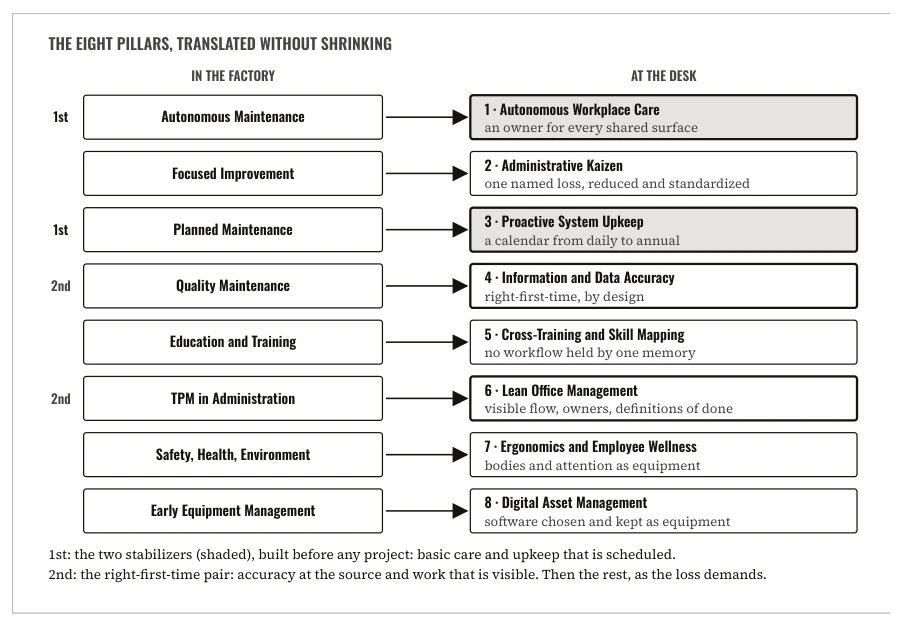
Once you translate the nouns, the pillars begin to make sense. Autonomous Maintenance becomes something like autonomous workplace care: every person owns the basic reliability of the environment they work in. That sounds almost insultingly simple until you realize how much of your week is spent compensating for neglected basics. Searching for the latest file. Rebuilding a template. Asking who owns a decision. Re-entering data that already exists. Chasing approvals because the queue is invisible. Those are not “just admin.” They are system losses.
Planned Maintenance becomes proactive system upkeep: scheduled, deliberate care for the software, the configurations, the access rules, the templates, the naming conventions, the dashboards, and the recurring workflows that keep the business running. If you only ever fix those things when they break, you are running your office the way an irresponsible plant runs its machines: wait for failure, then pay overtime and panic premiums.
Quality Maintenance becomes information and data accuracy: building conditions where the correct output is the default, not an act of vigilance. In a factory, this includes error-proofing devices and process controls. In an office, it includes validation rules, required fields, locked definitions, version control, and checklists for high-stakes work. It also includes something most teams avoid because it feels political: agreeing on what words mean. If “customer,” “lead,” “active,” “complete,” and “approved” mean different things to different people, your system will produce defects no matter how hardworking your team is.
Even Safety, Health, and Environment translates cleanly once you stop thinking only about hard hats. Ergonomics, focus, burnout, meeting load, and the physical environment are safety issues in an office because they determine whether the human equipment can operate reliably. A team that lives in constant cognitive overload is not “high performing.” It is running hot. Factories know what happens when you run hot: you get breakdowns. At this point, many leaders nod, but one more question sits underneath their nodding. It is the question that keeps TPM trapped in the “interesting, but not for us” category: “Where is the machine?”
Where is the machine?
In knowledge work, the machine is the system that turns attention into outcomes. Attention is your raw material. Decisions are your assemblies. Documents are your parts. Commitments are your shipments. Software, templates, meetings, and norms are your conveyors and fixtures. Your “machine” is not a single object. It is a web of routines and dependencies that either carries work smoothly or shakes it loose at every step.
This is also why office TPM must be translated carefully to avoid becoming a personality critique. If you tell a team, “We have too many errors,” they will hear, “You are sloppy.” If you tell a team, “We have too much waiting,” they will hear, “You are slow.” If you tell a team, “We have too much overprocessing,” they will hear, “You are bureaucratic.”
TPM offers a more accurate, more humane interpretation: the system is producing exactly what it is designed to produce. If it produces rework, drift, waiting, and constant clarification, that is not a moral failure. It is design and upkeep failure. You can fix it the same way a plant fixes chronic downtime: by identifying the loss, finding its causes, and building routines that keep it from returning.
The hand-raiser from the beginning of this chapter, the one who asked about Facilities, is not the enemy. They are your clue. They are showing you exactly how deep the translation problem runs. When people hear TPM and look for a physical machine, they are revealing the mental model that keeps office waste invisible: the belief that real production is physical and that office work is too abstract to manage as a system.
The goal of this book is to replace that belief with a better one. Your work counts as production because it produces outcomes the business cannot survive without. Your tools count as equipment because they determine your capacity. Your workflows count as production lines because they have flow, constraints, and defects. And your invisible losses count as losses because they cost the organization money, time, and trust, whether anyone can point to a broken bearing or not.
When you translate TPM this way, you stop treating it as an imported factory program and start seeing it as what it always was: a practical discipline for keeping a value-producing system capable, day after day, in the face of drift.
And once you see drift, you can stop paying for it in the most expensive way possible: constant, invisible compensation.
Productivity is a system property
There is a reason the office keeps slipping back into the same argument, even after you translate the nouns.
Someone will say, “Sure, workflows matter,” and then, almost in the same breath, they will add, “But this isn’t a factory. You can’t measure knowledge work the same way.”
They are half right. You cannot measure knowledge work exactly the same way. The mistake is what comes next: the assumption that because measurement is harder, management must stay vague. That is how offices end up with a strange double standard. They demand rigor from people but accept fog from the system.
TPM’s first real gift to a knowledge-work environment is not a tool. It is a reframe of what productivity actually is.
Most offices define productivity as effort plus responsiveness. If people answer quickly, attend meetings, reply to emails, keep their calendars full, and seem busy, the organization concludes it is productive. This definition is comforting because it is visible. You can see busyness. You can praise it. You can promote it. You can build a culture around it.
But busyness is not output. It is often the cost of a system that cannot produce smoothly.
In a factory, productivity is the rate at which a system turns inputs into saleable outputs. TPM grew up in an environment where you could see the line, see the stoppages, and count the parts. In an office, the output is often a decision, a forecast, a customer resolution, a contract, a month-end close, a hire, or a plan. The output is real, but it is less tangible, and the work that produces it is more easily confused with the noise that surrounds it.
So let’s be plain: a knowledge worker’s raw material is attention. Not time on the clock. Attention. The ability to focus, recall, decide, draft, analyze, and follow through. And your organization’s productive capacity is the amount of valuable outcome you can produce from that attention without burning people out or creating downstream mess.
Once you accept that attention is the raw material, the office starts to look less mysterious. It starts to look like a production system that is leaking attention in predictable, preventable ways.
Those leaks are what TPM calls losses. The reason factories took losses seriously is that the losses were obvious and the costs were immediate. If a line stops, everyone knows. If defects rise, scrap bins fill. If a changeover takes too long, output drops. But an office can lose enormous productive capacity without anything ever “breaking.” The work still moves. It just moves through extra loops, extra check-ins, extra versions, extra approvals, and extra explanations.
You have lived this. You have had the week where you were in motion the whole time, but by Friday you could not point to a finished thing with the same confidence you had on Monday. You were not lazy. You were not incompetent. The system simply extracted your attention as an operating cost.
This is what I meant earlier when I said offices pay an entropy tax. The system drifts, and then people pay the difference with their attention. They pay it in search time, in rework, in the mental load of keeping track of what the system fails to track, and in the emotional load of navigating unclear ownership.
Think about how often your day includes any of the following sentences, said out loud or typed with a polite smile:
“Just circling back.” “Who owns this?” “Do we have a latest version?” “I thought you were doing that.” “Can you resend the file?” “Let’s hop on a quick call.” Each of these is a tiny patch applied to a system that is not providing the reliability it should. In small doses, they seem harmless. In aggregate, they become a permanent second job. This is why the TPM reframe matters: productivity is not a personal virtue. It is a system property.
In the old office story, the hero is the person who stays late, catches errors at the last minute, remembers what nobody documented, and pushes the work through the approval maze by sheer persistence. Organizations reward this heroism because it feels like commitment. It is also expensive. It is the human equivalent of running a machine until it fails and then celebrating the technician who worked all weekend to get it running again.
TPM is not anti-effort. It is anti-heroics as a business model. In TPM language, a heroic organization is one that has normalized losses. It has decided, often unconsciously, that the drift is the price of doing business and that the correct response is to demand more effort from people instead of more reliability from the system.
The hand-raiser from the beginning of this chapter, the one who wanted to know whether Facilities already had a schedule, is still with us here. They represent the default mental model: production is what happens in the visible world. So the office treats its own production system as invisible, and because it is invisible, it becomes unmaintained.
Three shifts
To reframe productivity, you have to bring the office system out of invisibility and into the realm of things you can care for. That starts with three shifts.
First, stop treating tools as accessories. In knowledge work, tools are not optional. They shape behavior the way a fixture shapes a part. If your CRM allows duplicates without warning, it will grow more duplicates. If your shared drive has no naming convention, it will become unsearchable. If your reporting pipeline requires manual copy-paste, it will produce errors and consume attention. If your communication lives in three chat tools plus email plus meetings, you will pay in fragmentation. The tool is not neutral. The tool is designed.
Second, stop treating workflows as informal. Many offices insist they have no processes, only “ways of working.” This is usually said with pride, as if process is what bureaucracies have and agile teams do not. But the absence of formal process does not mean the absence of process. It means the process is unwritten, inconsistent, and stored in people’s heads. That is not agility. That is fragility.
Unwritten processes create two predictable costs: they punish new people and they reward gatekeepers. If the only way to get something done is to know who to ask and how to ask them, then institutional knowledge becomes a toll road. It also becomes a single point of failure, a theme we will return to when we talk about cross-training and skill mapping. For now, notice the productivity implication: every unwritten step becomes a moment where attention must be spent on navigation rather than value.
Third, stop treating losses as the price of being “fast-paced.” Many offices wear chaos as a badge. “Things move quickly here” often means “things break regularly and we fix them with urgency.” TPM does not remove pace. It removes fake pace, the kind that looks like speed in the moment but produces rework, waiting, and burnout as a delayed invoice.
What must be true?
If you want a practical way to hold this reframe in your mind, ask a simple question about any recurring office output: What must be true for this to come out right the first time, without drama?
Take that monthly slide deck example from earlier. What must be true? Definitions must be consistent.
- The data source must be trusted.
- The template must be current.
- The owner must be clear.
- The version must be controlled.
- The review must be appropriate to risk, not habitual.
Those are system conditions. If they are not true, people will compensate. They will triple-check numbers, rebuild charts, reconcile definitions in back channels, and schedule pre-meetings to avoid embarrassment in the real meeting. That compensation is not free. It is your productivity leaking.
Or take a different output: an approval for a purchase order. What must be true? The request must contain complete information. The approver must be identifiable. The criteria must be known. The queue must be visible. The system must notify the right person at the right time. If those conditions are weak, you get waiting, escalation, and the familiar pattern where the requester pings repeatedly because they cannot see whether the work is moving. Again, the organization calls this “follow-up.”
TPM calls it a loss because the system is forcing attention to be spent on shepherding rather than producing.
When you start looking this way, you realize why TPM had to insist on the word total. These conditions are not owned by one function. IT may own the software, but Finance owns the definitions, Operations owns the handoffs, Legal owns the criteria, managers own the decision rules, and every employee owns the basic care of the workspace they operate in. If any part opts out, drift returns through the open door.
This is also where office workers often feel, for the first time, that someone is taking their work seriously. Not praising their hustle, but respecting the reality of what it costs to produce a clean outcome in a messy system.
You are already doing maintenance
Because here is the quiet truth that sits under the fatigue of many competent teams: they are already doing maintenance. They are just doing it in the worst possible form.
They maintain the system by memory instead of design. By reminders instead of triggers. By meetings instead of flow. By heroics instead of standard work. By personal vigilance instead of error-proofing. By constant checking instead of built-in quality.
TPM does not introduce maintenance into the office. It reveals that maintenance has been happening all along, just privately, inefficiently, and at the expense of the very attention you are trying to convert into value.
Once you see that, the question is no longer, “Can we measure office productivity like a factory?”
The question becomes, “Can we afford not to measure losses that are consuming our attention every day?”
In the next chapters, we will make those losses visible. We will name them, map them, and translate the pillars into routines that fit a modern office. But the hinge of the whole book is here: productivity is not how hard people work. It is how little of their work is forced to be about fighting the system.
A well-maintained system makes good work feel straightforward. Not easy, but clean. Work enters, moves, and exits with minimal friction. People spend their attention on judgment, creativity, and service, not on scavenger hunts, clarifications, and rework loops.
That is not a factory dream imported into the office. It is what office workers have been asking for, in a hundred indirect ways, every time they say, “There has to be a better way to do this.” TPM is one name for that better way once you stop hearing “maintenance” and looking for the printer.
A purchase request comes in by email. Maya, who has been there longest, knows which requests need a second signature and which can go straight through, so people send them to her. Priya checks every approved request against her own spreadsheet because the official tracker has been wrong before. Jordan, three weeks in, asks whoever is online which form is current. Nothing is broken. Requests take twelve days on average and six in ten come back for a missing field. Every one of those days is paid for in attention: Maya’s memory, Priya’s second copy, Jordan’s questions. That is maintenance. It is being done in the worst form, as compensation, by the people closest to the work, and it is invisible because nothing stops. The chapter asks the only question that changes it: what must be true for a request to come out right the first time?
Field Procedure 1 · Find the machine on one desk
- Pick one recurring output your team produces: a report, an approval, a reply, a record. One, not the department.
- Write what must be true for it to come out right the first time: the inputs, the definitions, the permissions, the template, the handoff, the decision rule.
- Beside each, write where it lives today. If the answer is a person’s name, that condition is held by memory, not by the system.
- Mark the conditions that have drifted: the template with three versions, the definition two people read differently, the step that exists only in someone’s inbox.
- Count the attention spent each week keeping the output right in spite of the drift: the checks, the chases, the questions, the redo. That number is the maintenance already being paid.
- Choose the one condition whose repair would release the most of that attention. That is where this book’s work starts.
- Write the sentence that replaces the old reflex: “Maintenance is not what interrupts our work. It is what keeps our work from becoming an interruption.” Post it where the output is made.
Checklist · You have found the machine when
- The output has a named owner and a written definition of “right the first time”
- Every condition it depends on has a home that is not a person’s memory
- The team can say which conditions have drifted, and since when
- The weekly attention spent compensating for drift has been counted, not guessed
- “Whose fault?” has been replaced by “What must be true?”
- The first condition to repair has been chosen, and it is one, not all
- The word maintenance means care of capability, and nobody in the room hears the printer
Your Move This Week
Choose the output. Write what must be true for it to come out right the first time, and beside each condition, where it lives. Every line that reads as a person’s name is a page of this book.