
The Broken Mirror: A Mirror That Only Reflects Cash Will Always Make You Feel Smaller Than You Are
Why a mirror that only reflects cash makes you feel smaller, and the seven other mirrors that show who you are.
Fourteen chapters on the cash mirror, the morning habit of letting a balance decide who you are, and seven more mirrors to keep beside it: creative, relational, skill, repair, civic, legacy and dignity. Includes five real research cases, six teaching cases and a 30-term dictionary.
Contents
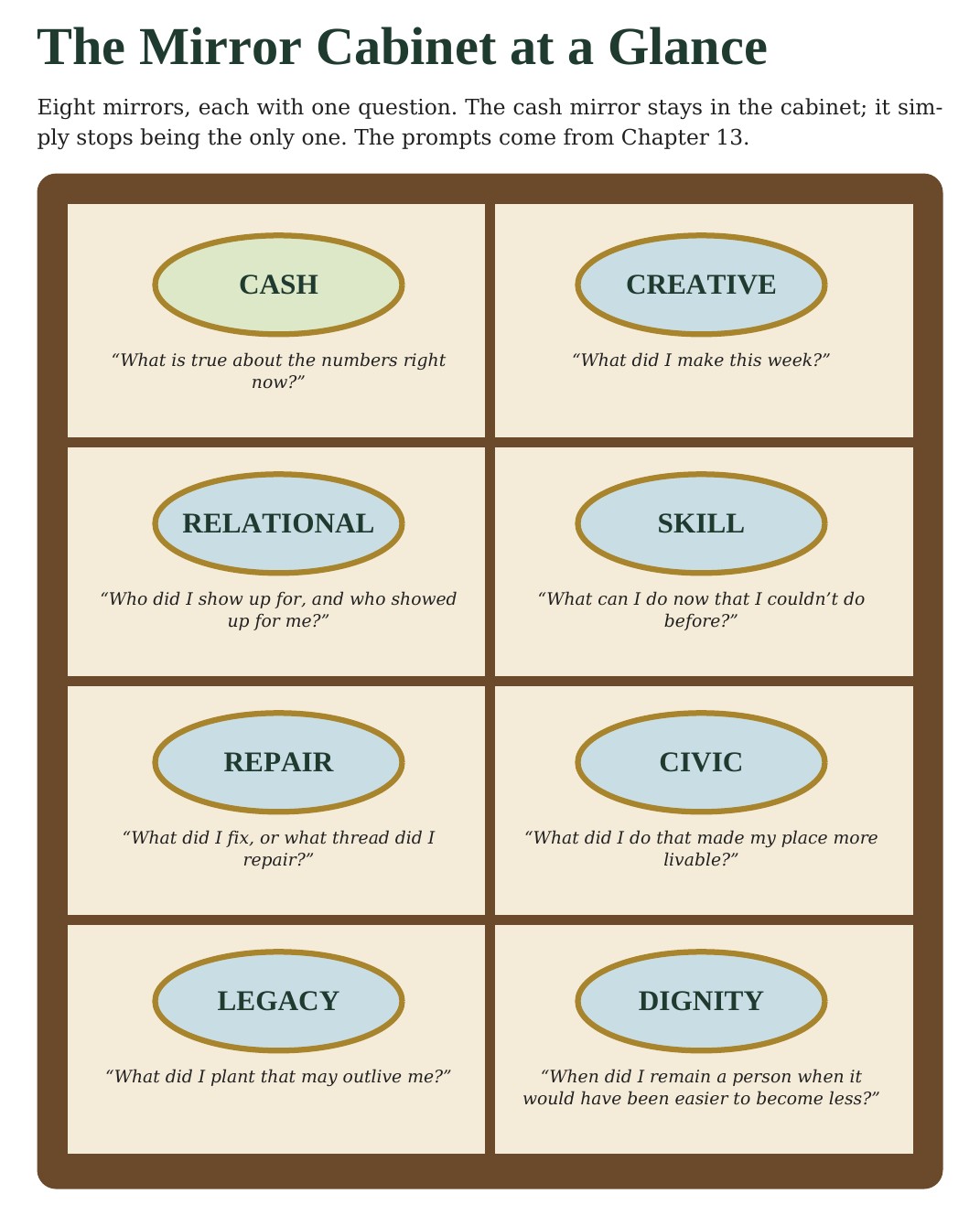
Paperback, 210 pages, 8.5 x 11 inches, black and white. Before you begin: A Note on Care, The Six Rooms, and The Mirror Cabinet at a Glance.
1. The 6:47 AM Ritual: Meeting the Cash Mirror. Before water or a toothbrush, many people check their balance and let the number answer who they are that day. This chapter names that ritual, the cash mirror, and makes a promise about the other mirrors still within reach.
2. The Manufactured Reflection. The cash-only mirror is not a law of nature; banks, advertisers, employers and platforms built it over generations. Seeing how it was made is the first step to seeing that it is not the only reflection.
3. The Compliment That Wasn't. “How much do you make?” arrives as small talk but works as an audit that sorts people. This chapter shows what the question is really asking and gives you graceful ways to decline it.
4. The Kids Are Watching. Children inherit the cash mirror the way they inherit an accent, by hearing it every day. Here are practical ways for parents to narrate their boundaries and give children a wider set of mirrors.
5. The Sabotage Loop. A low number can quietly become a story about who you are, and that story changes behavior in ways that make the number worse. This chapter shows how the loop runs and where to break it.
6. The Creative Mirror. The creative mirror asks what you have made, not what you have earned. Ten minutes of making, a no-audience rule and a private finished list rebuild a self that does not need applause.
7. The Relational Mirror. The 2 AM test shows who would answer your call and whose call you would answer. Anchors, aisles and trustlines give you a way to measure belonging that money cannot.
8. The Skill Mirror. When the problem is competence rather than worth, the answer is practice with proof. Ten-minute sessions and a one-sentence Skill Receipt turn “I am stuck” into “I have proof.”
9. The Repair Mirror. The repair mirror asks what you have fixed, from a leaning fence panel to a frayed friendship. Daily Repair Receipts show that you are not defined by what is broken.
10. The Civic Mirror. Beyond your front door, the sidewalk, the school and the library are also yours to tend. This chapter asks “What am I part of?” and turns small acts of upkeep into belonging.
11. The Legacy Mirror. Belonging to a place changes how you see time, from this week to the decades ahead. Eulogy sentences help you decide what you want to plant that may outlive you.
12. The Dignity Mirror. Dignity is not the same as success, strength or respectability. This chapter asks when you remained a person when it would have been easier to become less, and keeps a ledger of the answers.
13. The Mirror Cabinet. The goal is not to smash the cash mirror but to store it beside seven others and consult each on purpose. Three rituals turn the cabinet into daily practice: the Two-Minute Mirror Switch, the Sunday Evening Cabinet Check and the Five-Decision Cabinet Run.
14. The Question That Grows You. The cash question asks how much you have; the growth question asks who you need to become. The final chapter makes the growth question a weekly habit that keeps your options expanding.
At the back: Case Studies, The Broken Mirror Dictionary, The Grade Level Check, 27 Free Ways to Learn to Read, the Global Barter Exchange, About the Author, and Not Because It Was Easy.
Chapter 1. The 6:47 AM Ritual: Meeting the Cash Mirror
At 6:47 in the morning the phone is already awake.
Not you, not really. Your eyes are open, but your body is still negotiating with the day. The light in the room is gray and undecided. The first breath tastes like sleep. Somewhere in the house a pipe ticks as it cools, or a refrigerator hums like it has been doing all night, faithful and unnoticed. Your hand finds the phone the way it finds a familiar doorknob in the dark. Thumbprint. Face ID. A small glow that makes your face look more tired than it is.
And then, before water, before toothbrush, before the small mercy of being clean, you check the number.
Sometimes you do not even call it checking. You call it “just looking.” You tell yourself it is practical. Responsible. Adult. “I just want to make sure everything cleared.” “I’m just seeing what’s coming out.” “I’m just confirming that paycheck hit.” The language is always modest, almost apologetic, as if the act itself wants to be invisible.
But the body knows it is not invisible. Your shoulders lift a fraction. Your stomach tightens, or loosens. Your breath changes. The day tilts.
The number appears the way weather appears when you pull back a curtain. It is not only information. It is forecast. It tells you what kind of person you are allowed to be today: generous or guarded, patient or brittle, hopeful or braced. It tells you how big you are permitted to feel when you walk into your kitchen, your job, your marriage, your own thoughts.
This check happens so often in the United States that it has become a shared morning liturgy we do not name. Bank apps and card apps, payroll apps and brokerage apps, debt dashboards and payment notifications. At 6:47, in kitchens and parking lots, in break rooms and bedrooms, on couches where someone slept in their clothes, on pillows next to someone they love and do not want to wake. It happens in the quiet before children rise, and it happens in the loud when a baby finally fell asleep in a parent’s arms and the parent is too wired to return to bed. It happens in the same minute that coffee is brewing and in the same minute that someone is already running late.
Eighty-four million times a day in America alone, a person looks into that glass and asks, silently, “What am I?”
Not “What do I have?” Not even “What can I do?” The mind thinks it is asking those smaller questions, the ones that sound like budgeting. But the nervous system hears the larger one. The larger one is the question that has always lived beneath money: “Am I safe?” and beneath safety: “Am I enough?”
In older lives, the first mirror of the morning was a literal mirror. A face. A bruise healing. A new line. The evidence that you survived another night. You could look at your own eyes and remember, however briefly, that you were a person and not a ledger. Even if you did not like what you saw, it was still you. A human face with human history behind it.
Now the first mirror is often a number.
The number is brutally simple. It does not mention the friend you called back yesterday when you did not feel like it. It does not mention the apology you swallowed and then finally said. It does not mention the dinner you cooked, the lesson you learned, the patience you practiced, the craving you resisted, the mile you walked, the small courage you showed when nobody was keeping score. It does not mention your child’s laugh in the back seat, or your mother’s voice when you checked on her, or the fact that you are still here.
The number does not care. That is part of its power. It pretends to be neutral. It pretends to be pure. It pretends to be the opposite of judgment because it is arithmetic. But arithmetic, when used as identity, is judgment in its cleanest clothes.
If the number is high enough, you feel tall. You might not say that out loud, but you feel it. The spine straightens. The day seems more spacious. You speak more kindly. You imagine more options. You take a risk you would not have taken yesterday. You are, for a few hours, the version of yourself you like best.
If the number is low, you feel smaller. That is the part people are hesitant to admit. We are taught to be stoic about money, and we are taught to pretend that our selfhood is untouched by it. So we say, “It’s just a temporary cash flow thing,” while our mood drops like a stone. We say, “It’ll be fine,” while we start treating every plan, every invitation, every want, as an accusation. We start doing the quiet math of embarrassment: if my card declines, if my rent is late, if I cannot reciprocate, if I cannot keep up, if someone finds out.
The phone does not have to speak. It has trained you to hear it anyway. It has trained you to translate its number into your size.
This is what the book means by a mirror. A mirror is anything you use, consciously or unconsciously, to decide who you are. A mirror is a surface that answers the question “What am I worth?” without ever asking permission to answer it.
And this, now, is America’s new mirror: the morning balance check.
What makes it different from older measurements is not only its frequency. It is its intimacy. A paycheck used to arrive in an envelope. A bank balance used to require a trip, or at least a conscious choice to sit down and reconcile. You could go hours, days, sometimes a week, without being confronted by the number unless you went looking for it. You could live your life in front of other mirrors without realizing you were avoiding the cash one. The cash mirror was a place, not a companion.
Now it lives in the same device that wakes you up, that holds your family photos, that contains your conversations, that tells you the weather and the news and the arguments of strangers. It is not simply accessible. It is integrated. It sits next to your calendar and your camera like it belongs beside your memories.
It is the first look. And because it is the first look, it has an unfair advantage. Whatever you see first becomes the lens through which you see everything else.
A parent checks the balance at 6:47 and then, ten minutes later, tells a child to hurry up with shoes and breakfast. But the parent’s voice has already been colored by the number. A husband checks the balance at 6:47 and then, an hour later, kisses his wife goodbye with a distracted mind, half calculating the credit card bill. A college student checks the balance at 6:47 and then goes to class already feeling behind, even if they slept eight hours and studied and did everything right.
It is not that money does not matter. It matters. There is nothing noble about pretending otherwise. Money is shelter. Money is medication. Money is the ability to leave a dangerous situation. Money is a buffer between your children and panic. It is groceries. It is time. It is choices. The cash mirror reflects something real.
The problem is not that you look into it. The problem is that it has become the only mirror many people trust, the only mirror many people consult, and therefore the only mirror many people feel in their bodies.
A mirror that only reflects cash will always make you feel smaller than you are, because you are not made of cash.
Still, the ritual persists because it feels rational. It feels like control. In a culture that moves fast and forgets easily, the balance check offers an immediate answer. It offers the illusion of certainty before you have even put your feet on the floor. It is a tiny lever you can pull in a world that does not hand you many levers. When the future feels unstable, you reach for the nearest stable thing, and numbers pretend to be stable.
But notice what the ritual costs. At 6:47 you have not yet had a chance to be a person today. You have not yet practiced your values. You have not yet helped anyone. You have not yet learned anything. You have not yet made anything. You have not yet repaired anything. You have not yet shown dignity or built legacy or widened your circle or improved your skill. You have not yet done any of the things that will turn out to matter when the day is over.
And yet the first evaluation arrives anyway.
This is why people feel tired before the day begins. They wake up already graded.
It is also why the number can feel like truth even when you know, intellectually, that it is not. The mind can say, “I’m more than my bank account,” while the body says, “Apparently not, because look at what you did first.”
The first mirror shapes the first sentence you say to yourself.
Some mornings, if you are willing to be honest, that sentence is not about budgeting at all. It is about worth. It sounds like: “I’m behind.” Or, “I’m failing.” Or, “I have to catch up.” Or, “I can’t relax.” Or, “Who did I think I was?” Or the cruelest version, the one people rarely admit even to themselves: “I’m not the kind of person who gets to be okay.”
The manufacturers of this mirror do not need you to say those sentences out loud. They do not need your devotion. They do not need your gratitude. They need only the reflex. They need only that you keep looking.
So the first task of this chapter is not to scold you for checking. The first task is to help you see what you are actually doing when you check. To name it as a ritual, because anything unnamed has the power of nature, and anything named can be changed.
At 6:47, you are not merely gathering information. You are meeting your reflection.
And the book makes you one promise at the beginning, before we go any further: by the last page, you will be able to look at yourself in more than one mirror. Not as a motivational trick. As a practical skill. As a way to live a life that is larger than a number without pretending the number does not exist.
But first, you have to understand how the cash mirror became the first mirror. You have to understand why it appears so early in the morning, so quietly, so convincingly. You have to understand why you reach for it before the toothbrush.
Because once you see the ritual clearly, you can finally choose what gets to reflect you when the day begins.
The ritual feels private, like something you invented on your own. A small act between you and your morning. But it did not arrive out of nowhere, and it is not merely a personal quirk multiplied by millions of people. The reason it has such power is that it has a history. It has been trained into us, slowly, by systems that learned how to convert survival into identity.
If you could step far enough back in time, you would see that money was once loud rather than intimate. It arrived as coins you could hear, as bills you could touch, as a payment you received in the open and spent in the open. You knew who had it and who did not because it was carried, counted, handed over, argued about. It was social. It was physical. It was not inside your pillow, glowing at 6:47.
And more importantly, it was not the first mirror.
For most of human history, the first mirror was the world itself. Your hands. Your body’s strength. The quality of your shelter. The health of the people you loved. The weather. The harvest. The favor of a boss, yes, or the cruelty of one, yes, but the measurement of a life was not reduced to a single portable number that followed you into every room and into your sleep.
People were poor, people were exploited, people were treated like tools. There has never been a golden age. But the measuring devices were different. A person could be valued for endurance, for reliability, for the steadiness of their presence. In many places, you were known by reputation more than by score. Your name carried a story, and a story carries multiple dimensions. Even the harshest communities did not have the technological ability to compress a person into one digit and refresh it every second.
Then came wages as a primary relationship.
When life becomes organized around employment, and employment becomes organized around a number, the number begins to creep from the edges of life toward the center. At first it is simple: you need money because you need food, rent, fuel, medicine. Money becomes the gatekeeper of survival. The mind can hold that without collapsing into self-worth. A person can say, honestly, “I need money,” without saying, “I am money.”
But the brain does not like gatekeepers. It prefers shortcuts. If money keeps you safe, the brain starts treating money as safety itself. If money gets you respect, the brain starts treating money as respect. If money allows you to leave, the brain starts treating money as freedom. And then, because the brain likes single explanations, it begins to treat money as the central explanation. Not one factor among many, but the factor. The master key.
That is the first turn in the origin story: money moved from being a tool you used into being a signal you read.
The second turn is that the signal got standardized.
In earlier eras, one person could be wealthy in land and broke in cash. One person could be rich in livestock and poor in coin. One person could have a thriving business and be temporarily underwater because a shipment hadn’t arrived. One person could be valued in a community even if their pockets were empty because everyone knew their character, their skill, their loyalty, their usefulness, their kindness, their willingness to show up.
Those are messy measurements. They require stories. They require memory. They require human judgment, which is slow.
Modern economic life does not like slow. It likes comparable. It likes sortable. So we built structures that made money more uniform and therefore more powerful as a measuring stick. The paycheck became a steady drumbeat. Bills became scheduled. Financial products turned into monthly obligations. Entire lives began to run on recurring transactions, due dates, automatic drafts. A person who was once measured by seasons and relationships began to be measured by cycles of payment.
Then we placed the measurement inside institutions that could insist on their version of reality.
Banks did not just hold money. They started to interpret you. Employers did not just pay wages. They began to define social status through titles and salary bands, even when they pretended not to. Insurance companies did not just spread risk. They began to price you as a person. Landlords and lenders did not just ask whether you had income. They began to ask whether you had a certain kind of income, documented in a certain kind of way, arriving on a certain kind of schedule.
And as these institutions grew, they needed a fast answer to a question as old as trade: Can I trust you?
Trust is ancient. Measuring it at scale is new.
That need created a hunger for simple proxies. The system does not have time to know your mother’s voice, your neighbor’s opinion, the way you kept your promises at seventeen, the way you repaired what you broke, the way you told the truth when lying would have been easier. Those are the measurements that matter in a human life, but they are not machine-readable.
Numbers are machine-readable.
So we taught the system to ask for numbers that could stand in for trust. Not because they were perfect, but because they were portable. Income. Balance. Debt-to-income ratio. Payment history. Utilization. A collection notice, a late fee, a bounced check. The language of worth got translated into the language of creditworthiness, and once that translation exists, it spreads into places it was never meant to go.
A lender asks, “Will you repay?” and the system hears, “Are you responsible?” A landlord asks, “Are you stable?” and the system hears, “Are you safe to be near?” A potential employer asks, “Are you a risk?” and the system hears, “Are you the kind of person we want?”
You can feel the shift: the number stops being about a transaction and starts being about a person.
This is where the mirror becomes dangerous. Not because money is evil, but because the measurement is pretending to be a complete biography.
At the same time, another industry discovered something that seems obvious once you see it but is hard to unsee afterward: dissatisfaction is profitable.
If you can be made to feel slightly behind, you will buy. If you can be made to feel slightly less attractive, you will buy. If you can be made to feel slightly less secure, you will buy. If you can be made to feel slightly less worthy, you will buy. You will buy not only products but identities: the identity of someone who has it together, someone who belongs, someone who is safe, someone who is enviable.
Advertising did not invent insecurity, but it learned to aim it like a beam of light. It learned to take the cash mirror and tilt it toward your face.
And the more the culture used money as a language for status, the more every purchase became a kind of social sentence. Not just “I bought this,” but “This is who I am.” Or worse, “This is who I am trying to be.” People began to curate themselves through spending the way earlier generations curated themselves through conduct and community. Shopping became self-portraiture.
That is another turn in the origin story: money moved from being an instrument of survival into being an instrument of identity performance.
The final turn is technological, and it explains the specific intimacy of 6:47. Even a few decades ago, you could avoid your money for hours at a time. The cash mirror was there, but it had a physical boundary. You had to go to an ATM. You had to open a statement. You had to sit at a desk. You had to decide to enter the room where the mirror lived.
The smartphone eliminated the room.
Now the mirror is not on the wall. It is in your pocket, in your bed, on your nightstand. It is the same object that delivers affection and panic, entertainment and obligation, headlines and family photos. Money became not just accessible but ambient, present in the background like a hum you stop noticing until it changes pitch.
Notifications made it worse by making the mirror look at you first.
Your bank does not wait for you to consult it. Your card app is eager to narrate your life back to you: purchase approved, balance low, payment due, unusual activity. These are framed as helpful, and sometimes they are. But the deeper effect is that the mirror keeps clearing its throat. It keeps reminding you that it is there.
The result is the morning reflex you just named: before you have even done anything today, you check what the system thinks you are.
And because that mirror is connected to so many other parts of life, it has become persuasive. It is not only your bank balance. It is your rent portal. Your student loan servicer. Your credit card dashboard. Your employer’s payroll app. Your retirement account. Your grocery delivery. Your ride share. Your subscriptions. Your medical bill. A person can go from waking up to being charged three times before breakfast.
When you live inside that stream, it begins to feel like the stream is life itself. But it is not.
This is why the cash mirror makes you feel smaller than you are. It is not because you are imagining its power. It genuinely touches survival. It genuinely touches opportunity. It genuinely touches relief. It can change what happens to you. That is real.
What is not real is the lie of totality. The lie that the cash mirror is the whole face.
A human being cannot be accurately reflected by a single measurement, no matter how sharp the glass. You already know this in other arenas. You would not measure a marriage by one conversation. You would not measure a child by one grade. You would not measure a year by one bad week. You would not measure a person’s goodness by one act, either their best or their worst. And yet we have allowed ourselves to be measured by a number we can refresh endlessly, as if refreshing it makes it truer.
That is the origin story: money became safety, then status, then identity, then an always-on interface. The mirror was manufactured, and then it was placed everywhere, and then it was taught to speak in the first person. By the time you wake up and reach for the phone, it no longer feels like a tool you consult. It feels like a voice inside your day.
The work ahead is not to destroy that voice. It is to demote it.
The cash mirror belongs in a sane life. It just does not belong in the position of first and only. It cannot carry the full weight of “What am I?” without distorting you. It was never designed to. It was designed to count.
There are other ways to see yourself that are just as real, and in the long run, more stabilizing. They do not ignore money. They put it in its place, among other reflections that tell the truth about what kind of person you are becoming. You do not have to abandon practicality to stop shrinking. You only have to stop letting one manufactured pane of glass serve as your entire self-portrait.
If you can understand how cash became our reflection, you can begin to understand something else: reflections can be changed. Not by pretending, not by positive thinking, but by choosing what you consult, when you consult it, and what you refuse to let it define.
The next step is to make a promise explicit. Not a vague promise that you will “feel better about money,” but a practical one: by the last page, you will know how to stand in front of more than one mirror, so that at 6:47 the first look does not get to be the final verdict.
So here is the promise, stated plainly enough that you can hold me to it.
By the last page of this book, you will be able to look at yourself in more than one mirror.
Not as a slogan. Not as a mood. Not as a trick for days when the numbers are ugly. As a practical ability. As a skill you can learn and practice the same way you learned to drive, or cook, or manage a calendar, or speak a language well enough to order dinner without panic. The point is not to become a person who never checks the bank balance. The point is to become a person who can check it without shrinking.
Because the cash mirror does something subtle that almost nobody names while it is happening. It takes a tool and turns it into a verdict.
It is a tool when it helps you not overdraft, when it helps you plan, when it helps you pay people on time, when it helps you build the calm that comes from knowing where you stand. It becomes a verdict when it answers questions it has no authority to answer. When it begins to tell you what kind of spouse you are, what kind of parent you are, what kind of friend you are, what kind of citizen you are, what kind of human you are.
At 6:47, in that half-lit moment before you have done anything today, the verdict lands early. And because it lands early, it becomes the frame. You start the day as a defendant rather than a person.
This book is going to interrupt that. Not by demonizing money, and not by romanticizing poverty, and not by pretending you can meditate your way out of a rent increase. We are not doing fantasy here. Money is real. Its pressures are real. The system that manufactured the mirror is real. The reason the mirror became intimate and constant is real. You are not weak for feeling it. You are not shallow for being affected by it. You are a human nervous system responding to a world where numbers are tied to survival.
But there is another truth that is just as real: you are bigger than the mirror. If you have ever watched someone you love go through a hard season and still stay kind, you already know this. If you have ever seen a person lose a job and still show up for their family, you already know this. If you have ever met someone who does not have much money but somehow makes the room feel safer, you already know this. If you have ever known a person with plenty of money who feels hollow and frightened anyway, you already know this too. The cash mirror is not lying about its number. It is lying by omission. It is telling one truth loudly enough that it begins to sound like all truth.
The promise is that we will restore the missing truths. We will place other mirrors back into the room.
Let me explain what I mean by mirrors, because I am going to ask you to use the word differently than you are used to.
A mirror, in the language of this book, is anything you consult to decide who you are. Anything that answers the question “What am I worth?” or even the quieter question beneath it, “Am I enough?” The mirror does not have to be physical. It can be a conversation. It can be an app. It can be a job title. It can be a memory. It can be the look on someone’s face when you walk into a room. It can be the way your body feels after you keep a promise. It can be a credit score. It can also be a child running to you without thinking, because their body has already decided you are safe.
In the first pages, you saw what happens when one mirror gets promoted above all the others. It becomes the first look, and therefore it becomes the lens. The morning balance check is not merely a habit. It is a form of self-measurement that happens before you have done anything worth measuring. You wake up and the system hands you a number and says, “Here. This is you.” And if you do not have other mirrors nearby, if you have not practiced looking into them, you accept the offer. Not because you are gullible, but because you are tired, and the number is immediate, and immediacy feels like certainty.
So the promise is not that you will stop looking into the cash mirror. The promise is that it will stop being your only mirror, and it will stop being your first mirror, unless you deliberately choose it.
That matters. “Deliberately” is the hinge. The cash mirror’s power is not only in what it shows you. Its power is in how automatically you consult it. Automatic mirrors become masters. Chosen mirrors become instruments. This book is about moving you from automatic to chosen.
I need to be careful here, because there is a way people talk about “self-worth” that sounds beautiful and changes nothing. It becomes an inspirational poster over the same old reflexes. You read a line, you nod, you still check the bank balance at 6:47, you still feel the day tilt, you still treat your life like it is on probation until the next deposit. The promise of this book is not that you will collect nicer sentences. It is that you will build a different daily practice.
That practice begins with one unglamorous realization: the cash mirror is not the only reliable mirror. It has convinced you it is, because it is numeric and frequent and tied to consequences. But reliability is not the same as completeness.
A heart monitor is reliable. It tells you something true. It does not tell you whether you are brave. A scale is reliable. It tells you something true. It does not tell you whether you are faithful. A credit score is reliable in its own limited way. It tells you how you behave inside one particular system. It does not tell you how you treat people who cannot give you anything. It does not tell you what you make with your hands. It does not tell you what you repair. It does not tell you what you learn. It does not tell you what you endure without becoming cruel.
The cash mirror has been allowed to speak beyond its jurisdiction. That is the problem. This book is going to redraw the border.
And I am going to ask you for something in return, because the promise is a partnership.
I am going to ask you to notice, without dramatizing it, the moment you shrink. Not the moment you feel concern about money. Concern is sane. I mean the moment you feel smaller as a person. The moment the number starts to rewrite your posture, your voice, your patience. The moment you start treating yourself as a problem to be managed rather than a person to be lived. The moment you begin to think, “When I get the number up, then I can finally relax, then I can finally be generous, then I can finally be myself.” That moment is the mirror taking over.
When you notice it, do not scold yourself. Scolding is just another way to stay trapped in the same glass. Instead, treat the moment like a bell. A signal. It is telling you, “You are looking into a mirror that cannot show your whole face.”
Later in the book, you will build a cabinet of mirrors. That phrase will become practical, not poetic. You will decide which mirrors belong in your life, where they sit, and how often you consult them. You will have rituals simple enough to do on a Sunday evening when you are tired. You will have a way to run major decisions past more than one reflection, so you do not keep choosing your life based on the most anxious number in the room.
But before we get there, you need to trust that there are other mirrors worth consulting. Not decorative mirrors. Not “feel good” mirrors that lie to you in the opposite direction. Real mirrors. Mirrors that reflect something solid and verifiable, something you can point to without having to persuade yourself.
That is why, in the chapters ahead, you will meet other forms of reflection that do not compete with money, but contextualize it. They will show dimensions of you that the cash mirror cannot register, even if it refreshes every second. They will feel unfamiliar at first, the way any neglected muscle feels sore when you start using it again. Some readers will feel resistance, because the cash mirror is efficient, and the other mirrors require presence. Presence is slower than scrolling.
But slower is not the same as weaker. In fact, the slower mirrors tend to be the ones that hold up under pressure.
Here is how you will know the promise is working as you read.
One day, you will check the number at 6:47 and it will still be what it is. The bills will still exist. The responsibilities will still exist. Nothing magical will happen to the economy. And yet the number will not be able to tell you who you are.
You will feel the difference in your body first. The check will become information rather than an identity event. The day will not tilt as far. Your shoulders will stay more level. Your voice will be steadier at breakfast. You will be less likely to take your anxiety out on someone you love. You will be more likely to make decisions that are wise rather than reactive, even if they are hard.
You will still care about money. You will simply stop using it as a mirror for your size.
That is what “more than one mirror” means. It means you will have other ways to see yourself on days when the cash mirror is low, and other ways to stay humble on days when it is high. It means your reflection will not be held hostage by a manufactured pane of glass that was never designed to carry your entire humanity.
And because I do not want this to stay abstract, I will tell you one small thing to do tomorrow morning, before the rest of the book teaches you the full practice.
When you reach for the phone at 6:47, pause for three breaths before you open the app. Not as a meditation performance. As a delay long enough to remind your nervous system that you are allowed to exist before you are evaluated.
Then, after you check the number, say one sentence out loud. Not a motivational speech. One sentence of truth that the cash mirror cannot give you.
It can be as plain as, “I am more than this number.”
Or it can be even plainer, and more useful: “This is information, not a verdict.” The sentence will feel small. That is fine. Small sentences are how big practices begin.
This is the promise: you will not have to beg the cash mirror to be kinder. You will simply stop asking it to be a god.
By the last page, you will look at yourself in more than one mirror. And when you do, you will discover something that should have been obvious all along but rarely becomes obvious until a person has lived long enough to feel the cost of forgetting it.
You were never the number.
You were the one holding the phone.
Chapters 2 through 14, the case studies and The Broken Mirror Dictionary continue in the book.