The Efficiency Classroom: The TPM Teaching Method
Count the six losses in your class for one week, find the tallest, and fix that one. Book 11 of Zero Breakdowns: The TPM Series.
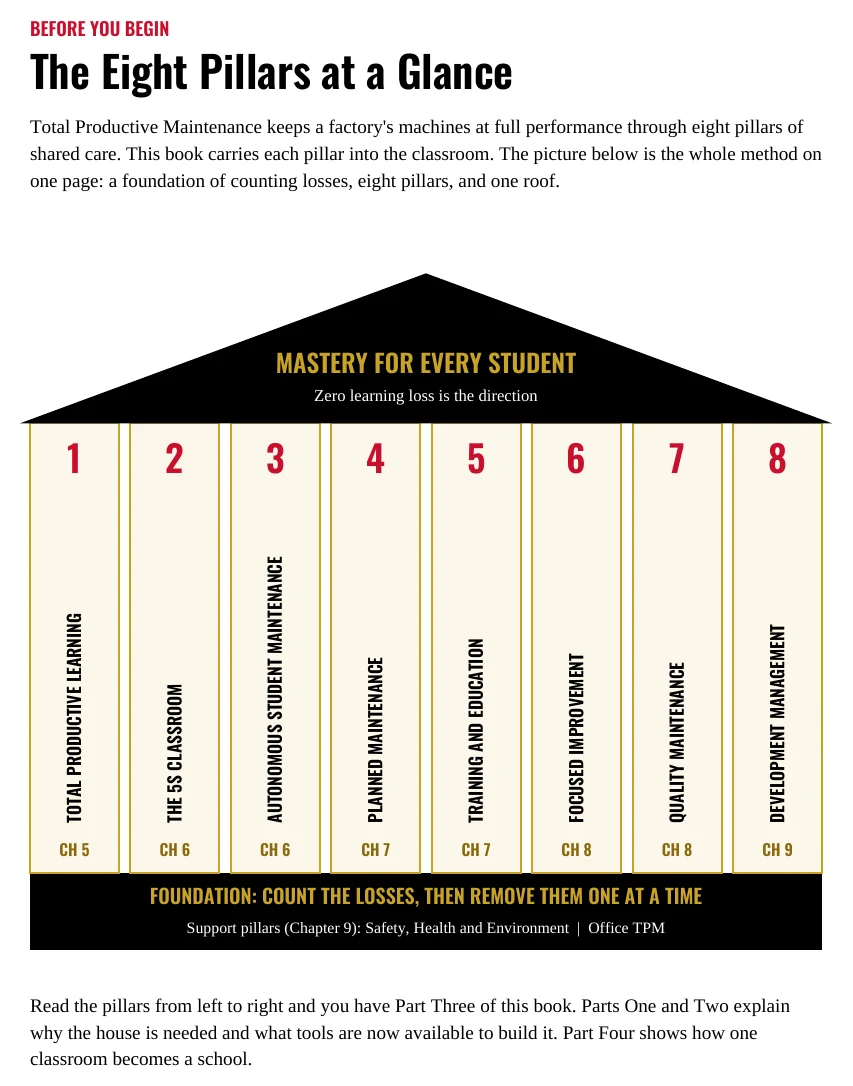
Every class loses minutes. Factories learned long ago to count the six losses that shrink a machine's useful time; this book carries that method, Total Productive Maintenance, into teaching. Eleven chapters, each ending with a Field Card, plus the Loss Log card, real and teaching case studies, a 32-term dictionary and the free on-screen Loss Log tool. Revision 2, 2026. 127 pages.
Chapter 1: The Breakdown of the Status Quo
The Factory Model's Enduring Legacy
Walk into most schools today, and you'll witness a scene that would be instantly recognizable to someone transported from 1925. Students sit in rows. A teacher lectures from the front. Bells ring to signal transitions. Learning happens in rigid blocks of time, organized by age rather than ability or interest. This is not because we lack imagination, but because our educational system remains stubbornly tethered to a model designed for a world that no longer exists.
The 19th-century factory model of education emerged during the Industrial Revolution with a clear purpose: to prepare workers for factory jobs that required obedience, punctuality, and the ability to perform repetitive tasks. The system was designed to process large numbers of students through standardized curricula, much like an assembly line processes raw materials into finished products. In that context, the model made sense. It was efficient for its intended purpose.
But we no longer live in that world. The factories that shaped our educational system have largely disappeared, replaced by a knowledge economy that demands creativity, critical thinking, collaboration, and adaptability. Yet our schools continue to operate as if preparing students for 1955 rather than 2025 and beyond.
The disconnect between our educational methods and the needs of modern society creates profound waste—waste that extends far beyond financial costs to include wasted time, wasted potential, and wasted lives.
Defining Educational Waste
In manufacturing, waste (or "muda" in Japanese lean philosophy) refers to any activity that consumes resources without creating value. Seven types of waste have been identified in manufacturing: overproduction, waiting, transportation, overprocessing, inventory, motion, and defects. When we apply this lens to education, the scale of waste becomes staggering.
Time Waste: Consider the traditional classroom where a teacher presents material to thirty students simultaneously. Some students already understand the concept and must wait, bored and disengaged, while the teacher explains it. Others are lost from the first minute but must sit through the entire lesson anyway, falling further behind with each passing moment. The teacher must pace the lesson for the "average" student, meaning most students experience the lesson as either too slow or too fast. Hours upon hours of student time—arguably the most precious resource in education—are wasted daily.
A student who grasps algebra concepts in twenty minutes must sit through a fifty-minute class. Multiply this by hundreds of students and thousands of classes, and we're discussing millions of hours of human potential squandered.
Meanwhile, students struggling with basic concepts proceed to advanced topics before they're ready, building shaky towers of knowledge destined to collapse.
Resource Waste: Schools invest enormous sums in textbooks that quickly become outdated, in technology that sits unused or underutilized, in programs that lack evidence of effectiveness, and in interventions that address symptoms rather than root causes. Teachers spend countless hours creating lesson plans from scratch when excellent resources exist or preparing for assessments that measure recall rather than understanding.
Administrative overhead consumes resources that could support learning. Compliance requirements divert attention from instruction. Facility maintenance often prioritizes appearance over function. The list continues, but the pattern is clear: resources that should enhance learning are diverted to maintaining a system designed for a different era.
Potential Waste: Perhaps the most tragic waste is the squandering of human potential. Students with exceptional abilities in particular domains languish in classes designed for generalists. Students who could excel with personalized pacing and targeted intervention instead receive generic instruction. Young people with tremendous capacity for creative or critical thinking spend years memorizing facts for tests, only to forget most of what they "learned" within months.
Gallup's student polls show that engagement declines steadily from elementary school through high school: in the 2016 poll, 74 percent of fifth graders were engaged, against about one-third of students in grades 10 through 12. This represents a catastrophic loss of human potential during the very years when young people should be discovering their passions and developing their capabilities.
Opportunity Cost Waste: Every hour spent on ineffective methods is an hour not spent on effective ones. Every dollar invested in maintaining obsolete systems is a dollar unavailable for genuine innovation. Every student who graduates without achieving true mastery represents not just a personal tragedy but a societal loss—of productivity, innovation, and human flourishing.
The opportunity costs extend beyond school years. Students who don't achieve mastery in K-12 education require remedial coursework in college, extending time to degree completion and increasing debt. Students who graduate without critical thinking skills or genuine knowledge face limited career prospects. The ripple effects touch families, communities, and the entire economy.
The Efficiency Imperative
If waste in education were merely a matter of modest inefficiency, we might tolerate it. But the scale of waste in our current system is untenable, both practically and morally. In an era of constrained budgets, growing demands, and urgent needs, we cannot afford to squander resources on such a massive scale.
More importantly, we cannot afford to waste the potential of our young people. Every child who moves through our educational system without achieving genuine mastery, without discovering their capabilities, and without developing critical thinking and creativity represents a profound moral failure. We can and must do better.
The good news is that we have the knowledge and tools to dramatically improve educational efficiency. The principles of Total Productive Maintenance, developed to eliminate waste and optimize performance in manufacturing, can be adapted to transform education. This is not about treating students as products on an assembly line but about applying proven principles of continuous improvement, systematic problem-solving, and waste elimination to create learning environments where every student achieves mastery.
The efficiency imperative is not about doing more with less, though that will be a beneficial outcome. It's about recognizing that our current system wastes the most precious resources we have—the time and potential of our children—and committing to change.
The Resistance to Change
Despite the obvious problems with traditional education, efforts at reform have repeatedly failed to produce lasting change. Why? The resistance to educational change is deeply rooted and multifaceted.
Structural Inertia: The educational system is massive, employing millions of people and serving tens of millions of students. Like any large bureaucracy, it resists change through sheer inertia. Established routines, policies, and practices continue not because they work well, but because changing them requires enormous effort.
School districts are bound by union contracts, state regulations, federal mandates, and local traditions. Curriculum decisions involve multiple stakeholders with competing interests. Changing one element of the system often requires changing many others, creating a chicken-and-egg problem that paralyzes reform efforts.
Professional Identity: Many educators have built their professional identities around traditional teaching methods. They spent years learning these methods, honing their craft, and developing expertise. Suggesting that these methods are inefficient can feel like an attack on their professional competence and dedication.
This is not a criticism of teachers, who work incredibly hard under challenging conditions. Rather, it's recognition that human beings naturally resist changes that seem to threaten their professional identity or suggest that their years of effort were misguided. Effective reform must honor teachers' expertise while providing compelling reasons and clear pathways for change.
Fear of the Unknown: The traditional model, however inefficient, is familiar. Teachers know how to operate within it. Parents understand it because they experienced it themselves. Students know what to expect. Moving to a new model involves uncertainty and risk.
What if it doesn't work? What if students fall behind? What if we make things worse?
These fears are not irrational.
- Educational history is littered with reforms that promised transformation but delivered disappointment.
- Fads come and go, leaving cynicism in their wake.
- Teachers and parents have learned to be skeptical of the latest educational innovation.
Misaligned Incentives: Current educational systems create incentives that work against efficiency and genuine learning. Schools are funded based on attendance, not learning. Teachers are evaluated based on test scores, not student mastery. Students are promoted based on seat time, not demonstrated competence. Administrators focus on compliance with regulations rather than educational outcomes.
These misaligned incentives create a system that optimizes for the wrong outcomes. Until we realign incentives around genuine learning and efficiency, efforts at reform will continue to face headwinds.
Why This Time Can Be Different
Previous reform efforts have largely failed because they tried to change education through top-down mandates or superficial modifications to the existing system. The TPM Teaching Method offers something different: school reform from the inside out based on proven principles of efficiency and continuous improvement.
This approach works because it:
Empowers Teachers: Rather than dictating methods from above, TPM provides teachers with tools and principles they can adapt to their specific contexts. Teachers become continuous improvement experts, identifying and eliminating waste in their own classrooms.
Focuses on Systems: TPM recognizes that individual effort cannot overcome systemic inefficiency. It provides methods for identifying and addressing root causes rather than symptoms, creating sustainable change rather than temporary improvements.
Provides Evidence: TPM's success in manufacturing provides a proof of concept. The principles work. When properly adapted to education, they produce measurable improvements in efficiency and outcomes. Teachers can see results in their own classrooms, building confidence and momentum for broader change.
Addresses Real Problems: Unlike reforms driven by ideology or theory, TPM responds to problems that teachers and students experience daily. It's not about implementing someone's vision of ideal education but about eliminating waste and optimizing learning in practical, tangible ways.
The breakdown of the status quo is not a tragedy to mourn but an opportunity to seize. The traditional factory model of education served its purpose in its time, but that time has passed. We now have the understanding, tools, and imperative to create something better—an educational system that treats student time and potential as the precious resources they are, that eliminates waste, and that enables every student to achieve genuine mastery.
The journey begins by recognizing that the emperor has no clothes—that our current system is fundamentally inefficient and outdated. Only then can we move forward to build something worthy of our children's potential.