The Shellbreaker Protocol
How to break free from poverty, dependence and disaster, starting with what you already have.
Eight chapters follow Rosa for one year, from a leaking roof to a Circle of her own. The book names the five walls of the shell, gives two rules for breaking out, and shows how to learn, trade and prepare without money, power or a classroom. Every chapter ends with a tap, a field procedure and a checklist.
Contents
Paperback, 100 pages, 8.5 x 11 inches, color. ISBN 979-8-1831-6275-2. Before you begin: Six Plates, Thought Soup, How to Use This Book, and Free With This Book.
1. The Shell. The five walls of the shell, why the education wall holds up the others, poverty as a business, and the first tap.
2. Rule One: Start with What Is Already in Your Hands. Rule One, the six-column Inventory, how to take one in an hour, and how to find a first move in it.
3. Rule Two: Accept Rescue. Refuse Residence. Rule Two, relief and recovery and rebuilding, the five-question Ladder Test, and planning the way out of every rescue.
4. Learning Without Power, Fees or a Classroom. Reading first, University on a Stick and University in a Box, learning when the power is out, and Rosa reads her lease.
5. Trade Without Money. Barter, four rules for a fair trade, the trade ledger, trade circles and time banks, and what barter cannot do.
6. Before the Disaster. The water, light, paper and knowledge shelves, the street Inventory, and a plan that fits on one card.
7. During and After. The first seventy-two hours, the first month, the long year of rebuilding, and remote places with longer waits.
8. Teach One, Then One More. Each one teach one, the grandmothers who became engineers, the Shellbreaker Circle, and measuring the shell.
At the back: Deep Research, Case Studies, The Shellbreaker Dictionary, and The Field Cards.
Chapter 1. The Shell
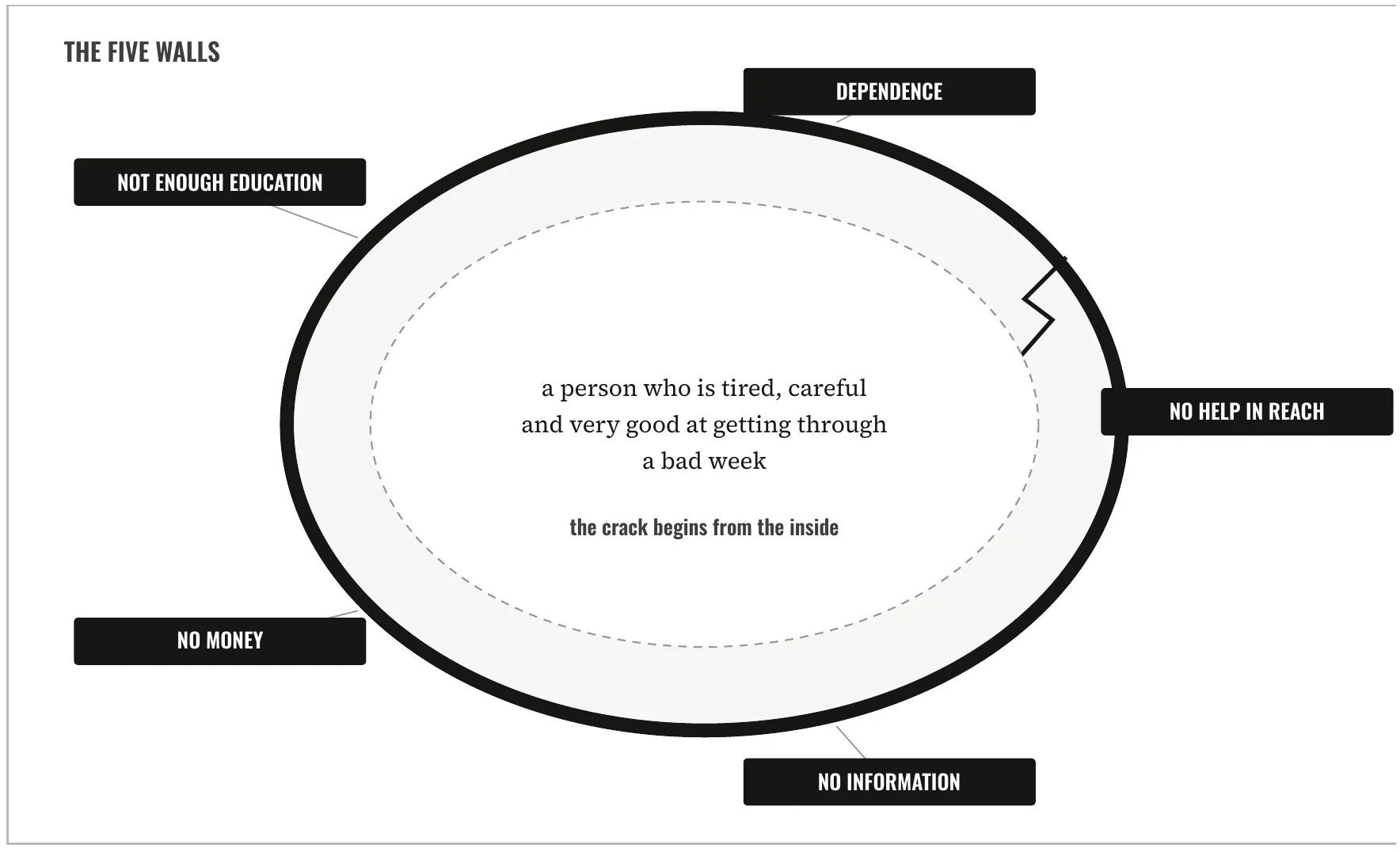
A shell is not a cage. Nobody locked you in; it grew from help that once kept you safe and from an education that ended too soon. This chapter names the five walls that make up almost every shell, and asks the one question every kind of help must answer.
Rosa, her neighbors and her street are a teaching composite. They describe no real person, and every situation they meet is a common one.
1.1 A Shell Is Not a Cage
A cage is built by someone else, and someone else holds the key. A shell is different. It grows around you a little at a time, and it grows from things that once kept you safe. A chick inside an egg is protected by its shell for exactly as long as it needs to be. After that, the same shell that protected it will kill it if it stays inside.
Millions of people live inside shells like that. Nobody locked them in. The shell grew from help that was real when it arrived, from habits that made sense at the time, and from an education that ended before it gave them what they needed to get out. From the outside, the shell can even look like a life. There is a roof, most of the time. There is food, most of the week. There is a routine. What there is not is a way forward.
This book is about breaking that shell from the inside, which is the only way a shell has ever been broken. It is written for people who are inside one, for people who are trying to help someone inside one, and for anyone who suspects that the next storm, layoff or illness could build one around them. It does not assume you have money, electricity, a car, a computer or a diploma. It assumes only that you can read these words, or that someone can read them to you, and that you are willing to begin.
1.2 Meet Rosa
Rosa is a teaching composite, not a real person, but every part of her story is common. She is thirty-four and works two part-time jobs, one cleaning offices at night and one stocking shelves on weekends. Neither job offers enough hours to count as full time, so neither offers benefits. She rents a room in a house with a leaking roof and shares a kitchen with three other tenants.
When the storm came last spring, the roof failed over her side of the house. The power went out for nine days. The bus line she depends on stopped running for two weeks because the road was flooded. She lost eleven shifts, threw away a refrigerator's worth of food, and spent most of a week finding out which office handled which kind of help. By the time the help came, she had already borrowed money to cover the rent.
Rosa is not lazy and she is not stupid. She is tired, she is careful with every dollar, and she is very good at getting through a bad week. Getting through a bad week is a real skill, and people who have never needed it tend to underestimate it. What Rosa cannot do is get ahead. Every time she gets a little room to breathe, something breaks, and the little room is gone.
When we look closely at Rosa's life, we find five walls. They are the same five walls that make up almost every shell, in every country, in every kind of disaster.
1.3 The First Wall: No Help in Reach
When something goes wrong, Rosa has nowhere to turn but the next emergency program. That help is real, and on some days it is the difference between eating and not eating. But it is built for crises, not for climbing out. It arrives after the damage, it asks her to prove again and again that she is poor enough to qualify, and it leaves before the recovery is finished.
Notice what the help does not do. It does not teach her to fix the roof, or find her a trade that pays more, or show her how to read the lease that says whose job the roof is. It does not connect her with the neighbor two houses down who is a retired electrician and would trade an afternoon of work for a week of home-cooked meals. It treats her as a person with a need, never as a person with something to offer.
The help that is in reach is the help that keeps her exactly where she is.
1.4 The Second Wall: No Information
Rosa does not know what she is entitled to, what her lease actually says, which repairs are her landlord's duty, or where to learn a skill that pays more. The information exists. It is behind a website she cannot easily read on a cracked phone with a limited data plan, in an office she cannot reach without the bus, or behind a fee she cannot pay.
Information is the cheapest form of power there is, and the one most often kept from the people who need it most. A family that knows how to purify water, how to read a weather warning, how to file for help, how to keep a small garden or how to repair a leaking pipe has a shell with cracks already in it. A family that does not know these things is at the mercy of whoever does.
In a disaster, this wall grows thicker. The power goes out, the phone dies, the internet is gone, and the only information left is what people carry in their heads and on paper. Whatever you did not learn before the storm, you will not be able to look up during it.
1.5 The Third Wall: No Money
This is not "not enough money" in the ordinary sense. It is no margin at all. Without a margin, every surprise becomes a crisis, and every crisis is paid for with something that costs more than it should.
Being poor is expensive. A person with no bank account pays a fee to cash a paycheck. A person with no savings borrows against the next paycheck, and the federal Consumer Financial Protection Bureau has reported that a typical two-week payday loan charging fifteen dollars for every hundred borrowed works out to an annual rate of almost 400 percent. A person who cannot afford a bulk bag of rice buys small bags at a higher price per pound. A person who cannot afford a car repair loses the job the car got them to.
Rosa's eleven lost shifts cost her more than eleven shifts. They cost her the loan she took to cover the rent, the fees on that loan, the food she had to replace, and the hours she spent standing in lines that a person with savings would never have had to stand in. The shell is not only made of what she lacks. It is made of what lacking it costs.
1.6 The Fourth Wall: Not Enough Education
Rosa spent twelve years in school, roughly 14,000 hours of her life. She can read a text message and a bus schedule. She cannot comfortably read a rental contract, a medical bill, the instructions on a prescription, or a page of training material for a better job. When something important arrives in writing, she asks someone else what it says, and she trusts their answer.
She is not alone, and she is not unusual. In the 2023 international survey of adult skills, 28 percent of adults in the United States scored at or below the lowest level of literacy, up from 19 percent in 2017. At that level, a person can usually read a short, simple text and find one piece of information in it. A longer document, a form with several parts, or a page that asks the reader to compare and decide is out of reach. That is more than one adult in four, in one of the richest countries in the world, after a dozen years of required school.
Think about what that means in daily life. A person who cannot read a lease cannot know whether it is fair. A person who cannot read a loan agreement cannot see the rate. A person who cannot read the instructions for a water filter, a generator or a medicine cannot use them safely when there is no one around to explain. And a person who cannot read well cannot teach themselves anything new from a book, which is the cheapest and most portable teacher ever invented.
Of the five walls, this is the one that holds up the others. Help, information and money all arrive in writing.
1.7 The Wall Nobody Talks About
Education is the wall people least like to discuss, because it points at a system almost everyone passed through and many people trust.
I believe the system was never designed to produce independent readers and thinkers for everyone. It was designed to sort people, to hold them for a set number of hours, and to release them with a diploma whether or not they could use what the diploma claims they learned. A person who cannot read a contract must trust whoever reads it for them: the landlord, the lender, the agency, the salesman. That trust is not free. Someone is always collecting on it.
You do not have to agree with me about why the system works this way to see what it produces. The numbers above are the government's own. Whatever the intent, the result is a shell, and the shell is made of words a person was never taught to read.
There is good news hidden in this wall. Reading is not a gift that some people are born with and others are not. It is a skill, and adults learn it every day, at every age, often faster than children do because they know exactly why they want it. The same twelve years that failed to teach Rosa to read a contract could not take away her ability to learn it now. Chapter 4 shows how that learning can begin without a school, a teacher, a computer or a fee.
1.8 The Fifth Wall: Dependence
The last wall is the one that holds the others in place.
When the only help that comes is help that keeps you exactly where you are, you learn to wait for it. You learn which office opens on which day, which forms to fill in, which words to use so that you qualify. You become very skilled at being helped. Waiting becomes a habit, and the habit becomes a way of seeing yourself: as a person things happen to, not a person who makes things happen.
This is the wall that does the most damage, because it convinces the person inside the shell that the shell is the world. Rosa does not believe she could fix the roof, learn a trade, start a small business or teach her neighbor's children to read. Nobody has ever asked her to. Everything in her life has told her that her job is to need, not to give.
Dependence is not a character flaw. It is a learned response to a system that rewards it. And anything learned can be unlearned.
1.9 Poverty as a Business
There is another uncomfortable truth. Some of the help that surrounds people like Rosa has become an industry in its own right. Programs, contracts, salaries and buildings depend on there being people in need. The more need there is, the more funding there is. Most of the people who work in that industry are decent, and many are heroic. But the industry as a whole has little reason to finish its work, because a finished job ends the funding.
The moneyed world has a heart of gold. So does a boiled egg.
This book does not name organizations, and it does not ask anyone to refuse help in a crisis. A person who is hungry should eat. A person whose roof has fallen in should take the tarp. What this book asks is a simpler question, one that anyone can ask of any kind of help, from any source:
Does this leave me more able to stand on my own, or less?
Help that answers "more" is a ladder. Help that answers "less" is another layer of shell. Chapter 3 turns that question into a rule you can use every day.
1.10 Why the Shell Feels Safe
If the shell is so harmful, why do people stay inside? Because from the inside, the shell feels like protection, and sometimes it is. The routine is known. The help, however limited, is reliable. Trying something new means risking what little you have, and when you have very little, every risk feels enormous.
There is also the voice that says it is too late. Rosa is thirty-four. She tells herself that learning is for children, that a trade takes years, that a business needs money she will never have. Every one of those beliefs is a part of the shell, and every one of them is false. People learn to read at sixty. People learn trades in months. People start businesses with a skill, a neighbor and an afternoon.
The shell does not have to be broken all at once. It cannot be. It breaks the way an egg breaks: one tap, then another, then a small crack, then light.
1.11 What Breaks a Shell
A chick does not wait for someone to open the egg. If someone does it for the chick, the chick is often too weak to survive. It breaks the shell itself, one small tap at a time, and the effort of breaking out is what makes it strong enough to live outside.
That is the Shellbreaker Protocol: a set of small, repeatable steps that a person can begin today, with nothing but what is already in their hands. It does not need electricity, money or a classroom to start. It is built from things Global Sovereign University already offers for free: ways to learn to read, learning that works without power or an internet connection, a way to trade skills and goods without money, and a plain-language guide to preparing for the next disaster before it arrives.
It does need two things from you: a willingness to begin, and a refusal to treat the shell as home.
The rest of this book gives you the taps. Chapter 2 starts with the first and most important one.
1.12 Your First Tap
Before you read Chapter 2, take a piece of paper and draw five boxes. Label them: help, information, money, education, dependence. In each box, write one sentence about what that wall looks like in your own life right now. If you are reading this to help someone else, fill in the boxes with them, in their words, not yours.
Do not judge what you write. Do not try to fix anything yet. Just write it down.
You cannot break a shell you cannot see. Now you can see yours.
Field Procedure 1: Draw your shell
1. Take a sheet of paper and draw five boxes.
2. Label them: help, information, money, education, dependence.
3. In each box, write one sentence about what that wall looks like in your life right now.
4. Do not judge what you write, and do not try to fix anything yet.
5. Circle the wall that is pressing hardest this month.
6. Date the page and keep it. In three months you will draw it again.
Checklist: You can see your shell when
You can name all five walls.
You know which wall is pressing hardest right now.
You can tell a ladder from another layer of shell.
You have asked of the help you receive: does it leave me more able to stand on my own?
You have stopped treating the shell as home.