TPM 2.0: Total Productive Maintenance for the Smart Factory
Digital Twins, Condition-Based Monitoring, and Risk-Based Reliability. Book 3 of Zero Breakdowns: The TPM Series.
A breakdown is not fate; it is a loss people have stopped seeing. TPM 2.0 climbs the maintenance staircase from run-to-failure to a factory of digital twins: condition monitoring, prediction, risk-based reliability and augmented reality at the machine. Ten chapters, a Deep Research section, four real case studies, two teaching cases and 14 free learning apps.
Welcome
A breakdown is not fate. It is a loss that people have stopped seeing. TPM 2.0 takes the proven discipline of Total Productive Maintenance and rebuilds it for plants where every important machine can have a living digital copy. The whole book is 170 pages: ten chapters, a Foundations section on planned maintenance, a Deep Research section summarizing ten published studies, six case studies and a dictionary. Chapter 1 is below in full.
Free learning apps for this book live on the TPM page of this website: The Twin Room (run Pump P-101 for a year under four maintenance plans), The Failure Pattern Sorter, The Warning Window and The Eight Pillars Card. No account, no cost.
Chapter 1: The Maintenance Paradigm Shift
For most of industrial history, maintenance was not a strategy so much as a consequence. Machines ran until they stopped, production adapted around the outage, and the organization absorbed the losses as an unavoidable cost of doing business. That mindset still echoes in plants that keep an unofficial inventory of “known bad actors” on the floor: the pump that seizes twice a year, the conveyor that needs coaxing to start on cold mornings, the press that “just does that sometimes.” Everyone learns the quirks, and the quirks become normalized. Yet this normalization is exactly what TPM set out to challenge with its insistence that breakdowns are not fate, but a form of waste.
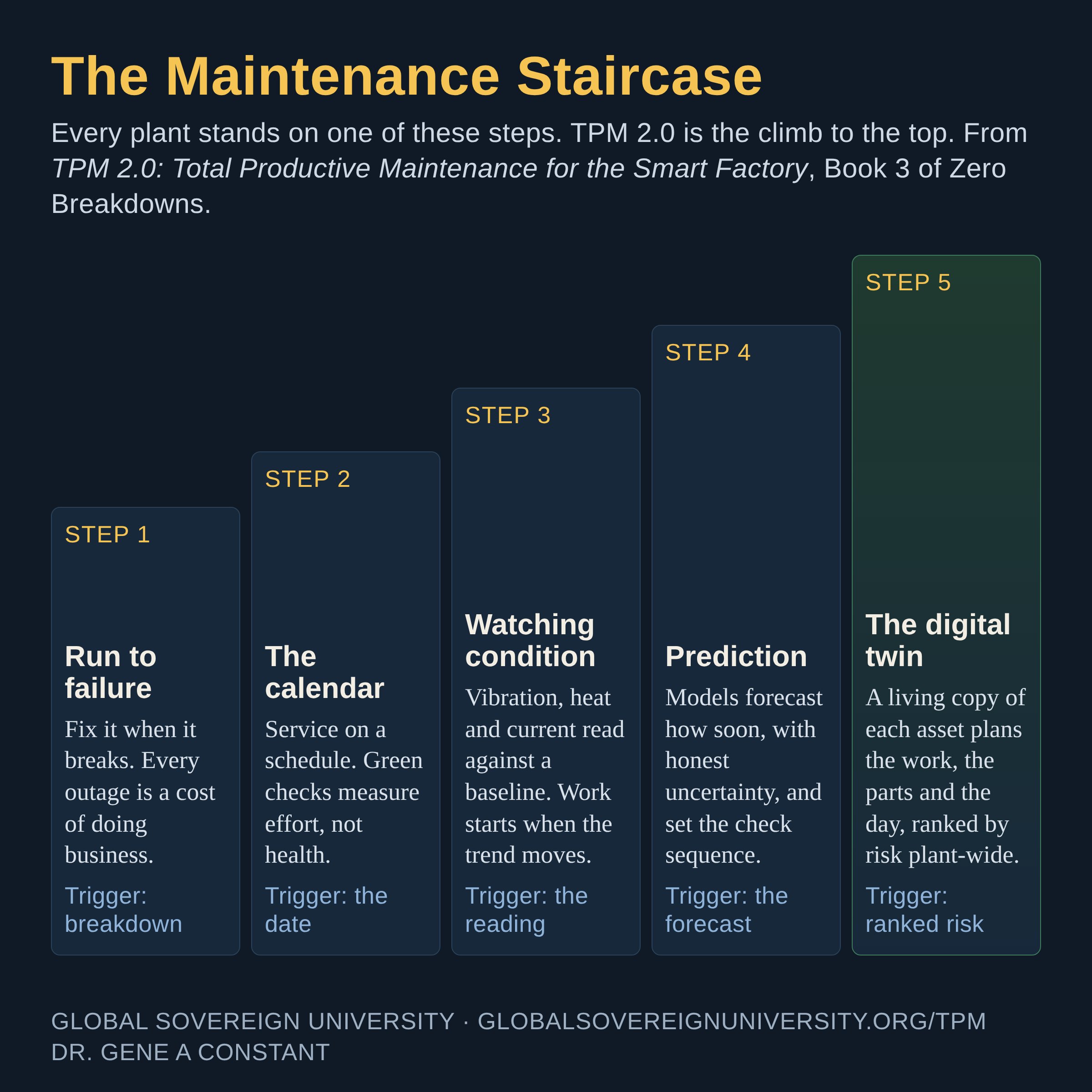
Reactive maintenance, often called run-to-failure, is maintenance 1.0 in its most honest form. The trigger is simple: failure. The signal is undeniable: the line stops, quality degrades, a safety interlock trips, or a motor burns out. The strengths of reactive maintenance are also its trap. It requires minimal planning, minimal up-front investment, and it can look efficient on a quiet month. But it hides its true cost in the ripple effects: overtime labor, expedited shipping, scrapped material, missed deliveries, and the slow erosion of confidence that operators and planners feel when equipment behaves unpredictably.
Even when the failure itself is straightforward, its consequences are rarely confined. A failed bearing is not just a bearing; it can be a bent shaft, a damaged housing, contamination that migrates downstream, heat that changes tolerances, or vibration that loosens fasteners elsewhere. In a tightly coupled production system, one unplanned stoppage becomes a cascade: upstream work-in-process piles up, downstream stations starve, and the schedule becomes a negotiation rather than a plan. This is the first reason the “maintenance is a cost center” narrative took root. Reactive work is visible as spending, while avoided losses remain invisible. TPM’s “Zero Breakdowns” goal is, in part, an attempt to make those avoided losses measurable and therefore actionable.
The move away from reactive maintenance did not begin with sensors or AI. It began with a shift in the economics of downtime. As manufacturing adopted just-in-time principles, reduced buffers, and increased automation, a single failure event became more expensive. At the same time, equipment itself grew more complex: variable frequency drives, servo systems, programmable logic controllers, and increasingly tight tolerances. Complexity raises two realities that reactive maintenance cannot negotiate with. First, failures often do not announce themselves with a clean, sudden stop. They creep in as minor speed losses, micro-stoppages, quality drift, and energy inefficiency. Second, when failure does happen, troubleshooting requires specialized knowledge and the right parts at the right time. Waiting until the line is down to start learning and sourcing is the most expensive way to operate.
Preventive maintenance emerged as the first systematic alternative, often labeled maintenance 2.0. The idea was to replace or service components on a schedule to reduce the probability of failure. It brought discipline, planning, and documentation. It also introduced the maintenance calendar as a central operating tool: weekly lubrication routes, monthly inspections, quarterly overhauls, annual shutdowns. In many plants, the introduction of a CMMS formalized this approach, turning maintenance into a managed backlog rather than a collection of emergencies. Preventive maintenance was a major step forward, and it aligned naturally with TPM’s emphasis on standardization, cleaning, inspection, and early detection of abnormalities.
But preventive maintenance carries an assumption that time is a reliable proxy for degradation. Sometimes it is. Certain consumables and wear parts have reasonably predictable lifetimes under stable conditions. Yet modern equipment rarely operates under stable conditions for long. Loads vary with product mix, environmental conditions fluctuate, operators make adjustments, and upstream variability creates transient stresses. Under these realities, calendar-based tasks can drift into two familiar traps.
The first is over-maintenance. Components are replaced while they still have useful life, introducing unnecessary cost and, more subtly, introducing risk. Every time a machine is opened, aligned, torqued, rewired, or reassembled, there is an opportunity for human error: contamination, misalignment, improper lubrication, incorrect settings, or a forgotten fastener. Preventive maintenance can paradoxically cause failures when it becomes maintenance for maintenance’s sake rather than maintenance justified by condition and risk.
The second trap is false confidence. A completed checklist can create the illusion of control even when the checklist is not tied to actual failure modes. Many organizations have lived through the painful lesson that “we did the PM” is not the same as “we reduced the risk.” A task performed on time is not automatically a task performed effectively, and a task performed effectively is not automatically the right task in the first place. This is where the maintenance conversation begins to move from activities to outcomes, from compliance to reliability.
Reliability-centered maintenance and condition monitoring were early answers to these limitations, and they helped the industry mature. Instead of asking, “What is due this week?” organizations began to ask, “How does this asset fail, what are the consequences, and what evidence would tell us that failure is approaching?” This shift reframed maintenance as a problem of signal and response. Failure modes have signatures: vibration patterns for rotating equipment, thermal anomalies for electrical connections, pressure differentials for filters, current harmonics for motors, acoustic emissions for leaks, oil particle counts for wear. When those signatures can be measured, maintenance can be triggered by condition rather than time.
Condition-based maintenance sits between preventive and predictive. The trigger is no longer a fixed calendar date, but a threshold: a vibration level exceeding baseline, a temperature rise above normal, an increase in energy consumption per unit produced. Even simple thresholds can reduce over-maintenance and catch problems earlier, but thresholding is only a beginning. It tends to be reactive in a new way: it responds to an alarm condition that may already represent late-stage degradation. It also struggles with context. A vibration spike might be a failing bearing, or it might be a transient process change, a resonance at a certain speed, a loose mounting, or a sensor fault. Without richer models and historical comparison, it is easy to generate either too many alarms, which people learn to ignore, or too few, which defeats the purpose.
Predictive maintenance changes the question again. It asks not only “Is something wrong?” but “What is likely to happen next, and when?” Prediction is fundamentally about time horizon and uncertainty. A threshold tells you that a metric crossed a line. A predictive model estimates remaining useful life, probability of failure within a window, or the expected degradation trajectory under current operating conditions. This is where maintenance becomes a planning advantage. If you can credibly say that a gearbox has a 70 percent chance of failure within the next 120 operating hours, you can coordinate parts, schedule labor, align with production plans, and choose the least disruptive intervention window. The value is not just fewer breakdowns; it is fewer surprises.
This predictive capability did not appear overnight. It required a convergence of enabling factors that, until recently, were too expensive or too fragmented to deploy widely: low-cost sensors, reliable connectivity, scalable storage, and analytics capable of learning from noisy industrial data. It also required a cultural shift in the way maintenance and operations share information. In reactive environments, the relationship is often transactional: operations reports a problem, maintenance fixes it. In predictive environments, the relationship becomes collaborative: operations provides context about how equipment is run, maintenance provides insight into how equipment is degrading, and both agree on interventions that protect throughput and quality.
The evolution from reactive to predictive is therefore not merely a technology upgrade. It is a maturity journey in decision-making. Reactive maintenance decides after failure. Preventive maintenance decides before failure, but often without proof that the decision matches the asset’s actual condition. Condition-based maintenance decides when evidence crosses a threshold. Predictive maintenance decides based on modeled futures, with quantified uncertainty and trade-offs. That last phrase matters. Real manufacturing decisions are rarely binary. You might accept elevated risk for a short time to meet a customer deadline, then intervene during a planned changeover. Or you might intervene earlier than necessary if the consequences of failure are severe, such as safety risk, environmental release, or major downstream damage. Prediction becomes useful when it can be paired with consequence, and consequence forces us to think in terms of risk, not just wear.
This progression also reveals why TPM remains relevant rather than obsolete. TPM’s original discipline was aimed at making equipment behavior visible and controllable through operator involvement, standard work, and relentless elimination of losses. Predictive maintenance does not replace that discipline; it amplifies it. A sensor can detect abnormal vibration, but an operator trained to recognize early signs, keep equipment clean, and report abnormalities provides context that no data stream captures on its own. Conversely, analytics can validate whether a recurring issue is truly resolved or merely temporarily masked. The “Zero Breakdowns” objective becomes less aspirational when prediction turns unknown failure into managed risk and when autonomous maintenance practices keep the asset within the operating envelope the model assumes.
This is the point where the story naturally extends beyond predictive maintenance as a set of tools and into the idea of a living model. Predictive methods need memory: baselines, histories, operating contexts, interventions, outcomes. They need a way to connect what the asset is, how it is used, how it has changed over time, and what those changes mean for future behavior. In other words, they need a coherent representation of the asset across its lifecycle, not a scattered collection of sensor dashboards and work orders. The next step in the evolution is not simply better prediction, but a tighter connection between the physical machine and its virtual understanding, so that every cycle, alarm, adjustment, and repair updates the model and sharpens the next decision. That is where the maintenance paradigm shift becomes irreversible, and where TPM begins to transform into TPM 2.0.
The phrase “digital twin” is often used casually, as if it were simply a 3D model of a machine or a dashboard that shows sensor values. In maintenance, that casual definition is not just incomplete; it is misleading. A digital twin, in the TPM 2.0 sense, is not a picture of an asset. It is the asset’s living model, a virtual counterpart that changes when the physical asset changes, learns when the asset behaves differently, and retains memory when people come and go. If predictive maintenance is about modeled futures, the digital twin is the environment in which those futures can be modeled consistently, because it holds the asset’s identity, context, and history together in one coherent representation.
To see why this matters, consider the way many plants have tried to modernize reliability. They add vibration sensors on the “known bad actors” from the reactive era, stand up a condition monitoring dashboard, and integrate alarms into email or a control room screen. The result can be helpful, but it often remains fragmented. The vibration system knows about vibration. The CMMS knows about work orders. The PLC knows about cycle counts. The quality system knows about defects. Operations knows about the “cold morning” startup quirk that never made it into documentation. When a failure happens, the investigation pulls evidence from multiple places, sometimes days later, and the conclusions are shaped as much by what can be found as by what actually occurred.
A digital twin is a deliberate attempt to end that fragmentation. It becomes the asset’s single narrative, not in the sense that it replaces every system, but in the sense that it links them into a living, traceable story. The twin knows what the machine is: its bill of materials, configuration, control logic version, critical tolerances, lubrication specifications, and operating envelope. It knows how the machine is being used: speeds, loads, product recipes, start-stop patterns, environmental conditions, and operator adjustments. It knows what has happened to the machine: repairs, part replacements, alignments, balancing, modifications, parameter changes, and the outcomes of those interventions. And crucially, it knows what the machine’s condition signals mean in context, because it can compare today’s telemetry not only to a generic threshold, but to this specific asset’s baseline, its age, its duty cycle, and its recent history.
This is why the digital twin is best understood as a living model rather than a static artifact. A static model is like a photograph: useful for reference, but blind to time. A living model is like a medical record combined with a real-time monitor. It is not satisfied with the fact that a bearing temperature is 72 degrees; it wants to know whether 72 is normal for this bearing under this load, at this ambient temperature, after this lubrication event, with this alignment condition, and with this production mix. A living model turns numbers into meaning, and meaning into decisions.
In practice, the term “digital twin” spans a range of maturity levels, and it helps to separate what it is from what it is not. Many organizations begin with what could be called a digital representation: a structured set of asset information, perhaps with a 3D view, a tag list, and links to manuals and spare parts. This already brings value because it reduces the time wasted searching for documentation and tribal knowledge. The next step is often a digital shadow: the physical asset streams data into a digital environment, but the relationship is mostly one-way. You can observe the asset, trend it, and set alarms, but the digital side does not actively model behavior or feed decisions back into operations. A true twin closes the loop. It does not just receive telemetry; it maintains a dynamic state, runs models that interpret and forecast behavior, and can recommend or even trigger actions within agreed boundaries. The difference is not philosophical. It is operational. A digital shadow tells you what happened. A digital twin helps decide what to do next.
That decision-making capability depends on synchronization. A twin is only “alive” when it stays synchronized with the asset’s current reality, not last month’s configuration or last year’s baseline. This is where many predictive maintenance efforts quietly fail: the model is trained on old conditions, then the asset is modified, a different supplier’s part is installed, a motor is rewound, a gearbox ratio changes, a recipe pushes higher torque, and the analytics start drifting. People lose trust because the system appears to “cry wolf” or miss obvious issues. The solution is not merely to retrain models occasionally; the solution is to make change itself a first-class citizen in the asset’s digital identity. Every significant change to the physical machine must become a change event in the twin, with traceability: what changed, when, why, by whom, and what verification was performed. In TPM language, this is the digital extension of restoring and sustaining basic conditions. The twin makes “basic conditions” explicit, measurable, and auditable over time.
A living model also requires a language for “state.” Maintenance decisions are rarely based on a single variable. They depend on operating state (running, idling, starting, stopping), process state (which product is being made, what recipe parameters are active), and health state (normal, degraded, at-risk, critical). A digital twin organizes telemetry around these states so comparisons are meaningful. A vibration level that is normal at full speed might be abnormal during coast-down. A current spike that is acceptable during startup might be a sign of mechanical binding during steady-state. Without state awareness, analytics become noisy and thresholds become either too permissive or too sensitive. With state awareness, the twin can ask better questions: Is this anomaly persistent across comparable operating states? Does it correlate with a specific product recipe? Did it appear after a particular work order closure? Did energy per unit change at the same time quality drift began?
This is where the earlier discussion about “modeled futures with quantified uncertainty” becomes tangible. A digital twin can hold multiple models at once, each suited to a different decision. It might include a physics-based model that estimates expected temperatures given load and ambient conditions. It might include a statistical baseline model that learns normal behavior patterns for this specific asset. It might include a machine learning model that estimates remaining useful life for a bearing using vibration spectra, oil debris counts, and runtime. It might include a rules-based layer that encodes known failure modes and the tasks that mitigate them. None of these models alone is the twin. The twin is the container that keeps them aligned to the same asset identity, the same timeline, and the same maintenance reality.
Memory is the feature that makes this container so powerful for TPM. In traditional environments, the plant’s memory lives in individuals and in scattered notes. That is why “we fixed that last year” can mean anything from “we replaced the part” to “we tightened it and hoped.” A digital twin preserves institutional memory at the granularity that reliability work actually needs. If a gearbox has been replaced three times, the twin can show whether the replacements were identical or whether the ratio, supplier, lubrication type, or installation method changed. If an operator reports that the conveyor “needs coaxing” on cold mornings, that observation can be logged as a contextual symptom and correlated with temperature and motor current. Over time, the twin can help determine whether the symptom is harmless variability, a lubrication viscosity issue, a failing capacitor, or a mechanical alignment problem made worse by thermal contraction. The goal is not to replace human judgment. It is to keep human judgment from being reset to zero when the shift changes or when a veteran technician retires.
The “living” aspect also means the twin is not confined to maintenance. It dissolves the boundary between operations and maintenance that reactive environments tend to reinforce. When operations adjusts a parameter to meet throughput, the twin records the new operating regime and evaluates its impact on degradation rate and risk. When maintenance performs an intervention, the twin records the new baseline and verifies whether the intervention actually restored expected behavior. This is how the “Zero Breakdowns” objective becomes less about heroic response and more about controlled system behavior. Breakdowns thrive in gaps: gaps between what was done and what was recorded, between what is happening and what is understood, between what is optimized locally and what is sustainable globally. A digital twin is an attempt to close those gaps with continuity.
It is important, however, not to romanticize the twin as a perfect mirror. A twin is a model, and all models are approximations. Sensors drift. Signals are noisy. Context is incomplete. Some failure modes remain stubbornly hard to predict, especially those driven by rare events or human error. The twin’s value comes not from claiming certainty, but from making uncertainty explicit and manageable. Instead of saying “this bearing is fine” or “this bearing will fail,” a twin-supported decision might say: given current load, temperature, and vibration trends, the probability of failure within the next two weeks is rising; the risk is elevated because this asset is a bottleneck; the best window for intervention is the planned changeover on Thursday; the recommended action is to inspect alignment, sample oil, and prepare a replacement kit if inspection confirms early-stage spalling. That is a different kind of conversation than “we did the PM” or “it failed again.” It is a conversation that joins evidence, probability, consequence, and timing.
In that sense, the digital twin is not just a technology object. It is a new discipline of keeping the asset’s story coherent. It is the practical mechanism by which predictive maintenance becomes plan-able and by which TPM becomes scalable without losing rigor. But coherence requires connection, and connection requires a thread that ties the asset’s story from its earliest decisions to its final days. A living model needs more than real-time telemetry; it needs lineage. That is where the digital twin naturally extends into the idea of the digital thread: the continuous chain of data and decisions that links commissioning to operation, operation to maintenance, maintenance to improvement, and improvement back to design and procurement. Without that thread, the twin risks becoming just another system that knows some things, while the organization continues to forget the rest.
A living model needs lineage. That lineage is what the industry increasingly calls the digital thread: the continuous chain of data, decisions, and changes that ties an asset’s story together from its earliest specification to its retirement. If the digital twin is the asset’s current, evolving model, the digital thread is the reason that model can stay coherent over years of production pressure, staffing changes, supplier substitutions, and improvement projects. It is the difference between knowing what the machine is doing right now and knowing why it behaves the way it does.
In many plants, equipment information is technically “available” but practically unreachable. A drawing lives in an engineering folder that no one opens. A PLC program revision sits on a laptop that left with a contractor. The lubrication change that solved last winter’s startup issue was discussed in a meeting but never updated in the standard. The maintenance crew knows the gearbox was replaced three times, but the CMMS only shows three work orders with vague notes: “replaced gearbox.” Procurement knows the last replacement came from a different supplier because the original lead time exploded, but that knowledge never makes it into reliability analysis. When the conveyor needs coaxing on cold mornings again, the organization responds as if it is the first time. The plant has data, but it does not have continuity.
TPM was designed to fight this kind of organizational amnesia. Its routines, cleaning standards, abnormality tagging, and operator involvement create a culture where problems are surfaced early and causes are pursued rather than tolerated. But TPM’s original tools were largely physical and local: a tag on a leak, a checklist at a machine, a whiteboard for downtime causes, a binder of standards. Those tools are powerful, yet they struggle to scale when equipment fleets grow, product mixes change faster, and technology turns assets into complex combinations of mechanics, electronics, and software. The digital thread is the mechanism by which TPM’s discipline becomes durable in a world where “basic conditions” include firmware versions, parameter sets, sensor calibrations, and cyber-physical interactions.
At its core, the digital thread answers four questions continuously: What is this asset? How is it supposed to operate? What has changed? What happened as a result? It is tempting to treat these as documentation questions, but in TPM 2.0 they are operational questions because they determine whether analytics can be trusted and whether decisions can be defended. When a predictive model drifts, the cause is often not the algorithm. It is a broken thread: the asset changed, but the model never found out. A motor was rewound, the torque curve shifted, current signatures changed, and alarms began to misfire. A different bearing clearance class was installed, and the vibration baseline moved. A recipe pushed higher loads, and temperature thresholds that once indicated danger became normal, or worse, normal temperatures began to hide danger because the real issue was increased load and reduced margin. Without change traceability, the digital twin becomes a snapshot that slowly diverges from reality.
The thread begins earlier than most maintenance teams are invited into the conversation. It begins in design and procurement, where the DNA of reliability is quietly set. What duty cycle is assumed? What environment is expected? What tolerances are specified? What sensors are built in, if any? What is the vendor’s recommended lubrication, and does it align with the plant’s existing lubrication strategy? What spares are truly critical, and what is the supplier lead time in real terms, not brochure promises? Traditional organizations treat these as capital project details that fade into the background once commissioning is complete. A digital thread treats them as foundational context that stays attached to the asset for life.
Commissioning is the first major opportunity to either anchor the thread or break it. When equipment is installed, alignments are set, baselines are measured, control logic is tuned, and initial operator habits form. If those baseline values remain trapped in a startup report PDF, the plant loses the reference point it will later need to judge drift. TPM language calls this “initial cleaning” and “restoring basic conditions,” but the digital thread makes those conditions explicit and retrievable. It stores the “as commissioned” state: vibration signatures at known loads, thermal images of electrical panels under normal current, motor current waveforms during startup, pressure and flow curves, cycle time distributions, and the initial parameter sets in the PLC, drive, and HMI. This is not bureaucracy. It is the origin story of the machine’s normal.
From there, the thread must survive the messy reality of production. Machines do not age politely. They are adjusted, pushed, idled, restarted, and occasionally improvised upon. Operators find workarounds. Maintenance fixes what is urgent. Engineering implements changes to meet a new product requirement. Each of these actions may be rational in isolation, yet together they can create the exact fragmentation described earlier: the vibration system knows one story, the CMMS another, and the tribal memory a third. The digital thread’s job is to make every meaningful event in the asset’s life linkable on a shared timeline so cause and effect can be studied rather than guessed.
That means the thread must connect systems that were never designed to speak the same language. Telemetry comes from PLCs, historians, SCADA, and edge devices. Work execution comes from the CMMS and technician notes. Quality outcomes come from inspection systems, SPC databases, and scrap reports. Inventory reality comes from ERP. Even the “cold morning” startup quirk, once only a comment exchanged between shifts, becomes valuable when captured as an observable symptom tied to ambient temperature, oil viscosity, motor current, and time-to-speed. When these sources remain separate, investigations become archaeology. When they are threaded, investigations become analysis.
Consider a common scenario: a gearbox failure on a conveyor that is a known bad actor. In a reactive environment, the timeline starts at failure, and the story is reconstructed backward under pressure. In a threaded environment, the timeline is already assembled. The thread shows that six weeks earlier, vibration on the drive-end bearing began trending upward only during certain recipes. Two weeks later, energy per unit rose slightly. A week after that, a work order was closed for “lubricated gearbox,” and the lubricant type entered did not match the standard. Three days later, the conveyor started requiring coaxing on cold mornings again, and operators began using repeated starts to get it moving. Those repeated starts show up as increased inrush events in the motor current signature. Finally, a tooth spalled and the gearbox failed catastrophically. The point is not that the thread magically prevents failure. The point is that it makes the path to failure legible early enough to intervene and, just as importantly, makes the learning undeniable afterward. The next decision is no longer “replace gearbox again.” It becomes “restore the correct lubricant, retrain lubrication practice, adjust recipe transition ramp to reduce shock load, and update the twin’s expected current signature accordingly.” TPM’s improvement loop becomes sharper because the evidence is threaded.
A useful way to understand the digital thread is to distinguish it from mere data integration. Integration is about moving data. A thread is about preserving meaning. Meaning depends on identity, configuration, and context. Identity means the plant can say, with no ambiguity, which physical asset produced which data stream and which work orders. Configuration means the plant knows which version of hardware, firmware, and parameters were active when the data was generated. Context means the plant knows the operating state: running, starting, stopping, idle; which product and recipe; what load; what environment. A vibration value without identity, configuration, and context is just a number. With the thread, it is a piece of the asset’s story that can be compared fairly across time.
This is also why the digital thread is inseparable from change management. Earlier we noted that many predictive efforts fail quietly when models are trained on old conditions and the asset evolves. The digital thread is the corrective mechanism because it treats change events as first-class data. When maintenance installs a different supplier’s bearing, the thread records not only that a bearing was replaced, but which bearing, with what clearance, what installation method, what torque values, what alignment readings, and what verification tests were done. When engineering changes a drive parameter to smooth acceleration, the thread records the parameter delta, the reason, the approval, and the date. When operations introduces a new recipe that increases peak torque, the thread records the new operating regime and tags it to telemetry. The twin can then adjust baselines, retrain models with the right segmentation, and avoid the “cry wolf” effect that destroys trust.
Trust is the hidden currency of TPM 2.0. A digital twin that cannot explain itself becomes another dashboard people ignore. A digital thread helps the twin explain itself because it can point to lineage: “This anomaly is significant because it appeared after the motor rewind on March 12,” or “This temperature rise is expected because the new recipe increased load by 15 percent,” or “The model confidence is lower because the sensor was recalibrated yesterday and baseline is still stabilizing.” This kind of explanation changes how teams work. Instead of debating whether the system is wrong, they debate what action is justified by risk and consequence, which is exactly the mature decision-making TPM has always tried to cultivate.
The thread also extends beyond a single plant. When the same asset type exists across multiple lines or facilities, a threaded approach allows learning to propagate. If one site discovers that a certain coupling supplier produces better alignment stability, that evidence can be linked to reduced vibration trends and fewer micro-stoppages. If a design weakness is found, the thread can carry that insight back to procurement specifications, standard spare parts lists, and future capital projects. The equipment lifecycle becomes a closed learning loop rather than a repeating cycle of rediscovery. In other words, the digital thread turns “we fixed that last year” into “we fixed that, here is exactly what changed, here is the verification data, here is the impact on downtime and quality, and here is how the standard was updated so it stays fixed.”
None of this requires pretending that reality will become tidy. People will still write imperfect notes, sensors will still fail, and production pressure will still demand compromises. The digital thread is not a promise of perfection. It is a discipline of continuity: a commitment that the asset’s story will not be allowed to fragment beyond repair. It is the infrastructure that lets a digital twin remain living instead of slowly becoming historical fiction. And it is the practical way TPM’s foundational idea, that breakdowns are waste and therefore removable, can be pursued across an equipment lifecycle that now includes software updates, data models, and cyber-physical feedback loops.
Once the digital thread is in place, the shift described earlier becomes irreversible. Maintenance decisions no longer begin with “what is due” or end with “what broke.” They begin with “what is changing” and end with “what did we learn.” That is the mindset shift that turns maintenance from a cost center into a value driver, not because the language changed, but because the organization can finally see, with continuity, how daily actions accumulate into reliability or into risk. The next chapters build on this foundation by showing how that continuity is achieved technically, through sensors, edge computing, and cloud infrastructure, and operationally, through the way telemetry becomes trustworthy enough to support real-time health scoring and condition-based action.