TQMain Duo-Core Model: Total Quality Maintenance from the Boardroom to the Shop Floor
A machine does not have to break to make bad product. It only has to drift. Book 8 of Zero Breakdowns: The TPM Series.
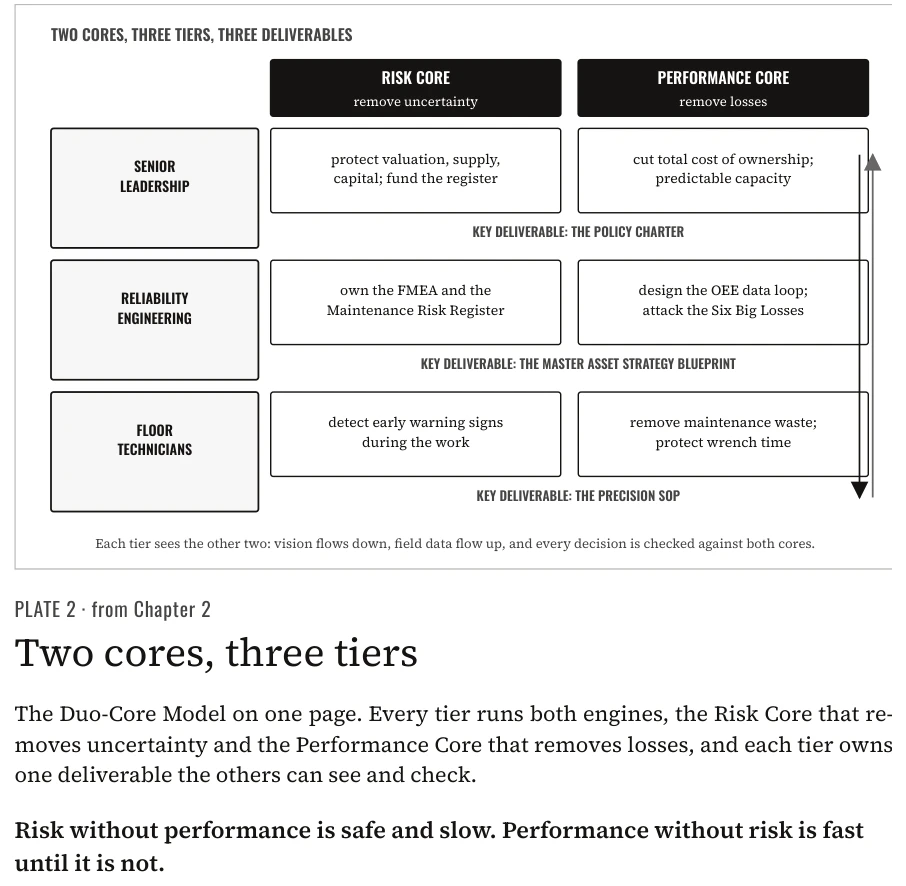
TQMain treats the condition of the equipment as the first cause of product quality, and maintenance as the work of holding that condition inside its limits. The Duo-Core Model runs two engines at once, a Risk Core and a Performance Core, across three tiers: senior leadership, reliability engineering and floor technicians. Nine chapters in three parts cover the one-page charter, the FMEA and risk register, OEE worked by hand, Cp and Cpk, the four-part Precision SOP and wrench time. With three real cases, a 47-term dictionary and the free SOP Bench tool.
Chapter 1: Maintenance Is a Quality Decision
A machine that runs but cannot hold its tolerances is not up; it is making defects at full speed. This chapter joins the quality scoreboard and the maintenance scoreboard, shows where defects really come from, and introduces the three tiers that run Total Quality Maintenance.
1.1 Two Departments, One Product
In most plants, quality and maintenance live in different buildings, report to different managers and keep different scoreboards. Quality counts defects, complaints and returns. Maintenance counts work orders, hours and spare parts. When a batch of product fails inspection, quality writes a nonconformance report and looks for a process cause. When a machine stops, maintenance writes a work order and looks for a broken part. The two reports rarely meet.
Total Quality Maintenance starts from a plain observation: they were always describing the same thing. A sealing jaw that runs eight degrees cooler than it should does not break. It keeps running. It just makes weak seals, and some of those weak seals leak in a customer's pantry three weeks later. A worn bearing does not stop a filler. It lets the filler head wobble, and the fill weights spread wider until some packages are short. The machine is still "available." The product is not good.
A machine that runs but cannot hold its tolerances is not up. It is making defects at full speed.
TQMain, the short name this book uses, joins the two scoreboards. It treats the condition of the equipment as the first cause of product quality, and it treats maintenance as the work that keeps that condition inside its limits. The idea has a research history. The engineer Basim Al-Najjar described Total Quality Maintenance in 1996 as an approach that uses the condition of the machine to reduce the cost of quality continuously, and that work is summarized in the Deep Research section of this book.
What this book adds is a way to run it: the Duo-Core Model, built so that a boardroom, an engineering desk and a shop floor can all work from the same page.
What the old split costs
When maintenance is judged only on keeping machines running, three things happen. First, small drifts in condition are ignored because they do not stop production. Second, quality problems are investigated as process problems, so the fix is a new inspection step instead of a restored machine. Third, the budget conversation goes badly: maintenance asks for money to prevent failures nobody has seen, while quality spends money sorting and reworking product that a better-kept machine would never have made.
None of this is anyone's fault. It is what the scoreboards reward. Change the scoreboard and the behavior follows.
1.2 Maintenance Is Asset Preservation
The phrase in the TQMain Charter that does the most work is short: maintenance is not a repair expense; it is a quality preservation capability. That sentence changes what maintenance is for.
A repair expense is something you try to minimize. You spend as little as you can, as late as you can, and you call the result efficiency. A preservation capability is something you invest in, the way a museum invests in climate control. Nobody at a museum asks how cheaply the paintings can be allowed to crack. They ask what conditions the paintings need and they hold those conditions every day.
Equipment is the same. Every machine that touches the product has conditions it needs: a temperature window, a pressure range, an alignment tolerance, a lubrication state, a clean surface. While those conditions hold, the machine makes good product. When they drift, it starts making product that is a little worse, then worse again, long before anything breaks. Preservation means holding the conditions, not waiting for the break.
Three questions that replace "is it running?"
The old daily question in most maintenance meetings is whether everything is running. TQMain replaces it with three:
- Is each critical machine inside its condition limits right now, and how do we know?
- Which machines are drifting toward a limit, and how much time do we have before product is affected?
- Which defects this week can be traced back to a machine condition, and which condition was it?
The first question needs measurement. The second needs trend data and an understanding of how each machine fails. The third needs quality and maintenance to share one record. The rest of this book builds the tools for all three.
1.3 Where Defects Really Come From
Ask a production team where defects come from and you will hear about materials, operators and recipes. Those matter. But in most mature processes the recipe has been settled for years, the materials come from approved suppliers, and the operators have done the job a thousand times. What changes from week to week is the condition of the equipment.
Think about a pouch sealer, the machine at the center of this book's worked examples. It has three settings that decide whether a seal is good: the temperature of the sealing jaws, the pressure they close with, and the dwell time they stay closed. Each setting has a window. Too cool, too light or too short, and the seal is weak. Too hot, too hard or too long, and the film burns or wrinkles. The recipe sets each value in the middle of its window.
But the machine does not hold the setting perfectly. A heater element ages and the jaw temperature wanders. An air regulator wears and the pressure swings. A worn cam lets the dwell time vary from cycle to cycle. Each of those is a maintenance condition. None of them stops the machine. All of them make defects.
The recipe says what the machine should do. The condition of the machine decides what it actually does.
Spread and centering
Two things go wrong with a condition, and they need different fixes. The first is spread: the value wanders more widely than it used to, so more cycles fall outside the window. Spread usually comes from wear, looseness or contamination, and it is fixed by restoring the machine. The second is centering: the value has drifted to one side of its window, so even a small wander pushes it over the edge. Centering usually comes from a setting, a calibration or a sensor that has drifted, and it is fixed by adjustment and calibration. Chapter 6 gives each of these a number. For now it is enough to see that both are maintenance problems that show up as quality problems.
1.4 The Cost of Quality, Seen from the Machine
Quality professionals sort the cost of quality into four buckets. Prevention costs are what you spend so defects never happen: training, design reviews, maintenance planning. Appraisal costs are what you spend checking: inspection, testing, audits. Internal failure costs are defects caught before the customer sees them: scrap, rework, sorting, downtime. External failure costs are defects the customer finds: returns, complaints, recalls, lost accounts.
The pattern found again and again is that prevention is the cheapest bucket and external failure the most expensive by far. A dollar spent holding a machine's conditions saves many dollars of sorting, and many more of recalls.
TQMain puts maintenance where it belongs: in the prevention bucket. That is not a slogan. It changes the budget conversation from "maintenance costs too much" to "this is the cheapest quality money we spend." Chapter 3 shows how leaders write that into policy, and Chapter 9 shows how they check that the money actually went where the risk was.
The hidden factory
Every plant has a second, hidden factory that nobody planned. It sorts suspect product, reruns batches, adjusts machines that will not hold, waits for parts and explains to customers what went wrong. It has its own staff, its own overtime and its own floor space, and it does not appear on any organization chart. Much of the hidden factory exists because equipment conditions drift. TQMain's promise is that as conditions are held, the hidden factory shrinks, and its people go back to making good product.
1.5 The Riverside Plant
The worked examples in this book follow one plant and one line, so that each chapter builds on the last. Riverside is a mid-size food packaging plant. Line 4 fills and seals flexible pouches of soup and broth. Its heart is the pouch sealer. Upstream is a filler fed by a transfer pump, asset PMP-402. Downstream is a checkweigher and a case packer.
Five people carry the examples. Grace is the plant manager, and she owns the TQMain Charter. Omar is the reliability engineer; he keeps the risk register and the numbers. Tess is the lead maintenance technician on Line 4. Luis is the line operator on the day shift. Nadia runs quality for the plant. All five are teaching composites. They describe no real company or person, but every situation they meet is drawn from the kind of work real plants do every day.
Line 4 at the start
When the story opens, Line 4 looks fine on paper. It is available about nine hours in ten. Maintenance closes its work orders on time. But Nadia's records show a seal-failure rate that creeps up through every month and drops back each time Tess replaces the jaw heaters, and the plant is spending more each quarter on customer credits for leaking pouches. Nobody has connected the two charts. That connection is where TQMain begins.
1.6 The Three Tiers
TQMain is not a program for the maintenance department. It is a way for the whole organization to work, and it divides that work into three tiers, each with its own job.
- Senior leadership sets the vision and funds it. Leaders decide that equipment condition is a quality matter, sign the policy that says so, approve the tolerance limits the plant will hold, and put money where the risk is.
- Reliability engineering designs the system. Engineers turn the vision into numbers: which machines matter most, how each one fails, what its limits are, and how the data will show drift before it becomes a defect.
- Floor technicians execute with precision. Technicians and operators do the work to exact limits, catch early warning signs during the work, and report anything outside its limits the same shift.
Each tier depends on the other two. Leaders who fund nothing get a policy on a wall. Engineers without field data build registers of guesses. Technicians without clear limits and support do their best and get blamed. The Duo-Core Model, which Chapter 2 introduces, is how the three tiers stay connected, and the matrix in Chapter 9 is how each tier checks the other two.
What this book asks of each reader
If you lead, read Part One closely, then read the first section of every later chapter to see what your decisions set in motion. If you engineer, read the whole book, because your work sits between the other two. If you work on the floor, start with Part Three and the field cards at the back, then come back to Part One to see why the plant is asking you to work this way. Everyone should do the field procedure and the free tool at the end of each chapter. They are how the ideas become habits.
Worked example: Two charts nobody had put together
Nadia keeps a chart of seal failures on Line 4. Tess keeps a log of jaw heater changes. For a year the two never met. When Omar laid one over the other, the pattern was plain: seal failures climbed for three to five weeks before every heater change, then dropped back the day after. The heaters were not failing suddenly. They were aging, letting jaw temperature wander low, and making weak seals the whole time they were "running fine." The leaking pouches customers returned were a maintenance problem that had been investigated as a quality problem for a year.
Field Procedure 1 · Lay the two charts side by side
- Pick one machine whose product defects you track.
- Get twelve months of its defect counts from quality, by week.
- Get twelve months of its maintenance history: breakdowns, part changes, adjustments and calibrations, by date.
- Put both on one time line, defects as a line and maintenance events as marks.
- Look for defects that climb before a maintenance event and fall after it. Each one is a condition that drifted while the machine kept running.
- Write down the condition, how long it drifted before anyone acted, and what it cost in defects.
Checklist · The quality and maintenance split is closing when
- Quality and maintenance records for critical machines can be read on one time line
- Defects are traced to machine conditions, not only to materials and people
- The morning meeting asks whether machines are inside their limits, not only whether they are running
- Maintenance spending is discussed as prevention cost, not repair expense
- Each of the three tiers can say what its own part in TQMain is
Your Move This Week
Choose one defect your plant fights every month and ask the maintenance team one question about it: which condition on which machine would make this defect more likely? Write their answer down. It is the first line of your TQMain record.