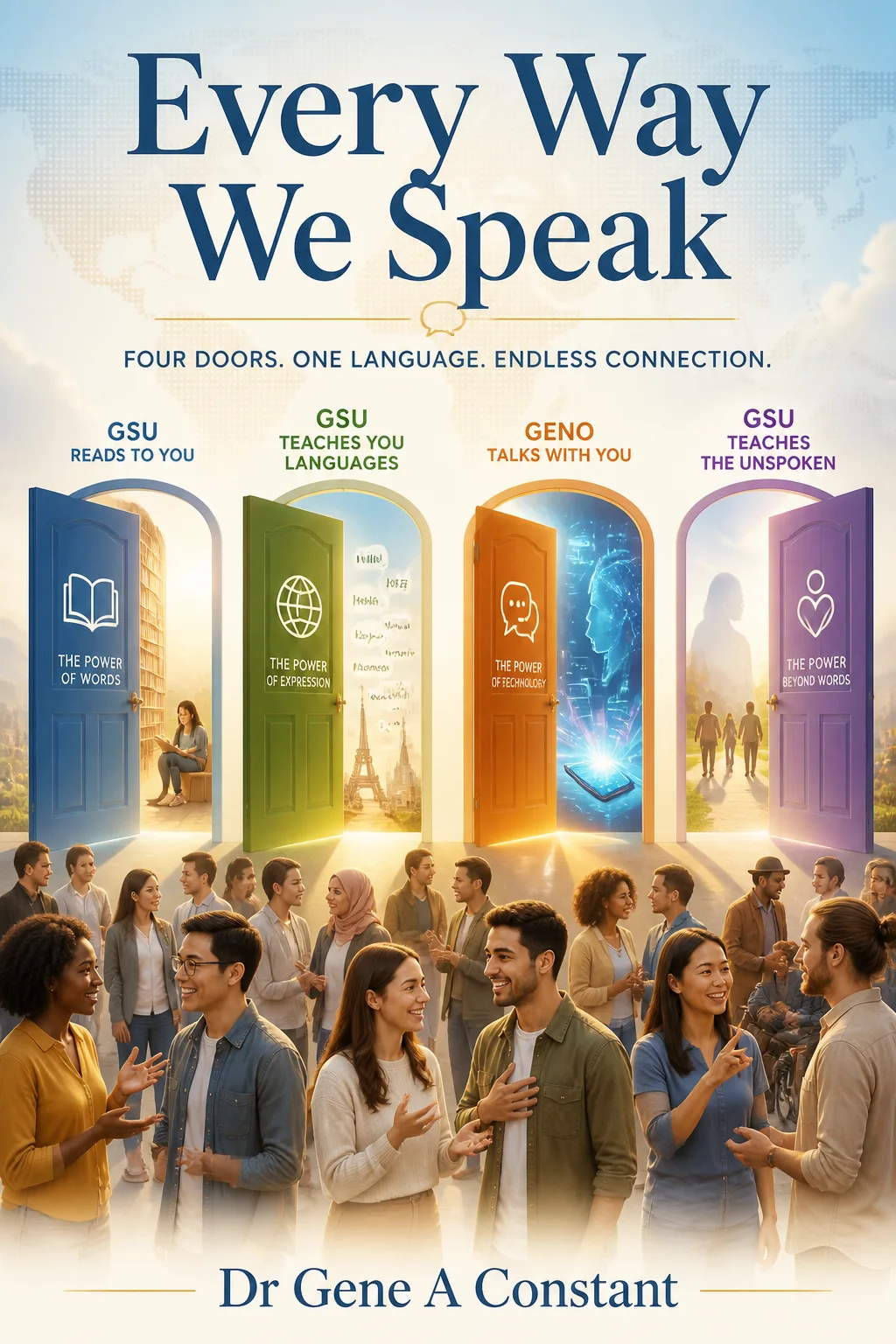
Every Way We Speak
Four Doors. One Language. Endless Connection.
Communication is one connected system, and this book opens it through four doors: GSU reads to you, GSU teaches you languages, GENO talks with you, and GSU teaches the unspoken. It maps the Ten Channels of Human Communication, from words and tone to space, time and silence, then closes with debate, critical thinking and leadership. A free twelve-lesson class teaches it chapter by chapter.
From Chapter 1: GSU Reads to You
Before we ask a learner to speak with confidence, spell accurately, write clearly, or enter a conversation in a new language, we begin with a more basic human ability: listening. Listening is not passive. It is the first laboratory of communication. Long before most people learn to read a page, they learn the world through sound: a caregiver’s voice, a warning, a story, a name repeated with affection, the rhythm of a song, and the rise and fall of a question. The ear receives language before the hand can write it or the mouth can reproduce it.
This is why the first door of the GSU communication ecosystem is simple and powerful: GSU reads to you.
To be read to is not childish, remedial, or secondary to “real” learning. It is a direct route into the living structure of language. When text is heard aloud, marks on a page become movement. A comma becomes a brief breath. A period becomes a completed thought. A question mark lifts the voice and invites an answer. A paragraph becomes more than a block of letters; it becomes a sequence of ideas with shape, pacing, and emotional direction.
For a learner who has struggled with reading, this transformation can be profound. Printed words may appear fixed, crowded, or unfamiliar. A person may recognize some letters but not know how they join into sounds. They may know a word when they hear it but fail to recognize it when they see it written. They may have avoided forms, books, instructions, emails, and public situations where reading is expected. Over time, that avoidance can become shame.
GSU rejects that shame completely.
Literacy is not a measure of intelligence, worth, ambition, or potential. It is a set of learnable mechanical and cognitive skills. Like any skill, it becomes stronger through patient practice, useful tools, and repetition that respects the learner rather than humiliates them. The Adult Literacy Lab begins from that conviction. No adult should be made to feel late to their own education. No learner should have to pretend they understand text when they do not. And no one should be excluded from clear communication because traditional systems failed to teach in a way that matched how they learn.
Listening creates a bridge between the language a learner already carries internally and the language represented on the page. Many adults who say, “I cannot read,” are not without language. They have rich experiences, detailed memories, opinions, humor, practical knowledge, and spoken vocabulary. They may explain a problem at work with precision, tell a story that holds a room’s attention, or understand complicated instructions when someone speaks them aloud. The gap is often not a lack of thought. The gap is the connection between visual symbols and spoken sound.
When GSU reads text aloud, the learner can follow that connection in real time. They see the word and hear it at once. They begin to recognize that the unfamiliar shape on the screen is connected to a sound they may already know. Repeated exposure helps create a reliable association: this arrangement of letters says this word; this word carries this meaning; this sentence communicates this idea.
Consider the difference between encountering the word “necessary” alone and encountering it through guided audio. On the page, it may feel long and unstable, especially to someone uncertain about vowel patterns or syllable breaks. But when it is read aloud slowly and naturally, the learner hears its parts: nec-es-sar-y. They hear the stress in the word. They hear how it works within a sentence: “It is necessary to ask questions when instructions are unclear.” Meaning arrives with sound, and sound begins to make the spelling less mysterious.
This process is not limited to individual words. Listening teaches the music of complete language. Every language has rhythm. English moves through stressed and unstressed syllables, short and long phrases, pauses for emphasis, and changes in pitch that signal feeling or purpose. A fluent reader does not merely pronounce one word after another. A fluent reader groups words into meaningful units.
Listen to these two versions of the same sentence:
“After the meeting, we will review the plan.”
Read without attention to phrasing, it can sound flat and disconnected: “After. The. Meeting. We. Will. Review. The. Plan.”
Read with natural rhythm, it becomes understandable: “After the meeting, we will review the plan.”
The words are identical. The meaning is not. In the first version, the listener must work to assemble the pieces. In the second, the speaker provides the structure through pacing. This is one reason audio support matters so deeply. It models not only what words sound like but also how thoughts travel.
The learner begins to hear where an idea starts, where it develops, and where it lands. They hear that some words carry the central weight of a sentence while others connect the parts. They learn that a pause can create clarity, that a shift in tone can indicate contrast, and that emphasis can reveal what matters most.
Take the sentence, “I did not say she lost the report.” Depending on which word receives emphasis, the meaning changes:
“I did not say she lost the report.” Someone else may have said it.
“I did not say she lost the report.” Perhaps the speaker implied it but did not state it.
“I did not say she lost the report.” The person may have misplaced it rather than lost it.
A page alone cannot always teach these differences to a beginning learner. Audio can. By hearing language used with intention, the learner discovers that communication is never only about vocabulary. It is also about timing, emotion, relationship, and context. This understanding will later become essential as GSU introduces the Ten Channels of Human Communication. For now, the foundation is simple: sound carries meaning.
Listening also strengthens vocabulary in a more natural way than isolated memorization. A vocabulary list may tell a learner that “reluctant” means hesitant or unwilling. But a sentence gives the word life: “Although she was reluctant to speak at first, she shared an idea that changed the whole discussion.” In context, the learner hears not only a definition but also a human situation. The word becomes attached to a feeling, an action, and a possible future use.
This is how language enters long-term memory. It is not stored merely as a fact but as an experience. A learner hears a word in a story, recognizes it later in a workplace message, then uses it in a conversation. Each encounter adds strength to the connection. The goal is not to collect impressive words. The goal is to understand and use language when it matters.
The GSU reading experience supports this growth by giving learners control. They can listen more than once. They can slow down a difficult passage. They can pause after a sentence and repeat it aloud. They can return to a word without fear of holding up a classroom, disappointing a teacher, or being judged by peers. That control matters. Many literacy struggles are made worse by pressure. When a learner is rushed, the brain shifts from curiosity to self-protection. Instead of asking, “What sound does this make?” the learner may think, “I hope no one notices I do not know.”
A respectful learning environment replaces that fear with permission. Permission to replay. Permission to pause. Permission to begin with simple material. Permission to learn at an adult pace, for adult purposes, with adult dignity.
Listening practice can also become part of ordinary life. A learner might follow along as a short article is read aloud, then summarize its main point in their own words. They might listen to an email before sending a response, noticing whether the message sounds clear and respectful. They might hear a practical instruction, pause after each step, and identify the action being requested. They might listen to a story and notice the words that reveal who, what, where, when, and why.
The aim is not perfect performance on the first attempt. The aim is active attention.
Active listening asks more than, “Did I hear the words?” It asks, “What did those words mean?” “What feeling did the speaker communicate?” “What is the main point?” “What information is missing?” “What response is needed?” These questions prepare learners not only for reading but also for conversation, collaboration, debate, leadership, and every other form of human exchange explored throughout this book.
The voice that reads to a learner is therefore doing more than delivering text. It is demonstrating how language behaves in the world. It shows that words have sounds, sounds have patterns, patterns create meaning, and meaning can be understood, questioned, and shared.
For someone rebuilding literacy, this can be the beginning of a new relationship with language. The page no longer stands as a silent test of what they do not know. It becomes a source of information, independence, imagination, and possibility. Each sentence heard and followed is one more step from recognition to understanding. Each word connected to its sound is one more tool placed in the learner’s hands.
Before language can be spoken with clarity, it must be heard with attention. Before words can be written with confidence, they must become familiar in the mind. GSU reads to you because every communicator deserves a starting place where language is available, patient, and alive.
Continue with the free Lesson 1 of the Every Way We Speak class →