
A free chapter from Global Sovereign University
Four doors to being understood.
Hear the book read to you, learn a new language, practice talking with GENO, and learn the language no one speaks out loud. Chapter 1 is free to read and hear, with a free twelve-lesson class.
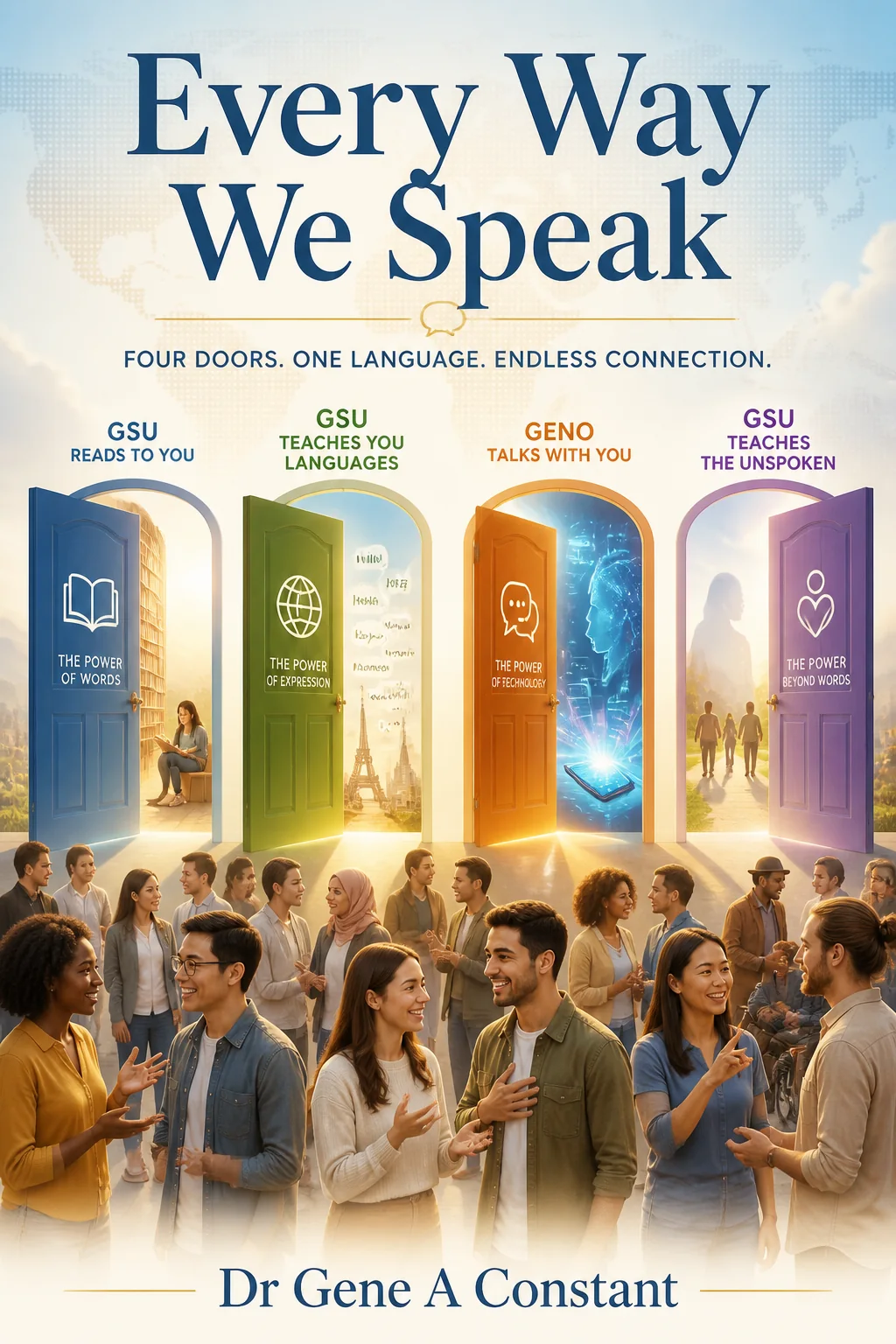
Every Way We Speak
Dr. Gene A Constant · Chapter 1, free to read and hear here
- GSU reads to you.
- GSU teaches you languages.
- GENO talks with you.
- GSU teaches the unspoken.
Four doors and ten channels of human communication: listening, the building blocks of words, the physical side of speech, learning a new language, rehearsing with GENO, then words, tone, face, gesture, posture, touch, space, time, appearance and silence, ending in debate and leadership. Read Chapter 1 here, have it read to you, and take the free class one chapter at a time.
The free class: twelve lessons
One lesson per chapter, in the book's order. Each one has the chapter broken into its ideas, a hands-on bench, and new questions every attempt. All twelve are open. Free, no account, and your progress stays on your own device.
- 1GSU Reads to YouThe first door. Why listening comes first, how sound turns print into meaning, how stress and rhythm change what a sentence says.Open
- 2Building Blocks of WordsWords are built: sounds, syllables, word families and meaningful parts, spelling by sound mapping, and writing as construction.Open
- 3The Pronunciation GymSpeech is made by the body: breath, voicing, where the tongue and lips go, stress, and articulation without shame.Open
- 4GSU Teaches You LanguagesThe second door. Immersion over memorization, language inside real scenes, register, and repairing a misunderstanding.Open
- 5GENO Talks With YouThe third door. Rehearsing with GENO, feedback you can use, and confidence before contact with real people.Open
- 6The Spoken Channels (Words and Tone)Lexical precision, emphasis and pitch, and matching the message to the manner.Open
- 7The Physical Channels (Face, Gesture, and Posture)Signals as information, not proof: reading one, checking it, and bringing the body into line with the words.Open
- 8The Environmental Channels (Touch, Space, and Time)Consent before contact, respecting distance and territory, and what timing says.Open
- 9The Silent Channels (Appearance and Silence)First impressions without verdicts, the many meanings of a pause, and silence used with clarity.Open
- 10GSU Teaches the UnspokenThe fourth door. Reading patterns, preparing the conditions, catching communication leaks, and congruence.Open
- 11Debate and Critical ThinkingAn argument is not a fight: claim, reasons, evidence and explanation, analytical listening, fallacies, and precision under pressure.Open
- 12Leadership and InfluenceExecutive presence for any learner, inspiring a team honestly, guiding disagreement, and negotiating with respect.Open
The Certificate of Comprehension
Thirty questions drawn from all twelve lessons, graded on our server; you need 80% to pass. A pass prints a serial-numbered certificate with a link anyone can use to verify it. It records comprehension of the book. It is not a language certification or an industry credential.
Sit the examThe other eleven chapters
Chapter 1 is free above. The paperback holds all twelve chapters. Every chapter also has its own free lesson, so you can learn each idea today.
- 2Building Blocks of WordsFree lesson
- 3The Pronunciation GymFree lesson
- 4GSU Teaches You LanguagesFree lesson
- 5GENO Talks With YouFree lesson
- 6The Spoken Channels (Words and Tone)Free lesson
- 7The Physical Channels (Face, Gesture, and Posture)Free lesson
- 8The Environmental Channels (Touch, Space, and Time)Free lesson
- 9The Silent Channels (Appearance and Silence)Free lesson
- 10GSU Teaches the UnspokenFree lesson
- 11Debate and Critical ThinkingFree lesson
- 12Leadership and InfluenceFree lesson